
Edexcel iGCSE Physics (4PH1) 2.2 Mains Electricity Exam Style Question Paper 2B - New Syllabus
Question
The photograph shows transmission cables used for long-distance transmission of electricity.

(a) The diagram shows a power station and a school. Add to the diagram by drawing the structures needed to efficiently transfer energy from the power station to the school using electricity.

(b) Explain how the amount of current in the transmission cables increases the efficiency of the transmission of electricity.
Syllabus Topic Codes (Edexcel International GCSE Physics 4PH1):
• 6.19–6.20P: Transformer Voltage, Turns Ratio, and Power — part (a)
• 2.4–2.5: Power, Current, Voltage, and Electrical Energy Transfer — part (b)
▶️ Answer/Explanation
(a) Transformers for efficient transmission [3 marks]
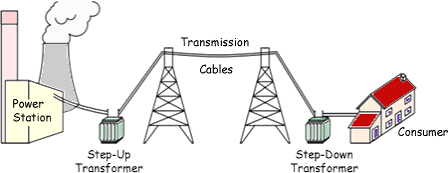
- Draw a transformer between the power station and the school.
- Draw a second transformer between the power station and the school.
- Label the transformer nearest the power station step-up and the transformer nearest the school step-down.
The step-up transformer increases the voltage before electricity is transmitted over long distances. The step-down transformer reduces the voltage before the electricity is supplied to the school.
(b) Effect of current on transmission efficiency [3 marks]
- Current flowing through the transmission cables causes the cables to heat up.
- Using a lower current reduces the heating effect in the cables.
- Therefore, less electrical energy is wasted to the surroundings, increasing the efficiency of transmission.
For a given power, increasing the transmission voltage allows the current to be reduced because \(P=IV\). The power wasted in the cables is proportional to \(I^2R\), so reducing the current greatly reduces energy loss.
Question
The photograph shows a water bath that a technician uses to heat some water.

(a) The water bath is filled with water at an initial temperature of \(15^\circ\mathrm{C}\). Calculate the initial temperature of the water in kelvin.
(b) The technician heats the water to a final temperature of \(60^\circ\mathrm{C}\).
(i) Describe how the energy of the water molecules changes as the temperature of the water increases.
(ii) The table shows some information about the heating element in the water bath and the heating process.

Calculate the energy transferred by the heating element in the water bath during the heating process.
(iii) Calculate the mass of water being heated. Assume that all the energy is transferred to the thermal store of the water.
[for water, specific heat capacity = \(4200\,\mathrm{J\,kg^{-1}\,^\circ C^{-1}}\)]
(c) Some water evaporates as a gas from the water bath.
(i) Describe the arrangement of particles in a gas.
(ii) Describe two differences between evaporation and boiling.
Syllabus Topic Codes (Edexcel International GCSE Physics 4PH1):
• 5.18–5.19: Temperature, Molecular Speed, and Kinetic Energy — part (b)(i)
• 2.4–2.5: Power, Current, Voltage, and Electrical Energy Transfer — part (b)(ii)
• 5.12–5.13P: Specific Heat Capacity and Thermal Energy Change Equation — part (b)(iii)
• 5.10P: Particle Model of Solids, Liquids, and Gases — part (c)(i)
• 5.9P: Changes of State — part (c)(ii)
▶️ Answer/Explanation
(a) Temperature in kelvin [1 mark]
Use the conversion:
\(T_{\mathrm{K}}=T_{^\circ\mathrm{C}}+273\)
\(T_{\mathrm{K}}=15+273=288\,\mathrm{K}\)
\(\boxed{288\,\mathrm{K}}\)
(b)(i) Energy of the water molecules [2 marks]
As the temperature increases, the energy of the water molecules increases.
The average kinetic energy of the molecules increases, meaning that the molecules move faster on average.
(b)(ii) Energy transferred by the heating element [3 marks]
Use:
\(E=VIt\)
The heating time is \(45\,\mathrm{min}\), so convert it to seconds:
\(t=45\times60=2700\,\mathrm{s}\)
Substitute \(V=230\,\mathrm{V}\), \(I=1.5\,\mathrm{A}\), and \(t=2700\,\mathrm{s}\):
\(E=230\times1.5\times2700\)
\(E=931\,500\,\mathrm{J}\)
Therefore:
\(\boxed{E\approx9.3\times10^5\,\mathrm{J}}\)
(b)(iii) Mass of water [3 marks]
Use the thermal energy equation:
\(Q=mc\Delta T\)
The temperature change is:
\(\Delta T=60-15=45^\circ\mathrm{C}\)
Since all the energy is transferred to the thermal store of the water:
\(9.3\times10^5=m\times4200\times45\)
Rearranging:
\(m=\dfrac{9.3\times10^5}{4200\times45}\)
\(m\approx4.92\,\mathrm{kg}\)
\(\boxed{m\approx4.9\,\mathrm{kg}}\)
(c)(i) Arrangement of particles in a gas [2 marks]
- The particles are arranged randomly.
- The particles are widely spaced with large gaps between them.
(c)(ii) Evaporation and boiling [2 marks]
- Boiling occurs at a specific or fixed temperature, whereas evaporation can occur at any temperature.
- Boiling occurs throughout the liquid, whereas evaporation occurs only at the surface.
Question
The diagram shows a step-down transformer.

(a) The input power to the transformer is \(16\,\mathrm{W}\). The transformer is used for \(2.5\) hours. Calculate the energy transferred to the transformer during this time.
(b) Explain how a transformer works. In your answer, include reasons for using
• two coils
• the iron core
• an a.c. power supply
(c) State how the primary coil of the transformer can be changed to increase the output voltage.
Syllabus Topic Codes (Edexcel International GCSE Physics 4PH1):
• 6.15–6.16: Induced Voltage and Electricity Generation by Induction — part (b)
• 6.17–6.18P: Transformers and Step-Up and Step-Down Transformers — parts (b) and (c)
• 6.19–6.20P: Transformer Voltage, Turns Ratio, and Power — part (c)
▶️ Answer/Explanation
(a) Energy transferred [3 marks]
Use the relationship:
\(E=Pt\)
The time must be converted from hours to seconds:
\(t=2.5\times3600=9000\,\mathrm{s}\)
Therefore:
\(E=16\times9000\)
\(E=144000\,\mathrm{J}\)
Therefore:
\(\boxed{E=1.44\times10^5\,\mathrm{J}}\)
(b) How a transformer works [6 marks]
- The transformer can step up or step down the voltage.
- An alternating current in the primary coil produces a magnetic field.
- Because the current is alternating, the magnetic field is continuously changing.
- The changing magnetic field passes through the iron core.
- The iron core strengthens the magnetic field and transfers the changing magnetic field to the secondary coil.
- The changing magnetic field through the secondary coil induces a voltage across the secondary coil.
Why two coils are used: The primary and secondary coils are electrically separate, allowing electrical energy to be transferred by the changing magnetic field.
Why an iron core is used: Iron is a soft magnetic material, so it can be magnetised and demagnetised easily. It also provides a strong magnetic field pathway between the coils.
Why an a.c. supply is used: An alternating current produces a changing magnetic field. This changing field is required to induce a voltage in the secondary coil. A steady d.c. supply would not continuously produce the changing magnetic field needed for transformer operation.
(c) Increasing the output voltage [1 mark]
For a transformer:
\(\displaystyle \frac{V_\mathrm{p}}{V_\mathrm{s}}=\frac{N_\mathrm{p}}{N_\mathrm{s}}\)
To increase the output voltage \(V_\mathrm{s}\), the number of turns on the primary coil should be decreased, while the secondary coil remains unchanged.
\(\boxed{\text{Use fewer turns on the primary coil.}}\)
Question
Kori Nuclear Power Plant in South Korea is one of the world’s largest nuclear fission power stations.

(a) The reactors at Kori use nuclear fission to generate electricity. The products released during nuclear fission have high energy in their kinetic store. Give a product of nuclear fission.
(b) Give two disadvantages of using nuclear fission to generate electricity.
(c) Kori has a maximum power output of \(7.49\times10^9\,\mathrm{W}\).
(i) State what is meant by the term power.
(ii) Calculate the minimum time taken for Kori to transfer \(6.47\times10^{14}\,\mathrm{J}\) of energy.
Syllabus Topic Codes (Edexcel International GCSE Physics 4PH1):
• 4.18–4.19P: Electricity Generation from Energy Resources; Advantages and Disadvantages — part (b)
• 4.16–4.17: Power, Energy, and Time — parts (c)(i)–(ii)
▶️ Answer/Explanation
(a) Product of nuclear fission [1 mark]
A product of nuclear fission can be a daughter nucleus, such as a nucleus of barium or krypton.
Fission can also release neutrons.
Example answer: \(\boxed{\text{barium nucleus}}\)
(b) Disadvantages of nuclear fission [2 marks]
Any two valid disadvantages include:
- It produces radioactive waste, which requires safe storage and disposal.
- The fuel, such as uranium, is a non-renewable resource.
- There is a risk of a nuclear accident.
- Nuclear power stations have high construction or decommissioning costs.
(c)(i) Meaning of power [1 mark]
Power is the rate of energy transfer, or the rate of doing work.
\(\displaystyle P=\frac{E}{t}\)
(c)(ii) Minimum time [3 marks]
Use the relationship:
\(\displaystyle P=\frac{E}{t}\)
Rearrange to make \(t\) the subject:
\(\displaystyle t=\frac{E}{P}\)
Substitute the values:
\(\displaystyle t=\frac{6.47\times10^{14}}{7.49\times10^9}\)
\(\displaystyle t\approx86400\,\mathrm{s}\)
Therefore:
\(\boxed{t=8.64\times10^4\,\mathrm{s}}\)
This is the minimum time because the calculation assumes Kori operates continuously at its maximum power output.
Question
The diagram shows a step-down transformer.
(a) The input power to the transformer is \(16\,\mathrm{W}\). The transformer is used for \(2.5\) hours. Calculate the energy transferred to the transformer during this time.
(b) Explain how a transformer works. In your answer, include reasons for using
• two coils
• the iron core
• an a.c. power supply
(c) State how the primary coil of the transformer can be changed to increase the output voltage.
Syllabus Topic Codes (Edexcel International GCSE Physics 4PH1):
• 6.15–6.16: Induced Voltage and Electricity Generation by Induction — part (b)
• 6.17–6.18P: Transformers and Step-Up and Step-Down Transformers — parts (b) and (c)
• 6.19–6.20P: Transformer Voltage, Turns Ratio, and Power — part (c)
▶️ Answer/Explanation
(a) Energy transferred [3 marks]
Use the relationship:
\(E=Pt\)
The time must be converted from hours to seconds:
\(t=2.5\times3600=9000\,\mathrm{s}\)
Therefore:
\(E=16\times9000\)
\(E=144000\,\mathrm{J}\)
Therefore:
\(\boxed{E=1.44\times10^5\,\mathrm{J}}\)
(b) How a transformer works [6 marks]
- The transformer can step up or step down the voltage.
- An alternating current in the primary coil produces a magnetic field.
- Because the current is alternating, the magnetic field is continuously changing.
- The changing magnetic field passes through the iron core.
- The iron core strengthens the magnetic field and transfers the changing magnetic field to the secondary coil.
- The changing magnetic field through the secondary coil induces a voltage across the secondary coil.
Why two coils are used: The primary and secondary coils are electrically separate, allowing electrical energy to be transferred by the changing magnetic field.
Why an iron core is used: Iron is a soft magnetic material, so it can be magnetised and demagnetised easily. It also provides a strong magnetic field pathway between the coils.
Why an a.c. supply is used: An alternating current produces a changing magnetic field. This changing field is required to induce a voltage in the secondary coil. A steady d.c. supply would not continuously produce the changing magnetic field needed for transformer operation.
(c) Increasing the output voltage [1 mark]
For a transformer:
\(\displaystyle \frac{V_\mathrm{p}}{V_\mathrm{s}}=\frac{N_\mathrm{p}}{N_\mathrm{s}}\)
To increase the output voltage \(V_\mathrm{s}\), the number of turns on the primary coil should be decreased, while the secondary coil remains unchanged.
\(\boxed{\text{Use fewer turns on the primary coil.}}\)