
Edexcel iGCSE Physics (4PH1) 2.4 Electric Charge Exam Style Question Paper 1B - New Syllabus
Question
A student investigates the voltage-current characteristics of an unknown component, X.
(a) The student is given this equipment to investigate component X.
• battery
• variable resistor
• ammeter
• voltmeter
• connecting wires
The diagram shows an incomplete circuit containing the battery and component X. Complete the diagram by drawing a circuit the student could use for their investigation.

(b) The graph shows the results of the investigation.

(i) Draw a line of best fit on the graph.
(ii) Calculate the resistance of component X when the voltage is \(4.2\,\mathrm{V}\). Give the unit.
(iii) Which of these is equivalent to \(4.2\,\mathrm{V}\)?
A 4.2 coulombs per second (C/s)
B 4.2 seconds per joule (s/J)
C 4.2 joules per second (J/s)
D 4.2 joules per coulomb (J/C)
(iv) The student concludes that component X is a filament lamp. Comment on the student’s conclusion.
Syllabus Topic Codes (Edexcel International GCSE Physics 4PH1):
• 2.13: Relationship between voltage, current and resistance, \(V=IR\) — part (b)(ii)
• 2.20: Voltage as energy transferred per unit charge and the volt as a joule per coulomb — part (b)(iii)
• 2.10: Qualitative effect of changing resistance on current — part (b)(iv)
▶️ Answer/Explanation
Ans
(a) circuit symbols for variable resistor, ammeter and voltmeter drawn correctly;
variable resistor drawn in series with battery and component X;
ammeter drawn in series with component X;
voltmeter drawn in parallel with component X;
(b) (i) straight line of best fit drawn with points distributed equally either side;
(ii) use of voltage = current × resistance;
correct reading of current from graph;
substitution OR rearrangement;
evaluation;
matching unit;
e.g.
V = I × R
current = 2.35 (×10⁻³) (A)
4.2 = 2.35 (×10⁻³) × R OR R = V / I
(resistance =) 1800
ohms / Ω
(iii) D (4.2 joules per coulomb); 1
A is incorrect because this is the unit for current
B is incorrect because this is the reciprocal of the unit for power
C is incorrect because this is the unit for power
(iv) graph for lamp should be a curve;
(because) a lamp does not obey Ohm’s Law/ lamp
does not have I directly proportional to V.
component X is a resistor;
Questions
The photograph shows a power bank used to recharge the battery in an electronic device.
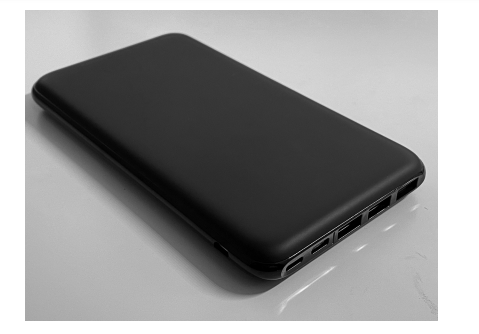
(a) The power bank stores charge. The charge stored can be measured in amp-hours (Ah). 1Ah is the amount of charge transferred by a current of 1A in a time of 1 hour. Calculate the charge stored in coulombs when the charge stored is 1Ah. Use the formula
charge stored = current × time taken
(b) An electronic device is connected to the power bank. Whilst recharging, the electronic device receives a constant current of 2.4A and \(3.8 × 10^3C\) of charge is transferred.
(i) Calculate the time taken to recharge the electronic device. Give your answer in minutes.
(ii) The electronic device is connected to the power bank using a long cable. Suggest how using a long cable affects the time taken to recharge the electronic device when compared with a short cable.
(c) A student owns three electronic devices. Each electronic device stores a different amount of charge. The table gives some information about the charge stored by the electronic devices and how often they need to be recharged.
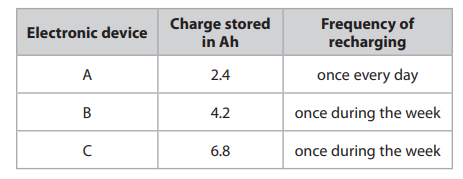
The power bank stores a maximum charge of 26.8Ah. The student needs to take these three electronic devices on a school trip for one week. Determine whether the maximum charge of the power bank is enough to recharge the batteries of the three electronic devices during the school trip
Syllabus Topic Codes (Edexcel International GCSE Physics 4PH1):
• 4.3: Calculation of charge, current and time using \(Q=It\) — part (b)(i)
• 4.6: Resistance in electrical circuits and factors affecting resistance, including length of a conductor — part (b)(ii)
• 4.3: Charge stored, charge transfer and quantitative calculations using \(Q=It\) — part (c)
▶️Answer/Explanation
Ans
(a) conversion of hours into seconds;
evaluation;
e.g.
1 hour = (60 × 60 =) 3600 (s)
(charge = 1 × 3600 =) 3600 (C)
(b) (i) substitution OR rearrangement;
evaluation in seconds;
conversion to minutes;
e.g.
\(3.8 × 10^3 = 2.4 × t\) OR t = Q/I
(t =) 1600 (s)
(t =) 26 (minutes)
(ii) idea that longer cable has more resistance;
(so) charging current will be less AND time taken
will increase;
(c) any four from:
MP1. determination of total charge needed for the week;
MP2. quantitative comparison to power bank charge;
MP3. idea that power bank cannot recharge all devices (from completely flat);
MP4. idea that devices will not always be completely empty when recharged;
MP5. idea that devices could be used less (which would make them last longer before recharging);
MP6. idea that other charging facilities might be available;