
Edexcel iGCSE Physics (4PH1) 2.4 Electric Charge Exam Style Question Paper 2B - New Syllabus
Question
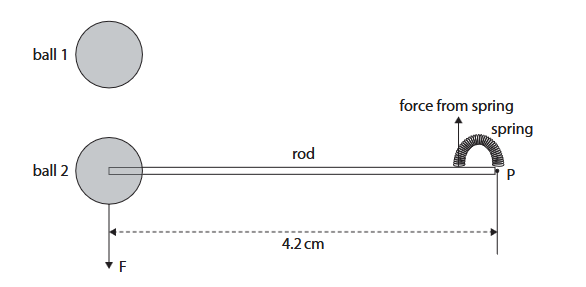
The diagram shows the apparatus used to investigate electric charge.
The equipment is viewed from above.
- ball 1 and ball 2 have a positive charge
- ball 1 is fixed in place
- ball 2 is attached to a rod that can rotate about point P
- ball 2 does not move
(a) State, in terms of charged particles, how the balls have become positively charged. (1)
(b) Ball 1 exerts a force, \(F\), of \(0.57\,\mathrm{N}\) on ball 2.
(i) State the value of the force exerted on ball 1 from ball 2. (1)
force = __________________ \(\mathrm{N}\)
(ii) Calculate the moment on the rod from force \(F\) about point P. (2)
moment = __________________ \(\mathrm{N\,cm}\)
(iii) State the magnitude of the moment about point P due to the force from the spring. (1)
magnitude of moment = __________________ \(\mathrm{N\,cm}\)
(iv) Draw an arrow on the diagram to show the direction of the force that the rod exerts on the spring. (1)
Syllabus Topic Codes (Edexcel International GCSE Physics 4PH1):
• 1.29P: Newton’s Third Law — part (b)(i) and relevant to part (b)(iv)
• 1.30P–1.33P: Moments, Principle of Moments and Moments on a Beam — parts (b)(ii) and (b)(iii)
▶️ Answer/Explanation
(a) Positive charge [1 mark]
The balls have become positively charged because they have lost electrons.
Final Answer: \( \boxed{\mathrm{loss\ of\ electrons}} \)
(b)(i) Force on ball 1 [1 mark]
By Newton’s Third Law, the force exerted on ball 1 by ball 2 has the same magnitude as the force exerted on ball 2 by ball 1, but acts in the opposite direction.
Therefore:
\(F=0.57\,\mathrm{N}\)
Final Answer: \( \boxed{0.57\,\mathrm{N}} \)
(b)(ii) Moment about point P [2 marks]
1. Use the moment equation:
\(\mathrm{moment}=\mathrm{force}\times\mathrm{perpendicular\ distance}\)
2. Substitute the values:
\(\mathrm{moment}=0.57\times4.2\)
\(\mathrm{moment}=2.394\,\mathrm{N\,cm}\)
To an appropriate number of significant figures:
\(\mathrm{moment}\approx2.4\,\mathrm{N\,cm}\)
Final Answer: \( \boxed{2.4\,\mathrm{N\,cm}} \)
(b)(iii) Moment due to the spring [1 mark]
Ball 2 does not move, so the rod is in rotational equilibrium. Therefore, the clockwise and anticlockwise moments about point P must be equal in magnitude.
Hence, the magnitude of the moment due to the spring is equal to the moment calculated in part (b)(ii).
\(\mathrm{moment}=2.4\,\mathrm{N\,cm}\)
Final Answer: \( \boxed{2.4\,\mathrm{N\,cm}} \)
(b)(iv) Direction of the force from the rod on the spring [1 mark]
- The spring exerts an upward force on the rod.
- By Newton’s Third Law, the rod exerts an equal and opposite force on the spring.
- Therefore, the force exerted by the rod on the spring acts downwards.
Final Answer: Draw a downward arrow on the spring.
Question
The photograph shows a camper van with a solar panel on its roof. The solar panel is made from lots of solar cells connected together.
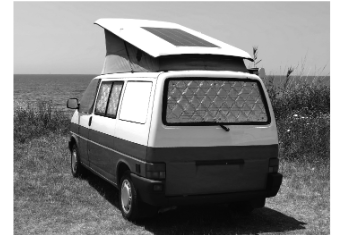
The solar panel is connected to a battery. The solar panel receives energy from the Sun to charge the battery.
(a) Describe how energy is transferred from the Sun’s energy store to the battery’s energy store. (3)
(b) The petrol engine can also be used to charge the battery of the camper van.
Give an advantage of using the solar panel instead of the petrol engine to charge the battery.
Do not refer to cost in your answer. (1)
(c) The surface of the solar panel is black.
Explain why black is a suitable colour for the solar panel. (2)
(d) The solar panel can charge the battery in the camper van with a maximum current of \(15\,\mathrm{A}\).
Calculate the minimum time to transfer \(360\,000\,\mathrm{C}\) of charge through the battery.
Use the formula
\(\mathrm{charge\ transferred}=\mathrm{current}\times\mathrm{time}\) (3)
time = __________________ \(\mathrm{s}\)
Syllabus Topic Codes (Edexcel International GCSE Physics 4PH1):
• 4.6–4.7: Renewable and Non-renewable Energy Resources — part (b)
• 4.15: Absorption and Emission of Radiation — part (c)
• 2.10: Electric Charge and Current — part (d)
▶️ Answer/Explanation
(a) Energy transfer from the Sun to the battery [3 marks]
1. Energy is transferred from the nuclear energy store of the Sun by radiation.
2. The solar panel absorbs the radiation from the Sun.
3. Energy is transferred electrically from the solar panel to the battery, increasing the chemical energy store of the battery.
Final Answer: Energy from the Sun’s nuclear energy store is transferred by radiation to the solar panel. The panel transfers energy electrically to the battery, increasing the chemical energy store of the battery.
(b) Advantage of using a solar panel [1 mark]
One advantage is that solar power is a renewable energy resource.
Alternatively, the solar panel does not produce \( \mathrm{CO_2} \) during operation or reduces the need to use petrol.
Final Answer: \( \boxed{\mathrm{Solar\ power\ is\ renewable}} \)
(c) Why black is suitable for the solar panel [2 marks]
Black is a good absorber of radiation.
Therefore, the black surface absorbs a large amount of the radiation from the Sun.
Final Answer: Black is a good absorber of radiation, so the solar panel absorbs more radiation from the Sun.
(d) Minimum time to transfer the charge [3 marks]
1. Use the charge equation:
\(Q=It\)
2. Rearrange for time:
\(t=\dfrac{Q}{I}\)
3. Substitute the values:
\(t=\dfrac{360\,000}{15}\)
\(t=24\,000\,\mathrm{s}\)
Final Answer: \( \boxed{24\,000\,\mathrm{s}} \)
Question
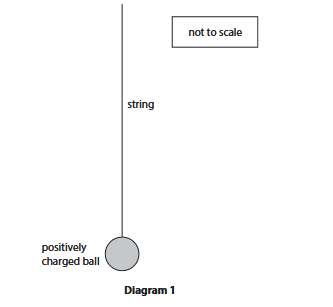
A student uses this apparatus to investigate static electricity.
The positively charged ball is suspended vertically on a long length of string.
(a) The ball is made of a material that is a good electrical conductor.
Name a material that is a good electrical conductor. (1)
(b) Explain, in terms of the movement of charged particles, how the ball has become positively charged. (2)
(c) The student places a centimetre scale behind the length of string.
The string lines up with the \(5.0\,\mathrm{cm}\) mark on the scale when the ball is in its resting position, as shown in diagram 2.
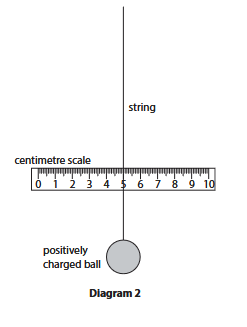
The student brings a negatively charged polythene rod near to the right side of the ball.
The ball moves, as shown in diagram 3.
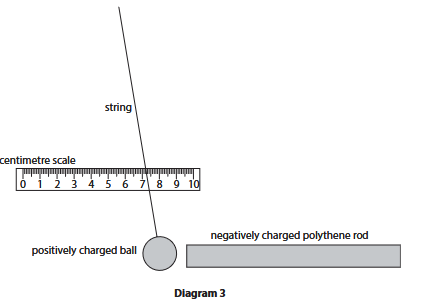
(i) Explain how the movement of the ball shows that the charge on the polythene rod is negative. (2)
(ii) In diagram 3, the string lines up with the \(7.2\,\mathrm{cm}\) mark on the scale.
The student moves the polythene rod slightly further away from the ball.
Predict a possible reading on the scale. (1)
reading = __________________ \(\mathrm{cm}\)
(d) The student extends the investigation by measuring the reading on the scale for rods made from different materials.
As a control variable, the student charges each rod by rubbing it with a cloth the same number of times.
Give two other control variables for the student’s investigation. (2)
1. ________________________________________________
2. ________________________________________________
(e) The bar chart shows the results of the student’s investigation.
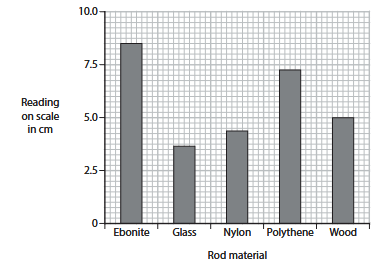
(i) Justify the use of a bar chart to present the student’s results. (1)
(ii) Deduce what can be concluded about the charge on each of the rods used in the investigation.
Use information from the bar chart to help your answer. (3)
Syllabus Topic Codes (Edexcel International GCSE Physics 4PH1):
• 2.4 Static Electricity: Forces Between Charged Objects — parts (c)(i) and (c)(ii)
• Experimental Skills: Control Variables and Presenting Data — parts (d) and (e)
▶️ Answer/Explanation
(a) Good electrical conductor [1 mark]
A suitable material is copper. Other suitable conductors include aluminium, silver, graphite and iron.
Final Answer: \( \boxed{\mathrm{copper}} \)
(b) How the ball becomes positively charged [2 marks]
1. Charging occurs through the transfer of electrons, which are negatively charged particles.
2. The ball loses electrons, leaving it with more positive charge than negative charge.
Final Answer: Electrons are transferred away from the ball. The ball loses negatively charged electrons and therefore becomes positively charged.
(c)(i) Charge on the polythene rod [2 marks]
The positively charged ball moves towards the polythene rod.
Attraction occurs between oppositely charged objects. Since the ball is positive, the polythene rod must be negative.
Final Answer: The ball is attracted towards the rod, showing that the rod has an opposite charge. Since the ball is positively charged, the rod must be negatively charged.
(c)(ii) New scale reading [1 mark]
Moving the rod further away decreases the electrostatic force between the rod and the ball. Therefore, the ball moves closer to its original position.
The original reading is \(5.0\,\mathrm{cm}\), and the current reading is \(7.2\,\mathrm{cm}\). A possible reading must therefore be greater than \(5.0\,\mathrm{cm}\) but less than \(7.2\,\mathrm{cm}\).
Example Final Answer: \( \boxed{6.0\,\mathrm{cm}} \)
(d) Control variables [2 marks]
Any two suitable control variables include:
- The distance between the rod and the ball.
- The initial charge on the ball.
- The dimensions of the rod, such as its length or thickness.
Example Final Answer: Keep the distance between the rod and ball constant and keep the initial charge on the ball constant.
(e)(i) Use of a bar chart [1 mark]
The rod material is a categorical variable, so a bar chart is appropriate for comparing the results for the different categories of material.
Final Answer: A bar chart is suitable because rod material is a categorical variable.
(e)(ii) Conclusions about the charge on the rods [3 marks]
- Wood has no charge because the reading is \(5.0\,\mathrm{cm}\), the same as the original position of the ball.
- Ebonite and polythene are negatively charged because they attract the positively charged ball, and the ball moves towards them.
- Glass and nylon are positively charged because the readings show the ball moves away from the rods.
- Ebonite has the largest negative charge, while polythene has a smaller negative charge.
- Glass has the largest positive charge, while nylon has the smallest positive charge.
Final Answer: Wood is uncharged. Ebonite and polythene are negatively charged, with ebonite having the largest negative charge. Glass and nylon are positively charged, with glass having the largest positive charge and nylon the smallest positive charge.
Question
A flour mill is a factory where flour is produced.
The photograph shows some flour moving through metal channels in the flour mill.
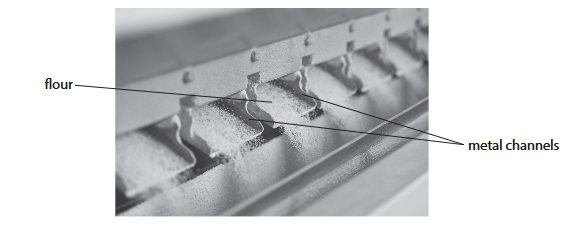
(a) The flour particles can become charged as they move through the metal channels.
(i) Explain how the flour particles can become charged. (2)
(ii) The charged flour particles move away from each other as they fall from the end of each channel.
Complete the passage by writing a suitable word or words in each blank space. (2)
Flour particles move away from each other because they have
____________________________ charges.
This causes the flour particles to exert
____________________________ forces on each other.
(b) The dust created by producing flour in a flour mill is dangerous because the dust is flammable. This creates a risk of an explosion.
Explain why connecting the metal channels to earth reduces the risk of an explosion in a flour mill. (2)
Syllabus Topic Codes (Edexcel International GCSE Physics 4PH1):
• 2.24P: Positive and Negative Charge — part (a)(ii)
• 2.25P: Forces Between Electric Charges — part (a)(ii)
• 2.26–2.28P: Electrostatic Phenomena, Dangers, and Uses — part (b)
▶️ Answer/Explanation
(a)(i) How the flour particles become charged [2 marks]
1. As the flour particles move through the metal channels, there is rubbing or friction between the particles and the surfaces.
2. This causes a transfer of electrons, leaving the particles electrically charged.
Final Answer: Friction occurs as the flour particles move through the metal channels. This causes electrons to be transferred, so the flour particles become charged.
(a)(ii) Forces between the charged flour particles [2 marks]
The two missing terms are:
Flour particles move away from each other because they have like charges.
This causes the flour particles to exert repulsive forces on each other.
Final Answer: \( \boxed{\mathrm{like}} \) charges and \( \boxed{\mathrm{repulsive}} \) forces.
(b) Why earthing reduces the risk of explosion [2 marks]
1. Connecting the metal channels to Earth allows excess charge/electrons to flow to Earth, preventing the channels and particles from becoming highly charged.
2. This reduces the chance of a spark occurring, which could ignite the flammable flour dust.
Final Answer: Earthing allows excess charge to flow to Earth, preventing a large build-up of charge and reducing the possibility of a spark that could ignite the flour dust.
Question
The diagram shows a machine that can be used to measure the speed of fast-moving protons.

(a) At the start, the proton is attracted towards a negatively charged plate.
(i) Give a reason why the proton is attracted to the negatively charged plate.
(ii) The proton accelerates at \(1.90\times10^{11}\,\mathrm{m\,s^{-2}}\) from rest to a speed of \(1.38\times10^5\,\mathrm{m\,s^{-1}}\). Show that the time taken for this acceleration is about \(7\times10^{-7}\,\mathrm{s}\).
(b) The proton passes through a hole in the negatively charged plate and enters an area where there is a magnetic field. The magnetic field exerts a force on the proton, as shown in the diagram. This force causes the proton to follow a circular path without changing speed.
(i) Give the direction of the magnetic field.
(ii) Suggest how increasing the strength of the magnetic field will affect the proton when it is moving in the magnetic field.
Syllabus Topic Codes (Edexcel International GCSE Physics 4PH1):
• 1.6: Acceleration — part (a)(ii)
• 6.11P: Force on a Charged Particle in a Magnetic Field — parts (b)(i) and (b)(ii)
▶️ Answer/Explanation
(a)(i) Attraction between charges [1 mark]
The proton has a positive charge and the plate has a negative charge. Opposite charges attract.
Answer: Opposite charges attract.
(a)(ii) Time taken for acceleration [3 marks]
Use the equation:
\(a=\dfrac{v-u}{t}\)
The proton starts from rest, so:
\(u=0\,\mathrm{m\,s^{-1}}\)
Therefore:
\(1.90\times10^{11}=\dfrac{1.38\times10^5}{t}\)
Rearranging:
\(t=\dfrac{1.38\times10^5}{1.90\times10^{11}}\)
\(t=7.26\times10^{-7}\,\mathrm{s}\)
Therefore:
\(\boxed{t\approx7\times10^{-7}\,\mathrm{s}}\)
(b)(i) Direction of the magnetic field [1 mark]
The direction of the magnetic field is:
\(\boxed{\text{into the page}}\)
This direction is determined using the force on a moving positive charge and the direction of its motion shown in the diagram.
(b)(ii) Effect of increasing magnetic field strength [2 marks]
For a charged particle moving perpendicular to a magnetic field:
\(F=qvB\)
- Increasing the magnetic field strength \(B\) increases the magnetic force on the proton.
- This increases the centripetal acceleration, causing the proton to move in a tighter circular path.
- The proton would therefore follow a circle with a smaller radius.
The speed does not change because the magnetic force acts perpendicular to the proton’s direction of motion.
Question
This question is about electrostatics.
(a) A polythene rod is rubbed with a cloth, which causes both the rod and the cloth to become charged.
(i) Which of these is the force that causes the rod and the cloth to become charged?
A friction
B gravitational
C magnetic
D tension
(ii) The polythene rod becomes negatively charged. Which of these statements explains how the rod has become negatively charged?
A the rod gains electrons
B the rod loses electrons
C the rod gains protons
D the rod loses protons
(b) A student has rods made from different materials. The student rubs each rod the same way with a cloth. The student measures the charge gained by each rod three times. The table shows the results.

(i) One of the readings for the polythene rod is anomalous. Circle the anomalous result in the results table.
(ii) State how the student should deal with the anomalous result.
(iii) Calculate the mean charge for the polythene rod.
(iv) Describe how the student could use the rods to demonstrate that there are two different types of electric charge.
Syllabus Topic Codes (Edexcel International GCSE Physics 4PH1):
• 2.24P: Positive and Negative Charge — part (a)(ii) and part (b)(iv)
• 2.25P: Forces Between Electric Charges — part (b)(iv)
▶️ Answer/Explanation
(a)(i) Force involved in charging [1 mark]
Answer: A, friction.
Rubbing the polythene rod with the cloth causes electrons to be transferred between the two materials, leaving both objects charged.
(a)(ii) Negative charge [1 mark]
Answer: A, the rod gains electrons.
A negative charge results from an excess of electrons. Protons remain bound within the nuclei and are not transferred during charging by friction.
(b)(i) Anomalous result [1 mark]
The anomalous reading is:
\(\boxed{-80}\)
(b)(ii) Dealing with the anomalous result [1 mark]
The student should repeat or check the test and then exclude the anomalous reading from the calculation of the mean if it is confirmed to be anomalous.
(b)(iii) Mean charge for the polythene rod [2 marks]
The anomalous value of \(-80\) should not be included in the mean.
Using the remaining two readings:
\( \mathrm{mean}=\dfrac{(-60)+(-60)}{2} \)
\( \mathrm{mean}=-60 \)
Therefore, the mean charge is \(\boxed{-60}\) in the units given in the table.
(b)(iv) Demonstrating two types of electric charge [3 marks]
The student could first charge two rods by rubbing them with the cloth. The rods could then be suspended so that they are free to move.
- Bring two rods with the same type of charge close together. They should repel each other.
- Bring rods with opposite types of charge close together. They should attract each other.
The observation of both attraction and repulsion provides evidence that there are two different types of electric charge. Like charges repel, while unlike charges attract.
Question
A cleaning product is applied to a car using a sponge pad. The sponge pad is rubbed against the car to apply the cleaning product.

(a) Some parts of the car are made of metal and other parts are made of plastic. The metal parts of the car are earthed. Explain why the pad becomes charged when rubbing the plastic parts, but not when rubbing the metal parts.
(b) The sponge pad is held near a metal post that is connected to the ground. The sponge pad discharges with a small spark through the air to the metal post.
(i) The sponge pad stores \(5.0\,\mathrm{mJ}\) of energy in its electrostatic store. The voltage between the sponge pad and the metal post is \(6000\,\mathrm{V}\). Calculate the charge transferred by the spark.
(ii) The small spark between the sponge pad and the metal post demonstrates that the sponge pad is charged. Describe a different experiment that could demonstrate that the sponge pad is charged. You may draw a diagram to support your answer.
Syllabus Topic Codes (Edexcel International GCSE Physics 4PH1):
• 2.23P: Core Practical: Charging by Friction — part (a)
• 2.24P: Positive and Negative Charge — parts (a) and (b)
• 2.25P: Forces Between Electric Charges — part (b)(ii)
• 2.26–2.28P: Electrostatic Phenomena, Dangers, and Uses — parts (a), (b)(i) and (b)(ii)
▶️ Answer/Explanation
(a) Charging by rubbing [3 marks]
- Plastic is an insulator, whereas metal is a conductor.
- Rubbing causes electrons to be transferred between the sponge pad and the plastic by friction.
- Because plastic is an insulator, the charge remains on the plastic and builds up.
- In the metal parts, electrons can flow through the metal to Earth because the metal is earthed, so charge does not build up.
Therefore, the insulating plastic allows a static charge to remain, while the conducting metal provides a path for charge to flow to Earth.
(b)(i) Charge transferred [3 marks]
Use the relationship:
\(E=QV\)
Rearrange to make \(Q\) the subject:
\(Q=\dfrac{E}{V}\)
Convert \(5.0\,\mathrm{mJ}\) to joules:
\(E=5.0\times10^{-3}\,\mathrm{J}\)
Substitute:
\(Q=\dfrac{5.0\times10^{-3}}{6000}\)
\(Q=8.3\times10^{-7}\,\mathrm{C}\)
Charge transferred: \( \boxed{8.3\times10^{-7}\,\mathrm{C}} \)
(b)(ii) Demonstrating that the pad is charged [2 marks]
- Bring the charged sponge pad close to another uncharged insulator.
- If the uncharged object is attracted to the sponge pad, this demonstrates that the sponge pad is charged.
The charged sponge causes charges within the nearby object to become redistributed, producing an attractive force. This provides evidence that the sponge pad carries a static charge.
Question
A tumble dryer is a household device that dries clothes. The clothes rotate in a heated cylinder. Clothes often stick together when they are dry because they become electrostatically charged. A student investigates how different materials charge electrostatically in a model tumble dryer. The diagram shows the model tumble dryer.

This is the student’s method.
- put four dry squares of the same material into the cylinder
- rotate the cylinder at constant speed for three minutes
- remove any squares that are stuck together
- measure the force needed to pull the squares apart
- repeat this for squares of different material
(a)(i) Name a device the student could use to measure a force.
(ii) State the independent and dependent variables in this investigation.
(iii) State a control variable in this investigation.
(b) Explain how the squares of material stick together. Use ideas about electrostatic charge in your answer.
(c) The table shows some of the student’s results.

Explain which type of graph is the most appropriate to present the results from this investigation.
(d)(i) State the formula linking charge, current and time.
(ii) When the squares of material are pulled apart there is a small spark. There is a current of \(4.3\times10^{-6}\,\mathrm{A}\) in the air for a time of \(2.3\times10^{-3}\,\mathrm{s}\). Calculate the charge that is transferred.
Syllabus Topic Codes (Edexcel International GCSE Physics 4PH1):
• 2.24P: Positive and Negative Charge — part (b)
• 2.25P: Forces Between Electric Charges — part (b)
• 2.13–2.15: Voltage, Current, Resistance, Charge, and Time — part (d)
▶️ Answer/Explanation
(a)(i) Measuring force [1 mark]
The student could use a newtonmeter to measure the force needed to pull the squares apart.
(a)(ii) Variables [2 marks]
- Independent variable: the material of the squares.
- Dependent variable: the force needed to pull the squares apart.
The material is changed deliberately, while the force required to separate the charged squares is measured.
(a)(iii) Control variable [1 mark]
One suitable control variable is the speed of rotation of the cylinder.
Other acceptable control variables include the temperature, number of squares, size or thickness of the squares, direction of rotation, or rotation time.
(b) Electrostatic attraction [3 marks]
- Friction occurs between the pieces of material as they rotate together.
- Electrons are transferred between the materials during rubbing.
- The squares can therefore become oppositely charged.
- A square that gains electrons becomes negatively charged.
- Opposite charges attract, causing the squares to stick together.
The electrostatic attraction between oppositely charged squares provides the force holding them together.
(c) Suitable graph [2 marks]
A bar chart is the most appropriate graph.
This is because the independent variable, the material, is categorical rather than numerical. Each material can therefore be represented by a separate bar showing the force measured.
(d)(i) Charge, current and time [1 mark]
The formula linking charge, current and time is:
\(\boxed{Q=It}\)
(d)(ii) Charge transferred [2 marks]
Use:
\(Q=It\)
Substitute the values:
\(Q=(4.3\times10^{-6})(2.3\times10^{-3})\)
\(Q=9.89\times10^{-9}\,\mathrm{C}\)
Therefore:
\(\boxed{Q=9.9\times10^{-9}\,\mathrm{C}}\)
Question
The diagram shows the inside of an oscilloscope. Electrons leave the electron supply and accelerate towards the screen. The stream of electrons hits the screen.

(a) The grid is connected to the positive terminal of a high voltage power supply.
(i) Explain, in terms of the movement of particles, how the grid has become positively charged.
(ii) State the formula linking kinetic energy, mass and speed.
(iii) Calculate the speed of an electron when it has \(1.3\times10^{-15}\,\mathrm{J}\) of kinetic energy. The mass of an electron is \(9.1\times10^{-31}\,\mathrm{kg}\).
(b) The stream of electrons spreads out as it travels towards the screen. Explain why the electrons in the stream move apart from each other.
(c) The oscilloscope can cause the electrons to move in a circle. This produces a circular pattern on the screen.

(i) Use the scale to determine the radius of the circle.
(ii) The time taken for the electrons to complete one orbit of the circle is \(24\,\mathrm{ms}\). Calculate the orbital speed of the electrons. Use the formula
\(\displaystyle \mathrm{orbital\ speed}=\frac{2\pi\times\mathrm{orbital\ radius}}{\mathrm{time\ period}}\)
Syllabus Topic Codes (Edexcel International GCSE Physics 4PH1):
• 4.14: Kinetic Energy — parts (a)(ii)–(iii)
• 2.25P: Forces Between Electric Charges — part (b)
• 6.11P: Force on a Charged Particle in a Magnetic Field — part (c)
▶️ Answer/Explanation
(a)(i) Positive charging [2 marks]
The grid becomes positively charged because it loses electrons.
Electrons are transferred away from the grid, leaving it with more positive charge than negative charge.
(a)(ii) Kinetic energy formula [1 mark]
The formula linking kinetic energy, mass and speed is:
\(\boxed{E_\mathrm{k}=\dfrac{1}{2}mv^2}\)
(a)(iii) Speed of the electron [3 marks]
Use:
\(E_\mathrm{k}=\dfrac{1}{2}mv^2\)
Substitute the values:
\(1.3\times10^{-15}=\dfrac{1}{2}\times9.1\times10^{-31}\times v^2\)
Rearranging:
\(\displaystyle v^2=\frac{2(1.3\times10^{-15})}{9.1\times10^{-31}}\)
\(v^2\approx2.86\times10^{15}\)
Therefore:
\(v=\sqrt{2.86\times10^{15}}\)
\(v\approx5.35\times10^7\,\mathrm{m\,s^{-1}}\)
\(\boxed{v=5.3\times10^7\,\mathrm{m\,s^{-1}}}\)
(b) Repulsion between electrons [2 marks]
All the electrons in the stream have the same type of charge, so they are like charges.
Like charges repel each other. Therefore, the electrons exert repulsive forces on one another and move apart as they travel towards the screen.
(c)(i) Radius of the circle [1 mark]
From the scale on the diagram, the radius of the circular pattern is:
\(\boxed{r=2.5\,\mathrm{cm}}\)
(c)(ii) Orbital speed [3 marks]
Convert the quantities into SI units:
\(r=2.5\,\mathrm{cm}=2.5\times10^{-2}\,\mathrm{m}\)
\(T=24\,\mathrm{ms}=24\times10^{-3}\,\mathrm{s}\)
Use:
\(\displaystyle v=\frac{2\pi r}{T}\)
\(\displaystyle v=\frac{2\pi(2.5\times10^{-2})}{24\times10^{-3}}\)
\(v\approx6.54\,\mathrm{m\,s^{-1}}\)
Therefore:
\(\boxed{v=6.5\,\mathrm{m\,s^{-1}}}\)
Question
The photograph shows a person using a roll of plastic wrapping to cover a plate of food. The plastic wrapping sticks to the plate due to electrostatic charges.

The passage explains why the plastic wrapping sticks to the plate. Use words from the box to complete the passage. Each word may be used once, more than once, or not at all.

The person pulls a layer of plastic wrapping from the roll.
Forces between the layers of wrapping transfer particles called …………………………………………………….. from one layer to another layer.
The layer gaining these particles acquires a …………………………………………………….. charge.
The layer losing these particles acquires a …………………………………………………….. charge.
The negatively charged layer of wrapping repels …………………………………………………….. in the plate, leaving a positive charge in the plate where it touches the plastic wrapping.
The wrapping and plate …………………………………………………….. due to them having opposite charges.
Syllabus Topic Codes (Edexcel International GCSE Physics 4PH1):
• 2.26P: Electrostatic Phenomena — movement of electrons and attraction between charged objects
▶️ Answer/Explanation
Electrostatic charging [5 marks]
The completed passage is:
Forces between the layers of wrapping transfer particles called electrons from one layer to another layer.
The layer gaining these particles acquires a negative charge.
The layer losing these particles acquires a positive charge.
The negatively charged layer of wrapping repels electrons in the plate, leaving a positive charge in the plate where it touches the plastic wrapping.
The wrapping and plate attract due to them having opposite charges.
Completed answers:
1. electrons
2. negative
3. positive
4. electrons
5. attract
When the plastic wrapping is pulled from the roll, electrons are transferred between the layers. Gaining electrons makes an object negatively charged, while losing electrons makes it positively charged. The negatively charged wrapping also causes electrons in the conducting plate to move away from the region closest to the wrapping. This leaves that region relatively positive, so the opposite charges attract.
\(\boxed{\text{Like charges repel and unlike charges attract.}}\)