
Edexcel iGCSE Physics (4PH1) 3.2 Properties of Waves Exam Style Question Paper 1B - New Syllabus
Question
A ball is moving through the air with a speed of \(54.8\,\mathrm{m\,s^{-1}}\). The ball has a mass of \(159\,\mathrm{g}\).
(a) Calculate the energy in the kinetic store of the ball.
Give your answer to \(3\) significant figures. (4)
energy in kinetic store = __________________ \(\mathrm{J}\)
(b) The speed of the ball is measured using radio waves.
Radio waves of frequency \(2.90\times10^{10}\,\mathrm{Hz}\) travel towards the ball from a source.
The radio waves then reflect off the ball.
The reflected radio waves change frequency depending on the speed of the ball. This change in frequency is due to the Doppler effect.

(i) The change in frequency can be calculated using this formula.
\(\mathrm{speed\ of\ ball}=\dfrac{\mathrm{change\ in\ frequency}}{\mathrm{source\ frequency}}\times\dfrac{\mathrm{speed\ of\ radio\ waves}}{2}\)
Show that the change in frequency of the radio waves is approximately \(1.1\times10^{4}\,\mathrm{Hz}\).
\([\mathrm{speed\ of\ radio\ waves}=3.00\times10^{8}\,\mathrm{m\,s^{-1}}]\) (3)
change in frequency = __________________ \(\mathrm{Hz}\)
(ii) The change in frequency of the radio waves happens because the ball acts as a new source of radio waves.
The ball is moving away from the original source of radio waves.
Explain the change in frequency of the radio waves when the radio waves reflect off the ball. (3)
Syllabus Topic Codes (Edexcel International GCSE Physics 4PH1):
• 3.8: Doppler effect and the change in observed frequency and wavelength when a source moves relative to an observer — part (b)(i)
• 3.5: Wave speed, frequency and wavelength relationships — relevant to the radio-wave context in part (b)
▶️ Answer/Explanation
(a) Kinetic energy [4 marks]
1. Convert the mass into kilograms:
\(159\,\mathrm{g}=0.159\,\mathrm{kg}\)
2. Use the kinetic energy equation:
\(KE=\dfrac{1}{2}mv^2\)
3. Substitute the values:
\(KE=\dfrac{1}{2}(0.159)(54.8)^2\)
\(KE=238.74\,\mathrm{J}\)
4. Give the answer to \(3\) significant figures:
\(KE=239\,\mathrm{J}\)
Final Answer: \( \boxed{239\,\mathrm{J}} \)
(b)(i) Change in frequency [3 marks]
Given:
\(v_{\mathrm{ball}}=54.8\,\mathrm{m\,s^{-1}}\)
\(f=2.90\times10^{10}\,\mathrm{Hz}\)
\(v_{\mathrm{radio}}=3.00\times10^8\,\mathrm{m\,s^{-1}}\)
1. Substitute into the given equation:
\(54.8=\dfrac{\Delta f}{2.90\times10^{10}}\times\dfrac{3.00\times10^8}{2}\)
2. Rearrange for \(\Delta f\):
\(\Delta f=\dfrac{54.8(2.90\times10^{10})(2)}{3.00\times10^8}\)
3. Evaluate:
\(\Delta f=1.059\times10^4\,\mathrm{Hz}\)
Therefore, to \(3\) significant figures:
\(\Delta f\approx1.06\times10^4\,\mathrm{Hz}\)
Final Answer: \( \boxed{1.06\times10^4\,\mathrm{Hz}} \)
(b)(ii) Doppler effect [3 marks]
- The ball is moving away from the original radio-wave source.
- When the waves reflect from the moving ball, the ball acts as a new moving source of radio waves.
- Because the new source is moving away from the observer/source, the reflected waves have a lower frequency than the original waves.
The wavelength of the reflected radio waves is therefore increased while the wave speed remains approximately \(3.00\times10^8\,\mathrm{m\,s^{-1}}\).
Final Answer: The ball moves away from the source, so the reflected wavefronts are spread further apart. This increases the wavelength and decreases the frequency of the reflected radio waves.
Question
A student uses a ripple tank to investigate water waves.
Diagram 1 shows the ripple tank when viewed from the side.
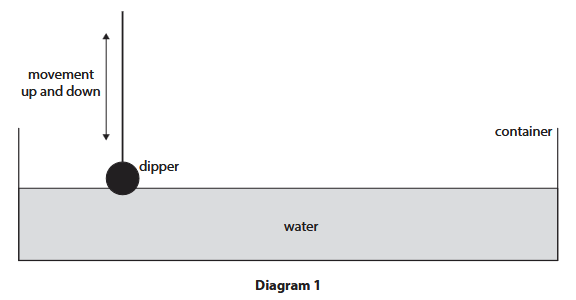
A dipper moves up and down to produce waves on the surface of the water in the container.
(a) The waves on the surface of the water are transverse.
State what is meant by a transverse wave.
You may draw a diagram to help your answer. (2)
(b) Diagram 2 shows the surface of the ripple tank, at an instant in time, when viewed from above.
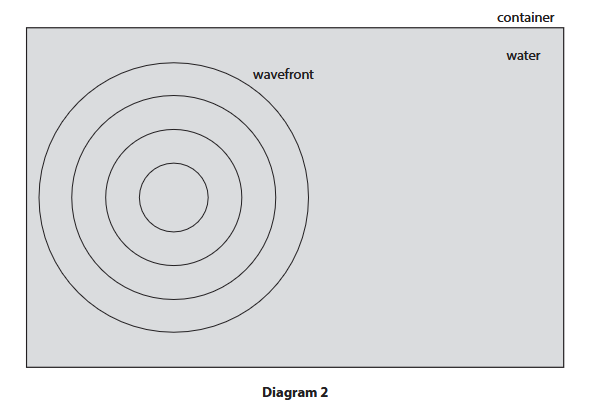
The dipper produces circular waves on the surface of the water.
(i) \(1\,\mathrm{cm}\) in diagram 2 is equal to \(2\,\mathrm{cm}\) in the laboratory.
Use the diagram to measure the wavelength of the water waves. (2)
wavelength = __________________ \(\mathrm{cm}\)
(ii) The dipper moves up and down with a frequency of \(15\,\mathrm{Hz}\).
Calculate the speed of the waves. (3)
(c) The student then makes the dipper move horizontally to the right at constant speed.
The dipper continues to move up and down with a frequency of \(15\,\mathrm{Hz}\).
Diagram 3 shows the surface of the ripple tank, at an instant in time, when viewed from above.
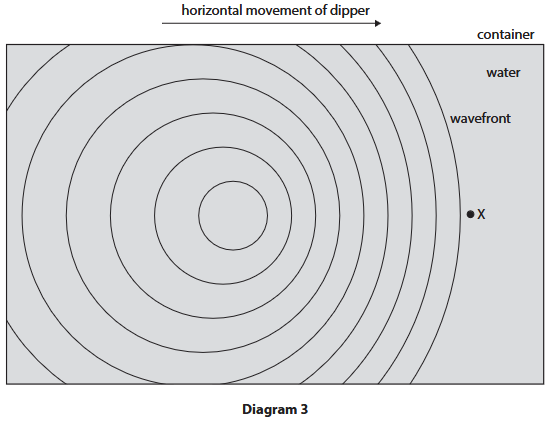
Explain how the frequency of the waves arriving at point X compares with the frequency at which the dipper moves up and down. (4)
Syllabus Topic Codes (Edexcel International GCSE Physics 4PH1):
• 3.3: Wave terminology — part (b)(i)
• 3.5–3.6: Wave speed, frequency, wavelength and time period — part (b)(ii)
• 3.7: Wave relationships in different contexts — part (c)
▶️ Answer/Explanation
(a) Meaning of a transverse wave [2 marks]
- In a transverse wave, the oscillations or vibrations of the particles are perpendicular to the direction of wave travel.
- The direction of oscillation is therefore at \(90^\circ\) to the direction of energy transfer or wave propagation.
Final Answer: A transverse wave is a wave in which the oscillations are perpendicular to the direction of wave travel or energy transfer.
(b)(i) Wavelength [2 marks]
The wavelength is the distance between two successive wavefronts.
From the diagram, the distance between adjacent wavefronts is approximately \(1.0\,\mathrm{cm}\) on the diagram.
The scale is \(1\,\mathrm{cm}\) on the diagram \(=2\,\mathrm{cm}\) in the laboratory.
Therefore,
\(\lambda=1.0\times2=2.0\,\mathrm{cm}\)
Final Answer: \( \boxed{2.0\,\mathrm{cm}} \)
(b)(ii) Wave speed [3 marks]
1. Convert the wavelength into metres:
\(\lambda=2.0\,\mathrm{cm}=0.020\,\mathrm{m}\)
2. Use the wave equation:
\(v=f\lambda\)
3. Substitute the values:
\(v=15\times0.020\)
\(v=0.30\,\mathrm{m\,s^{-1}}\)
Final Answer: \( \boxed{0.30\,\mathrm{m\,s^{-1}}} \)
(c) Frequency at point X [4 marks]
- The frequency of the waves arriving at point X is greater than the frequency at which the dipper moves up and down.
- The wavefronts become closer together in front of the moving dipper.
- Therefore, the wavelength decreases in the direction towards point X.
- The wave speed in the water does not change.
Using \(v=f\lambda\), if \(v\) remains constant while \(\lambda\) decreases, the frequency \(f\) must increase.
Final Answer: The frequency at point X is greater than \(15\,\mathrm{Hz}\). The wavefronts are closer together, so the wavelength decreases. Since the wave speed remains constant, \(v=f\lambda\) shows that the frequency must increase.
Question
This question is about light.
(a) Light is an example of a wave.
State what is meant by the term wave. (2 marks)
________________________________________________________________________________________________
________________________________________________________________________________________________
(b) Diagram 1 shows a ray of light incident on a mirror.
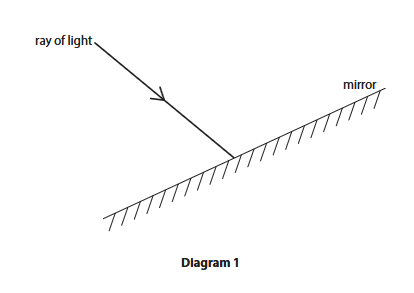
Draw another ray of light on Diagram 1 to show the path of the ray after it is incident on the mirror. (2 marks)
The reflected ray should be drawn from the point of incidence, making an angle of reflection equal to the angle of incidence.
(c) Diagram 2 shows a ray of red light entering a semi-circular glass block from the air.
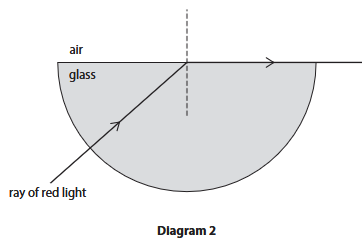
When the ray of red light is incident on the glass-air boundary, the light refracts with an angle of refraction of \(90^\circ\).
(i) Using Diagram 2, determine the critical angle for red light at the glass-air boundary. (1 mark)
critical angle = ____________________ degrees
(ii) Calculate the refractive index of the glass. (3 marks)
refractive index = ____________________
(iii) The refractive index of blue light in glass is higher than the refractive index of red light in glass.
A ray of blue light has an angle of incidence equal to the critical angle of red light.
Explain what would happen to the ray of blue light at the glass-air boundary. (3 marks)
________________________________________________________________________________________________
________________________________________________________________________________________________
________________________________________________________________________________________________
Syllabus Topic Codes (Edexcel International GCSE Physics 4PH1):
• 3.15–3.16: Law of reflection and ray diagrams — part (b)
• 3.20–3.22: Total internal reflection and critical angle — part (c)(i)
• 3.18, 3.20–3.22: Refractive index and critical angle — part (c)(ii)
• 3.20–3.22: Total internal reflection, critical angle and refractive index — part (c)(iii)
▶️ Answer/Explanation and Mark Scheme
(a) Meaning of a wave [2 marks]
- A wave is a disturbance involving vibrations or oscillations that transfers energy.
- A wave transfers energy or information without transferring matter overall.
(b) Reflection [2 marks]
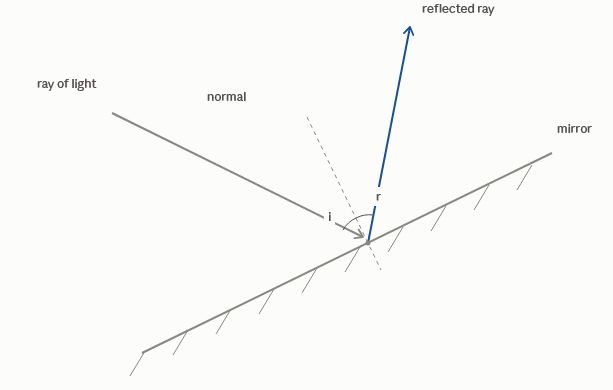
- Draw the reflected ray starting from the point of incidence.
- The angle of reflection must equal the angle of incidence: \(\boxed{i=r}\).
(c)(i) Critical angle [1 mark]
At the critical angle, the angle of refraction is \(90^\circ\).
From the diagram,
\(\boxed{c=49^\circ}\)
(c)(ii) Refractive index [3 marks]
For a glass-air boundary:
\(\sin c=\dfrac{1}{n}\)
Rearranging,
\(n=\dfrac{1}{\sin c}\)
\(n=\dfrac{1}{\sin49^\circ}\)
\(n\approx1.3\)
Answer: \( \boxed{1.3} \)
(c)(iii) Blue light at the boundary [3 marks]
- Blue light has a higher refractive index, so it has a lower critical angle than red light.
- The angle of incidence is equal to the critical angle for red light, so it is greater than the critical angle for blue light.
- Therefore, the blue light undergoes total internal reflection at the glass-air boundary.
Total: \(11\) marks
Questions
This question is about optical fibres.
(a) Optical fibres use light waves for communication. Which of these is a correct statement about waves?
A waves transfer energy, information and matter
B waves do not transfer energy, information, or matter
C waves transfer energy without transferring information or matter
D waves transfer energy and information without transferring matter
(b) A ray of light passes from air into a glass optical fibre. Diagram 1 shows the path of the ray of light after it has passed through the boundary between air and the optical fibre.
(i) Draw the path of the ray of light in air before it passed through the boundary.

(ii) State the name of the wave behaviour responsible for the path of the ray of light as it passes from air into the optical fibre.
(c) Diagram 2 shows the path of the ray of light as it travels through the optical fibre.

Explain the path of the ray of light as it travels through the optical fibre.
Syllabus Topic Codes (Edexcel International GCSE Physics 4PH1):
• 3.9: Reflection and Refraction of Waves — parts (b)(i) and (b)(ii)
• 3.20–3.22: Total Internal Reflection, Critical Angle, and Refractive Index — part (c)
▶️ Answer/Explanation
(a) Wave behaviour [1 mark]
Answer: D, waves transfer energy and information without transferring matter.
- A is incorrect because waves do not transfer matter from one place to another.
- B is incorrect because waves transfer energy and can transfer information.
- C is incorrect because waves can also transfer information.
(b)(i) Ray entering the optical fibre [1 mark]
The incident ray should be drawn so that, on entering the glass core from air, it bends towards the normal.

(b)(ii) Wave behaviour [1 mark]
The wave behaviour responsible for the change in direction is refraction.
(c) Light travelling through the optical fibre [3 marks]
- The ray undergoes total internal reflection at the boundary between the core and the surrounding material.
- The core has a higher refractive index than the surrounding material, such as air.
- The angle of incidence is greater than the critical angle.
Therefore, the light is repeatedly reflected inside the optical fibre and remains within the fibre, allowing it to travel along the fibre.
Questions
This question is about waves.
(a) The diagram represents a wave.

(i) Determine the amplitude of the wave by measuring it with a ruler. (1)
(ii) Determine the wavelength of the wave by measuring it with a ruler. (1)
(b) Microwaves are part of the electromagnetic spectrum.
(i) Name the part of the electromagnetic spectrum that has a lower frequency than microwaves. (1)
(ii) Microwaves travel at a speed of \(3.0\times10^8\,\mathrm{m\,s^{-1}}\) in air. A microwave has a wavelength of \(2.7\,\mathrm{cm}\). Calculate the frequency of this microwave. (3)
[wave speed = frequency × wavelength]
(c) A student uses a microwave source and a receiver to investigate microwaves. Photograph 1 shows how the student sets up their apparatus.

The meter shows the strength of the microwaves detected by the receiver. The strength of the microwaves is measured in arbitrary units. The student varies the distance between the microwave source and the receiver, and records the meter readings.
(i) Photograph 2 shows the analogue meter for one of the readings.

Give the reading on the analogue meter. (1)
(ii) The graph shows the results of the student’s investigation.

The student concludes that the meter reading is inversely proportional to the distance between the microwave source and the receiver. To be inversely proportional:
meter reading × distance = constant
Comment on the student’s conclusion. You should use data from the graph in your answer. (4)
Syllabus Topic Codes (Edexcel International GCSE Physics 4PH1):
• 3.10–3.11: The Electromagnetic Spectrum and Its Order — part (b)(i)
• 3.5–3.6: Wave Speed, Frequency, Wavelength, and Time Period — part (b)(ii)
• 3.7: Wave Relationships in Different Contexts — part (c)(ii)
▶️ Answer/Explanation
(a)(i) Amplitude [1 mark]
Measure the vertical distance from the equilibrium position to a crest or trough.
The amplitude is in the range:
\(\boxed{0.8\text{–}0.9\,\mathrm{cm}}\)
(a)(ii) Wavelength [1 mark]
Measure the horizontal distance between two successive points in phase, such as two adjacent crests.
The wavelength is in the range:
\(\boxed{3.9\text{–}4.0\,\mathrm{cm}}\)
(b)(i) Electromagnetic spectrum [1 mark]
The part of the electromagnetic spectrum with a lower frequency than microwaves is radio waves.
(b)(ii) Frequency of the microwave [3 marks]
Use:
\(v=f\lambda\)
Convert the wavelength into metres:
\(2.7\,\mathrm{cm}=0.027\,\mathrm{m}\)
Substituting \(v=3.0\times10^8\,\mathrm{m\,s^{-1}}\):
\(3.0\times10^8=f\times0.027\)
Rearranging:
\(f=\dfrac{3.0\times10^8}{0.027}\)
\(f\approx1.11\times10^{10}\,\mathrm{Hz}\)
\(\boxed{f\approx1.1\times10^{10}\,\mathrm{Hz}}\)
(c)(i) Analogue meter reading [1 mark]
The reading on the analogue meter is:
\(\boxed{68}\)
(c)(ii) Comment on the student’s conclusion [4 marks]
The student’s conclusion is not supported by the data because the meter reading × distance is not constant.
For example, using two pairs of readings from the graph:
\(\mathrm{constant}_1=\mathrm{meter\ reading}\times\mathrm{distance}\)
Calculate this value for one pair of readings and then calculate it for a second pair of readings.
The two calculated values are different, so:
meter reading × distance \(\neq\) constant.
Therefore, the meter reading is not inversely proportional to the distance between the microwave source and receiver.

Questions
Ground-penetrating radar (GPR) uses radio waves to detect changes in material underground.
(a)
(i) State the formula linking the speed, frequency and wavelength of a wave. (1)
(ii) GPR radio waves have a frequency of \(170\,\mathrm{MHz}\). The speed of radio waves is \(3.0\times10^8\,\mathrm{m\,s^{-1}}\). Calculate the wavelength of the waves. (3)
(b)
(i) A radio wave passes through the ground and refracts at the boundary between soil and rock. The diagram shows three wavefronts of the wave before and after refraction. The wave is also reflected at the boundary between the soil and the rock. Complete the diagram to show three wavefronts after the wave has been reflected at the boundary.

(ii) Explain why the radio waves passing through the rock have a smaller wavelength than the radio waves passing through the soil. (3)
Syllabus Topic Codes (Edexcel International GCSE Physics 4PH1):
• 3.8–3.9: Reflection and Refraction of Waves — part (b)(i)
• 3.9: Refraction of Waves and Changes in Wave Speed and Wavelength — part (b)(ii)
▶️ Answer/Explanation
(a)(i) Wave equation [1 mark]
The formula linking wave speed, frequency and wavelength is:
\(\boxed{v=f\lambda}\)
(a)(ii) Wavelength of the radio waves [3 marks]
Use:
\(v=f\lambda\)
Rearrange:
\(\lambda=\dfrac{v}{f}\)
Convert the frequency into hertz:
\(170\,\mathrm{MHz}=170\times10^6\,\mathrm{Hz}\)
Substitute:
\(\lambda=\dfrac{3.0\times10^8}{170\times10^6}\)
\(\lambda\approx1.76\,\mathrm{m}\)
Therefore:
\(\boxed{\lambda\approx1.8\,\mathrm{m}}\)
(b)(i) Reflected wavefronts [3 marks]
- Draw three reflected wavefronts to the right of the normal and above the rock.
- The wavefronts should be perpendicular to the direction of the reflected wave.
- The wavefronts should be parallel and equally spaced, with spacing consistent with the incident wave.
The reflected wave obeys the law of reflection, so the angle of reflection is equal to the angle of incidence.

(b)(ii) Smaller wavelength in rock [3 marks]
- The wavefronts are closer together in the rock, showing that the wavelength is smaller.
- Rock is optically denser than soil, so the wave travels more slowly in rock.
- The frequency remains constant when the wave passes from one medium to another.
Using \(v=f\lambda\), if \(f\) remains constant and \(v\) decreases, then \(\lambda\) must also decrease.
\(\boxed{v=f\lambda}\)
Questions
The photograph shows an x-ray image of a person’s knee. The person has had part of their knee replaced.

(a) X-rays are part of the electromagnetic spectrum. All electromagnetic waves are transverse waves and transfer energy.
(i) State another property that all electromagnetic waves have in common. (1)
(ii) State a harmful effect of excessive exposure to x-rays. (1)
(iii) Describe the difference between transverse waves and longitudinal waves. You may draw a diagram to help your answer. (3)
(b) The diagram shows a part of the knee called the patella. The patella has been removed from a person’s knee.

The patella is a small, irregularly shaped bone that is denser than water. Describe how to find the mass and the volume of the patella bone. (4)
(c) A scientist finds the volume and mass of a patella. The mass of the patella is \(17\,\mathrm{g}\). The volume of the patella is \(13\,\mathrm{cm^3}\). Calculate the density of the patella. Give your answer to 2 significant figures. (4)
Syllabus Topic Codes (Edexcel International GCSE Physics 4PH1):
• 3.3–3.4: Wave Terminology and Energy Transfer by Waves — part (a)
• 3.10–3.13: Electromagnetic Spectrum and X-rays — parts (a)(i) and (a)(ii)
• 5.3: Density, Mass and Volume — parts (b) and (c)
• 5.4: Core Practical: Density Measurements — part (b)
▶️ Answer/Explanation
(a)(i) Property of electromagnetic waves [1 mark]
All electromagnetic waves travel at the same speed in a vacuum.
In a vacuum:
\(\boxed{v=3.0\times10^8\,\mathrm{m\,s^{-1}}}\)
(a)(ii) Harmful effect of X-rays [1 mark]
Excessive exposure to X-rays can cause damage or mutations to cells and may lead to cancer.
(a)(iii) Transverse and longitudinal waves [3 marks]
- Both types of waves involve oscillations or vibrations.
- In a longitudinal wave, the vibrations of the particles are parallel to the direction of wave travel or energy transfer.
- In a transverse wave, the vibrations are perpendicular to the direction of wave travel or energy transfer.
Therefore, the key difference is the direction of vibration relative to the direction in which the wave travels.
(b) Measuring mass and volume of the patella [4 marks]
Mass:
Use a balance to measure the mass of the patella.
Volume:
- Use a measuring cylinder containing a known volume of water.
- Fully submerge the patella in the water and record the new volume.
- The volume of the patella is the increase in the water volume:
\(\boxed{V=V_{\mathrm{final}}-V_{\mathrm{initial}}}\)
The patella is denser than water, so it will sink, making it possible to fully submerge it and use water displacement to determine its volume.
(c) Density of the patella [4 marks]
Use the density equation:
\(\rho=\dfrac{m}{V}\)
Substitute \(m=17\,\mathrm{g}\) and \(V=13\,\mathrm{cm^3}\):
\(\rho=\dfrac{17}{13}\)
\(\rho=1.307\ldots\,\mathrm{g\,cm^{-3}}\)
To 2 significant figures:
\(\boxed{\rho=1.3\,\mathrm{g\,cm^{-3}}}\)
Questions
This question is about microwave ovens and microwaves.
(a) A microwave oven cooks some food. Diagram 1 represents a microwave emitted by the microwave oven.

(i) Determine the wavelength of the microwave. (2)
(ii) The microwave has a frequency of \(2.35\,\mathrm{GHz}\). Show that the speed of the microwave is about \(3\times10^8\,\mathrm{m\,s^{-1}}\). (3)
(b) Diagram 2 shows a damaged microwave oven with a hole in the door.

This microwave oven should not be used as it is very dangerous. State a harmful effect from the microwaves if this oven is used. (1)
Syllabus Topic Codes (Edexcel International GCSE Physics 4PH1):
• 3.5–3.6: Wave Speed, Frequency, Wavelength, and Time Period — parts (a)(i) and (a)(ii)
• 3.10–3.11: Harmful Effects and Uses of Electromagnetic Radiation — part (b)
▶️ Answer/Explanation
(a)(i) Wavelength of the microwave [2 marks]
Measure the horizontal distance between two adjacent points in phase, such as two successive crests.
From the diagram, the wavelength is approximately:
\(\lambda\approx12.5\,\mathrm{cm}\)
Therefore:
\(\boxed{\lambda=12.5\,\mathrm{cm}}\)
(a)(ii) Speed of the microwave [3 marks]
Use the wave equation:
\(v=f\lambda\)
Convert the units:
\(f=2.35\,\mathrm{GHz}=2.35\times10^9\,\mathrm{Hz}\)
\(\lambda=12.5\,\mathrm{cm}=12.5\times10^{-2}\,\mathrm{m}\)
Substituting:
\(v=(2.35\times10^9)(12.5\times10^{-2})\)
\(v=2.9375\times10^8\,\mathrm{m\,s^{-1}}\)
To an appropriate number of significant figures:
\(\boxed{v\approx3.0\times10^8\,\mathrm{m\,s^{-1}}}\)
(b) Harmful effect of microwaves [1 mark]
Microwaves can cause internal heating of body tissues or organs.
Therefore, leakage of microwaves from a damaged oven could cause harmful heating of the body.