
Edexcel iGCSE Physics (4PH1) 3.2 Properties of Waves Exam Style Question Paper 2B - New Syllabus
Question
This question is about sound waves.
(a) Describe an investigation to measure the frequency of a sound wave with an oscilloscope.
You may draw a diagram to help your answer. (5)
(b) The diagram shows an oscilloscope screen.
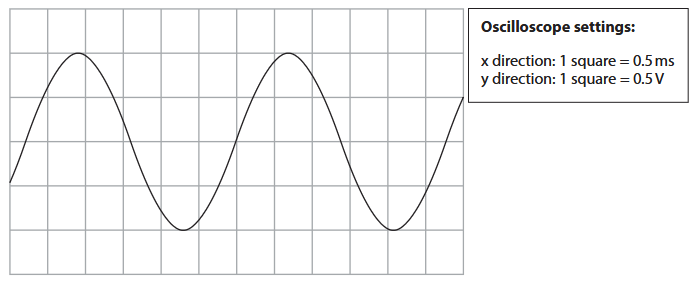
(i) Estimate the period, in ms, of the wave. (3)
period = __________________ \(\mathrm{ms}\)
(ii) Calculate the frequency of the wave. (1)
frequency = __________________ \(\mathrm{Hz}\)
Syllabus Topic Codes (Edexcel International GCSE Physics 4PH1):
• 3.28: Pitch and Frequency — parts (a) and (b)(ii)
• 3.5–3.6: Wave Speed, Frequency, Wavelength, and Time Period — relevant to the calculation of period and frequency in part (b)
▶️ Answer/Explanation
(a) Measuring the frequency of a sound wave using an oscilloscope [5 marks]
1. Produce a sound:
Use a microphone to detect the sound wave from a sound source.
2. Connect the microphone:
Connect the microphone to the oscilloscope so that the sound produces a trace on the screen.
3. Obtain a steady trace:
Adjust the oscilloscope controls until a steady, clear waveform is displayed.
4. Measure the period:
Measure the number of horizontal divisions for one complete wave, for example from one peak to the next peak.
Multiply the number of divisions by the time-base setting to find the period \(T\).
5. Calculate frequency:
Use:
\(f=\dfrac{1}{T}\)
A more reliable result can be obtained by measuring the time for several complete waves and dividing by the number of waves.
Final Answer: Connect a microphone to an oscilloscope, obtain a steady trace, measure the time for one or more complete waves using the time-base setting, calculate the period, and then use \(f=\dfrac{1}{T}\) to determine the frequency.
(b)(i) Period of the wave [3 marks]
1. Measure the horizontal distance for one complete wave.
The distance between two consecutive peaks is approximately \(5.6\) squares.
2. Use the time-base setting:
\(1\text{ square}=0.5\,\mathrm{ms}\)
3. Calculate the period:
\(T=5.6\times0.5\)
\(T=2.8\,\mathrm{ms}\)
Final Answer: \( \boxed{2.8\,\mathrm{ms}} \)
(b)(ii) Frequency of the wave [1 mark]
1. Convert the period into seconds:
\(T=2.8\,\mathrm{ms}=0.0028\,\mathrm{s}\)
2. Use the frequency equation:
\(f=\dfrac{1}{T}\)
\(f=\dfrac{1}{0.0028}\)
\(f=357.1\,\mathrm{Hz}\)
To 2 significant figures:
\(f=360\,\mathrm{Hz}\)
Final Answer: \( \boxed{360\,\mathrm{Hz}} \)
Question
This question is about sound waves.
(a) Which range of frequencies of sound waves can be heard by humans? (1)
A. \(2\,\mathrm{Hz}\) to \(20\,000\,\mathrm{Hz}\)
B. \(2\,\mathrm{Hz}\) to \(200\,000\,\mathrm{Hz}\)
C. \(20\,\mathrm{Hz}\) to \(20\,000\,\mathrm{Hz}\)
D. \(20\,\mathrm{Hz}\) to \(200\,000\,\mathrm{Hz}\)
(b) The table gives some statements about sound waves.
Complete the table by placing a tick (\(\checkmark\)) next to each correct statement. (2)
| Statement | Correct (\(\checkmark\)) |
|---|---|
| sound waves are longitudinal | |
| sound waves can travel through a vacuum | |
| sound waves are part of the electromagnetic spectrum | |
| sound waves can be reflected and refracted |
(c) An oscilloscope can be used to display a sound wave.
(i) Give the name of the variable that is measured on the x-axis of the oscilloscope screen. (1)
(ii) The diagram shows the trace on an oscilloscope screen when a sound wave is detected.
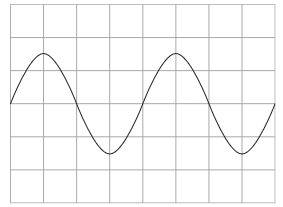
On the screen, draw the trace for a quieter sound wave with a lower frequency. (2)
Syllabus Topic Codes (Edexcel International GCSE Physics 4PH1):
• 3.2: Longitudinal and Transverse Waves — part (b), first statement
• 3.9: Reflection and Refraction of Waves — part (b), fourth statement
• 3.26: Sound Waves on an Oscilloscope — parts (c)(i) and (c)(ii)
▶️ Answer/Explanation
(a) Human hearing range [1 mark]
The normal human hearing range is approximately \(20\,\mathrm{Hz}\) to \(20\,000\,\mathrm{Hz}\).
Correct Answer: \( \boxed{\mathrm{C.\ 20\,Hz\ to\ 20\,000\,Hz}} \)
(b) Properties of sound waves [2 marks]
| Statement | Correct (\(\checkmark\)) |
|---|---|
| sound waves are longitudinal | \(\checkmark\) |
| sound waves can travel through a vacuum | |
| sound waves are part of the electromagnetic spectrum | |
| sound waves can be reflected and refracted | \(\checkmark\) |
Explanation:
- Sound waves are longitudinal waves.
- Sound requires a medium, so it cannot travel through a vacuum.
- Sound is a mechanical wave and is not part of the electromagnetic spectrum.
- Sound waves can undergo reflection and refraction.
(c)(i) Variable on the x-axis [1 mark]
The x-axis of an oscilloscope screen represents time.
Final Answer: \( \boxed{\mathrm{time}} \)
(c)(ii) Quieter sound with lower frequency [2 marks]
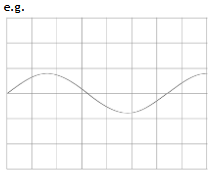
A quieter sound has a lower amplitude, so the new trace should have a smaller vertical height.
A lower-frequency sound has a larger period, so the waves should be further apart horizontally.
Final Answer: Draw a wave with lower amplitude throughout and a larger time period throughout.
Question
This question is about cosmic microwave background radiation (CMBR) and the Big Bang.
(a) CMBR has a mean frequency of \(1.6\times10^{11}\,\mathrm{Hz}\).
(i) State the formula linking wave speed, frequency and wavelength. (1)
(ii) Show that the mean wavelength of CMBR is about \(2\,\mathrm{mm}\). (3)
[speed of light \(=3.0\times10^8\,\mathrm{m\,s^{-1}}\)]
(b) CMBR was first released after the Big Bang.
When CMBR was first released it had a wavelength of about \(9\times10^{-5}\,\mathrm{mm}\), but now it has a wavelength of about \(2\,\mathrm{mm}\).
Using this information, explain how CMBR supports the Big Bang theory. (2)
(c) Explain how the cosmological red-shift of galaxies also supports the Big Bang theory. (4)
Syllabus Topic Codes (Edexcel International GCSE Physics 4PH1):
• 8.13–8.14P: The Big Bang Theory and its evidence — part (b)
• 8.15–8.16P: Red-shift, motion of galaxies and the red-shift equation — part (c)
• 8.17P: Red-shift and distance — relevant to part (c)
• 8.18P: Expansion of the Universe — relevant to parts (b) and (c)
▶️ Answer/Explanation
(a)(i) Wave speed equation [1 mark]
The relationship between wave speed, frequency and wavelength is
\(v=f\lambda\)
Final Answer: \( \boxed{v=f\lambda} \)
(a)(ii) Mean wavelength of CMBR [3 marks]
1. Use the wave equation:
\(v=f\lambda\)
2. Rearrange for wavelength:
\(\lambda=\dfrac{v}{f}\)
3. Substitute the values:
\(\lambda=\dfrac{3.0\times10^8}{1.6\times10^{11}}\)
\(\lambda=1.875\times10^{-3}\,\mathrm{m}\)
Since \(1\,\mathrm{m}=1000\,\mathrm{mm}\):
\(\lambda=1.875\,\mathrm{mm}\approx1.9\,\mathrm{mm}\)
Final Answer: \( \boxed{1.9\,\mathrm{mm}\approx2\,\mathrm{mm}} \)
(b) CMBR as evidence for the Big Bang [2 marks]
- The wavelength of CMBR has increased over time, from about \(9\times10^{-5}\,\mathrm{mm}\) to about \(2\,\mathrm{mm}\).
- This is evidence that the Universe is expanding, which supports the Big Bang theory.
Final Answer: The wavelength of CMBR has increased since it was first released, showing that the Universe has expanded. This supports the Big Bang theory because the theory predicts an expanding Universe.
(c) Cosmological red-shift and the Big Bang [4 marks]
- Most galaxies show a red-shift, indicating that they are moving away from the Earth and from each other.
- More distant galaxies show a greater red-shift.
- This indicates that more distant galaxies are travelling away from us faster.
- This provides evidence that the Universe is expanding, so the matter in the Universe must have originated from a much smaller, concentrated state, supporting the Big Bang theory.
Final Answer: Most galaxies are red-shifted, showing that they are moving away from Earth. More distant galaxies have a greater red-shift and are therefore moving away faster. This shows that the Universe is expanding, supporting the idea that all matter originated from a single point or very small region in the Big Bang.
Question
A high-frequency sound wave is detected by a microphone and displayed on an oscilloscope.
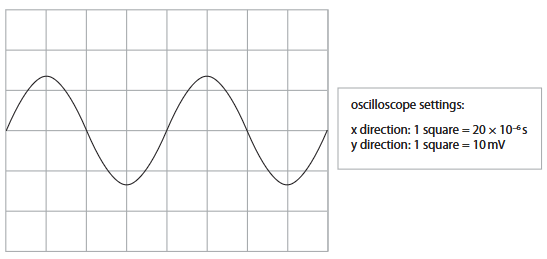
The diagram shows the oscilloscope screen when the sound wave is detected. It also shows the oscilloscope settings.
(a) Give the maximum frequency of sound that can be heard by humans. (1)
……………………………………………………………………………………………………………………………………………………………………………………………………………………………………………………
(b) Determine if the sound wave displayed on the oscilloscope could be heard by humans. (4)
……………………………………………………………………………………………………………………………………………………………………………………………………………………………………………………
(c) A student changes the settings of the oscilloscope to alter the displayed wave in these two ways:
- increase the amplitude of the wave
- only display one time period of the wave on the screen
The table shows some possible settings for the oscilloscope.
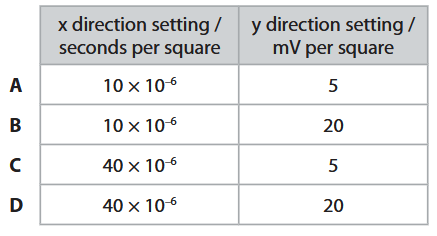
Which row of the table gives the student’s new oscilloscope settings? (1)
Syllabus Topic Codes (Edexcel International GCSE Physics 4PH1):
• 3.26P: Use of an oscilloscope and microphone to display a sound wave — parts (b) and (c)
• 3.27P: Investigating the frequency of a sound wave using an oscilloscope — part (b)
• 3.3: Frequency and time period of a wave — part (b)
▶️ Answer/Explanation
(a) Maximum frequency of human hearing [1 mark]
The frequency range of human hearing is approximately \(20\,\mathrm{Hz}\) to \(20\,000\,\mathrm{Hz}\).
Correct Answer: \(\boxed{20\,000\,\mathrm{Hz}}\)
(b) Determine whether the sound can be heard [4 marks]
1. Determine the time period from the oscilloscope.
One complete wave occupies approximately \(4\) horizontal squares.
The x-direction setting is \(20\times10^{-6}\,\mathrm{s}\) per square.
Therefore:
\(T=4\times20\times10^{-6}\)
\(T=80\times10^{-6}\,\mathrm{s}=8.0\times10^{-5}\,\mathrm{s}\)
2. Calculate the frequency.
\(f=\dfrac{1}{T}\)
\(f=\dfrac{1}{8.0\times10^{-5}}\)
\(f=12\,500\,\mathrm{Hz}\)
3. Compare with the human hearing range.
The calculated frequency of \(12\,500\,\mathrm{Hz}\) is between \(20\,\mathrm{Hz}\) and \(20\,000\,\mathrm{Hz}\).
Final Answer: Yes, the sound wave could be heard by humans because \(12\,500\,\mathrm{Hz}\) is within the human hearing range.
(c) Oscilloscope settings [1 mark]
The original settings are:
x-direction: \(20\times10^{-6}\,\mathrm{s}\) per square
y-direction: \(10\,\mathrm{mV}\) per square
To increase the displayed amplitude, the y-direction setting must be reduced from \(10\,\mathrm{mV}\) per square to \(5\,\mathrm{mV}\) per square.
To display only one time period instead of two, the time per square must be reduced from \(20\times10^{-6}\,\mathrm{s}\) to \(10\times10^{-6}\,\mathrm{s}\) per square.
Correct Answer: \(\boxed{\mathrm{A}}\), \(10\times10^{-6}\,\mathrm{s}\) per square and \(5\,\mathrm{mV}\) per square.
Why the other options are incorrect:
- B: \(20\,\mathrm{mV}\) per square would make the displayed amplitude smaller.
- C: \(40\times10^{-6}\,\mathrm{s}\) per square would display fewer waves, but the y-setting would decrease the displayed amplitude.
- D: \(40\times10^{-6}\,\mathrm{s}\) per square would display fewer waves, but \(20\,\mathrm{mV}\) per square would decrease the displayed amplitude.
Question
The diagram shows two students doing an experiment to measure the speed of sound in air.

This is their method.
- Both students stand \(100\,\mathrm{m}\) away from a large flat wall.
- Student A makes a sound by hitting two blocks of wood together.
- The sound waves travel to the wall and reflect back to the students as an echo.
- Student A hits the blocks together again when the echo is heard.
- Student A continues to hit the blocks together every time an echo is heard.
- Student B starts a timer when the blocks are hit together and stops the timer when the blocks have been hit together 20 more times.
(a) Give a reason why the students do not stand nearer to the wall.
(b) The students repeat their method five times. The table shows the students’ results.

(i) The students decide that one of their tests shows an anomalous result. Circle the anomalous result in the table.
(ii) Suggest a reason for the anomalous result.
(iii) Calculate the mean time between starting and stopping the timer. Give your answer to a suitable number of decimal places.
(iv) The speed of sound in air can be calculated using the formula
\( \mathrm{speed}=\dfrac{\mathrm{distance\ travelled}}{\mathrm{time\ taken}} \)
Use the students’ results to calculate a value for the speed of sound in air.
Syllabus Topic Codes (Edexcel International GCSE Physics 4PH1):
• 3.23: Sound Waves — parts (a) and (b)
• 3.5–3.7: Wave Speed, Frequency, Wavelength, and Time Period; Wave Relationships in Different Contexts — part (b)(iv)
▶️ Answer/Explanation
(a) Reason for standing \(100\,\mathrm{m}\) from the wall [1 mark]
The students need to stand far enough from the wall so that the time between the original sound and the echo is long enough to be measured accurately.
If they stood nearer to the wall, the time between successive echoes would be very short, making reaction time a significant source of error.
(b)(i) Anomalous result [1 mark]
The anomalous result is:
\(\boxed{11.18\,\mathrm{s}}\)
This value is noticeably different from the other results.
(b)(ii) Reason for the anomalous result [1 mark]
A suitable reason is that the student may have miscounted the number of block hits.
(b)(iii) Mean time [3 marks]
The anomalous result should be excluded when calculating the mean.
Mean including all five results:
\( \mathrm{mean}=11.642\,\mathrm{s} \)
Mean excluding the anomalous result:
\( \mathrm{mean}=11.7575\,\mathrm{s} \)
To a suitable number of decimal places:
\(\boxed{11.76\,\mathrm{s}}\)
(b)(iv) Speed of sound [3 marks]
The sound travels from the students to the wall and then back to the students, so the total distance travelled is:
\( \mathrm{distance}=2\times100=200\,\mathrm{m} \)
The measured time is for 20 echoes, so the time for one journey to the wall and back is:
\( t=\dfrac{11.76}{20}=0.588\,\mathrm{s} \)
Using:
\( \mathrm{speed}=\dfrac{\mathrm{distance}}{\mathrm{time}} \)
\( \mathrm{speed}=\dfrac{200}{0.588} \)
\( \mathrm{speed}\approx340\,\mathrm{m\,s^{-1}} \)
\(\boxed{\mathrm{speed}\approx340\,\mathrm{m\,s^{-1}}}\)
The doubling of the distance is important because the sound travels to the wall and then returns to the students.
Question
An oscilloscope can be used to determine the frequency of a sound wave.
(a) Give the name of the piece of apparatus that must be connected to the oscilloscope to detect the sound wave.
(b) The diagram shows the screen of the oscilloscope and the oscilloscope settings.

A sound wave of frequency \(250\,\mathrm{Hz}\) is detected. The sound wave produces a trace on the oscilloscope of amplitude \(4\,\mathrm{V}\). Complete the diagram by drawing the trace of this sound wave on the oscilloscope screen.
(c) The graph shows how the wavelength of sound waves in air varies with their frequency.

If wavelength and frequency are inversely proportional, then $\mathrm{wavelength × frequency = constant}$
Using the graph, evaluate whether the wavelength of sound waves in air is inversely proportional to their frequency.
Syllabus Topic Codes (Edexcel International GCSE Physics 4PH1):
• 3.5–3.7: Wave Speed, Frequency, Wavelength, and Time Period; Wave Relationships in Different Contexts — parts (b) and (c)
• 3.23: Sound Waves — parts (a), (b) and (c)
▶️ Answer/Explanation
(a) Apparatus [1 mark]
The apparatus required is a microphone.
(b) Oscilloscope trace [4 marks]
The frequency is \(250\,\mathrm{Hz}\). The time period is found using:
\(f=\dfrac{1}{T}\)
Therefore:
\(T=\dfrac{1}{f}=\dfrac{1}{250}\)
\(T=0.004\,\mathrm{s}\)
Using the time-base setting shown on the oscilloscope, one complete cycle should occupy 4 squares horizontally.
The amplitude of the trace is \(4\,\mathrm{V}\), corresponding to 2 squares vertically according to the voltage setting.
Therefore, draw a smooth approximately sine-shaped wave with:
- amplitude of \(2\) squares
- period of \(4\) squares

(c) Testing inverse proportionality [3 marks]
If wavelength and frequency are inversely proportional:
\(\lambda f=\mathrm{constant}\)
First pair of values:
Read one frequency and its corresponding wavelength from the graph and calculate:
\(\lambda_1f_1=\mathrm{constant}\)
Second pair of values:
Read a second frequency and its corresponding wavelength from the graph and calculate:
\(\lambda_2f_2=\mathrm{constant}\)
The two calculated values are approximately equal. Therefore, the product of wavelength and frequency is approximately constant.
Conclusion: the wavelength of sound waves in air is approximately inversely proportional to frequency.
Question
This question is about sound.
(a) State which wave property determines the pitch of a sound.
(b) The bar chart shows the maximum frequency of sound heard by four animals and a human.

Explain which of the bars is most likely to show the results for a human.
(c) A sound wave has a frequency of \(500\,\mathrm{Hz}\).
(i) Show that the time period of the sound wave is \(2.0\,\mathrm{ms}\).
(ii) The diagram shows the screen of an oscilloscope. The timebase of the oscilloscope is \(0.50\,\mathrm{ms}\) per square.

Draw the trace on the oscilloscope screen when the sound wave is detected.
Syllabus Topic Codes (Edexcel International GCSE Physics 4PH1):
• 3.26: Sound Waves on an Oscilloscope — part (c)(ii)
• 3.5–3.6: Wave Speed, Frequency, Wavelength, and Time Period — part (c)(i)
• 3.23: Sound Waves — parts (a), (b), and (c)
▶️ Answer/Explanation
(a) Wave property determining pitch [1 mark]
The wave property that determines the pitch of a sound is its frequency.
(b) Human hearing range [2 marks]
Answer: C.
Humans can normally hear frequencies up to approximately \(20\,\mathrm{kHz}\), or \(20\,000\,\mathrm{Hz}\). Therefore, the bar with a maximum frequency close to \(20\,\mathrm{kHz}\) is most likely to represent a human.
(c)(i) Time period [3 marks]
Use the relationship:
\(f=\dfrac{1}{T}\)
Rearrange:
\(T=\dfrac{1}{f}\)
Substitute \(f=500\,\mathrm{Hz}\):
\(T=\dfrac{1}{500}=0.002\,\mathrm{s}\)
Since \(1\,\mathrm{s}=1000\,\mathrm{ms}\):
\(T=0.002\times1000=2.0\,\mathrm{ms}\)
\(\boxed{T=2.0\,\mathrm{ms}}\)
(c)(ii) Oscilloscope trace [2 marks]
The time period is \(2.0\,\mathrm{ms}\), while the timebase is \(0.50\,\mathrm{ms}\) per square.
Therefore, the number of squares occupied by one complete cycle is:
\(\dfrac{2.0}{0.50}=4\) squares
The trace should therefore contain one or more complete waves with a consistent period of 4 squares per cycle, as shown in the mark-scheme example.

Question
This question is about sound waves.
(a) The table gives the frequencies of some different sound waves. Place ticks in the table to show which sound waves can be heard by humans.

(b) The diagram shows the screen of an oscilloscope when a sound wave is detected. Add to the diagram by drawing the trace of another sound wave that has a lower pitch and is quieter than the sound wave shown.

(c) The speed of sound in air varies with temperature. A student finds a formula in a textbook that links the speed of sound waves in air to the temperature of the air, measured in kelvin.
\(\mathrm{speed\ of\ sound\ in\ air}=(0.606\times\mathrm{temperature\ in\ kelvin})+166\)
(i) Calculate the speed of sound when the air temperature is \(46^\circ\mathrm{C}\).
(ii) Calculate the wavelength of a sound wave with a frequency of \(15000\,\mathrm{Hz}\) when the air temperature is \(46^\circ\mathrm{C}\).
Syllabus Topic Codes (Edexcel International GCSE Physics 4PH1):
• 3.26: Sound Waves on an Oscilloscope — part (b)
• 3.28P: Pitch and Frequency — part (b)
• 3.29P: Loudness and Amplitude — part (b)
• 3.23: Sound Waves — part (c)
• 3.5–3.7: Wave Speed, Frequency, Wavelength, and Time Period; Wave Relationships in Different Contexts — part (c)
▶️ Answer/Explanation
(a) Human hearing range [2 marks]
Humans can normally hear sound frequencies approximately between \(20\,\mathrm{Hz}\) and \(20000\,\mathrm{Hz}\).
Therefore, the correct entries are:
- A: not heard by humans
- B: heard by humans
- C: heard by humans
- D: heard by humans
- E: heard by humans
- F: not heard by humans

(b) Oscilloscope trace [2 marks]
- The wave should have a lower amplitude throughout because a quieter sound has a smaller amplitude.
- The wave should have a lower frequency throughout because a lower-pitched sound has a lower frequency.
Therefore, the new trace should have smaller vertical displacement and fewer complete cycles over the same horizontal interval.
(c)(i) Speed of sound [2 marks]
First convert the temperature from degrees Celsius to kelvin:
\(T=46+273=319\,\mathrm{K}\)
Substitute into the given formula:
\(v=(0.606\times319)+166\)
\(v=359.314\,\mathrm{m\,s^{-1}}\)
Therefore:
\(\boxed{v\approx360\,\mathrm{m\,s^{-1}}}\)
(c)(ii) Wavelength [3 marks]
Use the wave equation:
\(v=f\lambda\)
Rearrange to make wavelength the subject:
\(\lambda=\dfrac{v}{f}\)
Using \(v=360\,\mathrm{m\,s^{-1}}\) and \(f=15000\,\mathrm{Hz}\):
\(\lambda=\dfrac{360}{15000}\)
\(\lambda=0.024\,\mathrm{m}\)
Wavelength: \(\boxed{0.024\,\mathrm{m}}\)
Question
This is a question about electromagnetic waves.
(a) State which colour in the visible spectrum has the shortest wavelength.
(b) Explain a hazard of ultraviolet radiation to the human body.
(c)(i) State the formula linking speed, wavelength and frequency of a wave.
(ii) Calculate the frequency of radio waves with a wavelength of \(15\,\mathrm{m}\).
[speed of light \(=3.0\times10^8\,\mathrm{m\,s^{-1}}\)]
Syllabus Topic Codes (Edexcel International GCSE Physics 4PH1):
• 3.13: Effects and Risks of Electromagnetic Waves — part (b)
• 3.5–3.7: Wave Speed, Frequency, Wavelength, and Wave Relationships in Different Contexts — part (c)
▶️ Answer/Explanation
(a) Shortest wavelength [1 mark]
The colour with the shortest wavelength in the visible spectrum is violet.
In the visible spectrum, wavelength decreases from red to violet.
(b) Hazard of ultraviolet radiation [2 marks]
Ultraviolet radiation can cause damage or mutations in cells, which can lead to skin cancer.
Prolonged exposure to UV radiation can damage body cells, particularly cells in the skin. UV radiation can also cause damage to the eyes, potentially leading to blindness.
(c)(i) Wave equation [1 mark]
The formula linking speed, wavelength and frequency is:
\(\boxed{v=f\lambda}\)
(c)(ii) Frequency of the radio waves [2 marks]
Rearrange the wave equation:
\(f=\dfrac{v}{\lambda}\)
Substitute the values:
\(f=\dfrac{3.0\times10^8}{15}\)
\(f=2.0\times10^7\,\mathrm{Hz}\)
Frequency: \(\boxed{2.0\times10^7\,\mathrm{Hz}}\)
Question
A student uses this method to investigate the speed of sound in air.
- set up an oscilloscope to detect and display a sound wave
- use a computer and a speaker to produce a sound of known wavelength
- use the oscilloscope to determine the frequency of the sound wave
- use a formula to calculate the speed of sound
(a) Give the name of the equipment that should be connected to the oscilloscope to detect the sound wave.
(b) The diagram shows the oscilloscope screen and the oscilloscope settings.

(i) Determine the frequency of the sound wave.
(ii) The wavelength of the sound wave is \(27\,\mathrm{cm}\). Calculate the speed of sound.
(iii) Describe how the oscilloscope could be adjusted to show fewer wave cycles on the screen.
Syllabus Topic Codes (Edexcel International GCSE Physics 4PH1):
• 3.25P: Core Practical: Speed of Sound in Air — overall investigation
• 3.26: Sound Waves on an Oscilloscope — parts (a), (b)(i), and (b)(iii)
• 3.5–3.6: Wave Speed, Frequency, Wavelength, and Time Period — part (b)(ii)
▶️ Answer/Explanation
(a) Equipment [1 mark]
A microphone should be connected to the oscilloscope.
(b)(i) Frequency of the sound wave [4 marks]
From the oscilloscope trace, 5 complete wave cycles occupy 8 horizontal divisions.
Therefore, the number of divisions for one complete cycle is:
\(\displaystyle \frac{8}{5}=1.6\ \mathrm{divisions}\)
The timebase is \(0.5\,\mathrm{ms/division}\), so the time period is:
\(\displaystyle T=1.6\times0.5\times10^{-3}\)
\(\displaystyle T=8.0\times10^{-4}\,\mathrm{s}\)
Using:
\(\displaystyle f=\frac{1}{T}\)
\(\displaystyle f=\frac{1}{8.0\times10^{-4}}\)
\(\displaystyle f=1250\,\mathrm{Hz}\)
\(\boxed{f=1250\,\mathrm{Hz}}\)
(b)(ii) Speed of sound [3 marks]
Use the wave equation:
\(\displaystyle v=f\lambda\)
Convert the wavelength into metres:
\(\lambda=27\,\mathrm{cm}=0.27\,\mathrm{m}\)
Substitute:
\(\displaystyle v=1250\times0.27\)
\(\displaystyle v=337.5\,\mathrm{m\,s^{-1}}\)
Therefore:
\(\boxed{v\approx340\,\mathrm{m\,s^{-1}}}\)
(b)(iii) Showing fewer wave cycles [2 marks]
Adjust the timebase of the oscilloscope.
The timebase should be decreased, so that each horizontal division represents a shorter time. This reduces the total time displayed on the screen and therefore shows fewer wave cycles.
Question
The diagram shows the screen of an oscilloscope when a sound wave is detected, and the oscilloscope settings.

(a) Give the name of the piece of equipment that is connected to the oscilloscope to detect the sound wave.
(b) (i) Use the trace on the oscilloscope to determine the time period of the detected sound wave.
(ii) Calculate the frequency of the detected sound wave.
(c) (i) State the formula linking energy transferred, charge and voltage.
(ii) The effective voltage of the oscilloscope trace can be calculated using the formula
\( \mathrm{effective\ voltage}=\dfrac{\mathrm{amplitude\ of\ trace\ in\ V}}{\sqrt{2}} \)
Use the effective voltage to calculate the energy transferred when \(6.3\times10^{-5}\,\mathrm{C}\) of charge passes through the oscilloscope.
Syllabus Topic Codes (Edexcel International GCSE Physics 4PH1):
• 3.5–3.6: Wave Speed, Frequency, Wavelength, and Time Period — part (b)(ii)
• 2.20–2.21: Voltage, Energy Transfer, and Charge — parts (c)(i) and (c)(ii)
▶️ Answer/Explanation
(a) Equipment used to detect sound [1 mark]
A microphone is connected to the oscilloscope to detect the sound wave and convert it into an electrical signal.
(b)(i) Time period [2 marks]
One complete cycle of the trace occupies approximately \(5.3\) horizontal divisions.
The timebase is \(0.002\,\mathrm{s/division}\).
Therefore:
\(T=5.3\times0.002\)
\(T=0.0106\,\mathrm{s}\)
Therefore:
\(\boxed{T\approx0.011\,\mathrm{s}}\)
(b)(ii) Frequency [1 mark]
Use the relationship:
\(f=\dfrac{1}{T}\)
\(f=\dfrac{1}{0.011}\)
\(f\approx91\,\mathrm{Hz}\)
\(\boxed{f\approx91\,\mathrm{Hz}}\)
(c)(i) Energy, charge and voltage [1 mark]
The formula linking energy transferred, charge and voltage is:
\(\boxed{E=QV}\)
(c)(ii) Energy transferred [3 marks]
The amplitude of the trace is \(2\) divisions and the vertical scale is \(5\,\mathrm{V/division}\).
Therefore:
\(\mathrm{amplitude}=2\times5=10\,\mathrm{V}\)
The effective voltage is:
\(V_\mathrm{eff}=\dfrac{10}{\sqrt{2}}\)
\(V_\mathrm{eff}\approx7.1\,\mathrm{V}\)
Now use \(E=QV\):
\(E=(6.3\times10^{-5})\times7.1\)
\(E=4.47\times10^{-4}\,\mathrm{J}\)
Therefore:
\(\boxed{E\approx4.5\times10^{-4}\,\mathrm{J}}\)