
Edexcel iGCSE Physics (4PH1) 3.3 The Electromagnetic Spectrum Exam Style Question Paper 1B - New Syllabus
Question
Fluorescent tube lamps can be used in schools and office buildings for lighting.
The photograph shows an engineer installing a fluorescent tube lamp.
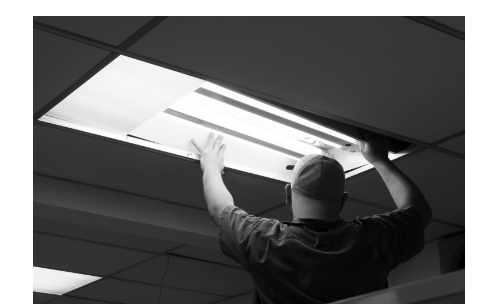
Diagram 1 shows a simplified view of the components of a fluorescent tube lamp.
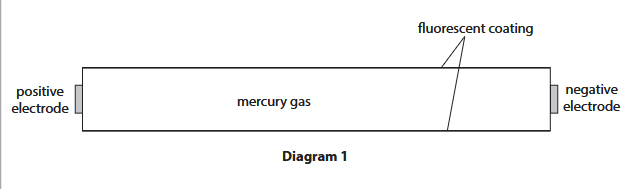
(a) When the lamp is on, a large voltage is applied between the positive electrode and the negative electrode.
(i) State what is meant by the term voltage. (1)
(ii) The large voltage causes electrons to accelerate from the negative electrode towards the positive electrode.
An electron gains \(1.0\times10^{-16}\,\mathrm{J}\) of energy when it accelerates between the electrodes.
Show that the voltage between the electrodes is about \(600\,\mathrm{V}\).
[magnitude of electron charge \(=1.6\times10^{-19}\,\mathrm{C}\)] (3)
(iii) The electron gains \(1.0\times10^{-16}\,\mathrm{J}\) of energy in its kinetic store when it accelerates from the negative electrode to the positive electrode.
Calculate the speed of an electron when it reaches the positive electrode.
Assume the electron is initially at rest.
[electron mass \(=9.1\times10^{-31}\,\mathrm{kg}\)] (4)
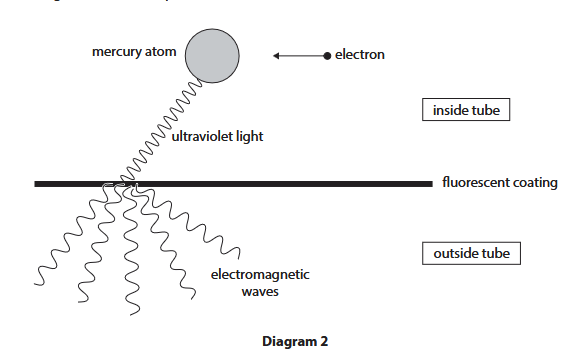
(b) When the electrons accelerate between the electrodes, they collide with mercury atoms.
Energy is transferred to the mercury atoms during the collisions. This causes the mercury atoms to emit ultraviolet light.
Atoms in the fluorescent coating absorb this ultraviolet light, which is then re-emitted as light from a different part of the electromagnetic spectrum.
Diagram 2 shows this process.
(i) Suggest why the tube must have a fluorescent coating for the lamp to operate effectively. (2)
(ii) Explain why the fluorescent tube lamp is dangerous if the fluorescent coating becomes damaged. (2)
Syllabus Topic Codes (Edexcel International GCSE Physics 4PH1):
• 4.4–4.5: Kinetic energy and energy transfers — part (a)(iii)
• 3.12–3.14: Electromagnetic waves and the electromagnetic spectrum — parts (b)(i) and (b)(ii)
• 7.4–7.5 and 7.15–7.16: Ionising radiation and associated hazards — part (b)(ii)
▶️ Answer/Explanation
(a)(i) Meaning of voltage [1 mark]
Voltage is the energy transferred per unit charge.
The relationship is:
\(V=\dfrac{E}{Q}\)
where \(V\) is voltage, \(E\) is energy transferred and \(Q\) is charge.
(a)(ii) Voltage between the electrodes [3 marks]
1. Use the electrical energy equation:
\(E=QV\)
2. Rearrange for voltage:
\(V=\dfrac{E}{Q}\)
3. Substitute the values:
\(V=\dfrac{1.0\times10^{-16}}{1.6\times10^{-19}}\)
\(V=625\,\mathrm{V}\)
Therefore, the voltage is about \(600\,\mathrm{V}\).
Final Answer: \( \boxed{625\,\mathrm{V}\approx600\,\mathrm{V}} \)
(a)(iii) Speed of the electron [4 marks]
The electron starts from rest, so its initial kinetic energy is zero. The energy gained becomes kinetic energy.
1. Use the kinetic energy equation:
\(E_{\mathrm{k}}=\dfrac{1}{2}mv^2\)
2. Rearrange for \(v\):
\(v^2=\dfrac{2E_{\mathrm{k}}}{m}\)
\(v=\sqrt{\dfrac{2E_{\mathrm{k}}}{m}}\)
3. Substitute the values:
\(v=\sqrt{\dfrac{2(1.0\times10^{-16})}{9.1\times10^{-31}}}\)
\(v\approx1.48\times10^7\,\mathrm{m\,s^{-1}}\)
Final Answer: \( \boxed{1.5\times10^7\,\mathrm{m\,s^{-1}}} \)
(b)(i) Function of the fluorescent coating [2 marks]
- Humans cannot see ultraviolet radiation.
- The fluorescent coating absorbs the ultraviolet radiation and emits visible light, which can be seen by humans.
Therefore, the coating converts the ultraviolet radiation produced by the mercury atoms into visible light, making the lamp useful for lighting.
(b)(ii) Danger if the coating is damaged [2 marks]
- If the coating is damaged, ultraviolet radiation could escape from the tube.
- Ultraviolet radiation is ionising radiation and can cause harmful effects such as skin damage, burns or an increased risk of cancer.
Mercury vapour is also harmful if it escapes from the damaged tube.
Final Answer: A damaged coating may allow ultraviolet radiation to escape. UV radiation can damage living cells and is harmful to people, while escaped mercury vapour is also toxic.
Question
The table shows an incomplete electromagnetic spectrum.

Two parts of the electromagnetic spectrum are missing. The missing parts are labelled A and B.
(a)
(i) Name the part labelled A.
(ii) Name the part labelled B.
(b)
(i) Give a use of microwaves.
(ii) Give a use of gamma rays.
Syllabus Topic Codes (Edexcel International GCSE Physics 4PH1):
• 3.11: Order of electromagnetic radiations according to wavelength and frequency — parts (a)(i), (a)(ii)
• 3.12: Uses of electromagnetic radiations — parts (b)(i), (b)(ii)
▶️ Answer/Explanation
Ans
(a) (i) infrared;
(ii) ultraviolet;
(b) (i) heating food / eq;
communication;
radar;
(ii) sterilising (equipment or food);
treating cancer;
medical imaging;
medical tracing techniques;
Question
This question is about the Sun.
(a) The table shows the different stages in the evolution of stars of different masses. Complete the table by adding ticks (ü) to show which stages of evolution occur in the life cycle of the Sun.

(b) When viewed from Earth, the surface of the Sun is yellow in colour. The surface of another star, Betelgeuse, is red in colour. Explain the difference between the Sun and Betelgeuse, based on the different colours of their surfaces.
(c) The Sun transfers energy to the Earth by radiation.
(i) Give a reason why energy is not transferred from the Sun to the Earth by conduction or convection.
(ii) A satellite orbiting the Earth contains sensitive equipment that can be damaged if it gets too hot. Explain which colour would be most appropriate for the outer surface of the satellite to protect the equipment.
Syllabus Topic Codes (Edexcel International GCSE Physics 4PH1):
• 8.7: Classification of stars according to their colour — part (b)
• 8.8: Relationship between a star’s colour and its surface temperature — part (b)
• 5.10: Arrangement and motion of particles in solids, liquids and gases — part (c)(i)
• 4.2: Energy transfers involving energy stores and radiation — part (c)(i)
• 3.10: Properties of electromagnetic radiation — part (c)(ii)
▶️ Answer/Explanation
Ans
(a) one mark for each correct tick;;;;

(b) idea of the temperatures being different;
Sun is hotter than Betelgeuse;
(c) (i) idea that there are no particles in space (between Sun and Earth);
(ii) shiny / white / silver;
poor absorber of (IR) radiation;
Questions
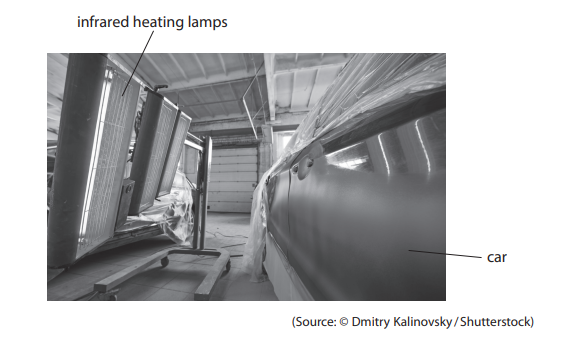
The photograph shows infrared heating lamps being used to harden fresh paint on a car.
(a) Give a harmful effect of infrared waves.
(b) The heating lamps produce visible light waves in addition to infrared waves.
(i) Give two similar properties of visible light waves and infrared waves.
(ii) Give two differences between the properties of visible light waves and infrared waves.
(c) The infrared heating lamps are placed 1.5 m from the car. Calculate the time taken for infrared waves emitted from a lamp to reach the car. [for infrared waves, speed = \(3.0 \times 10^8m/s\)]
(d) Paint takes less time to harden when it absorbs more energy from infrared radiation. A technician observes that white paint takes more time to harden than black paint. Explain this observation.
Syllabus Topic Codes (Edexcel International GCSE Physics 4PH1):
• 6.1: Electromagnetic waves and their properties — parts (b)(i), (b)(ii)
• 6.2: Speed of electromagnetic waves and the relationship between speed, distance and time — part (c)
• 6.5: Absorption of infrared radiation by surfaces — part (d)
▶️Answer/Explanation
Ans
(a) {skin / eye / tissue} burns;
(b) (i) any two from:
• both electromagnetic waves;
• both transfer energy;
• both transverse waves;
• both are non-ionising;
• both can travel through vacuum;
• both have same speed (in a vacuum);
(ii) • infrared has longer/higher wavelength;
• infrared has lower frequency;
(c) substitution into speed = distance / time;
rearrangement;
evaluation;
e.g.
\(3.0 × 10^8 = 1.5 / time\)
\(time = 1.5 / 3.0 × 10^8\)
\((time =) 5.0 × 10^{−9} (s)\)
(d) black is a better/good absorber (of infrared radiation);
idea that more energy/heat transferred to black car (in the same time);
Questions
This question is about waves.
(a) The diagram represents a wave.

(i) Determine the amplitude of the wave by measuring it with a ruler. (1)
(ii) Determine the wavelength of the wave by measuring it with a ruler. (1)
(b) Microwaves are part of the electromagnetic spectrum.
(i) Name the part of the electromagnetic spectrum that has a lower frequency than microwaves. (1)
(ii) Microwaves travel at a speed of \(3.0\times10^8\,\mathrm{m\,s^{-1}}\) in air. A microwave has a wavelength of \(2.7\,\mathrm{cm}\). Calculate the frequency of this microwave. (3)
[wave speed = frequency × wavelength]
(c) A student uses a microwave source and a receiver to investigate microwaves. Photograph 1 shows how the student sets up their apparatus.

The meter shows the strength of the microwaves detected by the receiver. The strength of the microwaves is measured in arbitrary units. The student varies the distance between the microwave source and the receiver, and records the meter readings.
(i) Photograph 2 shows the analogue meter for one of the readings.

Give the reading on the analogue meter. (1)
(ii) The graph shows the results of the student’s investigation.

The student concludes that the meter reading is inversely proportional to the distance between the microwave source and the receiver. To be inversely proportional:
meter reading × distance = constant
Comment on the student’s conclusion. You should use data from the graph in your answer. (4)
Syllabus Topic Codes (Edexcel International GCSE Physics 4PH1):
• 3.10–3.11: The Electromagnetic Spectrum and Its Order — part (b)(i)
• 3.5–3.6: Wave Speed, Frequency, Wavelength, and Time Period — part (b)(ii)
• 3.7: Wave Relationships in Different Contexts — part (c)(ii)
▶️ Answer/Explanation
(a)(i) Amplitude [1 mark]
Measure the vertical distance from the equilibrium position to a crest or trough.
The amplitude is in the range:
\(\boxed{0.8\text{–}0.9\,\mathrm{cm}}\)
(a)(ii) Wavelength [1 mark]
Measure the horizontal distance between two successive points in phase, such as two adjacent crests.
The wavelength is in the range:
\(\boxed{3.9\text{–}4.0\,\mathrm{cm}}\)
(b)(i) Electromagnetic spectrum [1 mark]
The part of the electromagnetic spectrum with a lower frequency than microwaves is radio waves.
(b)(ii) Frequency of the microwave [3 marks]
Use:
\(v=f\lambda\)
Convert the wavelength into metres:
\(2.7\,\mathrm{cm}=0.027\,\mathrm{m}\)
Substituting \(v=3.0\times10^8\,\mathrm{m\,s^{-1}}\):
\(3.0\times10^8=f\times0.027\)
Rearranging:
\(f=\dfrac{3.0\times10^8}{0.027}\)
\(f\approx1.11\times10^{10}\,\mathrm{Hz}\)
\(\boxed{f\approx1.1\times10^{10}\,\mathrm{Hz}}\)
(c)(i) Analogue meter reading [1 mark]
The reading on the analogue meter is:
\(\boxed{68}\)
(c)(ii) Comment on the student’s conclusion [4 marks]
The student’s conclusion is not supported by the data because the meter reading × distance is not constant.
For example, using two pairs of readings from the graph:
\(\mathrm{constant}_1=\mathrm{meter\ reading}\times\mathrm{distance}\)
Calculate this value for one pair of readings and then calculate it for a second pair of readings.
The two calculated values are different, so:
meter reading × distance \(\neq\) constant.
Therefore, the meter reading is not inversely proportional to the distance between the microwave source and receiver.

Questions
The photograph shows an x-ray image of a person’s knee. The person has had part of their knee replaced.

(a) X-rays are part of the electromagnetic spectrum. All electromagnetic waves are transverse waves and transfer energy.
(i) State another property that all electromagnetic waves have in common. (1)
(ii) State a harmful effect of excessive exposure to x-rays. (1)
(iii) Describe the difference between transverse waves and longitudinal waves. You may draw a diagram to help your answer. (3)
(b) The diagram shows a part of the knee called the patella. The patella has been removed from a person’s knee.

The patella is a small, irregularly shaped bone that is denser than water. Describe how to find the mass and the volume of the patella bone. (4)
(c) A scientist finds the volume and mass of a patella. The mass of the patella is \(17\,\mathrm{g}\). The volume of the patella is \(13\,\mathrm{cm^3}\). Calculate the density of the patella. Give your answer to 2 significant figures. (4)
Syllabus Topic Codes (Edexcel International GCSE Physics 4PH1):
• 3.3–3.4: Wave Terminology and Energy Transfer by Waves — part (a)
• 3.10–3.13: Electromagnetic Spectrum and X-rays — parts (a)(i) and (a)(ii)
• 5.3: Density, Mass and Volume — parts (b) and (c)
• 5.4: Core Practical: Density Measurements — part (b)
▶️ Answer/Explanation
(a)(i) Property of electromagnetic waves [1 mark]
All electromagnetic waves travel at the same speed in a vacuum.
In a vacuum:
\(\boxed{v=3.0\times10^8\,\mathrm{m\,s^{-1}}}\)
(a)(ii) Harmful effect of X-rays [1 mark]
Excessive exposure to X-rays can cause damage or mutations to cells and may lead to cancer.
(a)(iii) Transverse and longitudinal waves [3 marks]
- Both types of waves involve oscillations or vibrations.
- In a longitudinal wave, the vibrations of the particles are parallel to the direction of wave travel or energy transfer.
- In a transverse wave, the vibrations are perpendicular to the direction of wave travel or energy transfer.
Therefore, the key difference is the direction of vibration relative to the direction in which the wave travels.
(b) Measuring mass and volume of the patella [4 marks]
Mass:
Use a balance to measure the mass of the patella.
Volume:
- Use a measuring cylinder containing a known volume of water.
- Fully submerge the patella in the water and record the new volume.
- The volume of the patella is the increase in the water volume:
\(\boxed{V=V_{\mathrm{final}}-V_{\mathrm{initial}}}\)
The patella is denser than water, so it will sink, making it possible to fully submerge it and use water displacement to determine its volume.
(c) Density of the patella [4 marks]
Use the density equation:
\(\rho=\dfrac{m}{V}\)
Substitute \(m=17\,\mathrm{g}\) and \(V=13\,\mathrm{cm^3}\):
\(\rho=\dfrac{17}{13}\)
\(\rho=1.307\ldots\,\mathrm{g\,cm^{-3}}\)
To 2 significant figures:
\(\boxed{\rho=1.3\,\mathrm{g\,cm^{-3}}}\)
Questions
This question is about microwave ovens and microwaves.
(a) A microwave oven cooks some food. Diagram 1 represents a microwave emitted by the microwave oven.

(i) Determine the wavelength of the microwave. (2)
(ii) The microwave has a frequency of \(2.35\,\mathrm{GHz}\). Show that the speed of the microwave is about \(3\times10^8\,\mathrm{m\,s^{-1}}\). (3)
(b) Diagram 2 shows a damaged microwave oven with a hole in the door.

This microwave oven should not be used as it is very dangerous. State a harmful effect from the microwaves if this oven is used. (1)
Syllabus Topic Codes (Edexcel International GCSE Physics 4PH1):
• 3.5–3.6: Wave Speed, Frequency, Wavelength, and Time Period — parts (a)(i) and (a)(ii)
• 3.10–3.11: Harmful Effects and Uses of Electromagnetic Radiation — part (b)
▶️ Answer/Explanation
(a)(i) Wavelength of the microwave [2 marks]
Measure the horizontal distance between two adjacent points in phase, such as two successive crests.
From the diagram, the wavelength is approximately:
\(\lambda\approx12.5\,\mathrm{cm}\)
Therefore:
\(\boxed{\lambda=12.5\,\mathrm{cm}}\)
(a)(ii) Speed of the microwave [3 marks]
Use the wave equation:
\(v=f\lambda\)
Convert the units:
\(f=2.35\,\mathrm{GHz}=2.35\times10^9\,\mathrm{Hz}\)
\(\lambda=12.5\,\mathrm{cm}=12.5\times10^{-2}\,\mathrm{m}\)
Substituting:
\(v=(2.35\times10^9)(12.5\times10^{-2})\)
\(v=2.9375\times10^8\,\mathrm{m\,s^{-1}}\)
To an appropriate number of significant figures:
\(\boxed{v\approx3.0\times10^8\,\mathrm{m\,s^{-1}}}\)
(b) Harmful effect of microwaves [1 mark]
Microwaves can cause internal heating of body tissues or organs.
Therefore, leakage of microwaves from a damaged oven could cause harmful heating of the body.
Question
This question is about the electromagnetic spectrum.
(a) The table gives some statements about the electromagnetic spectrum. Place three ticks (✓) in the table to show which statements are correct.

(b) Electromagnetic waves can be useful, but can also be harmful.
(i) Give one use and one harmful effect of microwaves.
(ii) Give one use and one harmful effect of gamma rays.
Syllabus Topic Codes (Edexcel International GCSE Physics 4PH1):
• 3.12: Uses of Electromagnetic Waves — parts (b)(i) and (b)(ii)
• 3.13: Effects and Risks of Electromagnetic Waves — parts (b)(i) and (b)(ii)
▶️ Answer/Explanation
(a) Electromagnetic spectrum [3 marks]
The three correct statements should be identified and marked with ticks (✓) in the table.
The electromagnetic spectrum consists of electromagnetic waves arranged according to their frequency, wavelength, or energy. All electromagnetic waves travel at the same speed in a vacuum.

(b)(i) Microwaves [2 marks]
One valid use:
- Communication, such as satellite communication.
- Heating food in microwave ovens.
One harmful effect:
- Microwaves can cause internal heating of body tissue if sufficiently intense.
(b)(ii) Gamma rays [2 marks]
One valid use:
- Sterilising food or medical equipment by killing microorganisms.
- Treating cancer using radiotherapy.
- Medical tracing.
One harmful effect:
- Gamma rays are ionising radiation and can cause cell mutations.
- Exposure can increase the risk of cancer.
Gamma rays have enough energy to ionise atoms and molecules, which explains both their useful medical applications and their potential biological risks.