
Edexcel iGCSE Physics (4PH1) 3.4 Light and Sound Exam Style Question Paper 1B - New Syllabus
Question
This question is about light.
(a) Light is an example of a transverse wave.
Describe a transverse wave.
You may draw a diagram to help your answer. (2)
(b) Diagram 1 shows a ray of light in a section of optical fibre.
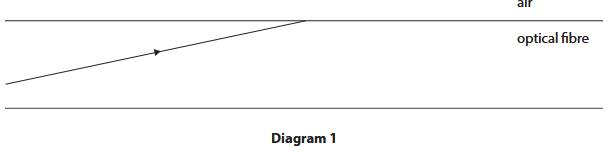
(i) The ray of light is incident at the boundary between the optical fibre and air.
The ray of light reflects at the boundary.
Complete diagram 1 by drawing the reflected ray of light. (2)
(ii) Explain why no light leaves the optical fibre when the light reflects at the boundary between the optical fibre and air. (3)
(c) Diagram 2 shows a different ray of light, incident on the boundary between water and air.
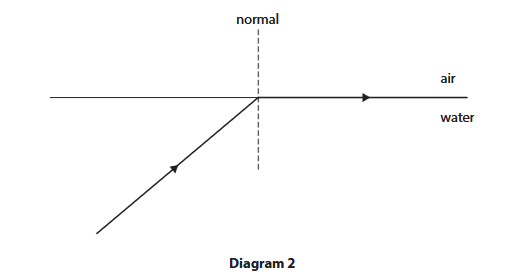
Using diagram 2, show that the refractive index of water is approximately \(1.3\). (4)
Syllabus Topic Codes (Edexcel International GCSE Physics 4PH1):
• 3.14–3.16: Light as a transverse wave, reflection and ray diagrams — parts (a) and (b)(i)
• 3.20–3.21: Total internal reflection and critical angle — part (b)(ii)
• 3.18: Refractive index, angle of incidence and angle of refraction — part (c)
▶️ Answer/Explanation
(a) Transverse wave [2 marks]
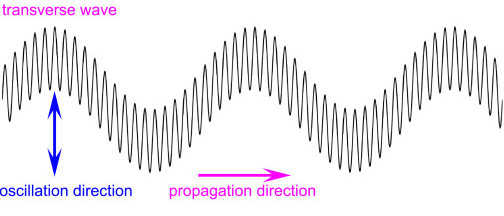
- A transverse wave consists of vibrations or oscillations.
- The vibrations are perpendicular to the direction of travel of the wave or the direction of energy transfer.
Therefore, the angle between the direction of vibration and the direction of travel is \(90^\circ\).
(b)(i) Reflected ray [2 marks]
- Draw a reflected ray travelling back into the optical fibre.
- The angle of reflection should be approximately equal to the angle of incidence:
\(\boxed{\mathrm{angle\ of\ reflection}=\mathrm{angle\ of\ incidence}}\)
(b)(ii) Total internal reflection [3 marks]
- Air has a lower refractive index than the material of the optical fibre.
- The angle of incidence is greater than the critical angle.
- Therefore, the light undergoes total internal reflection and remains inside the optical fibre.
Total internal reflection occurs when light travels from a more optically dense medium to a less optically dense medium and the angle of incidence is greater than the critical angle.
(c) Refractive index of water [4 marks]
1. Measure the angle of incidence:
From the diagram, the angle of incidence is approximately \(50^\circ\).
2. Identify the angle of refraction:
The refracted ray travels along the boundary, so the angle of refraction is \(90^\circ\).
3. Use the refractive index equation:
\(n=\dfrac{\sin i}{\sin r}\)
Since \(r=90^\circ\):
\(n=\dfrac{\sin 50^\circ}{\sin 90^\circ}\)
\(\sin 90^\circ=1\)
Therefore:
\(n=\sin 50^\circ\)
This gives the reciprocal form if the refractive index relationship is written for the water-to-air critical-angle situation. Using the critical-angle relationship:
\(\sin c=\dfrac{1}{n}\)
\(\sin 50^\circ=\dfrac{1}{n}\)
\(n=\dfrac{1}{\sin 50^\circ}\)
\(n\approx1.305\)
Final Answer: \( \boxed{n\approx1.3} \)
The angle of incidence should be measured from the normal, not from the surface.
Question
This question is about light.
(a) Light is an example of a wave.
State what is meant by the term wave. (2 marks)
________________________________________________________________________________________________
________________________________________________________________________________________________
(b) Diagram 1 shows a ray of light incident on a mirror.
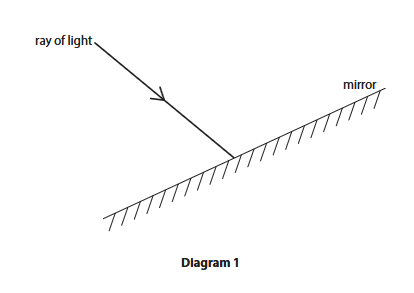
Draw another ray of light on Diagram 1 to show the path of the ray after it is incident on the mirror. (2 marks)
The reflected ray should be drawn from the point of incidence, making an angle of reflection equal to the angle of incidence.
(c) Diagram 2 shows a ray of red light entering a semi-circular glass block from the air.
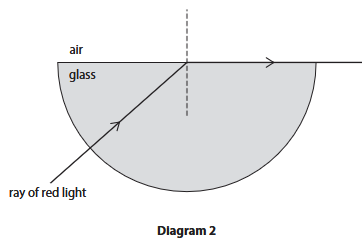
When the ray of red light is incident on the glass-air boundary, the light refracts with an angle of refraction of \(90^\circ\).
(i) Using Diagram 2, determine the critical angle for red light at the glass-air boundary. (1 mark)
critical angle = ____________________ degrees
(ii) Calculate the refractive index of the glass. (3 marks)
refractive index = ____________________
(iii) The refractive index of blue light in glass is higher than the refractive index of red light in glass.
A ray of blue light has an angle of incidence equal to the critical angle of red light.
Explain what would happen to the ray of blue light at the glass-air boundary. (3 marks)
________________________________________________________________________________________________
________________________________________________________________________________________________
________________________________________________________________________________________________
Syllabus Topic Codes (Edexcel International GCSE Physics 4PH1):
• 3.15–3.16: Law of reflection and ray diagrams — part (b)
• 3.20–3.22: Total internal reflection and critical angle — part (c)(i)
• 3.18, 3.20–3.22: Refractive index and critical angle — part (c)(ii)
• 3.20–3.22: Total internal reflection, critical angle and refractive index — part (c)(iii)
▶️ Answer/Explanation and Mark Scheme
(a) Meaning of a wave [2 marks]
- A wave is a disturbance involving vibrations or oscillations that transfers energy.
- A wave transfers energy or information without transferring matter overall.
(b) Reflection [2 marks]
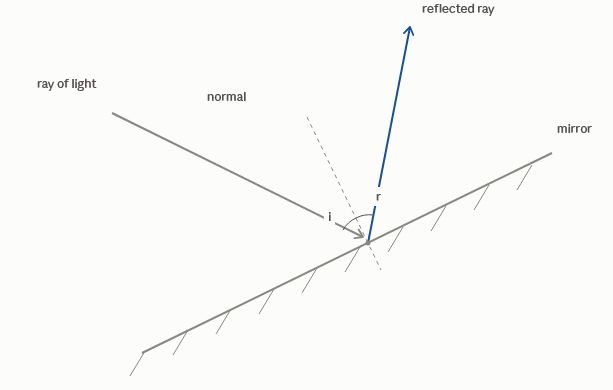
- Draw the reflected ray starting from the point of incidence.
- The angle of reflection must equal the angle of incidence: \(\boxed{i=r}\).
(c)(i) Critical angle [1 mark]
At the critical angle, the angle of refraction is \(90^\circ\).
From the diagram,
\(\boxed{c=49^\circ}\)
(c)(ii) Refractive index [3 marks]
For a glass-air boundary:
\(\sin c=\dfrac{1}{n}\)
Rearranging,
\(n=\dfrac{1}{\sin c}\)
\(n=\dfrac{1}{\sin49^\circ}\)
\(n\approx1.3\)
Answer: \( \boxed{1.3} \)
(c)(iii) Blue light at the boundary [3 marks]
- Blue light has a higher refractive index, so it has a lower critical angle than red light.
- The angle of incidence is equal to the critical angle for red light, so it is greater than the critical angle for blue light.
- Therefore, the blue light undergoes total internal reflection at the glass-air boundary.
Total: \(11\) marks
Question
The diagram shows two rays of green light entering a semicircular glass block.

(a) (i) Measure the angle of incidence and the angle of refraction for ray A as it enters the glass block.
(ii) State the formula linking refractive index, angle of incidence and angle of refraction.
(iii) Calculate the refractive index of the glass.
(b) (i) Complete the path of ray A until it crosses ray B. Label the point where the rays cross with the letter F.
(ii) The refractive index of glass for red light is lower than for green light. Explain what would happen to point F if red light were used instead of green light. You may draw a diagram to help your answer.
Syllabus Topic Codes (Edexcel International GCSE Physics 4PH1):
• 3.18: Relationship between refractive index, angle of incidence and angle of refraction — parts (a)(ii), (a)(iii)
• 3.16: Ray diagrams to illustrate refraction — parts (b)(i), (b)(ii)
• 3.18: Refractive index and the change in direction of light during refraction — part (b)(ii)
▶️ Answer/Explanation
Ans
(a) (i) angle of incidence = 40°;
angle of refraction = 23°
(ii) n = sin(i)/sin(r);
(iii) substitution of candidate’s values into formula;
e.g.
n = sin(40)/sin(23)
n = 1.6(5)
(b) (i) single ray emerges and extended to horizontal ray;
ray bends away from normal by eye;

(ii) idea that F moves away from the prism;
idea that red ray bends less than green at either interface;
idea that red ray bends less than green at both interfaces;
Questions
The diagram shows two rays of light, A and B, incident on the boundary between air and water.
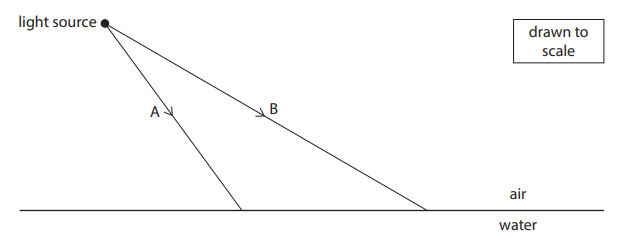
The refractive index of water is 1.33 Explain the paths of the two rays of light after they strike the boundary between air and water. Include calculations in your answer and draw on the diagram to support your answer.
Syllabus Topic Codes (Edexcel International GCSE Physics 4PH1):
• 3.16: Drawing ray diagrams to illustrate refraction — question
• 3.18: Relationship between refractive index, angle of incidence and angle of refraction — calculations
• 3.21–3.22: Critical angle and total internal reflection in relation to refractive index — question
▶️Answer/Explanation
Ans
any six from:
MP1. ray A is refracted and changes direction;
MP2. ray B is refracted and changes direction;
MP3. correctly measured angle of incidence for either ray;
MP4. correctly calculated angle of refraction for either ray A or ray B;
MP5. water and air have different (optical) densities;
MP6. light travels slower in water than air;
MP7. TIR does not happen because water is more (optically) dense than air;
Questions
This question is about optical fibres.
(a) Optical fibres use light waves for communication. Which of these is a correct statement about waves?
A waves transfer energy, information and matter
B waves do not transfer energy, information, or matter
C waves transfer energy without transferring information or matter
D waves transfer energy and information without transferring matter
(b) A ray of light passes from air into a glass optical fibre. Diagram 1 shows the path of the ray of light after it has passed through the boundary between air and the optical fibre.
(i) Draw the path of the ray of light in air before it passed through the boundary.

(ii) State the name of the wave behaviour responsible for the path of the ray of light as it passes from air into the optical fibre.
(c) Diagram 2 shows the path of the ray of light as it travels through the optical fibre.

Explain the path of the ray of light as it travels through the optical fibre.
Syllabus Topic Codes (Edexcel International GCSE Physics 4PH1):
• 3.9: Reflection and Refraction of Waves — parts (b)(i) and (b)(ii)
• 3.20–3.22: Total Internal Reflection, Critical Angle, and Refractive Index — part (c)
▶️ Answer/Explanation
(a) Wave behaviour [1 mark]
Answer: D, waves transfer energy and information without transferring matter.
- A is incorrect because waves do not transfer matter from one place to another.
- B is incorrect because waves transfer energy and can transfer information.
- C is incorrect because waves can also transfer information.
(b)(i) Ray entering the optical fibre [1 mark]
The incident ray should be drawn so that, on entering the glass core from air, it bends towards the normal.

(b)(ii) Wave behaviour [1 mark]
The wave behaviour responsible for the change in direction is refraction.
(c) Light travelling through the optical fibre [3 marks]
- The ray undergoes total internal reflection at the boundary between the core and the surrounding material.
- The core has a higher refractive index than the surrounding material, such as air.
- The angle of incidence is greater than the critical angle.
Therefore, the light is repeatedly reflected inside the optical fibre and remains within the fibre, allowing it to travel along the fibre.
Questions
Ground-penetrating radar (GPR) uses radio waves to detect changes in material underground.
(a)
(i) State the formula linking the speed, frequency and wavelength of a wave. (1)
(ii) GPR radio waves have a frequency of \(170\,\mathrm{MHz}\). The speed of radio waves is \(3.0\times10^8\,\mathrm{m\,s^{-1}}\). Calculate the wavelength of the waves. (3)
(b)
(i) A radio wave passes through the ground and refracts at the boundary between soil and rock. The diagram shows three wavefronts of the wave before and after refraction. The wave is also reflected at the boundary between the soil and the rock. Complete the diagram to show three wavefronts after the wave has been reflected at the boundary.

(ii) Explain why the radio waves passing through the rock have a smaller wavelength than the radio waves passing through the soil. (3)
Syllabus Topic Codes (Edexcel International GCSE Physics 4PH1):
• 3.8–3.9: Reflection and Refraction of Waves — part (b)(i)
• 3.9: Refraction of Waves and Changes in Wave Speed and Wavelength — part (b)(ii)
▶️ Answer/Explanation
(a)(i) Wave equation [1 mark]
The formula linking wave speed, frequency and wavelength is:
\(\boxed{v=f\lambda}\)
(a)(ii) Wavelength of the radio waves [3 marks]
Use:
\(v=f\lambda\)
Rearrange:
\(\lambda=\dfrac{v}{f}\)
Convert the frequency into hertz:
\(170\,\mathrm{MHz}=170\times10^6\,\mathrm{Hz}\)
Substitute:
\(\lambda=\dfrac{3.0\times10^8}{170\times10^6}\)
\(\lambda\approx1.76\,\mathrm{m}\)
Therefore:
\(\boxed{\lambda\approx1.8\,\mathrm{m}}\)
(b)(i) Reflected wavefronts [3 marks]
- Draw three reflected wavefronts to the right of the normal and above the rock.
- The wavefronts should be perpendicular to the direction of the reflected wave.
- The wavefronts should be parallel and equally spaced, with spacing consistent with the incident wave.
The reflected wave obeys the law of reflection, so the angle of reflection is equal to the angle of incidence.

(b)(ii) Smaller wavelength in rock [3 marks]
- The wavefronts are closer together in the rock, showing that the wavelength is smaller.
- Rock is optically denser than soil, so the wave travels more slowly in rock.
- The frequency remains constant when the wave passes from one medium to another.
Using \(v=f\lambda\), if \(f\) remains constant and \(v\) decreases, then \(\lambda\) must also decrease.
\(\boxed{v=f\lambda}\)
Questions
This question is about a filament lamp.
(a) Which of these is the correct circuit symbol for a filament lamp?

(b) The filament lamp emits visible light. The table gives some statements about visible light. Place ticks (✓) in the boxes to show which statements are correct for visible light.

(c) The diagram shows a ray of light from the filament lamp incident on the reflective side of a curved mirror.

Complete the diagram by drawing
(i) the normal line where the ray is incident on the mirror.
(ii) the reflected ray of light.
(d) The filament lamp is connected in a circuit with a switch and a battery of three cells.

(i) When the switch is on, the filament lamp transfers \(120\,\mathrm{J}\) of energy in a time of \(3.0\,\mathrm{minutes}\). Each cell has a voltage of \(1.5\,\mathrm{V}\). Calculate the current in the filament lamp.
(ii) A small plotting compass is placed near the wires in the circuit. When the switch is turned on, the compass needle moves to a new position. Give a reason why the compass needle moves.
Syllabus Topic Codes (Edexcel International GCSE Physics 4PH1):
• 3.10–3.12: The Electromagnetic Spectrum and Uses of Electromagnetic Waves — part (b)
• 3.15–3.16: Law of Reflection and Ray Diagrams — part (c)
• 2.4–2.5: Power, Current, Voltage, and Electrical Energy Transfer — part (d)(i)
• 6.8: Electromagnetism — part (d)(ii)
▶️ Answer/Explanation
(a) Filament lamp circuit symbol

The correct symbol is the filament lamp symbol shown in the answer image.
A is incorrect because it is an LED.
C is incorrect because it is a motor.
D is incorrect because it is an LDR.
(b) Visible light

The ticks shown in the answer image identify the statements that correctly describe visible light.
(c) Reflection from a curved mirror
(i) Draw the normal at the point of incidence. The normal must be perpendicular to the mirror surface at that point.
(ii) Draw the reflected ray on the other side of the normal so that:
\(\boxed{\mathrm{angle\ of\ reflection}=\mathrm{angle\ of\ incidence}}\)

(d)(i) Current in the filament lamp
The three cells are connected in series, so the total voltage is:
\(V=3\times1.5=4.5\,\mathrm{V}\)
Convert the time into seconds:
\(t=3.0\times60=180\,\mathrm{s}\)
Use the electrical energy equation:
\(E=IVt\)
Rearranging:
\(I=\dfrac{E}{Vt}\)
\(I=\dfrac{120}{4.5\times180}\)
\(I=0.148\ldots\,\mathrm{A}\)
\(\boxed{I=0.15\,\mathrm{A}}\)
(d)(ii) Effect on the plotting compass
When the switch is turned on, current flows through the wire. A current-carrying conductor produces a magnetic field around it.
The magnetic field interacts with the magnetic field of the compass, causing the compass needle to move.
Question
This is a question about reflection.
(a) Which diagram shows a light ray correctly reflected from a mirror?

(b) Name the equipment needed to measure the angle of incidence on a ray diagram.
(c) Light from a laser on the Earth reflects off special mirrors on the Moon. The graph shows the data from a light sensor attached to the laser. The first peak shows when the light leaves the laser and the second peak shows when the light has returned from the Moon.

(i) Determine the time taken for the light to travel from the Earth to the Moon and back again.
(ii) The speed of light is \(3.0\times10^5\,\mathrm{km\,s^{-1}}\). Calculate the total distance travelled by the light from the laser.
[average speed = distance moved ÷ time taken]
(iii) Calculate the distance from the Earth to the Moon.
Syllabus Topic Codes (Edexcel International GCSE Physics 4PH1):
• 8.2: The Universe, Galaxies, and Solar Systems — part (c)
• 8.6: Orbital Speed, Radius, and Time Period — part (c)(i)–(iii) calculation of distance using speed and time
▶️ Answer/Explanation
(a) Correct reflection [1 mark]
The correct diagram is C.
- The angle of reflection is equal to the angle of incidence.
- The reflected ray remains in the same medium and does not pass into the mirror.
(b) Measuring angle of incidence [1 mark]
A protractor is used to measure the angle of incidence on a ray diagram.
(c)(i) Time taken [1 mark]
The time taken is found from the difference between the times of the two peaks on the graph.
\(\boxed{t=2.5\,\mathrm{s}}\)
(c)(ii) Total distance travelled [2 marks]
Use:
\(\mathrm{distance}=\mathrm{speed}\times\mathrm{time}\)
Substitute \(v=3.0\times10^5\,\mathrm{km\,s^{-1}}\) and \(t=2.5\,\mathrm{s}\):
\(d=(3.0\times10^5)\times2.5\)
\(d=7.5\times10^5\,\mathrm{km}\)
Therefore: \(\boxed{d=750\,000\,\mathrm{km}}\)
(c)(iii) Distance from Earth to Moon [1 mark]
The light travels from Earth to the Moon and then back to Earth, so the Earth-Moon distance is half of the total distance.
\(\mathrm{distance}=\dfrac{750\,000}{2}\)
Therefore: \(\boxed{375\,000\,\mathrm{km}}\)
Question
The diagram shows the path of a ray of light.

(a)(i) Measure the angle of incidence for the ray at point K. Which of these is the angle of incidence?
A \(43^\circ\)
B \(47^\circ\)
C \(51^\circ\)
D \(55^\circ\)
(ii) State the formula linking refractive index, angle of incidence and angle of refraction.
(iii) The block has a refractive index of \(1.52\). Use the formula to show that the angle of refraction is about \(30^\circ\) for the ray at point K.
(b)(i) The refractive index of the block is \(1.52\). Calculate the critical angle of the block.
(ii) State what happens to the ray at point L.
Syllabus Topic Codes (Edexcel International GCSE Physics 4PH1):
• 3.18: Refractive Index — parts (a)(ii)–(iii) and (b)(i)
• 3.20–3.22: Total Internal Reflection, Critical Angle, and Refractive Index — parts (b)(i)–(ii)
▶️ Answer/Explanation
(a)(i) Angle of incidence [1 mark]
The angle of incidence is measured between the incident ray and the normal at point K.
From the diagram, the angle is approximately \(51^\circ\).
Therefore, the correct answer is C, \(51^\circ\).
(a)(ii) Refractive index formula [1 mark]
The relationship is:
\(\boxed{n=\dfrac{\sin i}{\sin r}}\)
(a)(iii) Angle of refraction [3 marks]
Use:
\(n=\dfrac{\sin i}{\sin r}\)
Substitute \(n=1.52\) and \(i=51^\circ\):
\(1.52=\dfrac{\sin51^\circ}{\sin r}\)
Rearranging:
\(\sin r=\dfrac{\sin51^\circ}{1.52}\)
\(\sin r\approx0.511\)
\(r=\sin^{-1}(0.511)\)
\(r\approx30.7^\circ\)
Therefore: \(\boxed{r\approx31^\circ}\), which is approximately \(30^\circ\).
(b)(i) Critical angle [3 marks]
For the critical angle:
\(\sin c=\dfrac{1}{n}\)
Substitute \(n=1.52\):
\(\sin c=\dfrac{1}{1.52}\)
\(c=\sin^{-1}\left(\dfrac{1}{1.52}\right)\)
\(c\approx41.1^\circ\)
Therefore: \(\boxed{c\approx41^\circ}\)
(b)(ii) Ray at point L [1 mark]
The angle of incidence at L is greater than the critical angle. Therefore, the ray undergoes total internal reflection and is reflected back into the block.
Question
The diagram shows the forces acting on a firework at take-off.

(a)(i) Calculate the magnitude of the resultant force on the firework.
(ii) State the formula linking resultant force, mass and acceleration.
(iii) The mass of the firework is \(160\,\mathrm{g}\). Calculate the acceleration of the firework.
(iv) Explain how the acceleration of the firework changes between take-off and running out of fuel. You can assume that the thrust force stays the same as the firework burns the fuel.
(b) The firework makes a sound with constant frequency. As the firework moves upwards, people on the ground notice that the frequency of the sound they hear changes. This is called the Doppler effect. Explain how the Doppler effect causes the observed frequency of sound to change for the people on the ground.
Syllabus Topic Codes (Edexcel International GCSE Physics 4PH1):
• 1.6: Acceleration — parts (a)(ii)–(iii)
• 1.17–1.18: Force, Mass, Weight, and Gravitational Field Strength — part (a)(iv)
• 1.21: Forces on Falling Objects and Terminal Velocity — part (a)(iv), considering changing forces and acceleration
• 3.8: Doppler Effect — part (b)
▶️ Answer/Explanation
(a)(i) Resultant force [1 mark]
The resultant force is found by subtracting the downward force from the upward thrust force shown in the diagram.
\(\boxed{F_{\mathrm{resultant}}=26.4\,\mathrm{N}}\)
(a)(ii) Resultant force equation [1 mark]
The formula linking resultant force, mass and acceleration is:
\(\boxed{F=ma}\)
(a)(iii) Acceleration of the firework [3 marks]
First convert the mass into kilograms:
\(160\,\mathrm{g}=0.16\,\mathrm{kg}\)
Rearrange \(F=ma\) to give:
\(a=\dfrac{F}{m}\)
Substitute \(F=26.4\,\mathrm{N}\) and \(m=0.16\,\mathrm{kg}\):
\(a=\dfrac{26.4}{0.16}\)
\(a=165\,\mathrm{m\,s^{-2}}\)
Therefore: \(\boxed{a=165\,\mathrm{m\,s^{-2}}}\)
(a)(iv) Change in acceleration [3 marks]
- As the firework burns fuel, its mass decreases, so its weight decreases.
- As the firework moves faster, air resistance increases.
- Therefore, the resultant force changes, causing the acceleration to change.
Since the thrust remains constant, the changing mass and increasing air resistance affect the resultant force and therefore the acceleration.
(b) Doppler effect [4 marks]
- The observed frequency decreases as the firework moves away from the people on the ground.
- The speed of the sound waves through the air remains approximately constant.
- As the firework moves away, the wavefronts behind the firework become more spread out.
- This causes the wavelength reaching the observers to increase.
Using the wave equation:
\(f=\dfrac{v}{\lambda}\)
Since \(v\) remains constant while \(\lambda\) increases, the observed frequency \(f\) decreases.
Question
A car is travelling in a straight line along a road. The car passes a person standing at the side of the road.

Before passing the person, the driver of the car presses the car’s horn. The horn makes a loud sound of constant frequency. The horn continues to make a sound until after the car has passed the person.
Discuss the differences in the frequencies of the sound heard by
- the driver of the car
- the person at the side of the road
Syllabus Topic Codes (Edexcel International GCSE Physics 4PH1):
▶️ Answer/Explanation
Doppler effect [6 marks]
For the driver:
- The frequency heard by the driver does not change.
- There is no relative movement between the driver and the horn because both are moving together.
For the person at the side of the road:
- The Doppler effect occurs because the car and the observer have relative motion.
- The frequency heard by the person is different from the frequency heard by the driver.
- As the car approaches, the observed frequency is higher.
- The wavefronts become closer together, so the wavelength decreases.
- As the car moves away, the observed frequency is lower.
- The wavefronts become further apart, so the wavelength increases.
- The speed of sound in the air remains approximately constant.
Using the wave equation:
\(v=f\lambda\)
Since the speed of sound \(v\) remains constant, a decrease in wavelength corresponds to an increase in frequency, while an increase in wavelength corresponds to a decrease in frequency.