
Edexcel iGCSE Physics (4PH1) 4.2 Energy Transfers Exam Style Question Paper 1B - New Syllabus
Question
A student does an experiment to investigate energy transfer by conduction.
(a) The student plans to use the piece of apparatus shown in the photograph.
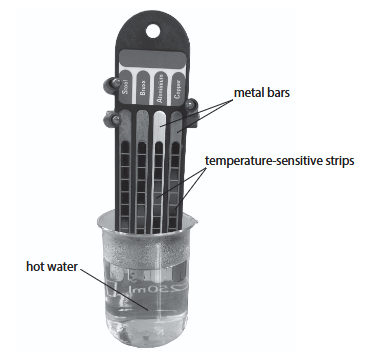
The apparatus has four bars made from different metals.
When the apparatus is placed in hot water, energy is transferred from the bottom of the bar to the top of the bar. The temperature-sensitive strip on each bar changes colour as the temperature of the bar changes.
The time taken for the colour change to reach the top of the bar can be used to compare how effective each metal is at transferring energy by conduction.
(i) Give three control variables in the student’s investigation. (3)
1. ________________________________________________________________
2. ________________________________________________________________
3. ________________________________________________________________
(ii) The student has this equipment:
- beaker
- hot water
- stopclock
- clamp and clamp stand
Design a method the student could use to compare the effectiveness of the metals at transferring energy by conduction.
You may draw a diagram to help your answer. (5)
(b) The table shows the results of the student’s investigation.
| Metal | Time taken for colour change in seconds |
|---|---|
| aluminium | \(29\) |
| brass | \(64\) |
| copper | \(22\) |
| steel | \(115\) |
(i) Plot a bar chart of the student’s results. (3)

(ii) Deduce which metal is the most effective at transferring energy by conduction. (2)
Syllabus Topic Codes (Edexcel International GCSE Physics 4PH1):
• 1.8–1.10: Experimental methods, control variables and processing results — parts (a)(i), (a)(ii) and (b)(i)
▶️ Answer/Explanation
(a)(i) Control variables [3 marks]
Any three valid control variables:
- Length of each metal bar
- Width of each metal bar
- Thickness of each metal bar
- Initial temperature of each bar
- Depth of each bar placed in the hot water
- Temperature of the hot water
The important point is that the physical dimensions and starting conditions should be kept the same so that the metal is the main variable being investigated.
(a)(ii) Experimental method [5 marks]
- Support the apparatus securely using the clamp and clamp stand.
- Place the apparatus into the hot water and start the stopclock at the same time.
- Measure the time taken for the temperature-sensitive strip to show the colour change at the top of each bar.
- Allow the apparatus to cool before repeating the experiment.
- Repeat the measurements and calculate a mean time for each metal. The metal with the shortest mean time transfers energy most effectively by conduction.
The bars should be kept at the same depth in the water and exposed to the same initial conditions for a fair comparison.
(b)(i) Bar chart [3 marks]
The bar chart should have:
- A suitable linear scale for time, occupying at least half of the available grid.
- Clearly labelled axes, including time in \(\mathrm{s}\).
- Four bars plotted at the correct values:
| Metal | Time / \(\mathrm{s}\) |
|---|---|
| Aluminium | \(29\) |
| Brass | \(64\) |
| Copper | \(22\) |
| Steel | \(115\) |
(b)(ii) Most effective metal [2 marks]
Correct Answer: \( \boxed{\mathrm{copper}} \)
Copper has the shortest time for the colour change to reach the top of the bar:
\(\mathrm{time}=22\,\mathrm{s}\)
A shorter time means energy is transferred from the hot water through the bar more quickly.
Final Answer: Copper is the most effective metal because it transfers energy by conduction in the shortest time.
Question
(a) The diagrams show a spring hanging from a nail.
- diagram 1 shows the spring with no weight added
- diagram 2 shows the spring stationary, after a weight has been added
- diagram 3 shows the spring after the weight has been pulled down
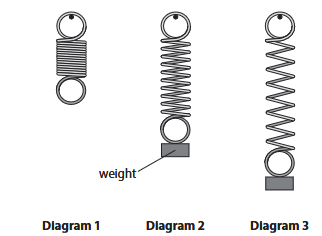
(i) Which energy store has increased for the spring in diagram 2 compared to the spring in diagram 1? (1)
A chemical
B elastic
C gravitational potential
D kinetic
(ii) The spring is released from the position shown in diagram 3.
Describe the energy transfers that take place until the spring stops vibrating. (6)
(b) Shock absorbers containing springs are used on motorcycles.
Shock absorbers are designed to compress and expand as the motorcycle moves across a rough surface.
A new type of shock absorber has been developed to generate electricity from the movement of the motorcycle.
This new type of shock absorber consists of magnets that slide inside a coil when the motorcycle goes over a bump.
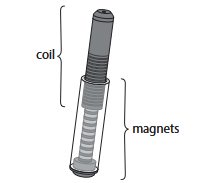
Some of the energy that would normally be wasted can be recovered, so fuel is saved.
(i) Which of these statements best describes the advantage of this new type of shock absorber? (1)
A it increases the energy transferred to a thermal store from the fuel
B it increases the efficiency of the motorcycle
C it decreases the speed of the motorcycle
D it decreases the braking power of the motorcycle
(ii) Explain how this new type of shock absorber can generate electricity. (3)
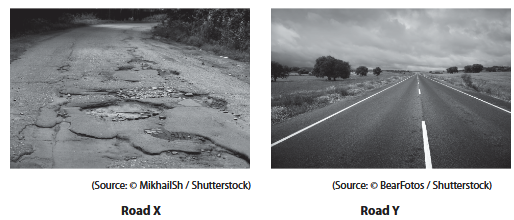
(iii) Road X has a rough surface.
Road Y has a smooth surface.
A motorcycle travels at the same speed along road X and road Y.
Explain why the new type of shock absorber will generate more electricity for this motorcycle on road X than on road Y. (3)
Syllabus Topic Codes (Edexcel International GCSE Physics 4PH1):
• 4.3: Conservation of energy — part (a)(ii)
• 6.15: Electromagnetic induction and induced voltage — parts (b)(ii) and (b)(iii)
• 6.16: Generation of electricity by electromagnetic induction — parts (b)(ii) and (b)(iii)
▶️ Answer/Explanation
(a)(i) Correct Answer: \( \boxed{\mathrm{B\ (elastic)}} \) [1 mark]
Adding the weight stretches the spring, so the energy in the elastic store of the spring increases.
For a spring, the elastic energy store can be related to its extension by \(E_{\mathrm{elastic}}=\dfrac{1}{2}kx^2\), where \(k\) is the spring constant and \(x\) is the extension.
(a)(ii) Energy transfers until the spring stops vibrating [6 marks]
- When the spring is released, its elastic energy store decreases as the spring moves upwards.
- Energy is transferred to the kinetic store of the weight and spring as they accelerate upwards.
- The gravitational potential energy store increases as the weight moves upwards.
- At the highest point, the motion reverses and the weight moves downwards, so gravitational potential energy is transferred to the kinetic store.
- As the spring moves downwards again, energy is transferred mechanically back into the elastic store of the spring.
- The amplitude of the vibrations decreases because energy is transferred to the thermal store of the spring and surroundings, mainly due to friction and air resistance.
Eventually, the vibrations stop and the energy initially stored in the spring has been transferred mainly to the thermal store of the spring and its surroundings.
Key principle: Energy is not destroyed. It is transferred between different energy stores.
(b)(i) Advantage of the new shock absorber [1 mark]
Correct Answer: \( \boxed{\mathrm{B\ it\ increases\ the\ efficiency\ of\ the\ motorcycle}} \)
Some energy that would otherwise be wasted is recovered and converted into useful electrical energy, so the overall efficiency increases.
(b)(ii) Generating electricity [3 marks]
- The magnets move through the coil when the shock absorber moves.
- The moving magnets cause the coil to cut magnetic field lines, so the magnetic field through the coil changes.
- An induced voltage is produced in the coil, which can cause a current to flow and generate electrical energy.
This is an example of electromagnetic induction.
(b)(iii) Why more electricity is generated on Road X [3 marks]
- Road X has a rougher surface, so there are more frequent and/or larger bumps.
- The shock absorber therefore compresses and expands more frequently and/or by a greater amount.
- The magnets move through the coil more frequently and/or over a greater distance, producing a larger or more frequent induced voltage and therefore more electrical energy.
The key idea is that greater movement of the magnets through the coil produces a greater amount of electromagnetic induction.
Final Answer: Road X causes more movement of the magnets through the coil, so the magnetic field through the coil changes more frequently and/or by a greater amount. This produces more induced voltage and therefore more electricity.
Question
Two students do an experiment to determine their power when running up a set of steps.
The diagram shows how they set up their experiment. Not all of the steps are shown in the diagram.
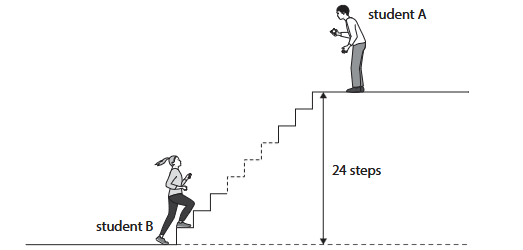
This is the students’ method.
- student A stands with a stopwatch at the top of the steps
- student A starts timing on the stopwatch and shouts “go” at the same time
- student B begins to run up the steps when she hears student A shout
- student A stops timing when student B reaches the top of the steps
The students repeat their method two more times.
(a) Give a reason why the times recorded may not be accurate. (1)
(b) There are \(24\) steps in total and each step has a height of \(19\,\mathrm{cm}\).
(i) Student B has a mass of \(67\,\mathrm{kg}\).
Show that student B gains about \(3000\,\mathrm{J}\) of energy in her gravitational store when she runs up the set of steps. (3)
(ii) The table shows the times recorded for student B.
| Time in \(\mathrm{s}\) |
|---|
| \(4.28\) |
| \(4.95\) |
| \(4.65\) |
Calculate the mean time from this data.
Give your answer to three significant figures. (2)
mean time = __________________ \(\mathrm{s}\)
(iii) Calculate the mean power of student B transferring energy to her gravitational store as she runs up the steps. (2)
(c) The students extend their investigation by calculating the power for students of different masses running up the steps.
The graph shows their results.
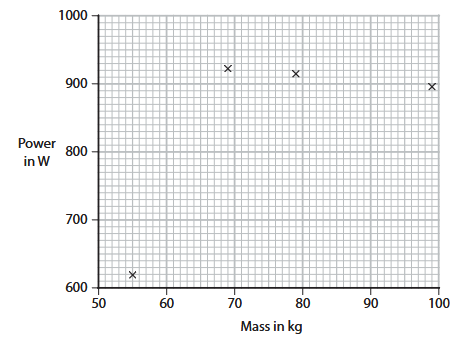
The students conclude that the greater the mass of the person, the greater the power of the person when running up the steps.
Comment on the students’ conclusion. (4)
Syllabus Topic Codes (Edexcel International GCSE Physics 4PH1):
• 4.16–4.17: Power, energy and time — parts (b)(iii) and (c)
• 4.3: Conservation of energy — relevant to the energy transferred to the gravitational store in part (b)(i)
▶️ Answer/Explanation
(a) Accuracy of timing [1 mark]
Student A and student B have reaction times, causing a delay between the stopwatch being started and student B beginning to run.
Final Answer: Human reaction time can cause an error in starting or stopping the stopwatch.
(b)(i) Gravitational potential energy [3 marks]
1. Use the equation:
\(E_{\mathrm{p}}=mgh\)
2. Calculate the total vertical height:
\(h=24\times0.19=4.56\,\mathrm{m}\)
3. Substitute the values:
\(E_{\mathrm{p}}=67\times9.81\times4.56\)
\(E_{\mathrm{p}}=2994\,\mathrm{J}\)
Therefore, \(E_{\mathrm{p}}\approx3000\,\mathrm{J}\).
Final Answer: \( \boxed{3.0\times10^3\,\mathrm{J}} \)
(b)(ii) Mean time [2 marks]
1. Add the three recorded times:
\(t_{\mathrm{total}}=4.28+4.95+4.65=13.88\,\mathrm{s}\)
2. Divide by the number of readings:
\(t_{\mathrm{mean}}=\dfrac{13.88}{3}=4.626\ldots\,\mathrm{s}\)
To three significant figures:
\(t_{\mathrm{mean}}=4.63\,\mathrm{s}\)
Final Answer: \( \boxed{4.63\,\mathrm{s}} \)
(b)(iii) Mean power [2 marks]
1. Use the equation:
\(P=\dfrac{E}{t}\)
2. Substitute the energy and mean time:
\(P=\dfrac{3055.2}{4.63}\)
\(P\approx660\,\mathrm{W}\)
Final Answer: \( \boxed{660\,\mathrm{W}} \)
(c) Comment on the students’ conclusion [4 marks]
The conclusion is not fully supported by the data.
- There are not enough data points to make a reliable conclusion.
- A greater range of masses should be tested.
- More measurements should be taken for each mass to improve the reliability of the results.
- The first two points suggest a possible weak positive correlation, but the final three points have approximately the same power.
- The first data point could be an anomaly.
- If the first point is considered anomalous, the data may suggest a weak negative correlation rather than a positive one.
- The final three points suggest that power could be independent of mass over that range.
- The person with the greatest mass does not have the greatest power.
Final Answer: The data do not provide sufficient evidence for the students’ conclusion. More masses and repeated measurements are needed. The graph shows considerable variation, and the greatest mass does not produce the greatest power.
Question
The diagram shows apparatus that can be used to demonstrate convection currents.
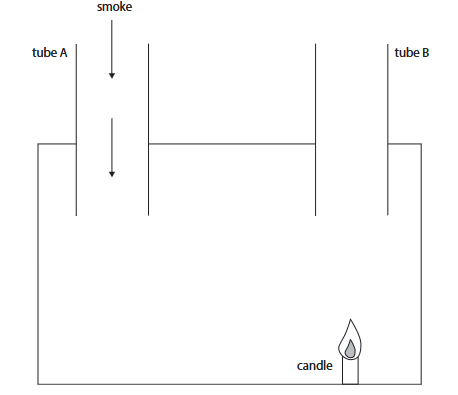
The apparatus consists of a box with two tubes, A and B, that allow air to enter and leave the box.
During the demonstration, a candle is placed inside the box directly underneath tube B.
A source of smoke is placed above tube A.
Using ideas about convection, explain why the smoke moves down into the box through tube A.
You may add to the diagram to help your answer. (5 marks)
________________________________________________________________________________________________
Syllabus Topic Codes (Edexcel International GCSE Physics 4PH1):
▶️ Answer/Explanation and Mark Scheme
Convection currents [5 marks]
- The candle heats the air underneath tube B.
- The heated air expands.
- The density of the heated air decreases.
- The hot air rises through tube B.
- Cooler air is drawn into the box through tube A to replace the air that has left, carrying the smoke downwards.
The process then repeats, producing a convection current.
Marking: Award up to \(5\) marks for any five correct points.
Question
Air is trapped in a boiling tube by sealing the boiling tube with a rubber bung. The boiling tube is placed in a beaker containing hot water.

(a) Energy is transferred from the thermal store of the water to the thermal store of the air in the boiling tube with an efficiency of 16%. The air in the boiling tube gains 1800 J of energy during this process. This is defined as the useful energy transfer. Calculate the amount of energy wasted during this process.
(b) Give two ways that the apparatus could be modified to improve the efficiency of the energy transfer.
Syllabus Topic Codes (Edexcel International GCSE Physics 4PH1):
▶️ Answer/Explanation
Ans
(a) substitution into given equation,
\(efficiency = \frac{useful \ output \ energy } {total \ output \ energy}(\times 100 \%)\);
rearrangement;
evaluation of total output energy;
evaluation of wasted energy;
e.g.
0.16 = 1800/total output
total output = 1800 / 0.16
total output = 11250 (J)
(wasted energy = 11250 – 1800 =) 9500 (J)
(b) any two from: 2
MP1. wrap beaker in insulation;
MP2. cover top of beaker;
MP3. fully immerse boiling tube in water;
MP4. shiny outer layer to the beaker;
MP5. use a thinner (walled) boiling tube
MP6. use a better conducting boiling tube
Questions
A student pours a known volume of hot water into a metal container. They place the metal container into an insulated plastic cup containing an equal volume of cold water.

The student uses temperature probes to measure the temperatures of both the water in the metal container and the water in the plastic cup. The hot water has an initial temperature of \(70^\circ\mathrm{C}\) and the cold water has an initial temperature of \(5^\circ\mathrm{C}\).
(a) On the axes, sketch how the temperature of the hot water and the temperature of the cold water vary with time. (4)

(b) Explain why the temperatures of the hot water and the cold water change. You should refer to different types of thermal energy transfer in your answer. (4)
(c) Explain how placing a lid on the plastic cup would affect the results. (3)
Syllabus Topic Codes (Edexcel International GCSE Physics 4PH1):
• 4.8: Radiation, Absorption, and Emission — part (b)
• 4.9: Core Practical: Thermal Energy Transfer — parts (a) and (b)
• 4.10: Reducing Unwanted Energy Transfer — part (c)
▶️ Answer/Explanation
(a) Temperature-time graph [4 marks]
The sketch should show:
- The temperature of the hot water decreases from \(70^\circ\mathrm{C}\).
- The temperature of the cold water increases from \(5^\circ\mathrm{C}\).
- Both curves should be smoothly curved, with the rate of temperature change decreasing with time.
- The two curves should approach the same intermediate equilibrium temperature.
The curves become closer together as thermal equilibrium is approached because the temperature difference between the two bodies becomes smaller.
(b) Thermal energy transfer [4 marks]
- The hot water loses thermal energy while the cold water gains thermal energy.
- Thermal energy is transferred from the hot water to the cold water because there is a temperature difference.
- Thermal energy is transferred mainly by conduction through the metal container.
- The transfer of thermal energy between the two water samples stops when they reach thermal equilibrium.
Some thermal energy may also be transferred to the surroundings by convection, evaporation, and radiation. The insulated plastic cup reduces unwanted thermal energy transfer to the surroundings.
(c) Effect of placing a lid on the cup [3 marks]
- A lid reduces thermal energy transfer by convection and also reduces energy loss from the surface by evaporation.
- Less thermal energy is lost to the surroundings, so the final equilibrium temperature will be higher than without the lid.
- The system will take longer to cool towards room temperature because the rate of unwanted thermal energy transfer is reduced.
Overall, the lid makes the experiment more thermally insulated and reduces unwanted energy transfer to the surroundings.
Questions
The circuit diagram shows a motor, power supply, switch and variable resistor connected in series.

(a) The switch is open and the motor is not moving. State how much energy is in the kinetic energy store of the motor. (1)
(b) The switch is closed. The motor takes \(0.42\,\mathrm{s}\) to reach its maximum speed of rotation. The mean current in the motor is \(3.9\,\mathrm{A}\). The voltage across the motor is \(7.1\,\mathrm{V}\). Show that the work done on the motor during the \(0.42\,\mathrm{s}\) is about \(12\,\mathrm{J}\). (3)
(c) Complete the Sankey diagram for the electric motor during the \(0.42\,\mathrm{s}\) by giving the missing information.

(d) Use the Sankey diagram to calculate the efficiency of the process of bringing the motor to its maximum speed of rotation. (3)
Syllabus Topic Codes (Edexcel International GCSE Physics 4PH1):
• 4.5: Energy Transfers in Devices and Sankey Diagrams — parts (b) and (c)
• 4.4: Efficiency — part (d)
▶️ Answer/Explanation
(a) Kinetic energy store [1 mark]
The motor is not moving, so its kinetic energy is zero.
\(\boxed{0\,\mathrm{J}}\)
(b) Work done on the motor [3 marks]
The electrical energy transferred to the motor can be calculated using:
\(E=VIt\)
Substitute the values:
\(E=7.1\times3.9\times0.42\)
\(E=11.6388\,\mathrm{J}\)
Therefore:
\(\boxed{E\approx12\,\mathrm{J}}\)
This is the total energy transferred electrically to the motor during the \(0.42\,\mathrm{s}\).
(c) Sankey diagram [3 marks]
The total input energy is approximately \(12\,\mathrm{J}\).
- Input: \(12\,\mathrm{J}\) of electrical energy transferred from the battery.
- Useful output: \(10\,\mathrm{J}\) transferred to the kinetic energy store of the motor.
- Wasted output: \(2\,\mathrm{J}\) transferred to the thermal store of the surroundings.
The energy is conserved because:
\(12=10+2\)
Input: \(12\,\mathrm{J}\) → useful: \(10\,\mathrm{J}\) + wasted: \(2\,\mathrm{J}\)
(d) Efficiency [3 marks]
Use the efficiency equation:
\(\mathrm{efficiency}=\dfrac{\mathrm{useful\ energy\ output}}{\mathrm{total\ energy\ input}}\times100\%\)
Substitute:
\(\mathrm{efficiency}=\dfrac{10}{12}\times100\%\)
\(\mathrm{efficiency}=83.3\%\)
Therefore:
\(\boxed{\mathrm{efficiency}\approx83\%}\)
The efficiency is less than \(100\%\) because some of the electrical energy is transferred to the surroundings, mainly as thermal energy.
Questions
A student uses this apparatus to investigate energy transfer by conduction in metals.

This is the student’s method.
- attach four strips, each made of a different metal, to a wooden ring
- use wax to attach a metal tack to the end of each metal strip
- place the strips above a Bunsen burner
- light the Bunsen burner and start a stopwatch at the same time
- when enough energy has been transferred to the wax, it melts, causing the metal tack to fall
- record the time taken for each tack to fall
(a) Explain how the wooden ring makes the apparatus safer for the student to use.
(b) Describe how energy is transferred by conduction through the metal strips.
(c) The bar chart shows the results of the student’s investigation.

(i) Justify the use of a bar chart in this investigation.
(ii) State how the student could improve the reliability of their results.
(iii) The student concludes that iron is the best metal for transferring energy by conduction. Evaluate the student’s conclusion.
Syllabus Topic Codes (Edexcel International GCSE Physics 4PH1):
• 4.9: Core Practical: Thermal Energy Transfer — parts (c)(i)–(iii)
▶️ Answer/Explanation
(a) Safety provided by the wooden ring
- There is a risk of burning from the heated apparatus.
- Wood is a thermal insulator.
- Therefore, the wooden ring does not become as hot as the metal strips and is safer to handle.
(b) Energy transfer by conduction
- Particles in the metal are able to vibrate about their fixed positions.
- Heating one end increases the energy and amplitude of the vibrations of the particles.
- These vibrations are transferred from particle to particle along the metal, transferring thermal energy from the hotter end to the cooler end.
In metallic conductors, thermal energy is also transferred by the movement of free electrons, which helps metals conduct thermal energy effectively.
(c)(i) Choice of bar chart
A bar chart is appropriate because the type of metal is a discrete/categorical variable. Each metal is a separate category, rather than a continuous numerical variable.
(c)(ii) Improving reliability
- Repeat the measurements for each metal.
- Calculate a mean time for each metal.
- Identify any anomalous results and repeat them where appropriate.
(c)(iii) Evaluating the conclusion
The conclusion is not supported by the results.
- Copper, aluminium and brass are better thermal conductors than iron.
- The tack falls sooner when thermal energy is transferred through a better conductor.
- Therefore, the metals with the shorter times are better at transferring thermal energy by conduction than iron.
Therefore, iron should not be described as the best metal for transferring energy by conduction based on these results.
Questions
The photograph shows a toy called a marble run.

A student lifts a marble from the table to the top of the marble run at point A. They release the marble from point A and it rolls through pipes to reach the bottom of the marble run at point B. The marble leaves the marble run at point B and rolls across the table. As the marble rolls, energy is transferred due to the different forces acting on the marble.
(a) Describe the energy transfers from before the student lifts the marble to when the marble reaches point B of the marble run.
(b) The student wants to measure how much energy the marble loses as it moves from point A to point B.
(i) The student needs to measure the speed of the marble as it leaves the marble run at point B. Describe a method the student could use to measure this speed.
(ii) The difference in height between point A and point B is \(0.21\,\mathrm{m}\). The mass of the marble is \(5.5\,\mathrm{g}\). The marble leaves the marble run at point B with a speed of \(0.76\,\mathrm{m\,s^{-1}}\). Calculate the energy lost by the marble as it rolls from point A to point B.
Syllabus Topic Codes (Edexcel International GCSE Physics 4PH1):
• 4.4: Gravitational Potential Energy — part (b)(ii)
• 4.5: Kinetic Energy — part (b)(ii)
• 4.10–4.11: Energy Transfer Measurements and Practical Investigations — part (b)(i)
▶️ Answer/Explanation
(a) Energy transfers
- The student transfers energy mechanically from their chemical energy store to the gravitational potential energy store of the marble as the marble is lifted.
- As the marble moves down the marble run, energy is transferred mechanically from the gravitational potential energy store to the kinetic energy store of the marble.
- Some of the energy is transferred to the thermal energy stores of the marble, marble run and surroundings because of resistive forces.
- Some energy is also transferred to the surroundings by radiation.
Therefore, not all of the gravitational potential energy becomes kinetic energy because some energy is dissipated to the surroundings.
(b)(i) Measuring the speed at point B
Method 1:
- Allow the marble to roll across the table for a known distance.
- Measure the time taken for the marble to travel this distance using a stopwatch.
- Calculate the speed using:
\(\mathrm{speed}=\dfrac{\mathrm{distance}}{\mathrm{time}}\)
Alternative: Use a light gate connected to a data logger, positioned so that the marble interrupts the light beam as it passes point B.
(b)(ii) Energy lost by the marble
First convert the mass into kilograms:
\(m=5.5\,\mathrm{g}=0.0055\,\mathrm{kg}\)
Gravitational potential energy at A:
\(\mathrm{GPE}=mgh\)
\(\mathrm{GPE}=0.0055\times10\times0.21\)
\(\mathrm{GPE}=0.01155\,\mathrm{J}\)
Kinetic energy at B:
\(\mathrm{KE}=\dfrac{1}{2}mv^2\)
\(\mathrm{KE}=\dfrac{1}{2}\times0.0055\times0.76^2\)
\(\mathrm{KE}=0.00159\,\mathrm{J}\)
Energy lost:
\(\mathrm{energy\ lost}=\mathrm{GPE}-\mathrm{KE}\)
\(\mathrm{energy\ lost}=0.01155-0.00159\)
\(\mathrm{energy\ lost}=0.00996\,\mathrm{J}\)
\(\boxed{\mathrm{energy\ lost}\approx0.010\,\mathrm{J}}\)
Question
The diagram shows a small computer in two different cases, X and Y. The electronic chip in the computer is hot when in use. Each case is designed to cool the computer chip.

Case X is made of white plastic and has a fan.
Case Y is made of black-painted aluminium metal and has no fan. There is a metal block that is in contact with the case and the chip.
(a) Explain the main method of heat transfer from the chip to the surroundings for case X.
(b) Explain the main method of heat transfer from the chip to the surroundings for case Y.
(c)(i) State the formula linking power, current and voltage.
(ii) The small computer operates at a voltage of \(5.1\,\mathrm{V}\) with a current of \(2.9\,\mathrm{A}\). Calculate the power of the small computer. Give the unit.
Syllabus Topic Codes (Edexcel International GCSE Physics 4PH1):
• 4.10: Reducing Unwanted Energy Transfer — parts (a) and (b)
• 2.4–2.5: Power, Current, Voltage, and Electrical Energy Transfer — part (c)
▶️ Answer/Explanation
(a) Case X: heat transfer [3 marks]
- The main method of heat transfer is convection.
- The fan helps the air circulate, increasing the rate of convection and carrying thermal energy away from the chip.
- Plastic and air are relatively poor conductors of thermal energy, so conduction is not the main method of heat transfer.
The white plastic is also a relatively poor emitter of infrared radiation, so convection is the main method in this case.
(b) Case Y: heat transfer [3 marks]
- The main method of heat transfer from the chip to the case is conduction.
- Aluminium is a good conductor of thermal energy, so thermal energy passes efficiently from the chip through the metal block and case.
- Convection is not the main method because hot air inside the case cannot circulate freely from the chip to the outside.
The black-painted surface is also a good emitter of infrared radiation, helping thermal energy transfer from the case to the surroundings.
(c)(i) Formula for power [1 mark]
The formula linking power, voltage and current is:
\(\boxed{P=VI}\)
(c)(ii) Power of the computer [3 marks]
Use:
\(P=VI\)
Substitute \(V=5.1\,\mathrm{V}\) and \(I=2.9\,\mathrm{A}\):
\(P=5.1\times2.9\)
\(P=14.79\,\mathrm{W}\)
Rounding appropriately:
Therefore: \(\boxed{P\approx15\,\mathrm{W}}\)