
Edexcel iGCSE Physics (4PH1) 4.2 Energy Transfers Exam Style Question Paper 2B - New Syllabus
Question
The photograph shows a camper van with a solar panel on its roof. The solar panel is made from lots of solar cells connected together.
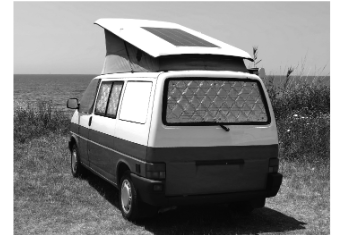
The solar panel is connected to a battery. The solar panel receives energy from the Sun to charge the battery.
(a) Describe how energy is transferred from the Sun’s energy store to the battery’s energy store. (3)
(b) The petrol engine can also be used to charge the battery of the camper van.
Give an advantage of using the solar panel instead of the petrol engine to charge the battery.
Do not refer to cost in your answer. (1)
(c) The surface of the solar panel is black.
Explain why black is a suitable colour for the solar panel. (2)
(d) The solar panel can charge the battery in the camper van with a maximum current of \(15\,\mathrm{A}\).
Calculate the minimum time to transfer \(360\,000\,\mathrm{C}\) of charge through the battery.
Use the formula
\(\mathrm{charge\ transferred}=\mathrm{current}\times\mathrm{time}\) (3)
time = __________________ \(\mathrm{s}\)
Syllabus Topic Codes (Edexcel International GCSE Physics 4PH1):
• 4.6–4.7: Renewable and Non-renewable Energy Resources — part (b)
• 4.15: Absorption and Emission of Radiation — part (c)
• 2.10: Electric Charge and Current — part (d)
▶️ Answer/Explanation
(a) Energy transfer from the Sun to the battery [3 marks]
1. Energy is transferred from the nuclear energy store of the Sun by radiation.
2. The solar panel absorbs the radiation from the Sun.
3. Energy is transferred electrically from the solar panel to the battery, increasing the chemical energy store of the battery.
Final Answer: Energy from the Sun’s nuclear energy store is transferred by radiation to the solar panel. The panel transfers energy electrically to the battery, increasing the chemical energy store of the battery.
(b) Advantage of using a solar panel [1 mark]
One advantage is that solar power is a renewable energy resource.
Alternatively, the solar panel does not produce \( \mathrm{CO_2} \) during operation or reduces the need to use petrol.
Final Answer: \( \boxed{\mathrm{Solar\ power\ is\ renewable}} \)
(c) Why black is suitable for the solar panel [2 marks]
Black is a good absorber of radiation.
Therefore, the black surface absorbs a large amount of the radiation from the Sun.
Final Answer: Black is a good absorber of radiation, so the solar panel absorbs more radiation from the Sun.
(d) Minimum time to transfer the charge [3 marks]
1. Use the charge equation:
\(Q=It\)
2. Rearrange for time:
\(t=\dfrac{Q}{I}\)
3. Substitute the values:
\(t=\dfrac{360\,000}{15}\)
\(t=24\,000\,\mathrm{s}\)
Final Answer: \( \boxed{24\,000\,\mathrm{s}} \)
Question
The photograph shows a cup that is designed to keep a drink hot.
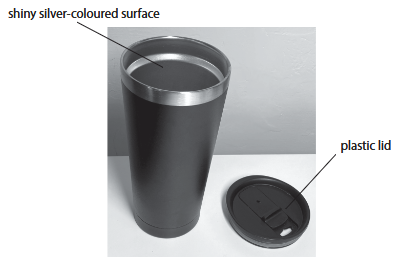
(a) The inside surface of the cup is shiny and silver-coloured.
Explain how the shiny silver-coloured surface helps to keep a drink hot. (2)
(b) Explain why a drink in the cup will stay hot for longer when the lid is placed on the cup. (2)
(c) A student investigates how the temperature of a drink in the cup varies with time.
This is the student’s method.
- pour some hot water into the cup and place the lid on the cup
- wait for the water to cool to \(80^\circ\mathrm{C}\) and then start a stopwatch
- measure the temperature of the water in the cup every 10 minutes
The graph shows the student’s results.
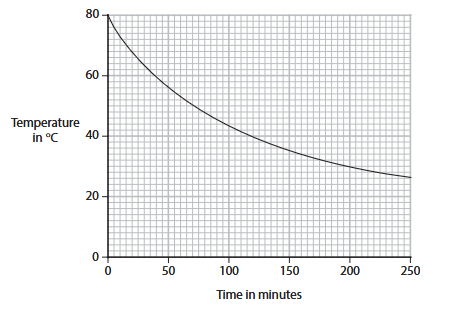
(i) On the graph, draw a tangent to the curve when the temperature is \(40^\circ\mathrm{C}\). (1)
(ii) Calculate the gradient of the tangent to find the rate of temperature change when the temperature is \(40^\circ\mathrm{C}\).
Give your answer in \(^{\circ}\mathrm{C}/\mathrm{minute}\). (3)
rate of temperature change = ………………………………………… \(^{\circ}\mathrm{C}/\mathrm{minute}\)
(iii) The student is working in a laboratory with a room temperature of \(20^\circ\mathrm{C}\).
Draw a line on the graph to show how the temperature of the water in the cup would change if there was no lid on the cup. (2)
Syllabus Topic Codes (Edexcel International GCSE Physics 4PH1):
• Topic 4.8: Radiation, Absorption, and Emission
• Topic 4.6–4.7: Thermal Energy Transfer and Convection in Everyday Phenomena
• Topic 5.11P: Core Practical: Heating and Cooling Curves
▶️ Answer/Explanation
(a) [2 marks]
The shiny silver-coloured surface is a poor absorber of infrared radiation. It therefore reflects infrared radiation back into the drink/cup rather than absorbing it, reducing thermal energy loss by radiation.
Answer: The surface is a poor absorber of infrared radiation, so it reflects infrared radiation and reduces the loss of thermal energy from the drink.
(b) [2 marks]
The lid traps air above the drink. This reduces or stops convection currents, reducing the transfer of thermal energy away from the drink.
Answer: The lid traps air and reduces convection currents, so less thermal energy is transferred away from the drink.
(c)(i) [1 mark]
A suitable tangent should be drawn to the curve at the point where the temperature is \(40^\circ\mathrm{C}\).
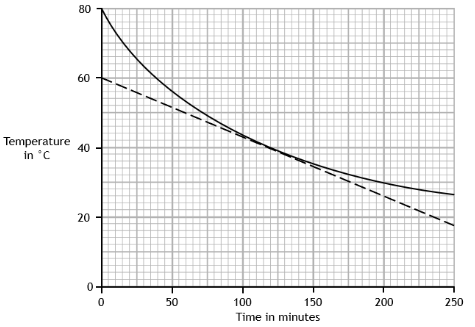
The tangent should be a straight line that touches the curve at \(40^\circ\mathrm{C}\) and follows the gradient of the curve at that point.
(c)(ii) [3 marks]
Use the gradient equation:
\(\mathrm{gradient}=\dfrac{\mathrm{change\ in\ temperature}}{\mathrm{change\ in\ time}}\)
Using two suitable points on the tangent, for example approximately \((0,60)\) and \((250,18)\):
\(\mathrm{gradient}=\dfrac{18-60}{250-0}\)
\(\mathrm{gradient}=\dfrac{-42}{250}\)
\(\mathrm{gradient}=-0.168\,^{\circ}\mathrm{C/minute}\)
Therefore, to an appropriate number of significant figures:
Answer: \(\boxed{-0.17\,^{\circ}\mathrm{C/minute}}\)
(c)(iii) [2 marks]
Without the lid, the water would cool faster because there would be greater thermal energy transfer to the surroundings, particularly by convection.
The new curve should:
- start at the same initial temperature of \(80^\circ\mathrm{C}\);
- lie below the original curve as the water cools faster;
- approach the room temperature of \(20^\circ\mathrm{C}\) without falling below it.
Graph answer: Draw a curve starting at \(80^\circ\mathrm{C}\), below the original cooling curve, and gradually approaching \(20^\circ\mathrm{C}\).
Question
A student investigates how much infrared radiation is absorbed by different surfaces.
(a) The photograph shows some of the equipment available to the student.

The student pours some water into each bottle. Describe a method the student could use to investigate how the colour of the bottle affects the amount of infrared radiation absorbed by the bottle. You may draw a diagram to help your answer.
(b) The student plots a graph to show how the temperature of the water in each bottle varies with time. Draw two curves to show the expected variation in temperature of the black bottle and the silver bottle during the investigation. Label your curves with the colour of each bottle.

Syllabus Topic Codes (Edexcel International GCSE Physics 4PH1):
• 4.9: Core Practical: Thermal Energy Transfer — part (a)
▶️ Answer/Explanation
(a) Method [6 marks]
A suitable method should change only the colour of the bottle while keeping other variables controlled.
- Put an equal volume of water into each bottle.
- Use water at the same starting temperature in each bottle.
- Place both bottles at an equal distance from the heater.
- Keep the heater output the same throughout the investigation.
- Measure the temperature of the water in each bottle after the same period of time.
- Repeat the investigation more than once.
- Calculate a mean from repeated measurements.
A suitable safety precaution should also be included to reduce the risk of burns, scalding, or electrocution.
The bottle colour is the independent variable, while the temperature increase of the water can be used to compare the amount of infrared radiation absorbed.
(b) Expected temperature curves [2 marks]
Both curves should show an increase in temperature with time.
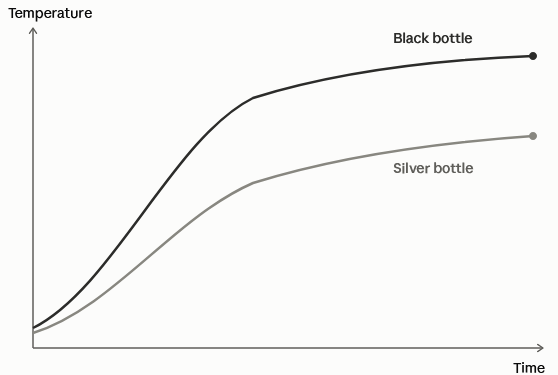
The curve labelled black should remain above the curve labelled silver throughout the investigation.
This is because black surfaces absorb infrared radiation more effectively, so the water in the black bottle is expected to heat up more than the water in the silver bottle.
Question
This question is about different methods of generating electricity.
(a) Natural gas can be burned to generate electricity. Name the energy store that decreases when natural gas is burned.
(b) Burning natural gas and the movement of water waves can both be used to generate electricity. Discuss the advantages and disadvantages of these two methods of generating electricity.
Syllabus Topic Codes (Edexcel International GCSE Physics 4PH1):
• 4.18–4.19P: Electricity Generation from Energy Resources; Advantages and Disadvantages — part (b)
▶️ Answer/Explanation
(a) Energy store [1 mark]
The chemical energy store decreases when natural gas is burned.
The chemical energy stored in the fuel is transferred to other energy stores and eventually used to generate electrical energy.
(b) Advantages and disadvantages [6 marks]
Natural gas
Advantages:
- Electricity generation can be changed to meet demand.
- It is a reliable method of generating electricity.
Disadvantages:
- Natural gas is non-renewable and will eventually run out.
- Burning natural gas produces \(CO_2\), a greenhouse gas.
- A country may become dependent on other countries to supply natural gas.
Wave power
Advantages:
- Wave power is a renewable energy resource.
- It produces no polluting gases during electricity generation.
Disadvantages:
- Waves may not always be present, so electricity generation can be variable.
- Wave-power systems may harm wildlife.
- The generator may suffer damage during storms.
Overall, natural gas provides a relatively reliable and controllable supply of electricity, but it is non-renewable and produces \(CO_2\). Wave power is renewable and does not produce polluting gases during generation, but its output depends on the availability of waves.
Question
A solid bar of chocolate is taken from a refrigerator.

(a) The temperature of the chocolate bar is \(5^\circ\mathrm{C}\). Describe the arrangement and motion of the particles inside the chocolate bar.
(b) The chocolate is heated at a constant rate until the temperature reaches \(45^\circ\mathrm{C}\). The chocolate has a melting point of \(32^\circ\mathrm{C}\) and a boiling point of \(55^\circ\mathrm{C}\).
(i) Describe the motion of the particles in the chocolate when the chocolate is at a temperature of \(45^\circ\mathrm{C}\).
(ii) Which of these is used to measure the temperature of the chocolate?
A balance
B ruler
C stopwatch
D thermometer
(iii) Use the axes to sketch a graph of how the temperature of the chocolate changes with time when it is heated from \(5^\circ\mathrm{C}\) to \(45^\circ\mathrm{C}\).

Syllabus Topic Codes (Edexcel International GCSE Physics 4PH1):
• 5.8P–5.9P: Energy Changes During Heating and Changes of State — part (b)(iii)
• 5.9P: Changes of State — part (b)(i) and (b)(iii)
▶️ Answer/Explanation
(a) Arrangement and motion of particles [2 marks]
Arrangement:
- The particles are closely packed.
- They have a fixed, regular arrangement.
Motion:
- The particles vibrate about fixed positions.
The particles cannot move freely from one position to another because the chocolate is a solid.
(b)(i) Motion of particles at \(45^\circ\mathrm{C}\) [2 marks]
The melting point of chocolate is \(32^\circ\mathrm{C}\), so at \(45^\circ\mathrm{C}\) the chocolate is a liquid.
- The particles move in a random manner.
- The particles are no longer held in fixed positions and can move past one another.
The temperature is below the boiling point of \(55^\circ\mathrm{C}\), so the chocolate remains a liquid rather than becoming a gas.
(b)(ii) Measuring temperature [1 mark]
The correct instrument for measuring temperature is a thermometer.
Correct answer: D, thermometer
(b)(iii) Temperature-time graph [3 marks]
The temperature initially increases from \(5^\circ\mathrm{C}\) to the melting point of \(32^\circ\mathrm{C}\).
At \(32^\circ\mathrm{C}\), the chocolate melts. During the change of state, the temperature remains constant even though energy continues to be transferred to the chocolate.
Once all the chocolate has melted, the temperature increases again from \(32^\circ\mathrm{C}\) to \(45^\circ\mathrm{C}\).
Therefore, the graph should have:
- an increasing section from \(5^\circ\mathrm{C}\) to \(32^\circ\mathrm{C}\),
- a horizontal section at \(32^\circ\mathrm{C}\), representing melting,
- another increasing section from \(32^\circ\mathrm{C}\) to \(45^\circ\mathrm{C}\).

Question
Concrete on top of buildings can be used to heat water. The photograph shows a concrete and water heating system being built into the roof of a house.

(a) A scientist wants to determine the specific heat capacity of concrete. The diagram shows some of the equipment they could use.

Describe a suitable method to find the specific heat capacity of concrete.
(b) Explain the advantage of the concrete having a high specific heat capacity when it is used to heat water in the heating system.
Syllabus Topic Codes (Edexcel International GCSE Physics 4PH1):
• 4.17P: Measuring Specific Heat Capacity Experimentally — part (a)
• 4.15: Energy Transfers and Thermal Energy — part (b)
▶️ Answer/Explanation
(a) Determining the specific heat capacity of concrete [5 marks]
A suitable method is:
- Measure the mass of the concrete using a balance.
- Measure the initial temperature of the concrete.
- Place an electric heater in good thermal contact with the concrete and connect it to an ammeter and voltmeter.
- Measure the current and voltage supplied to the heater.
- Heat the concrete for a measured time using a stopwatch.
- Calculate the energy supplied using \(E=VIt\).
- Measure the temperature change: \(\Delta T=T_\mathrm{final}-T_\mathrm{initial}\).
- Calculate the specific heat capacity using:
\(\displaystyle c=\frac{E}{m\Delta T}\)
The experiment could be repeated and the results averaged to improve reliability. Taking the temperature after the heater is switched off can also help determine the maximum temperature reached.
Alternative graph method: Plot temperature against time and determine the gradient. Then use:
\(\displaystyle \mathrm{gradient}=\frac{\mathrm{power}}{mc}\)
and rearrange to find \(c\).
(b) Advantage of a high specific heat capacity [2 marks]
A material with a high specific heat capacity can store a large amount of thermal energy for a given mass and temperature change.
Therefore, the concrete can absorb and release a large amount of energy to the water, helping the water temperature to be maintained for longer.
This makes the concrete useful as a thermal store in the heating system.
Question
The diagram shows some apparatus that can be used to determine the specific heat capacity of water.

(a) Describe how a student could use this apparatus to determine the specific heat capacity of water. Include details of any additional equipment needed in your answer.
(b) (i) The table shows the student’s results.

Use the student’s results to calculate the specific heat capacity of water.
(ii) Give two reasons why the energy from the heater is not all retained in the thermal store of the water.
Syllabus Topic Codes (Edexcel International GCSE Physics 4PH1):
• 5.14P: Core Practical: Specific Heat Capacity — part (a)
• 4.6–4.10: Thermal Energy Transfer, Convection, Radiation, Absorption, Emission, and Reducing Unwanted Energy Transfer — part (b)(ii)
▶️ Answer/Explanation
(a) Determining the specific heat capacity of water [5 marks]
- Measure the mass of the empty cup using a balance.
- Add water and measure the mass of the cup and water. Calculate the mass of water by subtracting the mass of the empty cup.
- Measure the initial temperature of the water using a thermometer.
- Connect a voltmeter and ammeter to measure the potential difference and current of the heater.
- Switch on the heater and measure the heating time using a stopwatch or timer.
- Stir the water throughout the experiment so that the temperature is approximately uniform.
- Measure the temperature change, or continue measuring the temperature after switching off the heater to determine the maximum temperature.
- Repeat the experiment and calculate an average to improve reliability.
The electrical energy supplied by the heater can be calculated using:
\(E=VIt\)
The specific heat capacity can then be calculated using:
\(E=mc\Delta T\)
Therefore:
\(c=\dfrac{E}{m\Delta T}\)
(b)(i) Specific heat capacity [3 marks]
Use the equation:
\(E=mc\Delta T\)
From the results:
\(E=54000\,\mathrm{J}\)
\(m=0.56\,\mathrm{kg}\)
\(\Delta T=22\,^\circ\mathrm{C}\)
Substitute:
\(54000=0.56\times c\times22\)
Rearranging:
\(c=\dfrac{54000}{0.56\times22}\)
\(c\approx4286\,\mathrm{J\,kg^{-1}\,^\circ C^{-1}}\)
Using the values and rounding appropriately gives approximately:
\(\boxed{c\approx4.3\times10^3\,\mathrm{J\,kg^{-1}\,^\circ C^{-1}}\)
(b)(ii) Energy losses [2 marks]
Two valid reasons are:
- Some energy is transferred to the beaker or cup and thermometer.
- Some energy is transferred to the surroundings.
The insulation is not perfect, and gaps around the heater or thermometer can also allow thermal energy to escape.