
Edexcel iGCSE Physics (4PH1) 4.3 Work and Power Exam Style Question Paper 1B - New Syllabus
Question
The diagram shows a force pulling a block up a ramp.
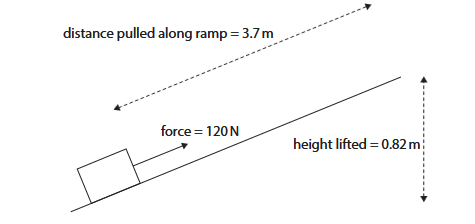
The force is \(120\,\mathrm{N}\), the distance pulled along the ramp is \(3.7\,\mathrm{m}\), and the height lifted is \(0.82\,\mathrm{m}\).
(a) Show that the work done by the force is about \(440\,\mathrm{J}\).
Use the formula
\(\text{work done}=\text{force}\times\text{distance moved}\)
work done = ____________________ (2 marks)
(b) The block gains \(12\,\mathrm{J}\) of energy in its gravitational store when it is lifted through a height of \(0.82\,\mathrm{m}\).
Calculate the mass of the block. (2 marks)
mass = ____________________ \(\mathrm{kg}\)
(c) A student states that most of the input energy is destroyed when the block is pulled up the ramp.
Comment on the student’s statement. (2 marks)
________________________________________________________________________________________________
________________________________________________________________________________________________
Syllabus Topic Codes (Edexcel International GCSE Physics 4PH1):
• 4.13: Gravitational potential energy — part (b)
• 4.3: Conservation of energy — part (c)
▶️ Answer/Explanation and Mark Scheme
(a) Work done [2 marks]
\(\text{work done}=\text{force}\times\text{distance}\)
\(W=120\times3.7\)
\(W=444\,\mathrm{J}\)
Answer: \( \boxed{444\,\mathrm{J}\approx440\,\mathrm{J}} \)
(b) Mass of the block [2 marks]
Use \(E_{\mathrm{p}}=mgh\).
\(12=m\times10\times0.82\)
\(m=\dfrac{12}{10\times0.82}\)
\(m\approx1.46\,\mathrm{kg}\)
Answer: \( \boxed{1.5\,\mathrm{kg}} \)
(c) Energy transfer [2 marks]
- Energy cannot be destroyed; it is conserved.
- Some of the input energy is transferred to the thermal/heat store of the surroundings, for example due to friction.
Total: \(6\) marks
Question
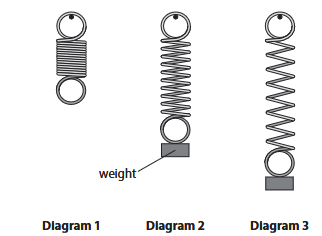
(a) The diagrams show a spring hanging from a nail.
- diagram 1 shows the spring with no weight added
- diagram 2 shows the spring stationary, after a weight has been added
- diagram 3 shows the spring after the weight has been pulled down
(i) Which energy store has increased for the spring in diagram 2 compared to the spring in diagram 1? (1)
A chemical
B elastic
C gravitational potential
D kinetic
(ii) The spring is released from the position shown in diagram 3.
Describe the energy transfers that take place until the spring stops vibrating. (6)
(b) Shock absorbers containing springs are used on motorcycles.
Shock absorbers are designed to compress and expand as the motorcycle moves across a rough surface.
A new type of shock absorber has been developed to generate electricity from the movement of the motorcycle.
This new type of shock absorber consists of magnets that slide inside a coil when the motorcycle goes over a bump.
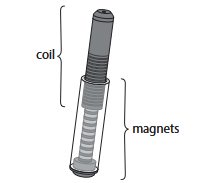
Some of the energy that would normally be wasted can be recovered, so fuel is saved.
(i) Which of these statements best describes the advantage of this new type of shock absorber? (1)
A it increases the energy transferred to a thermal store from the fuel
B it increases the efficiency of the motorcycle
C it decreases the speed of the motorcycle
D it decreases the braking power of the motorcycle
(ii) Explain how this new type of shock absorber can generate electricity. (3)
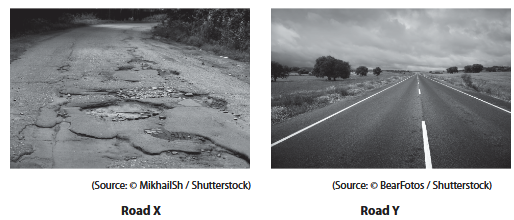
(iii) Road X has a rough surface.
Road Y has a smooth surface.
A motorcycle travels at the same speed along road X and road Y.
Explain why the new type of shock absorber will generate more electricity for this motorcycle on road X than on road Y. (3)
Syllabus Topic Codes (Edexcel International GCSE Physics 4PH1):
• 4.3: Conservation of energy — part (a)(ii)
• 6.15: Electromagnetic induction and induced voltage — parts (b)(ii) and (b)(iii)
• 6.16: Generation of electricity by electromagnetic induction — parts (b)(ii) and (b)(iii)
▶️ Answer/Explanation
(a)(i) Correct Answer: \( \boxed{\mathrm{B\ (elastic)}} \) [1 mark]
Adding the weight stretches the spring, so the energy in the elastic store of the spring increases.
For a spring, the elastic energy store can be related to its extension by \(E_{\mathrm{elastic}}=\dfrac{1}{2}kx^2\), where \(k\) is the spring constant and \(x\) is the extension.
(a)(ii) Energy transfers until the spring stops vibrating [6 marks]
- When the spring is released, its elastic energy store decreases as the spring moves upwards.
- Energy is transferred to the kinetic store of the weight and spring as they accelerate upwards.
- The gravitational potential energy store increases as the weight moves upwards.
- At the highest point, the motion reverses and the weight moves downwards, so gravitational potential energy is transferred to the kinetic store.
- As the spring moves downwards again, energy is transferred mechanically back into the elastic store of the spring.
- The amplitude of the vibrations decreases because energy is transferred to the thermal store of the spring and surroundings, mainly due to friction and air resistance.
Eventually, the vibrations stop and the energy initially stored in the spring has been transferred mainly to the thermal store of the spring and its surroundings.
Key principle: Energy is not destroyed. It is transferred between different energy stores.
(b)(i) Advantage of the new shock absorber [1 mark]
Correct Answer: \( \boxed{\mathrm{B\ it\ increases\ the\ efficiency\ of\ the\ motorcycle}} \)
Some energy that would otherwise be wasted is recovered and converted into useful electrical energy, so the overall efficiency increases.
(b)(ii) Generating electricity [3 marks]
- The magnets move through the coil when the shock absorber moves.
- The moving magnets cause the coil to cut magnetic field lines, so the magnetic field through the coil changes.
- An induced voltage is produced in the coil, which can cause a current to flow and generate electrical energy.
This is an example of electromagnetic induction.
(b)(iii) Why more electricity is generated on Road X [3 marks]
- Road X has a rougher surface, so there are more frequent and/or larger bumps.
- The shock absorber therefore compresses and expands more frequently and/or by a greater amount.
- The magnets move through the coil more frequently and/or over a greater distance, producing a larger or more frequent induced voltage and therefore more electrical energy.
The key idea is that greater movement of the magnets through the coil produces a greater amount of electromagnetic induction.
Final Answer: Road X causes more movement of the magnets through the coil, so the magnetic field through the coil changes more frequently and/or by a greater amount. This produces more induced voltage and therefore more electricity.
Question
A ball is moving through the air with a speed of \(54.8\,\mathrm{m\,s^{-1}}\). The ball has a mass of \(159\,\mathrm{g}\).
(a) Calculate the energy in the kinetic store of the ball.
Give your answer to \(3\) significant figures. (4)
energy in kinetic store = __________________ \(\mathrm{J}\)
(b) The speed of the ball is measured using radio waves.
Radio waves of frequency \(2.90\times10^{10}\,\mathrm{Hz}\) travel towards the ball from a source.
The radio waves then reflect off the ball.
The reflected radio waves change frequency depending on the speed of the ball. This change in frequency is due to the Doppler effect.

(i) The change in frequency can be calculated using this formula.
\(\mathrm{speed\ of\ ball}=\dfrac{\mathrm{change\ in\ frequency}}{\mathrm{source\ frequency}}\times\dfrac{\mathrm{speed\ of\ radio\ waves}}{2}\)
Show that the change in frequency of the radio waves is approximately \(1.1\times10^{4}\,\mathrm{Hz}\).
\([\mathrm{speed\ of\ radio\ waves}=3.00\times10^{8}\,\mathrm{m\,s^{-1}}]\) (3)
change in frequency = __________________ \(\mathrm{Hz}\)
(ii) The change in frequency of the radio waves happens because the ball acts as a new source of radio waves.
The ball is moving away from the original source of radio waves.
Explain the change in frequency of the radio waves when the radio waves reflect off the ball. (3)
Syllabus Topic Codes (Edexcel International GCSE Physics 4PH1):
• 3.8: Doppler effect and the change in observed frequency and wavelength when a source moves relative to an observer — part (b)(i)
• 3.5: Wave speed, frequency and wavelength relationships — relevant to the radio-wave context in part (b)
▶️ Answer/Explanation
(a) Kinetic energy [4 marks]
1. Convert the mass into kilograms:
\(159\,\mathrm{g}=0.159\,\mathrm{kg}\)
2. Use the kinetic energy equation:
\(KE=\dfrac{1}{2}mv^2\)
3. Substitute the values:
\(KE=\dfrac{1}{2}(0.159)(54.8)^2\)
\(KE=238.74\,\mathrm{J}\)
4. Give the answer to \(3\) significant figures:
\(KE=239\,\mathrm{J}\)
Final Answer: \( \boxed{239\,\mathrm{J}} \)
(b)(i) Change in frequency [3 marks]
Given:
\(v_{\mathrm{ball}}=54.8\,\mathrm{m\,s^{-1}}\)
\(f=2.90\times10^{10}\,\mathrm{Hz}\)
\(v_{\mathrm{radio}}=3.00\times10^8\,\mathrm{m\,s^{-1}}\)
1. Substitute into the given equation:
\(54.8=\dfrac{\Delta f}{2.90\times10^{10}}\times\dfrac{3.00\times10^8}{2}\)
2. Rearrange for \(\Delta f\):
\(\Delta f=\dfrac{54.8(2.90\times10^{10})(2)}{3.00\times10^8}\)
3. Evaluate:
\(\Delta f=1.059\times10^4\,\mathrm{Hz}\)
Therefore, to \(3\) significant figures:
\(\Delta f\approx1.06\times10^4\,\mathrm{Hz}\)
Final Answer: \( \boxed{1.06\times10^4\,\mathrm{Hz}} \)
(b)(ii) Doppler effect [3 marks]
- The ball is moving away from the original radio-wave source.
- When the waves reflect from the moving ball, the ball acts as a new moving source of radio waves.
- Because the new source is moving away from the observer/source, the reflected waves have a lower frequency than the original waves.
The wavelength of the reflected radio waves is therefore increased while the wave speed remains approximately \(3.00\times10^8\,\mathrm{m\,s^{-1}}\).
Final Answer: The ball moves away from the source, so the reflected wavefronts are spread further apart. This increases the wavelength and decreases the frequency of the reflected radio waves.
Question
Two students do an experiment to determine their power when running up a set of steps.
The diagram shows how they set up their experiment. Not all of the steps are shown in the diagram.
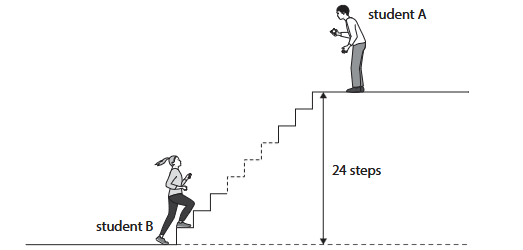
This is the students’ method.
- student A stands with a stopwatch at the top of the steps
- student A starts timing on the stopwatch and shouts “go” at the same time
- student B begins to run up the steps when she hears student A shout
- student A stops timing when student B reaches the top of the steps
The students repeat their method two more times.
(a) Give a reason why the times recorded may not be accurate. (1)
(b) There are \(24\) steps in total and each step has a height of \(19\,\mathrm{cm}\).
(i) Student B has a mass of \(67\,\mathrm{kg}\).
Show that student B gains about \(3000\,\mathrm{J}\) of energy in her gravitational store when she runs up the set of steps. (3)
(ii) The table shows the times recorded for student B.
| Time in \(\mathrm{s}\) |
|---|
| \(4.28\) |
| \(4.95\) |
| \(4.65\) |
Calculate the mean time from this data.
Give your answer to three significant figures. (2)
mean time = __________________ \(\mathrm{s}\)
(iii) Calculate the mean power of student B transferring energy to her gravitational store as she runs up the steps. (2)
(c) The students extend their investigation by calculating the power for students of different masses running up the steps.
The graph shows their results.
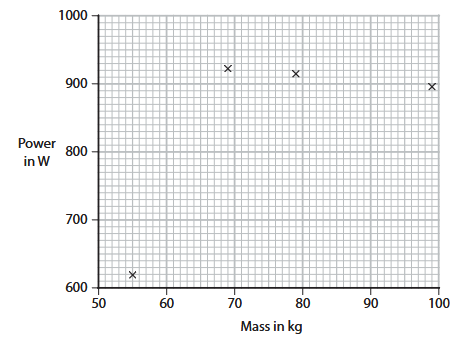
The students conclude that the greater the mass of the person, the greater the power of the person when running up the steps.
Comment on the students’ conclusion. (4)
Syllabus Topic Codes (Edexcel International GCSE Physics 4PH1):
• 4.16–4.17: Power, energy and time — parts (b)(iii) and (c)
• 4.3: Conservation of energy — relevant to the energy transferred to the gravitational store in part (b)(i)
▶️ Answer/Explanation
(a) Accuracy of timing [1 mark]
Student A and student B have reaction times, causing a delay between the stopwatch being started and student B beginning to run.
Final Answer: Human reaction time can cause an error in starting or stopping the stopwatch.
(b)(i) Gravitational potential energy [3 marks]
1. Use the equation:
\(E_{\mathrm{p}}=mgh\)
2. Calculate the total vertical height:
\(h=24\times0.19=4.56\,\mathrm{m}\)
3. Substitute the values:
\(E_{\mathrm{p}}=67\times9.81\times4.56\)
\(E_{\mathrm{p}}=2994\,\mathrm{J}\)
Therefore, \(E_{\mathrm{p}}\approx3000\,\mathrm{J}\).
Final Answer: \( \boxed{3.0\times10^3\,\mathrm{J}} \)
(b)(ii) Mean time [2 marks]
1. Add the three recorded times:
\(t_{\mathrm{total}}=4.28+4.95+4.65=13.88\,\mathrm{s}\)
2. Divide by the number of readings:
\(t_{\mathrm{mean}}=\dfrac{13.88}{3}=4.626\ldots\,\mathrm{s}\)
To three significant figures:
\(t_{\mathrm{mean}}=4.63\,\mathrm{s}\)
Final Answer: \( \boxed{4.63\,\mathrm{s}} \)
(b)(iii) Mean power [2 marks]
1. Use the equation:
\(P=\dfrac{E}{t}\)
2. Substitute the energy and mean time:
\(P=\dfrac{3055.2}{4.63}\)
\(P\approx660\,\mathrm{W}\)
Final Answer: \( \boxed{660\,\mathrm{W}} \)
(c) Comment on the students’ conclusion [4 marks]
The conclusion is not fully supported by the data.
- There are not enough data points to make a reliable conclusion.
- A greater range of masses should be tested.
- More measurements should be taken for each mass to improve the reliability of the results.
- The first two points suggest a possible weak positive correlation, but the final three points have approximately the same power.
- The first data point could be an anomaly.
- If the first point is considered anomalous, the data may suggest a weak negative correlation rather than a positive one.
- The final three points suggest that power could be independent of mass over that range.
- The person with the greatest mass does not have the greatest power.
Final Answer: The data do not provide sufficient evidence for the students’ conclusion. More masses and repeated measurements are needed. The graph shows considerable variation, and the greatest mass does not produce the greatest power.
Question
Fluorescent tube lamps can be used in schools and office buildings for lighting.
The photograph shows an engineer installing a fluorescent tube lamp.
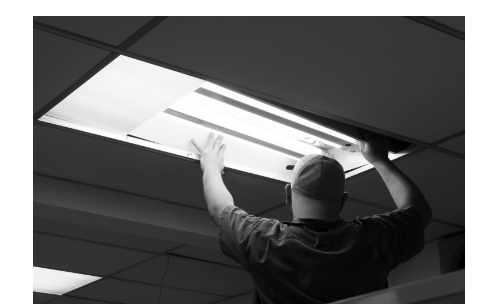
Diagram 1 shows a simplified view of the components of a fluorescent tube lamp.
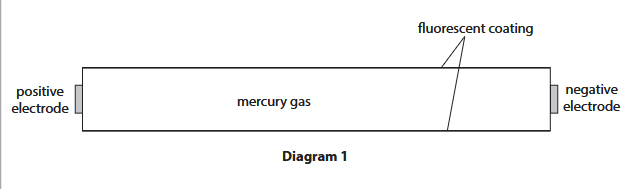
(a) When the lamp is on, a large voltage is applied between the positive electrode and the negative electrode.
(i) State what is meant by the term voltage. (1)
(ii) The large voltage causes electrons to accelerate from the negative electrode towards the positive electrode.
An electron gains \(1.0\times10^{-16}\,\mathrm{J}\) of energy when it accelerates between the electrodes.
Show that the voltage between the electrodes is about \(600\,\mathrm{V}\).
[magnitude of electron charge \(=1.6\times10^{-19}\,\mathrm{C}\)] (3)
(iii) The electron gains \(1.0\times10^{-16}\,\mathrm{J}\) of energy in its kinetic store when it accelerates from the negative electrode to the positive electrode.
Calculate the speed of an electron when it reaches the positive electrode.
Assume the electron is initially at rest.
[electron mass \(=9.1\times10^{-31}\,\mathrm{kg}\)] (4)
(b) When the electrons accelerate between the electrodes, they collide with mercury atoms.
Energy is transferred to the mercury atoms during the collisions. This causes the mercury atoms to emit ultraviolet light.
Atoms in the fluorescent coating absorb this ultraviolet light, which is then re-emitted as light from a different part of the electromagnetic spectrum.
Diagram 2 shows this process.
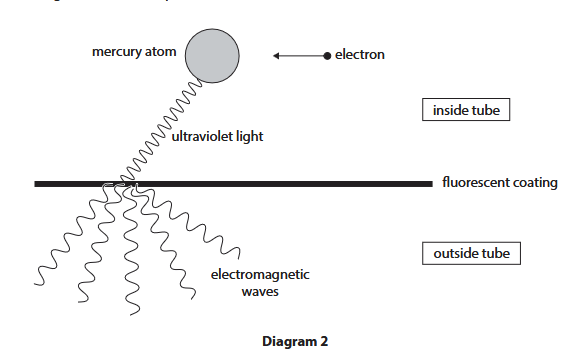
(i) Suggest why the tube must have a fluorescent coating for the lamp to operate effectively. (2)
(ii) Explain why the fluorescent tube lamp is dangerous if the fluorescent coating becomes damaged. (2)
Syllabus Topic Codes (Edexcel International GCSE Physics 4PH1):
• 4.4–4.5: Kinetic energy and energy transfers — part (a)(iii)
• 3.12–3.14: Electromagnetic waves and the electromagnetic spectrum — parts (b)(i) and (b)(ii)
• 7.4–7.5 and 7.15–7.16: Ionising radiation and associated hazards — part (b)(ii)
▶️ Answer/Explanation
(a)(i) Meaning of voltage [1 mark]
Voltage is the energy transferred per unit charge.
The relationship is:
\(V=\dfrac{E}{Q}\)
where \(V\) is voltage, \(E\) is energy transferred and \(Q\) is charge.
(a)(ii) Voltage between the electrodes [3 marks]
1. Use the electrical energy equation:
\(E=QV\)
2. Rearrange for voltage:
\(V=\dfrac{E}{Q}\)
3. Substitute the values:
\(V=\dfrac{1.0\times10^{-16}}{1.6\times10^{-19}}\)
\(V=625\,\mathrm{V}\)
Therefore, the voltage is about \(600\,\mathrm{V}\).
Final Answer: \( \boxed{625\,\mathrm{V}\approx600\,\mathrm{V}} \)
(a)(iii) Speed of the electron [4 marks]
The electron starts from rest, so its initial kinetic energy is zero. The energy gained becomes kinetic energy.
1. Use the kinetic energy equation:
\(E_{\mathrm{k}}=\dfrac{1}{2}mv^2\)
2. Rearrange for \(v\):
\(v^2=\dfrac{2E_{\mathrm{k}}}{m}\)
\(v=\sqrt{\dfrac{2E_{\mathrm{k}}}{m}}\)
3. Substitute the values:
\(v=\sqrt{\dfrac{2(1.0\times10^{-16})}{9.1\times10^{-31}}}\)
\(v\approx1.48\times10^7\,\mathrm{m\,s^{-1}}\)
Final Answer: \( \boxed{1.5\times10^7\,\mathrm{m\,s^{-1}}} \)
(b)(i) Function of the fluorescent coating [2 marks]
- Humans cannot see ultraviolet radiation.
- The fluorescent coating absorbs the ultraviolet radiation and emits visible light, which can be seen by humans.
Therefore, the coating converts the ultraviolet radiation produced by the mercury atoms into visible light, making the lamp useful for lighting.
(b)(ii) Danger if the coating is damaged [2 marks]
- If the coating is damaged, ultraviolet radiation could escape from the tube.
- Ultraviolet radiation is ionising radiation and can cause harmful effects such as skin damage, burns or an increased risk of cancer.
Mercury vapour is also harmful if it escapes from the damaged tube.
Final Answer: A damaged coating may allow ultraviolet radiation to escape. UV radiation can damage living cells and is harmful to people, while escaped mercury vapour is also toxic.
Question
A winch is used to pull a truck along a horizontal road. The winch is connected to the truck by a thick rope.

(a) The winch does \(41\,\mathrm{kJ}\) of useful work on the truck when the truck is pulled a horizontal distance of \(15\,\mathrm{m}\).
(i) State the formula linking work done, force and distance moved in the direction of the force. (1)
(ii) Calculate the force that the rope exerts on the truck. (3)
(b) The winch includes a small engine. The engine burns petrol to power the motor in the winch. The winch transfers energy mechanically to the truck.
(i) The winch has an efficiency of \(25\%\) when pulling the truck. Draw a Sankey diagram for this energy transfer. (3)
(ii) The winch can also be used to pull the truck uphill at a constant speed. The table gives some energy stores. Add one tick to each row to show what happens to the energy in each store as the truck is pulled uphill. (3)

Syllabus Topic Codes (Edexcel International GCSE Physics 4PH1):
• 4.5: Energy Transfers in Devices and Sankey Diagrams — part (b)(i)
• 4.3: Conservation of Energy — part (b)(ii)
• 4.13: Gravitational Potential Energy — part (b)(ii)
▶️ Answer/Explanation
(a)(i) Work done formula [1 mark]
The formula linking work done, force and distance moved in the direction of the force is:
\(\boxed{W=Fd}\)
where \(W\) is work done, \(F\) is force and \(d\) is the distance moved in the direction of the force.
(a)(ii) Force exerted by the rope [3 marks]
Given:
- \(W=41\,\mathrm{kJ}=41000\,\mathrm{J}\)
- \(d=15\,\mathrm{m}\)
Using \(W=Fd\):
\(41000=F\times15\)
Rearranging:
\(F=\dfrac{41000}{15}\)
\(F\approx2733\,\mathrm{N}\)
To an appropriate number of significant figures:
\(\boxed{F\approx2.7\times10^3\,\mathrm{N}}\)
(b)(i) Sankey diagram [3 marks]
The Sankey diagram should show:
- One input representing the chemical energy from the petrol.
- One useful output representing the mechanical energy transferred to the truck.
- One wasted output representing energy transferred to the surroundings, mainly as thermal energy and sound.
- The useful output should represent \(25\%\) of the input energy, so the wasted output represents \(75\%\).

(b)(ii) Energy stores when the truck is pulled uphill [3 marks]
As the truck is pulled uphill at a constant speed:
- The truck’s gravitational potential energy store increases because its height increases.
- The truck’s kinetic energy store remains unchanged because its speed is constant.
- The chemical energy store of the fuel decreases as energy is transferred from the fuel to the truck and the surroundings.
The correct completed table is shown below:

The key idea is that energy is transferred between stores, while the total amount of energy is conserved.
Question
A teacher demonstrates the penetrating ability of alpha, beta and gamma radiation from some radioactive sources.
(a)(i) State a precaution the teacher should take to make sure they are working safely with the radioactive sources.
(ii) State the name of a detector the teacher could use to detect the radiation from each source.
(b) Draw crosses (×) in the table to show which type of radiation cannot penetrate each material in the table.

(c) An alpha particle of mass \(6.6\times10^{-27}\,\mathrm{kg}\) travelling at a speed of \(2.1\times10^7\,\mathrm{m\,s^{-1}}\) hits a sheet of paper.
(i) Calculate the kinetic energy (KE) of the alpha particle.
(ii) State the work done on the alpha particle when its speed is reduced to \(0\,\mathrm{m\,s^{-1}}\) by the sheet of paper.
(iii) State which energy store of the paper increases when the alpha particle is stopped.
Syllabus Topic Codes (Edexcel International GCSE Physics 4PH1):
• 7.6: Core Practical: Radiation Penetration — part (b)
• 7.9: Detection of Ionising Radiation — part (a)(ii)
• 7.15–7.16: Contamination, Irradiation, and Dangers of Ionising Radiation — part (a)(i)
• 4.14: Kinetic Energy — part (c)(i)
• 4.12: Work Done and Energy Transfer — part (c)(ii)
• 4.2: Energy Stores and Energy Transfer Pathways — part (c)(iii)
▶️ Answer/Explanation
(a)(i) Safety precaution [1 mark]
One suitable precaution is to keep the radioactive source at arm’s length and minimise the exposure time.
(a)(ii) Detector [1 mark]
A Geiger-Müller tube and counter can be used to detect the radiation.

(b) Penetrating ability of radiation [3 marks]
The crosses should be placed as follows:
| Type of radiation | 10 cm of air | 2 cm of aluminium | 10 cm of lead |
|---|---|---|---|
| alpha | × | × | × |
| beta | × | × | |
| gamma | × |
Alpha radiation has the lowest penetrating ability, beta radiation has greater penetrating ability, and gamma radiation is the most penetrating.
(c)(i) Kinetic energy [3 marks]
Use:
\(\mathrm{KE}=\dfrac{1}{2}mv^2\)
Substitute \(m=6.6\times10^{-27}\,\mathrm{kg}\) and \(v=2.1\times10^7\,\mathrm{m\,s^{-1}}\):
\(\mathrm{KE}=\dfrac{1}{2}\times(6.6\times10^{-27})\times(2.1\times10^7)^2\)
\(\mathrm{KE}=1.4553\times10^{-12}\,\mathrm{J}\)
Therefore:
\(\boxed{\mathrm{KE}\approx1.5\times10^{-12}\,\mathrm{J}}\)
(c)(ii) Work done [1 mark]
The alpha particle is brought to rest, so all of its initial kinetic energy is transferred by the work done on it.
Therefore, the magnitude of the work done is:
\(\boxed{1.5\times10^{-12}\,\mathrm{J}}\)
(c)(iii) Energy store [1 mark]
The thermal energy store of the paper increases as the kinetic energy of the alpha particle is transferred to the paper.
Question
A model electric motor is used to lift a load through a vertical height.

(a) The load has a mass of \(400\,\mathrm{g}\) and gains \(3.2\,\mathrm{J}\) of energy in its gravitational store when lifted.
(i) State the formula linking gravitational potential energy, mass, gravitational field strength (\(g\)) and height.
(ii) Calculate the height the load is lifted.
(iii) State the amount of useful work done on the load by the motor when the load is lifted through this height.
(b) The load is lifted at a constant speed. Diagram 1 shows the lifting force acting on the load as it is lifted. Draw a labelled arrow on diagram 1 to show the other force acting on the load. Ignore the effects of air resistance.

(c) A joulemeter measures the amount of energy transferred electrically to the motor as the motor lifts the load. The joulemeter displays a reading of \(11.0\,\mathrm{J}\) when the load has gained \(3.2\,\mathrm{J}\) of energy in its gravitational store.
(i) Calculate the efficiency of the motor.
(ii) Justify why \(7.8\,\mathrm{J}\) of energy must be dissipated into the thermal store of the surroundings as the load is lifted.
(iii) Diagram 2 is an incomplete Sankey diagram. Complete the Sankey diagram to show the energy transferred by the motor.

Syllabus Topic Codes (Edexcel International GCSE Physics 4PH1):
• 4.12: Work Done and Energy Transfer — part (a)(iii)
• 1.17–1.18: Force, Mass, Weight, and Gravitational Field Strength — part (b)
• 4.4: Efficiency — part (c)(i)
• 4.3: Conservation of Energy — part (c)(ii)
• 4.5: Energy Transfers in Devices and Sankey Diagrams — part (c)(iii)
▶️ Answer/Explanation
(a)(i) Gravitational potential energy formula [1 mark]
The formula linking gravitational potential energy, mass, gravitational field strength and height is:
\(\boxed{E_{\mathrm{p}}=mgh}\)
(a)(ii) Height lifted [3 marks]
Convert the mass into kilograms:
\(400\,\mathrm{g}=0.40\,\mathrm{kg}\)
Use:
\(E_{\mathrm{p}}=mgh\)
Substitute \(E_{\mathrm{p}}=3.2\,\mathrm{J}\), \(m=0.40\,\mathrm{kg}\), and \(g=10\,\mathrm{N\,kg^{-1}}\):
\(3.2=0.40\times10\times h\)
\(h=\dfrac{3.2}{0.40\times10}\)
\(h=0.80\,\mathrm{m}\)
Therefore: \(\boxed{h=0.80\,\mathrm{m}}\)
(a)(iii) Useful work done [1 mark]
The useful work done is equal to the increase in the gravitational potential energy store.
Therefore: \(\boxed{W=3.2\,\mathrm{J}}\)
(b) Other force acting on the load [2 marks]
Since the load is moving at a constant speed, the resultant force is zero. Therefore, the upward lifting force must be balanced by the downward weight of the load.
Draw a vertically downward arrow labelled weight, \(W\), or \(mg\). The arrow should be equal in length to the lifting-force arrow.
(c)(i) Efficiency of the motor [3 marks]
Use:
\(\mathrm{efficiency}=\dfrac{\mathrm{useful\ energy\ output}}{\mathrm{total\ energy\ input}}\times100\%\)
Substitute the useful energy output \(3.2\,\mathrm{J}\) and total energy input \(11.0\,\mathrm{J}\):
\(\mathrm{efficiency}=\dfrac{3.2}{11.0}\times100\%\)
\(\mathrm{efficiency}\approx29\%\)
Therefore: \(\boxed{\mathrm{efficiency}=29\%}\)
(c)(ii) Dissipated energy [2 marks]
Energy must be conserved. The electrical energy supplied is \(11.0\,\mathrm{J}\), while \(3.2\,\mathrm{J}\) is transferred usefully to the gravitational store.
Therefore, the remaining energy is:
\(11.0-3.2=7.8\,\mathrm{J}\)
This energy is dissipated mainly into the thermal store of the surroundings.
Therefore: \(\boxed{7.8\,\mathrm{J}}\)
(c)(iii) Sankey diagram [2 marks]
The Sankey diagram should show:
- An input of \(11.0\,\mathrm{J}\).
- A useful output of \(3.2\,\mathrm{J}\) directed to the right and labelled useful output (energy).
- A dissipated output of \(7.8\,\mathrm{J}\) directed downwards and transferred to the thermal store of the surroundings.
The useful output arrow should have a width corresponding to 8 small squares, as shown by the mark scheme.
Question
The driver of a racing car makes a pit stop during a race to change the tyres on the racing car. The area where the tyres are changed is called the pit lane.

(a) Before entering the pit lane, the speed of the car must decrease for safety reasons.
(i) The mass of the racing car is \(830\,\mathrm{kg}\). The maximum braking force is \(41000\,\mathrm{N}\). Show that the maximum deceleration of the racing car is approximately \(50\,\mathrm{m\,s^{-2}}\).
(ii) The racing car is travelling at an initial speed of \(72\,\mathrm{m\,s^{-1}}\). Calculate the minimum distance needed to decrease the speed of the racing car from \(72\,\mathrm{m\,s^{-1}}\) to \(26\,\mathrm{m\,s^{-1}}\).
(b) The racing car slows down using its brakes. The brakes work using friction. The brakes become very hot when the racing car slows down. Using ideas about energy, explain why the brakes become hot.
(c) The tyres of the racing car also get very hot during a race. A mechanic has to handle the hot tyres during the pit stop. They wear protective gloves which have several layers of insulating materials. Explain how the layers of insulating materials in the gloves reduce the risk of the mechanic burning their hands on the hot tyres.
Syllabus Topic Codes (Edexcel International GCSE Physics 4PH1):
• 1.17–1.18: Force, Mass, Weight, and Gravitational Field Strength — part (a)(i)
• 1.9–1.10: Motion Equations — part (a)(ii)
• 1.16: Friction — part (b)
• 4.2–4.3: Energy Stores, Energy Transfer Pathways, and Conservation of Energy — part (b)
• 4.6–4.7: Thermal Energy Transfer and Convection — part (c)
• 4.10: Reducing Unwanted Energy Transfer — part (c)
▶️ Answer/Explanation
(a)(i) Maximum deceleration [3 marks]
Use Newton’s second law:
\(F=ma\)
Rearrange to find acceleration:
\(a=\dfrac{F}{m}\)
Substitute \(F=41000\,\mathrm{N}\) and \(m=830\,\mathrm{kg}\):
\(a=\dfrac{41000}{830}\)
\(a\approx49.4\,\mathrm{m\,s^{-2}}\)
Therefore: \(\boxed{a\approx50\,\mathrm{m\,s^{-2}}}\)
(a)(ii) Minimum braking distance [3 marks]
Use the motion equation:
\(v^2=u^2+2as\)
For braking, the acceleration is negative:
\(26^2=72^2+2(-50)s\)
\(676=5184-100s\)
\(100s=5184-676\)
\(s=45.08\,\mathrm{m}\)
Therefore: \(\boxed{s\approx45\,\mathrm{m}}\)
(b) Why the brakes become hot [3 marks]
- The kinetic energy store of the racing car decreases as the car slows down.
- Friction between the brake components causes energy to be transferred to the thermal energy store of the brakes.
- Therefore, the temperature of the brakes increases and they become hot.
This is an example of conservation of energy: the decrease in the car’s kinetic energy is transferred mainly into thermal energy.
(c) Insulating gloves [4 marks]
- The insulating materials are poor conductors of thermal energy.
- The layers trap pockets of air between them.
- Air is also a poor conductor and therefore acts as a good insulator.
- The multiple layers increase the thickness of the insulating material, reducing the rate of thermal conduction from the hot tyres to the mechanic’s hands.
Therefore, less thermal energy is transferred to the hands in a given time, reducing the risk of burns.