
Edexcel iGCSE Physics (4PH1) 4.3 Work and Power Exam Style Question Paper 2B - New Syllabus
Question
The photograph shows a camper van with a solar panel on its roof. The solar panel is made from lots of solar cells connected together.
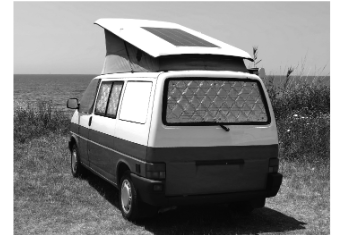
The solar panel is connected to a battery. The solar panel receives energy from the Sun to charge the battery.
(a) Describe how energy is transferred from the Sun’s energy store to the battery’s energy store. (3)
(b) The petrol engine can also be used to charge the battery of the camper van.
Give an advantage of using the solar panel instead of the petrol engine to charge the battery.
Do not refer to cost in your answer. (1)
(c) The surface of the solar panel is black.
Explain why black is a suitable colour for the solar panel. (2)
(d) The solar panel can charge the battery in the camper van with a maximum current of \(15\,\mathrm{A}\).
Calculate the minimum time to transfer \(360\,000\,\mathrm{C}\) of charge through the battery.
Use the formula
\(\mathrm{charge\ transferred}=\mathrm{current}\times\mathrm{time}\) (3)
time = __________________ \(\mathrm{s}\)
Syllabus Topic Codes (Edexcel International GCSE Physics 4PH1):
• 4.6–4.7: Renewable and Non-renewable Energy Resources — part (b)
• 4.15: Absorption and Emission of Radiation — part (c)
• 2.10: Electric Charge and Current — part (d)
▶️ Answer/Explanation
(a) Energy transfer from the Sun to the battery [3 marks]
1. Energy is transferred from the nuclear energy store of the Sun by radiation.
2. The solar panel absorbs the radiation from the Sun.
3. Energy is transferred electrically from the solar panel to the battery, increasing the chemical energy store of the battery.
Final Answer: Energy from the Sun’s nuclear energy store is transferred by radiation to the solar panel. The panel transfers energy electrically to the battery, increasing the chemical energy store of the battery.
(b) Advantage of using a solar panel [1 mark]
One advantage is that solar power is a renewable energy resource.
Alternatively, the solar panel does not produce \( \mathrm{CO_2} \) during operation or reduces the need to use petrol.
Final Answer: \( \boxed{\mathrm{Solar\ power\ is\ renewable}} \)
(c) Why black is suitable for the solar panel [2 marks]
Black is a good absorber of radiation.
Therefore, the black surface absorbs a large amount of the radiation from the Sun.
Final Answer: Black is a good absorber of radiation, so the solar panel absorbs more radiation from the Sun.
(d) Minimum time to transfer the charge [3 marks]
1. Use the charge equation:
\(Q=It\)
2. Rearrange for time:
\(t=\dfrac{Q}{I}\)
3. Substitute the values:
\(t=\dfrac{360\,000}{15}\)
\(t=24\,000\,\mathrm{s}\)
Final Answer: \( \boxed{24\,000\,\mathrm{s}} \)
Question
The photograph shows the tidal power station across the estuary of the river Rance in France.
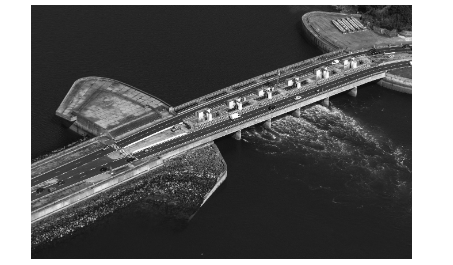
The diagram shows a simplified view of the tidal power station.
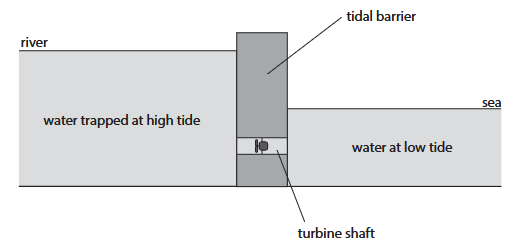
At high tide, water is trapped behind the tidal barrier.
At low tide, the trapped water is released through the turbine shaft. This causes a turbine to spin, which generates electricity.
(a) Give two advantages of generating electricity using tidal power. (2)
1. ________________________________________________
2. ________________________________________________
(b) Give two disadvantages of generating electricity using tidal power. (2)
1. ________________________________________________
2. ________________________________________________
(c) At low tide, water flows through the turbine shaft.
As the height of the trapped water in the river decreases, water falls through a height of \(8.0\,\mathrm{m}\) to reach the turbine shaft.
(i) Calculate the energy transferred from the gravitational store of the water when \(1.0\,\mathrm{kg}\) of water flows through the turbine shaft.
Use the formula
\(\mathrm{change\ in\ gravitational\ potential\ energy}=m\times g\times h\)
energy transferred = __________________ \(\mathrm{J}\)
(ii) The tidal power station has a maximum power output of \(240\,000\,\mathrm{kW}\) when water falls through a height of \(8.0\,\mathrm{m}\).
Calculate the mass of water flowing through the turbine shaft in \(1\,\mathrm{s}\) when the power station is operating at maximum power.
Assume the power station is 100% efficient. (3)
mass of water = __________________ \(\mathrm{kg}\)
Syllabus Topic Codes (Edexcel International GCSE Physics 4PH1):
• 4.13: Gravitational Potential Energy — part (c)(i)
• 4.16–4.17: Power, Energy and Time — part (c)(ii)
• 4.3: Conservation of Energy — relevant to parts (c)(i) and (c)(ii)
• 4.4: Efficiency — relevant to part (c)(ii)
▶️ Answer/Explanation
(a) Advantages of tidal power [2 marks]
Any two suitable advantages:
- Tidal power is a renewable energy resource, so the resource will not run out.
- It does not produce carbon dioxide or greenhouse gases during electricity generation.
- Tides are reliable and predictable.
- It does not produce radioactive waste.
Final Answer: Tidal power is renewable and does not produce carbon dioxide or greenhouse gases during electricity generation.
(b) Disadvantages of tidal power [2 marks]
Any two suitable disadvantages:
- It can have a negative impact on wildlife and marine ecosystems.
- It cannot always provide electricity when it is needed because the output depends on the tides.
- Tides vary over time, so the electrical output is not constant.
- Tidal power stations are only suitable in certain coastal locations.
Final Answer: Tidal power can affect wildlife and cannot always generate electricity when it is needed because the output depends on the tides.
(c)(i) Energy transferred [2 marks]
1. Use the gravitational potential energy equation:
\(\Delta E_\mathrm{p}=mgh\)
2. Substitute the values:
\(\Delta E_\mathrm{p}=(1.0)(10)(8.0)\)
\(\Delta E_\mathrm{p}=80\,\mathrm{J}\)
Final Answer: \( \boxed{80\,\mathrm{J}} \)
(c)(ii) Mass of water flowing through the turbine [3 marks]
1. Convert the power from kW to W:
\(240\,000\,\mathrm{kW}=240\,000\,000\,\mathrm{W}\)
2. Use \(P=\dfrac{E}{t}\):
For \(t=1\,\mathrm{s}\), the energy transferred is
\(E=Pt\)
\(E=(240\,000\,000)(1)\)
\(E=240\,000\,000\,\mathrm{J}\)
3. Use \(E=mgh\):
\(240\,000\,000=m\times10\times8.0\)
\(m=\dfrac{240\,000\,000}{80}\)
\(m=3\,000\,000\,\mathrm{kg}\)
Final Answer: \( \boxed{3.0\times10^6\,\mathrm{kg}} \)
Question
The diagram shows the collision between two balls, A and B. The masses and velocities of both balls are shown before and after the collision. Ball B is stationary before the collision.

(a) When the balls collide, ball B applies a force on ball A, which causes the velocity of ball A to change. Ball A also applies a force on ball B during the collision. Describe how the force applied on ball A compares with the force applied on ball B during the collision.
(b) Calculate the momentum of ball A before the collision.
(c) Show that the velocity, \(v\), of ball B after the collision is about \(0.6\,\mathrm{m\,s^{-1}}\).
(d) A collision is considered elastic if the total kinetic energy before the collision is equal to the total kinetic energy after the collision. Using data from the diagram, deduce whether this collision is elastic.
Syllabus Topic Codes (Edexcel International GCSE Physics 4PH1):
• 1.28P: Force, Momentum, and Time — part (a)
• 1.29P: Newton’s Third Law — part (a)
• 1.13–1.15: Scalars, Vectors, and Force as a Vector Quantity; Resultant Forces — part (a)
• 4.14: Kinetic Energy — part (d)
• 4.15: Conservation of Energy in Mechanical Systems — part (d)
▶️ Answer/Explanation
(a) Forces during the collision [2 marks]
- The force applied by ball A on ball B is equal in magnitude to the force applied by ball B on ball A.
- The two forces act in opposite directions.
This is an example of Newton’s Third Law. The forces form an action-reaction pair and act on different balls.
(b) Momentum of ball A before the collision [2 marks]
Use the momentum equation:
\(p=m v\)
From the diagram:
\(m=0.018\,\mathrm{kg}\)
\(v=4.9\,\mathrm{m\,s^{-1}}\)
Therefore:
\(p=0.018\times4.9\)
\(p=0.0882\,\mathrm{kg\,m\,s^{-1}}\)
So the momentum of ball A is approximately:
\(\boxed{0.088\,\mathrm{kg\,m\,s^{-1}}}\)
(c) Velocity of ball B after the collision [4 marks]
Momentum is conserved in the collision.
Total momentum before = total momentum after
Ball B is initially stationary, so its initial momentum is zero.
Therefore:
\(0.088=0.018\times(-3.5)+0.265v\)
Rearranging:
\(0.088+0.063=0.265v\)
\(v=\dfrac{0.151}{0.265}\)
\(v\approx0.57\,\mathrm{m\,s^{-1}}\)
Therefore:
\(\boxed{v\approx0.6\,\mathrm{m\,s^{-1}}}\)
(d) Determining whether the collision is elastic [4 marks]
For an elastic collision, the total kinetic energy before the collision must equal the total kinetic energy after the collision.
Use:
\(E_{\mathrm{k}}=\dfrac{1}{2}mv^2\)
Kinetic energy before the collision:
Ball B is stationary, so its initial kinetic energy is zero.
\(E_{\mathrm{k,before}}=\dfrac{1}{2}(0.018)(4.9)^2\)
\(E_{\mathrm{k,before}}\approx0.216\,\mathrm{J}\)
Kinetic energy after the collision:
For ball A:
\(E_{\mathrm{k,A}}=\dfrac{1}{2}(0.018)(3.5)^2\approx0.110\,\mathrm{J}\)
For ball B:
\(E_{\mathrm{k,B}}=\dfrac{1}{2}(0.265)(0.57)^2\approx0.043\,\mathrm{J}\)
Therefore:
\(E_{\mathrm{k,after}}\approx0.110+0.043=0.153\,\mathrm{J}\)
Since \(0.216\,\mathrm{J}\neq0.153\,\mathrm{J}\), the total kinetic energy is not conserved.
Therefore, the collision is not elastic. It is an inelastic collision.
Question
A wrench is used to turn a nut.

(a) The force applied to the wrench is \(28\,\mathrm{N}\). Calculate the moment applied by the wrench on the nut. Give a suitable unit.
(b) State two changes that could be made to increase the size of the moment applied to the nut.
(c) Diagram 2 shows the wrench as it is turned through \(90^\circ\).

(i) The force is applied over a distance that is equal to a quarter of the circumference of a circle. The circle has a radius of \(15\,\mathrm{cm}\). Calculate the distance over which the force is applied.
[circumference of circle \(=2\times\pi\times\mathrm{radius}\)]
(ii) Calculate the work done by the force as the wrench is turned through a quarter of the circumference of the circle.
Syllabus Topic Codes (Edexcel International GCSE Physics 4PH1):
• 4.11: Work Done by a Force — part (c)(ii)
• 4.12: Work Done and Energy Transfer — part (c)(ii)
▶️ Answer/Explanation
(a) Moment applied to the nut [3 marks]
Use the equation:
\( \mathrm{moment}=\mathrm{force}\times\mathrm{perpendicular\ distance} \)
From the diagram, the perpendicular distance from the nut is \(15\,\mathrm{cm}=0.15\,\mathrm{m}\).
Therefore:
\( \mathrm{moment}=28\times0.15 \)
\( \mathrm{moment}=4.2\,\mathrm{N\,m} \)
\(\boxed{4.2\,\mathrm{N\,m}}\)
(b) Increasing the moment [2 marks]
Two suitable changes are:
- Apply a larger force.
- Apply the force further from the nut, increasing the perpendicular distance.
This follows from \( \mathrm{moment}=\mathrm{force}\times\mathrm{perpendicular\ distance} \).
(c)(i) Distance travelled by the end of the wrench [2 marks]
The circumference of the circle is:
\(C=2\pi r\)
\(C=2\times\pi\times15\)
\(C\approx94.2\,\mathrm{cm}\)
The wrench is turned through a quarter of the circle, so:
\(d=\dfrac{94.2}{4}\)
\(d\approx23.6\,\mathrm{cm}\)
Therefore, to a suitable value:
\(\boxed{d\approx24\,\mathrm{cm}}\)
(c)(ii) Work done by the force [3 marks]
Convert the distance into metres:
\(24\,\mathrm{cm}=0.24\,\mathrm{m}\)
Use:
\(W=Fd\)
Therefore:
\(W=28\times0.24\)
\(W=6.72\,\mathrm{J}\)
So the work done is approximately \(6.7\,\mathrm{J}\).