
Edexcel iGCSE Physics (4PH1) 4.4 Energy Resources and Electricity Generation Exam Style Question Paper 1B - New Syllabus
Question
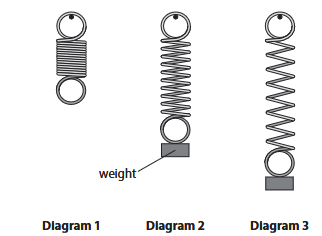
(a) The diagrams show a spring hanging from a nail.
- diagram 1 shows the spring with no weight added
- diagram 2 shows the spring stationary, after a weight has been added
- diagram 3 shows the spring after the weight has been pulled down
(i) Which energy store has increased for the spring in diagram 2 compared to the spring in diagram 1? (1)
A chemical
B elastic
C gravitational potential
D kinetic
(ii) The spring is released from the position shown in diagram 3.
Describe the energy transfers that take place until the spring stops vibrating. (6)
(b) Shock absorbers containing springs are used on motorcycles.
Shock absorbers are designed to compress and expand as the motorcycle moves across a rough surface.
A new type of shock absorber has been developed to generate electricity from the movement of the motorcycle.
This new type of shock absorber consists of magnets that slide inside a coil when the motorcycle goes over a bump.
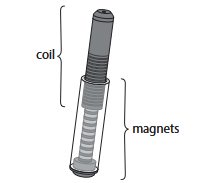
Some of the energy that would normally be wasted can be recovered, so fuel is saved.
(i) Which of these statements best describes the advantage of this new type of shock absorber? (1)
A it increases the energy transferred to a thermal store from the fuel
B it increases the efficiency of the motorcycle
C it decreases the speed of the motorcycle
D it decreases the braking power of the motorcycle
(ii) Explain how this new type of shock absorber can generate electricity. (3)
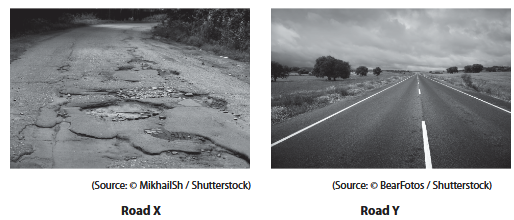
(iii) Road X has a rough surface.
Road Y has a smooth surface.
A motorcycle travels at the same speed along road X and road Y.
Explain why the new type of shock absorber will generate more electricity for this motorcycle on road X than on road Y. (3)
Syllabus Topic Codes (Edexcel International GCSE Physics 4PH1):
• 4.3: Conservation of energy — part (a)(ii)
• 6.15: Electromagnetic induction and induced voltage — parts (b)(ii) and (b)(iii)
• 6.16: Generation of electricity by electromagnetic induction — parts (b)(ii) and (b)(iii)
▶️ Answer/Explanation
(a)(i) Correct Answer: \( \boxed{\mathrm{B\ (elastic)}} \) [1 mark]
Adding the weight stretches the spring, so the energy in the elastic store of the spring increases.
For a spring, the elastic energy store can be related to its extension by \(E_{\mathrm{elastic}}=\dfrac{1}{2}kx^2\), where \(k\) is the spring constant and \(x\) is the extension.
(a)(ii) Energy transfers until the spring stops vibrating [6 marks]
- When the spring is released, its elastic energy store decreases as the spring moves upwards.
- Energy is transferred to the kinetic store of the weight and spring as they accelerate upwards.
- The gravitational potential energy store increases as the weight moves upwards.
- At the highest point, the motion reverses and the weight moves downwards, so gravitational potential energy is transferred to the kinetic store.
- As the spring moves downwards again, energy is transferred mechanically back into the elastic store of the spring.
- The amplitude of the vibrations decreases because energy is transferred to the thermal store of the spring and surroundings, mainly due to friction and air resistance.
Eventually, the vibrations stop and the energy initially stored in the spring has been transferred mainly to the thermal store of the spring and its surroundings.
Key principle: Energy is not destroyed. It is transferred between different energy stores.
(b)(i) Advantage of the new shock absorber [1 mark]
Correct Answer: \( \boxed{\mathrm{B\ it\ increases\ the\ efficiency\ of\ the\ motorcycle}} \)
Some energy that would otherwise be wasted is recovered and converted into useful electrical energy, so the overall efficiency increases.
(b)(ii) Generating electricity [3 marks]
- The magnets move through the coil when the shock absorber moves.
- The moving magnets cause the coil to cut magnetic field lines, so the magnetic field through the coil changes.
- An induced voltage is produced in the coil, which can cause a current to flow and generate electrical energy.
This is an example of electromagnetic induction.
(b)(iii) Why more electricity is generated on Road X [3 marks]
- Road X has a rougher surface, so there are more frequent and/or larger bumps.
- The shock absorber therefore compresses and expands more frequently and/or by a greater amount.
- The magnets move through the coil more frequently and/or over a greater distance, producing a larger or more frequent induced voltage and therefore more electrical energy.
The key idea is that greater movement of the magnets through the coil produces a greater amount of electromagnetic induction.
Final Answer: Road X causes more movement of the magnets through the coil, so the magnetic field through the coil changes more frequently and/or by a greater amount. This produces more induced voltage and therefore more electricity.
Question
A model electric motor is used to lift a load through a vertical height.

(a) The load has a mass of \(400\,\mathrm{g}\) and gains \(3.2\,\mathrm{J}\) of energy in its gravitational store when lifted.
(i) State the formula linking gravitational potential energy, mass, gravitational field strength (\(g\)) and height.
(ii) Calculate the height the load is lifted.
(iii) State the amount of useful work done on the load by the motor when the load is lifted through this height.
(b) The load is lifted at a constant speed. Diagram 1 shows the lifting force acting on the load as it is lifted. Draw a labelled arrow on diagram 1 to show the other force acting on the load. Ignore the effects of air resistance.

(c) A joulemeter measures the amount of energy transferred electrically to the motor as the motor lifts the load. The joulemeter displays a reading of \(11.0\,\mathrm{J}\) when the load has gained \(3.2\,\mathrm{J}\) of energy in its gravitational store.
(i) Calculate the efficiency of the motor.
(ii) Justify why \(7.8\,\mathrm{J}\) of energy must be dissipated into the thermal store of the surroundings as the load is lifted.
(iii) Diagram 2 is an incomplete Sankey diagram. Complete the Sankey diagram to show the energy transferred by the motor.

Syllabus Topic Codes (Edexcel International GCSE Physics 4PH1):
• 4.12: Work Done and Energy Transfer — part (a)(iii)
• 1.17–1.18: Force, Mass, Weight, and Gravitational Field Strength — part (b)
• 4.4: Efficiency — part (c)(i)
• 4.3: Conservation of Energy — part (c)(ii)
• 4.5: Energy Transfers in Devices and Sankey Diagrams — part (c)(iii)
▶️ Answer/Explanation
(a)(i) Gravitational potential energy formula [1 mark]
The formula linking gravitational potential energy, mass, gravitational field strength and height is:
\(\boxed{E_{\mathrm{p}}=mgh}\)
(a)(ii) Height lifted [3 marks]
Convert the mass into kilograms:
\(400\,\mathrm{g}=0.40\,\mathrm{kg}\)
Use:
\(E_{\mathrm{p}}=mgh\)
Substitute \(E_{\mathrm{p}}=3.2\,\mathrm{J}\), \(m=0.40\,\mathrm{kg}\), and \(g=10\,\mathrm{N\,kg^{-1}}\):
\(3.2=0.40\times10\times h\)
\(h=\dfrac{3.2}{0.40\times10}\)
\(h=0.80\,\mathrm{m}\)
Therefore: \(\boxed{h=0.80\,\mathrm{m}}\)
(a)(iii) Useful work done [1 mark]
The useful work done is equal to the increase in the gravitational potential energy store.
Therefore: \(\boxed{W=3.2\,\mathrm{J}}\)
(b) Other force acting on the load [2 marks]
Since the load is moving at a constant speed, the resultant force is zero. Therefore, the upward lifting force must be balanced by the downward weight of the load.
Draw a vertically downward arrow labelled weight, \(W\), or \(mg\). The arrow should be equal in length to the lifting-force arrow.
(c)(i) Efficiency of the motor [3 marks]
Use:
\(\mathrm{efficiency}=\dfrac{\mathrm{useful\ energy\ output}}{\mathrm{total\ energy\ input}}\times100\%\)
Substitute the useful energy output \(3.2\,\mathrm{J}\) and total energy input \(11.0\,\mathrm{J}\):
\(\mathrm{efficiency}=\dfrac{3.2}{11.0}\times100\%\)
\(\mathrm{efficiency}\approx29\%\)
Therefore: \(\boxed{\mathrm{efficiency}=29\%}\)
(c)(ii) Dissipated energy [2 marks]
Energy must be conserved. The electrical energy supplied is \(11.0\,\mathrm{J}\), while \(3.2\,\mathrm{J}\) is transferred usefully to the gravitational store.
Therefore, the remaining energy is:
\(11.0-3.2=7.8\,\mathrm{J}\)
This energy is dissipated mainly into the thermal store of the surroundings.
Therefore: \(\boxed{7.8\,\mathrm{J}}\)
(c)(iii) Sankey diagram [2 marks]
The Sankey diagram should show:
- An input of \(11.0\,\mathrm{J}\).
- A useful output of \(3.2\,\mathrm{J}\) directed to the right and labelled useful output (energy).
- A dissipated output of \(7.8\,\mathrm{J}\) directed downwards and transferred to the thermal store of the surroundings.
The useful output arrow should have a width corresponding to 8 small squares, as shown by the mark scheme.