
Edexcel iGCSE Physics (4PH1) 4.4 Energy Resources and Electricity Generation Exam Style Question Paper 2B - New Syllabus
Question
The diagram shows some of the parts of a hydroelectric power station.
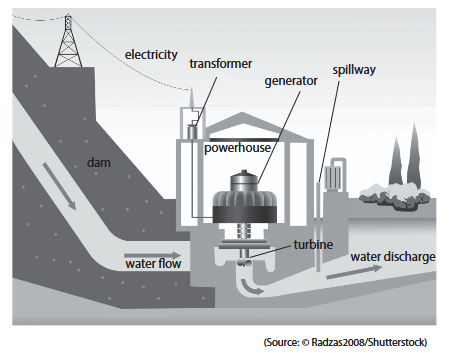
Water is discharged from the turbine, and a spillway is also shown.
(a) Water enters the turbine with a momentum of \(120\,000\,\mathrm{kg\,m\,s^{-1}}\).
(i) State the formula linking momentum, mass and velocity. (1)
(ii) A mass of \(14\,000\,\mathrm{kg}\) of water enters the turbine.
Calculate the velocity of the water as it enters the turbine. (2)
velocity = __________________ \(\mathrm{m\,s^{-1}}\)
(iii) The \(14\,000\,\mathrm{kg}\) of water leaves the turbine.
This water has a momentum of \(63\,000\,\mathrm{kg\,m\,s^{-1}}\) after it leaves the turbine.
The turbine exerts a force of \(6100\,\mathrm{N}\) on the water.
Calculate the time taken for the water to pass through the turbine. (3)
time = __________________ \(\mathrm{s}\)
(b) As the water passes through the turbine, energy is lost from the water’s kinetic energy store.
Explain what happens to the energy lost from the water’s kinetic energy store. (3)
(c) Hydroelectric power is an example of a renewable resource for the generation of electricity.
Give two examples of non-renewable resources for the generation of electricity. (2)
1. __________________________________________
2. __________________________________________
Syllabus Topic Codes (Edexcel International GCSE Physics 4PH1):
• 1.28P: Force, Momentum, and Time — part (a)(iii)
• 4.2–4.5: Energy Stores, Energy Transfer Pathways, Conservation of Energy, Efficiency, and Energy Transfers in Devices — part (b)
• 4.18–4.19P: Electricity Generation from Energy Resources; Advantages and Disadvantages — part (c)
▶️ Answer/Explanation
(a)(i) Momentum formula [1 mark]
The relationship between momentum, mass and velocity is:
\(p=mv\)
Final Answer: \( \boxed{p=mv} \)
(a)(ii) Velocity of the water [2 marks]
1. Start with the momentum equation:
\(p=mv\)
2. Rearrange for velocity:
\(v=\dfrac{p}{m}\)
3. Substitute the values:
\(v=\dfrac{120\,000}{14\,000}\)
\(v=8.57\,\mathrm{m\,s^{-1}}\)
To 2 significant figures:
\(v=8.6\,\mathrm{m\,s^{-1}}\)
Final Answer: \( \boxed{8.6\,\mathrm{m\,s^{-1}}} \)
(a)(iii) Time taken for the water to pass through the turbine [3 marks]
1. Calculate the change in momentum:
\(\mathrm{change\ in\ momentum}=120\,000-63\,000\)
\(\mathrm{change\ in\ momentum}=57\,000\,\mathrm{kg\,m\,s^{-1}}\)
2. Use the relationship between force, momentum change and time:
\(F=\dfrac{\Delta p}{t}\)
Therefore:
\(t=\dfrac{\Delta p}{F}\)
3. Substitute the values:
\(t=\dfrac{57\,000}{6100}\)
\(t=9.34\,\mathrm{s}\)
To an appropriate number of significant figures:
\(t=9.3\,\mathrm{s}\)
Final Answer: \( \boxed{9.3\,\mathrm{s}} \)
(b) Energy transfer from the water [3 marks]
- Energy is transferred mechanically from the water to the turbine.
- The kinetic energy store of the turbine increases as the turbine rotates.
- Some energy is also transferred to the thermal energy stores of the turbine and its surroundings, for example because of friction and other unwanted energy transfers.
Final Answer: The energy lost from the water’s kinetic energy store is mainly transferred mechanically to the turbine, increasing its kinetic energy store. Some energy is dissipated to the thermal energy stores of the turbine and surroundings.
(c) Non-renewable energy resources [2 marks]
Any two suitable examples include:
- coal
- gas
- oil
- petrol
- diesel
- kerosene
- uranium
- plutonium
- nuclear fuel
- fossil fuels
Final Answer: \( \boxed{\mathrm{coal\ and\ gas}} \)
Question
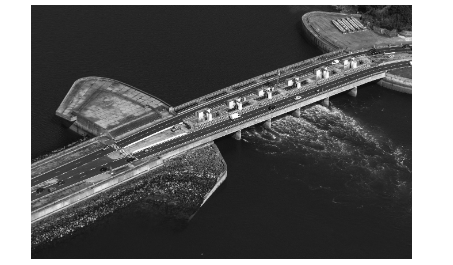
The photograph shows the tidal power station across the estuary of the river Rance in France.
The diagram shows a simplified view of the tidal power station.
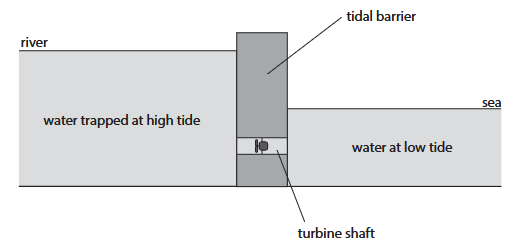
At high tide, water is trapped behind the tidal barrier.
At low tide, the trapped water is released through the turbine shaft. This causes a turbine to spin, which generates electricity.
(a) Give two advantages of generating electricity using tidal power. (2)
1. ________________________________________________
2. ________________________________________________
(b) Give two disadvantages of generating electricity using tidal power. (2)
1. ________________________________________________
2. ________________________________________________
(c) At low tide, water flows through the turbine shaft.
As the height of the trapped water in the river decreases, water falls through a height of \(8.0\,\mathrm{m}\) to reach the turbine shaft.
(i) Calculate the energy transferred from the gravitational store of the water when \(1.0\,\mathrm{kg}\) of water flows through the turbine shaft.
Use the formula
\(\mathrm{change\ in\ gravitational\ potential\ energy}=m\times g\times h\)
energy transferred = __________________ \(\mathrm{J}\)
(ii) The tidal power station has a maximum power output of \(240\,000\,\mathrm{kW}\) when water falls through a height of \(8.0\,\mathrm{m}\).
Calculate the mass of water flowing through the turbine shaft in \(1\,\mathrm{s}\) when the power station is operating at maximum power.
Assume the power station is 100% efficient. (3)
mass of water = __________________ \(\mathrm{kg}\)
Syllabus Topic Codes (Edexcel International GCSE Physics 4PH1):
• 4.13: Gravitational Potential Energy — part (c)(i)
• 4.16–4.17: Power, Energy and Time — part (c)(ii)
• 4.3: Conservation of Energy — relevant to parts (c)(i) and (c)(ii)
• 4.4: Efficiency — relevant to part (c)(ii)
▶️ Answer/Explanation
(a) Advantages of tidal power [2 marks]
Any two suitable advantages:
- Tidal power is a renewable energy resource, so the resource will not run out.
- It does not produce carbon dioxide or greenhouse gases during electricity generation.
- Tides are reliable and predictable.
- It does not produce radioactive waste.
Final Answer: Tidal power is renewable and does not produce carbon dioxide or greenhouse gases during electricity generation.
(b) Disadvantages of tidal power [2 marks]
Any two suitable disadvantages:
- It can have a negative impact on wildlife and marine ecosystems.
- It cannot always provide electricity when it is needed because the output depends on the tides.
- Tides vary over time, so the electrical output is not constant.
- Tidal power stations are only suitable in certain coastal locations.
Final Answer: Tidal power can affect wildlife and cannot always generate electricity when it is needed because the output depends on the tides.
(c)(i) Energy transferred [2 marks]
1. Use the gravitational potential energy equation:
\(\Delta E_\mathrm{p}=mgh\)
2. Substitute the values:
\(\Delta E_\mathrm{p}=(1.0)(10)(8.0)\)
\(\Delta E_\mathrm{p}=80\,\mathrm{J}\)
Final Answer: \( \boxed{80\,\mathrm{J}} \)
(c)(ii) Mass of water flowing through the turbine [3 marks]
1. Convert the power from kW to W:
\(240\,000\,\mathrm{kW}=240\,000\,000\,\mathrm{W}\)
2. Use \(P=\dfrac{E}{t}\):
For \(t=1\,\mathrm{s}\), the energy transferred is
\(E=Pt\)
\(E=(240\,000\,000)(1)\)
\(E=240\,000\,000\,\mathrm{J}\)
3. Use \(E=mgh\):
\(240\,000\,000=m\times10\times8.0\)
\(m=\dfrac{240\,000\,000}{80}\)
\(m=3\,000\,000\,\mathrm{kg}\)
Final Answer: \( \boxed{3.0\times10^6\,\mathrm{kg}} \)
Question
This question is about generating electricity from renewable energy resources.
(a) Photograph 1 shows a solar farm in the United Kingdom and photograph 2 shows a geothermal power station in Iceland.

Discuss the advantages and disadvantages of generating electricity using solar power and geothermal resources.
(b) A student investigates how the amount of light affects the output voltage of a solar cell. Photograph 3 shows how the student sets up their equipment.

(i) The student varies the distance between the solar cell and the lamp and measures the output voltage of the solar cell at each distance. The student’s results are shown below.

Draw a table showing the student’s results.
(ii) Give a control variable for the student’s investigation.
(iii) The student states that the solar cell could be used as a power source for the lamp. They suggest that this would work if:
- the solar cell is connected directly to the lamp
- the light from the lamp is used to produce the output power from the solar cell
Explain, with reference to the principle of conservation of energy, why the student’s suggestion would not work.
Syllabus Topic Codes (Edexcel International GCSE Physics 4PH1):
• 4.3: Conservation of Energy — part (b)(iii)
• 4.2: Energy Stores and Energy Transfer Pathways — part (b)(iii)
▶️ Answer/Explanation
(a) Advantages and disadvantages of solar and geothermal power
Solar power:
- Advantage: Produces no noise.
- Advantage: Produces no greenhouse, polluting, or harmful gases during electricity generation.
- Advantage: Solar energy is available in many locations.
- Disadvantage: Electricity generation depends on the amount of sunlight available.
- Disadvantage: A large area may be required for solar panels.
Geothermal power:
- Advantage: It can be used throughout the day and is not dependent on sunlight.
- Advantage: It requires a relatively small amount of space.
- Advantage: It produces very little or no noise.
- Disadvantage: It is not available in all locations.
- Disadvantage: It may release greenhouse, polluting, or harmful gases.
- Disadvantage: There is a possible risk of groundwater pollution.
The main comparison is that solar power is widely available but depends on sunlight, whereas geothermal power can provide a more continuous supply but is restricted to suitable geological locations.
(b)(i) Results table
The results should be organised into two columns with clear headings and units.
| Distance between lamp and solar cell | Output voltage |
|---|---|
| Include the appropriate unit from the results | Include the appropriate unit from the results |
All the values should be copied accurately and recorded to the same number of decimal places as originally given.
(b)(ii) Control variable
One suitable control variable is the power or brightness of the lamp.
Other acceptable answers include the amount of background light or the light intensity of the lamp.
(b)(iii) Conservation of energy [3 marks]
- The lamp and solar cell are not 100% efficient, so some energy is transferred to unwanted forms.
- Not all of the light produced by the lamp is received by the solar cell.
- Some energy is lost to the surroundings, for example as thermal energy in the lamp, solar cell, or connecting wires.
Therefore, the solar cell cannot produce enough electrical energy from the lamp’s light to continuously power the same lamp. This would require more useful energy to be produced than is supplied, which contradicts the principle of conservation of energy.
Question
A hydroelectric power (HEP) station generates electricity from renewable energy resources.
(a) State what is meant by the term renewable energy resource.
(b) The diagram shows the design of a HEP station.

Water flows from the upper lake to the lower lake through the turbine. The turbine is connected to a generator, which generates electricity. Describe the energy transfers involved in generating electricity in the HEP station.
(c) The HEP station is located near a large wind farm.
(i) Give one advantage of generating electricity using the HEP station rather than the wind farm.
(ii) Give one disadvantage of generating electricity using the HEP station rather than the wind farm.
(iii) The HEP station has an electric pump that can pump water from the lower lake back to the upper lake. The pump can be powered using electricity generated by the wind farm.
Explain how the HEP station and wind farm can be used together to maximise the effectiveness of generating electricity.
Syllabus Topic Codes (Edexcel International GCSE Physics 4PH1):
• 4.2: Energy Stores and Energy Transfer Pathways — part (b)
• 4.3: Conservation of Energy — parts (b) and (c)(iii)
• 4.4: Efficiency — part (c)(iii)
▶️ Answer/Explanation
(a) Renewable energy resource [1 mark]
A renewable energy resource is an energy resource that will not run out or can be replaced naturally at a rate comparable to its use.
(b) Energy transfers in a HEP station [4 marks]
The water stored in the upper lake has a large amount of gravitational potential energy.
As the water flows down towards the lower lake, its gravitational potential energy decreases and is transferred mainly to kinetic energy of the moving water.
The moving water transfers energy mechanically to the turbine, causing the turbine to rotate. The turbine drives the generator, which transfers energy into an electrical form.
Some energy is dissipated to the surroundings, for example as thermal energy and sound.
The overall energy pathway can therefore be represented as:
gravitational potential energy → kinetic energy → mechanical energy → electrical energy
(c)(i) Advantage of HEP compared with wind power [1 mark]
One advantage is that HEP can provide electricity more reliably because it is not directly dependent on wind conditions.
(c)(ii) Disadvantage of HEP compared with wind power [1 mark]
One disadvantage is that a large area of land may need to be flooded to create the reservoir, which can damage habitats.
(c)(iii) Using the HEP station and wind farm together [3 marks]
A wind farm cannot store the electrical energy it generates directly. When electricity demand is low and the wind farm is producing excess electricity, this electricity can be used to power the pump.
The pump transfers water from the lower lake back to the upper lake, increasing the gravitational potential energy stored in the water.
The upper lake therefore acts as an energy store for excess energy generated by the wind farm. When electricity demand is high, the stored water can flow through the turbine to generate electricity.
This allows excess wind energy to be stored and released when needed, increasing the amount of energy that can be transferred usefully to consumers.
Question
This question is about different methods of generating electricity.
(a) Natural gas can be burned to generate electricity. Name the energy store that decreases when natural gas is burned.
(b) Burning natural gas and the movement of water waves can both be used to generate electricity. Discuss the advantages and disadvantages of these two methods of generating electricity.
Syllabus Topic Codes (Edexcel International GCSE Physics 4PH1):
• 4.18–4.19P: Electricity Generation from Energy Resources; Advantages and Disadvantages — part (b)
▶️ Answer/Explanation
(a) Energy store [1 mark]
The chemical energy store decreases when natural gas is burned.
The chemical energy stored in the fuel is transferred to other energy stores and eventually used to generate electrical energy.
(b) Advantages and disadvantages [6 marks]
Natural gas
Advantages:
- Electricity generation can be changed to meet demand.
- It is a reliable method of generating electricity.
Disadvantages:
- Natural gas is non-renewable and will eventually run out.
- Burning natural gas produces \(CO_2\), a greenhouse gas.
- A country may become dependent on other countries to supply natural gas.
Wave power
Advantages:
- Wave power is a renewable energy resource.
- It produces no polluting gases during electricity generation.
Disadvantages:
- Waves may not always be present, so electricity generation can be variable.
- Wave-power systems may harm wildlife.
- The generator may suffer damage during storms.
Overall, natural gas provides a relatively reliable and controllable supply of electricity, but it is non-renewable and produces \(CO_2\). Wave power is renewable and does not produce polluting gases during generation, but its output depends on the availability of waves.
Question
Kori Nuclear Power Plant in South Korea is one of the world’s largest nuclear fission power stations.

(a) The reactors at Kori use nuclear fission to generate electricity. The products released during nuclear fission have high energy in their kinetic store. Give a product of nuclear fission.
(b) Give two disadvantages of using nuclear fission to generate electricity.
(c) Kori has a maximum power output of \(7.49\times10^9\,\mathrm{W}\).
(i) State what is meant by the term power.
(ii) Calculate the minimum time taken for Kori to transfer \(6.47\times10^{14}\,\mathrm{J}\) of energy.
Syllabus Topic Codes (Edexcel International GCSE Physics 4PH1):
• 4.18–4.19P: Electricity Generation from Energy Resources; Advantages and Disadvantages — part (b)
• 4.16–4.17: Power, Energy, and Time — parts (c)(i)–(ii)
▶️ Answer/Explanation
(a) Product of nuclear fission [1 mark]
A product of nuclear fission can be a daughter nucleus, such as a nucleus of barium or krypton.
Fission can also release neutrons.
Example answer: \(\boxed{\text{barium nucleus}}\)
(b) Disadvantages of nuclear fission [2 marks]
Any two valid disadvantages include:
- It produces radioactive waste, which requires safe storage and disposal.
- The fuel, such as uranium, is a non-renewable resource.
- There is a risk of a nuclear accident.
- Nuclear power stations have high construction or decommissioning costs.
(c)(i) Meaning of power [1 mark]
Power is the rate of energy transfer, or the rate of doing work.
\(\displaystyle P=\frac{E}{t}\)
(c)(ii) Minimum time [3 marks]
Use the relationship:
\(\displaystyle P=\frac{E}{t}\)
Rearrange to make \(t\) the subject:
\(\displaystyle t=\frac{E}{P}\)
Substitute the values:
\(\displaystyle t=\frac{6.47\times10^{14}}{7.49\times10^9}\)
\(\displaystyle t\approx86400\,\mathrm{s}\)
Therefore:
\(\boxed{t=8.64\times10^4\,\mathrm{s}}\)
This is the minimum time because the calculation assumes Kori operates continuously at its maximum power output.