
Edexcel iGCSE Physics (4PH1) 5.2 Density and Pressure Exam Style Question Paper 1B - New Syllabus
Question
The photograph shows a ring made of gold.
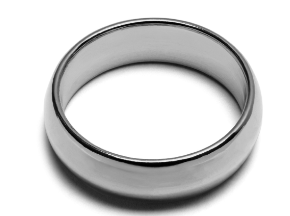
A student wants to determine the volume of the ring.
(a) The student measures the mass of the ring several times.
(i) Describe how the student should use laboratory equipment to accurately measure the mass of the ring. (2)
(ii) The table shows the student’s measurements of the mass of the ring.
| Mass in \(\mathrm{g}\) |
|---|
| \(6.411\) |
| \(6.408\) |
| \(6.410\) |
| \(6.426\) |
| \(6.412\) |
One of the student’s measurements is an anomaly.
Draw a circle around the anomalous result in the table. (1)
(iii) Calculate the mean mass of the gold ring. (3)
mean mass = __________________ \(\mathrm{g}\)
(iv) The student is given a value for the density of gold.
Which of these formulae should be used to calculate the volume of the gold ring? (1)
(B) volume = mass \(\div\) density\(^3\)
(C) volume = mass \(\div\) density
(D) volume = mass \(\div\) density\(^3\)
(b) The student does not know if the ring is made of pure gold.
The student suggests that they could also measure the volume of the ring using a displacement method.
Discuss which method (calculation method or displacement method) will give the most accurate volume measurement. (4)
Syllabus Topic Codes (Edexcel International GCSE Physics 4PH1):
• 5.4: Practical investigation of density using direct measurements of mass and volume — parts (a)(i), (a)(ii), (a)(iii) and (b)
▶️ Answer/Explanation
(a)(i) Measuring the mass accurately [2 marks]
- Use an electronic balance to measure the mass of the ring.
- Zero or tare the balance before placing the ring on it.
- Place the balance on a level surface and avoid draughts or air movement.
(a)(ii) Identifying the anomaly [1 mark]
The anomalous measurement is \(6.426\,\mathrm{g}\).
This value is noticeably further from the other measurements, which are clustered around \(6.410\,\mathrm{g}\).
(a)(iii) Mean mass [3 marks]
1. Exclude the anomalous value:
Use \(6.411\,\mathrm{g}\), \(6.408\,\mathrm{g}\), \(6.410\,\mathrm{g}\) and \(6.412\,\mathrm{g}\).
2. Calculate the mean:
\(\mathrm{mean\ mass}=\dfrac{6.411+6.408+6.410+6.412}{4}\)
\(\mathrm{mean\ mass}=\dfrac{25.641}{4}=6.41025\,\mathrm{g}\)
3. Round appropriately:
\(\mathrm{mean\ mass}=6.410\,\mathrm{g}\)
Final Answer: \( \boxed{6.410\,\mathrm{g}} \)
(a)(iv) Correct Answer: \( \boxed{\mathrm{C}} \) volume = mass \(\div\) density [1 mark]
The density relationship is:
\(\rho=\dfrac{m}{V}\)
Rearranging gives:
\(V=\dfrac{m}{\rho}\)
(b) Comparing the two methods [4 marks]
- The calculation method uses \(V=\dfrac{m}{\rho}\).
- This method assumes that the density value used is appropriate for the ring. If the ring is not pure gold, its density may differ from the given density of pure gold, causing an error in the calculated volume.
- The mass measurement is relatively precise because the balance gives several significant figures.
- The displacement method does not require the ring to be pure gold because the volume is measured directly from the change in water level.
- However, the ring has a small volume, so the change in water level may be small and the percentage uncertainty may be large.
- There may also be errors caused by splashing, the ring not being fully submerged, or difficulty reading the meniscus accurately.
Therefore, the calculation method is likely to give the more precise volume measurement if the ring is pure gold and the correct density is used. If the purity is uncertain, the displacement method avoids the uncertainty in the density and may give a more reliable measurement of the actual volume.
Final Answer: Both methods have advantages. The calculation method can be more accurate because the ring has a small volume and displacement measurements may have a large percentage uncertainty. However, the calculation method is affected by the purity of the gold, whereas displacement measures the volume directly.
Question
The diagram shows a pot made of clay.
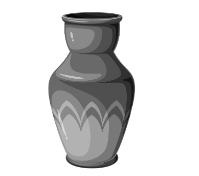
(a) Describe a method that could be used to accurately determine the volume of clay used in the pot. (4 marks)
________________________________________________________________________________________________
________________________________________________________________________________________________
________________________________________________________________________________________________
(b) Give the name of a piece of apparatus that could be used to measure the mass of the clay pot. (1 mark)
________________________________________________________________________________________________
(c) The clay pot can be used to hold liquids.
A student needs to determine the volume of liquid that can be contained in the pot.
The student measures the mass of the empty pot and then measures the mass of the pot again when it is filled with a liquid.
The table shows the student’s measurements.
| Mass of empty pot / kg | 1.2 |
| Mass of pot filled with liquid / kg | 6.8 |
The density of the liquid used is \(920\,\mathrm{kg\,m^{-3}}\).
Calculate the volume of liquid that can be contained in the pot.
Use the formula
\(\mathrm{density}=\dfrac{\mathrm{mass}}{\mathrm{volume}}\)
volume = ____________________ \(\mathrm{m^3}\) (4 marks)
Syllabus Topic Codes (Edexcel International GCSE Physics 4PH1):
• 5.3–5.4: Density, mass and volume / Density measurements — part (b)
• 5.3: Density, mass and volume — part (c)
▶️ Answer/Explanation and Mark Scheme
(a) Measuring the volume of clay [4 marks]
- Use a displacement method to determine the volume.
- Measure a known volume of water using a measuring cylinder.
- Fully submerge the clay pot in the water and measure the new volume.
- The difference between the two readings gives the volume of the clay. Repeat the measurement and take an average for greater accuracy.
Accuracy points: Avoid splashing, read the measuring cylinder at eye level, place it on a flat surface, and ensure there is no trapped air.
(b) Apparatus [1 mark]
\(\boxed{\text{top-pan balance}}\)
(c) Volume of liquid [4 marks]
1. Calculate the mass of the liquid:
\(m=6.8-1.2=5.6\,\mathrm{kg}\)
2. Rearrange the density equation:
\(\rho=\dfrac{m}{V}\)
\(V=\dfrac{m}{\rho}\)
3. Substitute:
\(V=\dfrac{5.6}{920}\)
\(V=0.006086\ldots\,\mathrm{m^3}\)
Answer: \( \boxed{0.0061\,\mathrm{m^3}} \)
Total: \(9\) marks
Question
This question is about pressure.
(a) Small air bubbles form in a container of water.
(i) The pressure of the water acts on these bubbles.
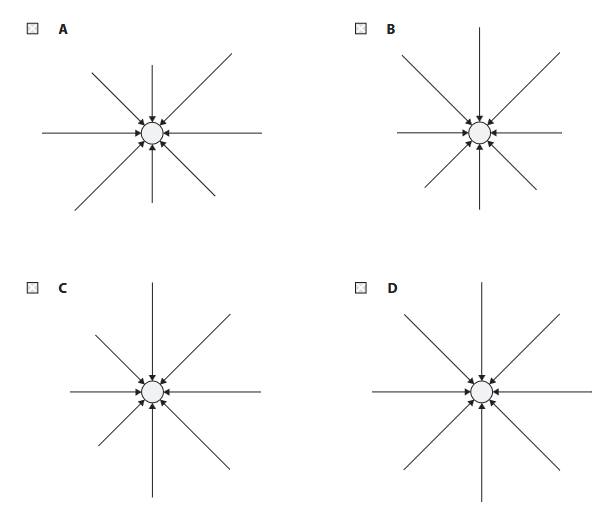
The diagrams show the forces that cause this pressure.
Which diagram correctly shows how the pressure of the water acts on a stationary air bubble? (1)
(ii) The diagram shows the air bubbles rising to the surface of the water in a container.
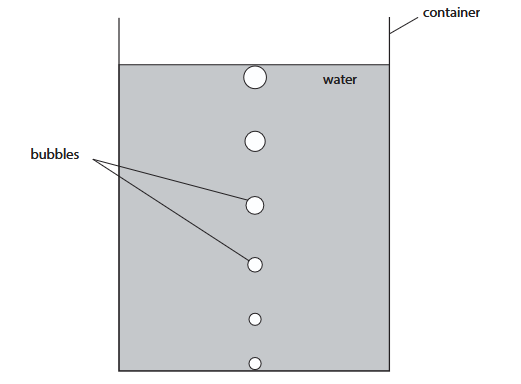
Explain why the bubbles increase in volume as they get nearer to the surface of the water.
Assume that the temperature of the water is the same throughout the container. (3)
(b) A teacher does a demonstration using an inflated balloon and a board with many sharp nails.
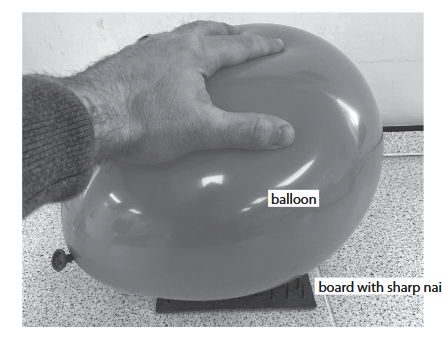
The teacher pushes the balloon onto the board of nails. The balloon does not pop.
The teacher then pops the balloon using a single nail.
Explain why the balloon does not pop when pushed onto the board of nails. (3)
Syllabus Topic Codes (Edexcel International GCSE Physics 4PH1):
• 5.6–5.7: Pressure in fluids at rest and pressure difference — parts (a)(i) and (a)(ii)
▶️ Answer/Explanation
(a)(i) Correct Answer: \( \boxed{\mathrm{D}} \) [1 mark]
The pressure of a stationary liquid acts equally in all directions at the same depth. Therefore, the forces acting on the bubble should be directed towards the centre and be balanced around the bubble.
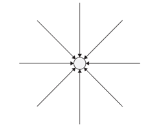
Diagram D correctly shows the pressure forces acting equally around the bubble.
(a)(ii) Effect of depth on the bubbles [3 marks]
- As the bubbles move nearer to the surface, the pressure of the water decreases.
- This is because there is less water above the bubbles, so the weight of water above them is smaller.
- The lower pressure outside the bubbles allows them to expand and increase in volume.
The pressure in a liquid can be related to depth by:
\(p=\rho gh\)
As the depth \(h\) decreases, the pressure \(p\) decreases.
Since the temperature is constant, the pressure and volume of the air in the bubble are inversely related:
\(pV=\mathrm{constant}\)
Therefore, when the external pressure decreases, the volume of the bubble increases.
(b) Balloon on a board of nails [3 marks]
Pressure is given by:
\(p=\dfrac{F}{A}\)
- The board has many nails, so the force from the balloon is spread over a much larger total area.
- For a given force, pressure is inversely proportional to area.
- Therefore, the pressure exerted by each nail on the balloon is relatively small, so the balloon does not pop.
In contrast, a single nail has a very small contact area. The same overall force is concentrated over this small area, producing a much larger pressure that can puncture the balloon.
Final Answer: The many nails spread the force over a large total area, reducing the pressure on the balloon. A single nail concentrates the force over a very small area, producing a much greater pressure and causing the balloon to pop.
Question
This question is about gas pressure.
(a) Diagram 1 shows some gas particles contained in a box.
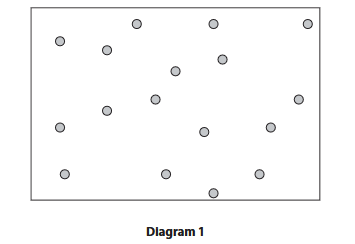
(i) The gas particles move in random motion.
State what is meant by the term random motion. (2 marks)
________________________________________________________________________________________________
________________________________________________________________________________________________
(ii) The gas exerts a pressure due to the gas particles colliding with the walls of the box.
Explain how these collisions produce a pressure. (2 marks)
________________________________________________________________________________________________
________________________________________________________________________________________________
(iii) The volume of the box is increased but the temperature of the gas remains constant.
Explain how increasing the volume of the box affects the pressure of the gas.
Assume the amount of gas remains constant. (3 marks)
________________________________________________________________________________________________
________________________________________________________________________________________________
________________________________________________________________________________________________
(b) Diagram 2 shows a device used to measure differences in gas pressure. This device is called a manometer.
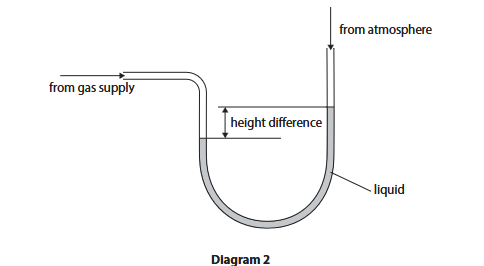
The difference between the pressure of the atmosphere and the pressure of the gas supply causes a difference in the height of the liquid levels on each side of the manometer.
(i) The liquid in the manometer is oil, which has a density of \(820\,\mathrm{kg\,m^{-3}}\).
The pressure difference between the atmosphere and the gas supply is \(1850\,\mathrm{Pa}\).
Calculate the height difference between the liquid levels in the manometer.
Use the formula
\(\mathrm{pressure\ difference}=\mathrm{height}\times\mathrm{density}\times\mathrm{gravitational\ field\ strength}\)
height difference = ____________________ \(\mathrm{m}\) (3 marks)
(ii) Different liquids can be used in the manometer.
Liquid mercury has a density of \(14000\,\mathrm{kg\,m^{-3}}\).
Suggest why liquid mercury would be more appropriate to use in the manometer when measuring large pressure differences. (2 marks)
________________________________________________________________________________________________
________________________________________________________________________________________________
(c) The pressure of a sample of gas is \(232\,\mathrm{kPa}\) at a temperature of \(16^\circ\mathrm{C}\).
Calculate the temperature when the pressure of the sample of gas increases to \(249\,\mathrm{kPa}\).
Give your answer in degrees Celsius \((^\circ\mathrm{C})\).
Assume that the volume and the mass of the gas sample remain constant. (4 marks)
temperature = ____________________ \(^{\circ}\mathrm{C}\)
Syllabus Topic Codes (Edexcel International GCSE Physics 4PH1):
• 5.20–5.22: Gas pressure relationships, especially pressure-volume — part (a)(iii)
• 5.6–5.7: Pressure in fluids at rest and pressure difference — parts (b)(i), (b)(ii)
• 5.16–5.17: Absolute zero and Kelvin temperature scale + 5.20–5.22: Gas pressure relationships — part (c)
▶️ Answer/Explanation and Mark Scheme
(a)(i) Random motion [2 marks]
- Gas particles move in different or unpredictable directions.
- They move at different or unpredictable speeds.
(a)(ii) Gas pressure [2 marks]
- The moving particles collide with the walls of the box, producing a force on the walls.
- Pressure is the force acting per unit area: \(p=\dfrac{F}{A}\).
(a)(iii) Effect of increasing volume [3 marks]
- The pressure decreases.
- At constant temperature, the average speed of the gas particles does not change.
- The particles have to travel a greater distance between collisions, so they collide with the walls less frequently, reducing the average force and therefore the pressure.
(b)(i) Height difference [3 marks]
Use
\(\Delta p=h\rho g\)
\(1850=h\times820\times10\)
\(h=\dfrac{1850}{8200}\)
\(h=0.2256\ldots\,\mathrm{m}\)
Answer: \( \boxed{0.23\,\mathrm{m}} \)
(b)(ii) Use of mercury [2 marks]
- Mercury has a much greater density than oil.
- For the same pressure difference, the height difference is therefore smaller, making the manometer more suitable for measuring large pressure differences.
(c) Temperature change [4 marks]
Since the volume and mass of the gas remain constant,
\(\dfrac{P_1}{T_1}=\dfrac{P_2}{T_2}\)
Convert the initial temperature to kelvin:
\(T_1=16+273=289\,\mathrm{K}\)
Rearrange:
\(T_2=\dfrac{P_2T_1}{P_1}\)
\(T_2=\dfrac{249\times289}{232}\)
\(T_2\approx310\,\mathrm{K}\)
Convert back to degrees Celsius:
\(T_2=310-273=37^\circ\mathrm{C}\)
Answer: \( \boxed{37^\circ\mathrm{C}} \)
Total: \(16\) marks
Question
A student needs to determine the density of some small rocks that appear to all be made of the same material.

(a) The student decides to measure the mass and the volume of each rock. Describe a method the student could use to accurately determine the mass and the volume of each rock. You may draw a diagram to help your answer.
(b) The table shows the student’s results for three of the rocks.

(i) State the formula linking density, mass and volume.
(ii) After looking at the data, the student concludes that one of the rocks may be made of a different material from the others. Using the data from the table, justify the student’s conclusion.
Syllabus Topic Codes (Edexcel International GCSE Physics 4PH1):
• 5.4: Practical: investigating density using direct measurements of mass and volume — part (a)
• 5.3: Density as a property that can be used to distinguish different materials — part (b)(ii)
▶️ Answer/Explanation
Ans
(a) MP1. use balance to measure mass;
MP2. use of measuring cylinder to measure volume;
PLUS
Any three from:
MP3. ensure balance reads zero before placing rock;
MP4. ensure balance is on a level surface;
MP5. ensure rock is dry when measuring its mass
MP6. recording volume before rock added to water
MP7. finding difference in volume of water after rock added
MP8. ensure rock is fully submerged;
MP9. ensure no water is spilt / all water collected by measuring cylinder;
MP10. read measuring cylinder at eye level / on a level surface;
MP11. read to bottom of water meniscus;
(b) (i) density = mass / volume;
(ii) idea that different materials have different densities;
correct evaluation of density for at least one rock;
correct evaluation of density for all rocks;
conclusion from density values that rock A is made from a different material (so student is correct);
Questions
This question is about air pressure.
(a) During an aeroplane flight, a passenger drinks some water from a plastic bottle. The passenger then replaces the top to seal the bottle, as shown in diagram 1.
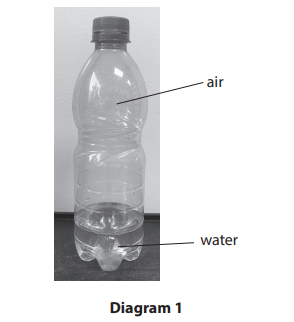
The air pressure outside the bottle is 80kPa. State the air pressure inside the bottle just after the bottle has been sealed.
(b) As the aeroplane descends, the air pressure inside the aeroplane changes. When the aeroplane lands, the passenger notices that the plastic bottle has collapsed, as shown in diagram 2.
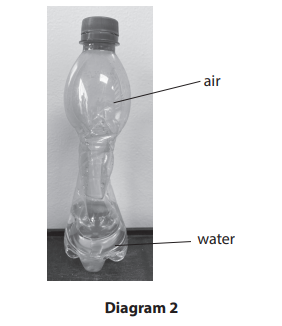
Explain why the bottle has collapsed.
(c) Explain how gas molecules in the air exert a pressure on the surface of the bottle.
Syllabus Topic Codes (Edexcel International GCSE Physics 4PH1):
• 5.8: Pressure in gases and the effect of changing pressure on enclosed gases — part (b)
• 5.5: Pressure in gases in terms of molecular motion and collisions with surfaces — part (c)
▶️Answer/Explanation
Ans
(a) 80 (kPa);
(b) any two from:
MP1. pressure (in aeroplane) increases;
MP2. (resultant) force (inwards) on bottle;
MP3. idea that decreasing volume (in bottle) increases pressure (in bottle);
(c) any three from:
MP1. (direction of) movement of molecules is random;
MP2. molecules collide with the (bottle) surface;
MP3. exert a force (on the surface);
MP4. pressure is force on an area;
Questions
The drawing shows a camel and a person in a desert.

(a) Describe a method you could use to find the pressure a person exerts on the ground when standing on two feet. (4)
(b) The total area of contact of the camel’s feet with the ground is \(1300\,\mathrm{cm^2}\). The mass of the camel is \(660\,\mathrm{kg}\). Calculate the pressure this camel exerts on the ground. (3)
Syllabus Topic Code (Edexcel International GCSE Physics 4PH1):
▶️ Answer/Explanation
(a) Method to determine pressure [4 marks]
- Measure the total area of contact of the person’s two feet with the ground.
- One method is to draw around the feet on squared or grid paper and use the grid to determine the total area.
- Measure the person’s mass using a balance or scales, then calculate their weight using \(W=mg\).
- Calculate the pressure using \(P=\dfrac{F}{A}\), where \(F\) is the weight of the person and \(A\) is the total contact area.
Thus:
\(\boxed{P=\dfrac{F}{A}}\)
(b) Pressure exerted by the camel [3 marks]
1. Calculate the weight of the camel:
\(W=mg\)
\(W=660\times10\)
\(W=6600\,\mathrm{N}\)
2. Calculate the pressure:
\(P=\dfrac{F}{A}\)
\(P=\dfrac{6600}{1300}\)
\(P\approx5.1\,\mathrm{N\,cm^{-2}}\)
\(\boxed{P\approx5.1\,\mathrm{N\,cm^{-2}}}\)
The area is given in \(\mathrm{cm^2}\), so the pressure is appropriately expressed in \(\mathrm{N\,cm^{-2}}\). If expressed in SI units, the area would first need to be converted to \(\mathrm{m^2}\).
Questions
The photograph shows an x-ray image of a person’s knee. The person has had part of their knee replaced.

(a) X-rays are part of the electromagnetic spectrum. All electromagnetic waves are transverse waves and transfer energy.
(i) State another property that all electromagnetic waves have in common. (1)
(ii) State a harmful effect of excessive exposure to x-rays. (1)
(iii) Describe the difference between transverse waves and longitudinal waves. You may draw a diagram to help your answer. (3)
(b) The diagram shows a part of the knee called the patella. The patella has been removed from a person’s knee.

The patella is a small, irregularly shaped bone that is denser than water. Describe how to find the mass and the volume of the patella bone. (4)
(c) A scientist finds the volume and mass of a patella. The mass of the patella is \(17\,\mathrm{g}\). The volume of the patella is \(13\,\mathrm{cm^3}\). Calculate the density of the patella. Give your answer to 2 significant figures. (4)
Syllabus Topic Codes (Edexcel International GCSE Physics 4PH1):
• 3.3–3.4: Wave Terminology and Energy Transfer by Waves — part (a)
• 3.10–3.13: Electromagnetic Spectrum and X-rays — parts (a)(i) and (a)(ii)
• 5.3: Density, Mass and Volume — parts (b) and (c)
• 5.4: Core Practical: Density Measurements — part (b)
▶️ Answer/Explanation
(a)(i) Property of electromagnetic waves [1 mark]
All electromagnetic waves travel at the same speed in a vacuum.
In a vacuum:
\(\boxed{v=3.0\times10^8\,\mathrm{m\,s^{-1}}}\)
(a)(ii) Harmful effect of X-rays [1 mark]
Excessive exposure to X-rays can cause damage or mutations to cells and may lead to cancer.
(a)(iii) Transverse and longitudinal waves [3 marks]
- Both types of waves involve oscillations or vibrations.
- In a longitudinal wave, the vibrations of the particles are parallel to the direction of wave travel or energy transfer.
- In a transverse wave, the vibrations are perpendicular to the direction of wave travel or energy transfer.
Therefore, the key difference is the direction of vibration relative to the direction in which the wave travels.
(b) Measuring mass and volume of the patella [4 marks]
Mass:
Use a balance to measure the mass of the patella.
Volume:
- Use a measuring cylinder containing a known volume of water.
- Fully submerge the patella in the water and record the new volume.
- The volume of the patella is the increase in the water volume:
\(\boxed{V=V_{\mathrm{final}}-V_{\mathrm{initial}}}\)
The patella is denser than water, so it will sink, making it possible to fully submerge it and use water displacement to determine its volume.
(c) Density of the patella [4 marks]
Use the density equation:
\(\rho=\dfrac{m}{V}\)
Substitute \(m=17\,\mathrm{g}\) and \(V=13\,\mathrm{cm^3}\):
\(\rho=\dfrac{17}{13}\)
\(\rho=1.307\ldots\,\mathrm{g\,cm^{-3}}\)
To 2 significant figures:
\(\boxed{\rho=1.3\,\mathrm{g\,cm^{-3}}}\)
Questions
A manometer is a device that can be used to measure the pressure difference between gas from a gas tap and the atmosphere. When a gas tap is connected to the manometer, the liquid in the manometer moves due to the additional pressure of the gas.

(a) The pressure difference is linked to the difference in height of the two surfaces of the liquid by the formula
pressure difference \(=\) density \(\times g \times\) height difference
The height difference between the two surfaces is \(0.094\,\mathrm{m}\). Calculate the pressure difference between the gas from the gas tap and the atmosphere.
For the liquid, density \(= 14000\,\mathrm{kg\,m^{-3}}\).
(b) The graph shows how the velocity of the surface of the liquid changes with time from when the gas tap is opened to when the water level stops moving.

(i) Use the graph to show that the distance travelled by the surface of the liquid is \(4.7\,\mathrm{cm}\).
(ii) Calculate the acceleration of the surface of the liquid.
(c) Explain how the gas pressure changes if the temperature of the gas increases. You should use ideas about particles in your answer.
Topic Classification:
(a) Topic – 4.b
(b) Topic – 1.c
(c) Topic – 6.d
▶️ Answer/Explanation
(a) Pressure difference
Use
\(\Delta p = \rho g \Delta h\)
Substitute the values:
\(\Delta p = 14000 \times 10 \times 0.094\)
Therefore,
\(\Delta p = 13160\,\mathrm{Pa}\)
\(\Delta p \approx 1.3 \times 10^4\,\mathrm{Pa}\)
Answer: \(1.3 \times 10^4\,\mathrm{Pa}\)
(b)(i) Distance travelled
The distance travelled is equal to the area under a velocity-time graph.
Using the values from the graph, the area is approximately
\(s \approx 4.7\,\mathrm{cm}\)
Answer: \(4.7\,\mathrm{cm}\)
(b)(ii) Acceleration
Acceleration is the gradient of a velocity-time graph:
\(a = \dfrac{\Delta v}{\Delta t}\)
Using the graph, the velocity changes by approximately \(47\,\mathrm{cm\,s^{-1}}\) over \(0.20\,\mathrm{s}\):
\(a = \dfrac{0-47}{0.20}\)
\(a = -235\,\mathrm{cm\,s^{-2}}\)
The negative sign indicates that the velocity is decreasing.
Answer: approximately \(-235\,\mathrm{cm\,s^{-2}}\)
(c) Effect of increasing temperature on gas pressure
- When the temperature increases, the gas particles gain kinetic energy and move faster.
- The particles collide with the walls of the container more frequently.
- The collisions are also harder because the particles have greater momentum.
- Therefore, the force exerted on the walls increases, causing the gas pressure to increase.
Question
The diagram shows a balloon with a mass attached held at rest just below the surface of a deep pool of water.

(a) The balloon and mass are released. The graph shows the velocity-time graph for the balloon and mass as they fall through the water.

(i) Use information from the graph to determine the terminal velocity of the balloon and mass.
(ii) Explain how the balloon reaches terminal velocity. You should use ideas about forces acting on the balloon in your answer.
(b)(i) State the formula linking pressure difference, height, density and gravitational field strength.
(ii) Calculate the increase in pressure on the balloon when it has reached a depth of \(25\,\mathrm{m}\) in the water.
[for water, density = \(1000\,\mathrm{kg\,m^{-3}}\)]
(iii) At the surface, the atmospheric pressure on the balloon is \(1.0\times10^5\,\mathrm{Pa}\). Show that the total pressure on the balloon at a depth of \(25\,\mathrm{m}\) is \(3.5\times10^5\,\mathrm{Pa}\).
(iv) At the surface, where the pressure is \(1.0\times10^5\,\mathrm{Pa}\), the balloon has a volume of \(0.46\,\mathrm{m^3}\). Calculate the volume of the balloon at a depth of \(25\,\mathrm{m}\).
Syllabus Topic Codes (Edexcel International GCSE Physics 4PH1):
• 5.5–5.7: Pressure, Force, and Area; Pressure in Fluids at Rest and Pressure Difference — parts (b)(i)–(iii)
• 5.20–5.22: Gas Pressure Relationships (Pressure–Temperature and Pressure–Volume) — part (b)(iv)
▶️ Answer/Explanation
(a)(i) Terminal velocity [1 mark]
Terminal velocity is the constant velocity reached when the velocity-time graph becomes horizontal.
From the graph:
\(\boxed{v=8.2\,\mathrm{m\,s^{-1}}}\)
(a)(ii) Reaching terminal velocity [4 marks]
- The main forces acting are weight downwards and drag upwards.
- Initially, the weight is greater than the drag, so there is a resultant downward force and the balloon accelerates.
- As the speed increases, the drag force increases.
- Eventually, the drag becomes equal to the weight, so the resultant force is zero and the balloon continues at a constant velocity called terminal velocity.
At terminal velocity:
\(\boxed{\mathrm{weight}=\mathrm{drag}}\)
(b)(i) Pressure difference formula [1 mark]
The pressure difference in a liquid is given by:
\(\boxed{\Delta p=h\rho g}\)
(b)(ii) Increase in pressure [2 marks]
Use:
\(\Delta p=h\rho g\)
Taking \(h=25\,\mathrm{m}\), \(\rho=1000\,\mathrm{kg\,m^{-3}}\), and \(g=10\,\mathrm{N\,kg^{-1}}\):
\(\Delta p=25\times1000\times10\)
\(\Delta p=250\,000\,\mathrm{Pa}\)
Therefore: \(\boxed{\Delta p=2.5\times10^5\,\mathrm{Pa}}\)
(b)(iii) Total pressure [2 marks]
The total pressure is the atmospheric pressure at the surface plus the increase in pressure due to the water.
\(p=1.0\times10^5+2.5\times10^5\)
\(p=3.5\times10^5\,\mathrm{Pa}\)
Therefore: \(\boxed{p=3.5\times10^5\,\mathrm{Pa}}\)
(b)(iv) Volume of the balloon [3 marks]
At constant temperature, pressure and volume are inversely proportional, so:
\(p_1V_1=p_2V_2\)
Substitute \(p_1=1.0\times10^5\,\mathrm{Pa}\), \(V_1=0.46\,\mathrm{m^3}\), and \(p_2=3.5\times10^5\,\mathrm{Pa}\):
\(1.0\times10^5\times0.46=3.5\times10^5\times V_2\)
Rearranging:
\(V_2=\dfrac{1.0\times10^5\times0.46}{3.5\times10^5}\)
\(V_2=0.1314\,\mathrm{m^3}\)
Therefore: \(\boxed{V_2\approx0.13\,\mathrm{m^3}}\)
Question
A student wants to determine the density of air using an irregularly-shaped balloon made of metal foil. The balloon has a label stating that the volume of the balloon when full is \(490\,\mathrm{cm^3}\). This is part of the student’s method.
Step 1 measure the mass of the empty balloon
Step 2 fill the balloon with air
Step 3 measure the mass of the full balloon
Step 4 subtract the mass of the empty balloon from the mass of the full balloon.
(a)(i) Name the equipment the student could use to measure the mass of the balloon.
(ii) Suggest how the student could improve the reliability of their data.
(b) The table shows the student’s results.

Calculate the density of air to 2 significant figures. Give the unit.
(c) Describe how the volume of the balloon full of air could be measured using a large beaker and some water. You may use a diagram to help your answer.
Syllabus Topic Codes (Edexcel International GCSE Physics 4PH1):
• 5.4: Core Practical: Density Measurements — parts (a) and (c)
▶️ Answer/Explanation
(a)(i) Equipment for measuring mass [1 mark]
The student could use a balance to measure the mass of the balloon.
(a)(ii) Improving reliability [1 mark]
The student should repeat the measurements and calculate a mean. Any anomalous result should be identified and, where appropriate, excluded from the calculation.
(b) Density of air [4 marks]
First calculate the mass of the air by subtracting the mass of the empty balloon from the mass of the full balloon:
\(\mathrm{mass\ of\ air}=15.61-15.00\)
\(\mathrm{mass\ of\ air}=0.61\,\mathrm{g}\)
Use the density equation:
\(\rho=\dfrac{m}{V}\)
Substitute \(m=0.61\,\mathrm{g}\) and \(V=490\,\mathrm{cm^3}\):
\(\rho=\dfrac{0.61}{490}\)
\(\rho=0.001244\ldots\,\mathrm{g\,cm^{-3}}\)
To 2 significant figures:
Therefore: \(\boxed{\rho=0.0012\,\mathrm{g\,cm^{-3}}}\)
(c) Measuring the volume using water [3 marks]
The volume can be measured using the water displacement method.
- Measure and record the original volume of water in the large beaker.
- Fully submerge the inflated balloon in the water, ensuring that it is completely underwater.
- Measure the new volume of water and subtract the original volume from the new volume. The difference is the volume of the balloon.
Thus:
\(\mathrm{volume\ of\ balloon}=\mathrm{final\ water\ volume}-\mathrm{initial\ water\ volume}\)
Question
The gravitational field strength of a planet decreases with increasing distance from the planet. The table shows the value of the gravitational field strength of Mars at different distances from the centre of Mars.

(a) A student finds this formula in a textbook, which links distance from the centre of a planet to its gravitational field strength.
gravitational field strength \(\times\) distance\(^2\) = constant
Use data from the table to justify this formula.
(b) Olympus Mons is the tallest mountain on Mars. The distance between the centre of Mars and the peak of Olympus Mons is \(3410\,\mathrm{km}\). Calculate the gravitational field strength at the peak of Olympus Mons.
Syllabus Topic Codes (Edexcel International GCSE Physics 4PH1):
▶️ Answer/Explanation
(a) Justifying the relationship [4 marks]
The proposed relationship is:
\(\mathrm{gravitational\ field\ strength}\times\mathrm{distance}^2=\mathrm{constant}\)
Use one pair of values from the table. For example:
\(\mathrm{constant}=g\times d^2\)
For the first set of data:
\(\mathrm{constant}=10.7\times(2000)^2\)
\(\mathrm{constant}=42\,800\,000\)
Using a second set of data gives approximately the same value:
\(\mathrm{constant}\approx42\,700\,000\)
The calculated value of the constant remains approximately unchanged for different distances.
Therefore, the data support the formula.

(b) Gravitational field strength at Olympus Mons [3 marks]
From the relationship:
\(g\times d^2=\mathrm{constant}\)
Rearrange:
\(g=\dfrac{\mathrm{constant}}{d^2}\)
Using \(\mathrm{constant}=42\,700\,000\) and \(d=3410\,\mathrm{km}\):
\(g=\dfrac{42\,700\,000}{3410^2}\)
\(g\approx3.67\,\mathrm{N\,kg^{-1}}\)
Therefore: \(\boxed{g\approx3.7\,\mathrm{N\,kg^{-1}}}\)
This is consistent with the gravitational field strength decreasing as the distance from the centre of Mars increases.