
Edexcel iGCSE Physics (4PH1) 5.3 Change of State Exam Style Question Paper 2B - New Syllabus
Question
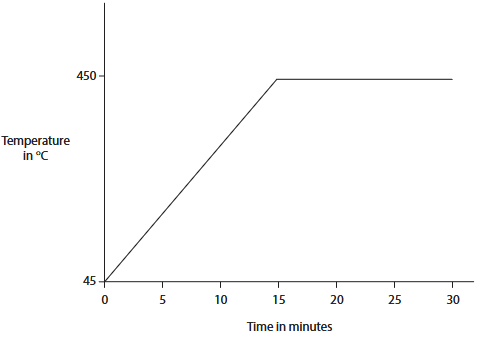
A student investigates how the temperature of a metal block varies with time as it is heated.
The student measures the temperature of the block at 5-minute intervals for a total of 30 minutes.
The graph shows the student’s results.
(a)(i) Give the name of a piece of equipment that the student could use to measure the time during the investigation. (1)
(a)(ii) Which of these is the dependent variable in this investigation? (1)
A. mass of block
B. temperature of block
C. time taken to heat block
D. volume of block
(b) The energy supplied to the block is \(440\,000\,\mathrm{J}\).
Calculate the mass of the metal block when the temperature of the block increases from \(45^\circ\mathrm{C}\) to its melting point of \(450^\circ\mathrm{C}\).
[for the metal, specific heat capacity \(=910\,\mathrm{J\,kg^{-1}\,^\circ C^{-1}}\)] (3)
mass = __________________ \(\mathrm{kg}\)
(c) The metal block melts and then the liquid metal boils to become a gas.
Describe the motion of the particles when the metal is a gas. (2)
(d) Suggest two changes to the graph if the student had used a different metal in their investigation. (2)
1. __________________________________________
2. __________________________________________
Syllabus Topic Codes (Edexcel International GCSE Physics 4PH1):
• 5.12–5.13P: Specific Heat Capacity and Thermal Energy Change Equation — part (b)
• 5.8P–5.10P: Energy Changes During Heating, Changes of State, and Particle Model of Solids, Liquids and Gases — part (c)
▶️ Answer/Explanation
(a)(i) Equipment for measuring time [1 mark]
A suitable piece of equipment is a stopwatch. A stop clock, timer or chronometer would also be suitable.
Final Answer: \( \boxed{\mathrm{stopwatch}} \)
(a)(ii) Dependent variable [1 mark]
The dependent variable is the quantity that is measured as the investigation is carried out.
The student measures the temperature of the block at different times.
Correct Answer: \( \boxed{\mathrm{B.\ temperature\ of\ block}} \)
(b) Mass of the metal block [3 marks]
1. Calculate the temperature change:
\(\Delta T=450-45\)
\(\Delta T=405^\circ\mathrm{C}\)
2. Use the specific heat capacity equation:
\(E=mc\Delta T\)
Rearrange for mass:
\(m=\dfrac{E}{c\Delta T}\)
3. Substitute the values:
\(m=\dfrac{440\,000}{(910)(405)}\)
\(m=1.1938\ldots\,\mathrm{kg}\)
To 2 significant figures:
\(m=1.2\,\mathrm{kg}\)
Final Answer: \( \boxed{1.2\,\mathrm{kg}} \)
(c) Motion of particles in a gas [2 marks]
- The particles move at high speed.
- The particles move in random directions.
Final Answer: The particles in the gas move at high speed in random directions.
(d) Changes to the graph for a different metal [2 marks]
1. The temperature could rise at a different rate, so the gradient of the rising section of the graph would be different.
2. The melting point would be different, so the horizontal section of the graph would occur at a different temperature.
Final Answer: The graph could have a different gradient during heating and a different melting-point temperature.
Question
A sample of liquid gallium is allowed to cool in a laboratory. The liquid gallium freezes to become a solid.
(a) Complete the diagram by drawing the arrangement of particles in a liquid and the arrangement of particles in a solid. The first particle in each box has been drawn for you.

(b) The initial temperature of the sample of liquid gallium is \(80^\circ\mathrm{C}\). The freezing temperature of gallium is \(30^\circ\mathrm{C}\). The final temperature of the solid gallium is \(20^\circ\mathrm{C}\). Complete the graph to show how the temperature of the gallium changes during the time that it cools to \(20^\circ\mathrm{C}\). Add appropriate values to the temperature axis.

Syllabus Topic Codes (Edexcel International GCSE Physics 4PH1):
• 5.9P: Changes of State — part (b)
• 5.10P: Particle Model of Solids, Liquids, and Gases — part (a)
▶️ Answer/Explanation
(a) Arrangement of particles [4 marks]
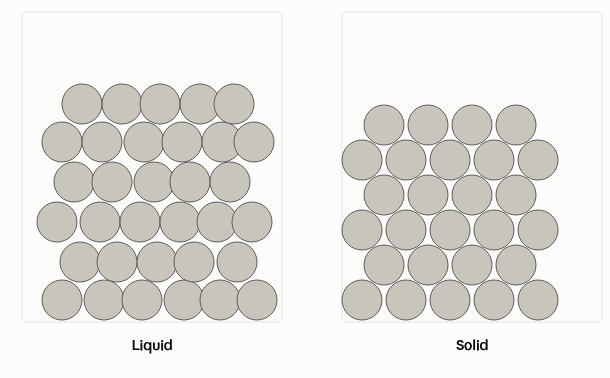
Liquid:
- Most particles should be shown in contact with each other.
- The particles should have a random arrangement.
Solid:
- The particles should be shown in contact with each other.
- The particles should have a regular arrangement.
In a liquid, particles remain close together but can move past one another. In a solid, the particles are held in fixed positions in a regular arrangement and can only vibrate about these positions.
(b) Cooling curve [3 marks]
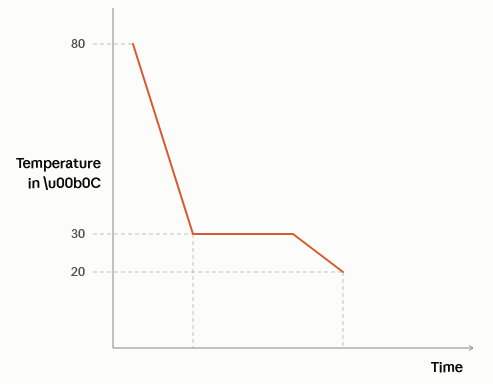
- Draw a decreasing line from \(80^\circ\mathrm{C}\) to \(30^\circ\mathrm{C}\).
- Draw a horizontal section at \(30^\circ\mathrm{C}\) to show the freezing process.
- After freezing, draw a decreasing line from \(30^\circ\mathrm{C}\) to \(20^\circ\mathrm{C}\).
- Label the temperature axis with suitable values, including \(80^\circ\mathrm{C}\), \(30^\circ\mathrm{C}\), and \(20^\circ\mathrm{C}\).
The temperature remains constant at \(30^\circ\mathrm{C}\) while the gallium freezes because energy is being transferred during the change of state rather than causing a decrease in temperature.
Cooling pattern:
\(80^\circ\mathrm{C}\) → decreasing temperature → \(30^\circ\mathrm{C}\) → constant temperature during freezing → decreasing temperature → \(20^\circ\mathrm{C}\)
Question
The photograph shows a water bath that a technician uses to heat some water.

(a) The water bath is filled with water at an initial temperature of \(15^\circ\mathrm{C}\). Calculate the initial temperature of the water in kelvin.
(b) The technician heats the water to a final temperature of \(60^\circ\mathrm{C}\).
(i) Describe how the energy of the water molecules changes as the temperature of the water increases.
(ii) The table shows some information about the heating element in the water bath and the heating process.

Calculate the energy transferred by the heating element in the water bath during the heating process.
(iii) Calculate the mass of water being heated. Assume that all the energy is transferred to the thermal store of the water.
[for water, specific heat capacity = \(4200\,\mathrm{J\,kg^{-1}\,^\circ C^{-1}}\)]
(c) Some water evaporates as a gas from the water bath.
(i) Describe the arrangement of particles in a gas.
(ii) Describe two differences between evaporation and boiling.
Syllabus Topic Codes (Edexcel International GCSE Physics 4PH1):
• 5.18–5.19: Temperature, Molecular Speed, and Kinetic Energy — part (b)(i)
• 2.4–2.5: Power, Current, Voltage, and Electrical Energy Transfer — part (b)(ii)
• 5.12–5.13P: Specific Heat Capacity and Thermal Energy Change Equation — part (b)(iii)
• 5.10P: Particle Model of Solids, Liquids, and Gases — part (c)(i)
• 5.9P: Changes of State — part (c)(ii)
▶️ Answer/Explanation
(a) Temperature in kelvin [1 mark]
Use the conversion:
\(T_{\mathrm{K}}=T_{^\circ\mathrm{C}}+273\)
\(T_{\mathrm{K}}=15+273=288\,\mathrm{K}\)
\(\boxed{288\,\mathrm{K}}\)
(b)(i) Energy of the water molecules [2 marks]
As the temperature increases, the energy of the water molecules increases.
The average kinetic energy of the molecules increases, meaning that the molecules move faster on average.
(b)(ii) Energy transferred by the heating element [3 marks]
Use:
\(E=VIt\)
The heating time is \(45\,\mathrm{min}\), so convert it to seconds:
\(t=45\times60=2700\,\mathrm{s}\)
Substitute \(V=230\,\mathrm{V}\), \(I=1.5\,\mathrm{A}\), and \(t=2700\,\mathrm{s}\):
\(E=230\times1.5\times2700\)
\(E=931\,500\,\mathrm{J}\)
Therefore:
\(\boxed{E\approx9.3\times10^5\,\mathrm{J}}\)
(b)(iii) Mass of water [3 marks]
Use the thermal energy equation:
\(Q=mc\Delta T\)
The temperature change is:
\(\Delta T=60-15=45^\circ\mathrm{C}\)
Since all the energy is transferred to the thermal store of the water:
\(9.3\times10^5=m\times4200\times45\)
Rearranging:
\(m=\dfrac{9.3\times10^5}{4200\times45}\)
\(m\approx4.92\,\mathrm{kg}\)
\(\boxed{m\approx4.9\,\mathrm{kg}}\)
(c)(i) Arrangement of particles in a gas [2 marks]
- The particles are arranged randomly.
- The particles are widely spaced with large gaps between them.
(c)(ii) Evaporation and boiling [2 marks]
- Boiling occurs at a specific or fixed temperature, whereas evaporation can occur at any temperature.
- Boiling occurs throughout the liquid, whereas evaporation occurs only at the surface.
Question
This question is about specific heat capacity.
(a) State what is meant by the term specific heat capacity.
(b) The diagram shows a sample of solid stearic acid being heated in a boiling tube using a water bath.

The mass of stearic acid in the boiling tube is \(58\,\mathrm{g}\). When the boiling tube is placed in the water bath, the temperature of the stearic acid increases from \(21^\circ\mathrm{C}\) to \(37^\circ\mathrm{C}\). The stearic acid does not melt. As the temperature of the stearic acid increases, an additional \(3500\,\mathrm{J}\) of energy needs to be transferred electrically to the water bath.
(i) Using this data, show that the specific heat capacity of the solid stearic acid is approximately \(4\,\mathrm{J\,g^{-1}\,^\circ C^{-1}}\).
(ii) The true value for the specific heat capacity of solid stearic acid is \(2.3\,\mathrm{J\,g^{-1}\,^\circ C^{-1}}\). Give a reason for the difference between the value in (i) and the true value.
Syllabus Topic Codes (Edexcel International GCSE Physics 4PH1):
• 5.14P: Core Practical: Specific Heat Capacity — parts (b)(i) and (b)(ii)
▶️ Answer/Explanation
(a) Specific heat capacity [3 marks]
Specific heat capacity is the energy required to raise the temperature of a unit mass of a substance by \(1^\circ\mathrm{C}\).
It can be expressed using:
\(\Delta Q=mc\Delta T\)
(b)(i) Specific heat capacity [3 marks]
Use the specific heat capacity equation:
\(\Delta Q=mc\Delta T\)
Rearrange to make \(c\) the subject:
\(c=\dfrac{\Delta Q}{m\Delta T}\)
The temperature change is:
\(\Delta T=37-21=16^\circ\mathrm{C}\)
Substitute the values:
\(c=\dfrac{3500}{58\times16}\)
\(c=3.77\,\mathrm{J\,g^{-1}\,^\circ C^{-1}}\)
Therefore:
\(\boxed{c\approx3.8\,\mathrm{J\,g^{-1}\,^\circ C^{-1}}}\)
This is approximately \(4\,\mathrm{J\,g^{-1}\,^\circ C^{-1}}\), as required.
(b)(ii) Difference from the true value [1 mark]
Some of the energy supplied is transferred to the boiling tube rather than only to the stearic acid.
Energy may also be transferred to the surroundings, so not all of the \(3500\,\mathrm{J}\) is used to increase the thermal energy of the stearic acid. This causes the calculated value of \(c\) to be higher than the true value.
Question
This question is about the use of water in central heating systems.
(a) A student does an investigation to find the specific heat capacity of water. This is the list of equipment they use.
- heater with a power output of \(50\,\mathrm{W}\)
- power supply
- beaker
- water
- thermometer
- stopwatch
- connecting leads
- balance
Describe an investigation the student could use to find the specific heat capacity of water. You may draw a diagram to help your answer.
(b) The diagram shows a simplified central heating system viewed from above.

Pipes transport hot water around a house to radiators and back to the boiler. The boiler heats water from \(16^\circ\mathrm{C}\) to \(65^\circ\mathrm{C}\).
(i) Calculate the energy transferred from the boiler to \(75\,\mathrm{kg}\) of water to raise the temperature of the water from \(16^\circ\mathrm{C}\) to \(65^\circ\mathrm{C}\).
[for water, specific heat capacity \(=4200\,\mathrm{J\,kg^{-1}\,^\circ C^{-1}}\)]
(ii) The radiators transfer energy from the water to the air in the house. The temperature of the water in the heating system decreases by \(4^\circ\mathrm{C}\) due to heat transferred to the air. This causes the air in the house to increase in temperature by \(15^\circ\mathrm{C}\). The mass of air in the house and the mass of water in the heating system are approximately the same. Explain why there is a larger temperature change in the air.
Syllabus Topic Codes (Edexcel International GCSE Physics 4PH1):
• 5.14P: Core Practical: Specific Heat Capacity — part (a)
▶️ Answer/Explanation
(a) Investigation to determine specific heat capacity [5 marks]
- Measure the mass of the water, for example by finding the difference between the mass of the empty beaker and the mass of the beaker containing water.
- Measure the initial temperature of the water using the thermometer.
- Switch on the \(50\,\mathrm{W}\) heater and measure the time for which it heats the water.
- Record the temperature increase of the water. It is useful to continue recording temperature and time readings and plot a temperature-time graph.
- Calculate the energy transferred using \(E=Pt\).
- Use the specific heat capacity equation \(E=mc\Delta T\) to calculate \(c\).
Alternatively, the gradient of a temperature-time graph can be used with:
\(c=\dfrac{P}{m\times\mathrm{gradient}}\)
The experiment should be carried out carefully to reduce unwanted energy transfer to the surroundings, for example by insulating the beaker.
(b)(i) Energy transferred to the water [3 marks]
First calculate the temperature change:
\(\Delta T=65-16=49^\circ\mathrm{C}\)
Use:
\(\Delta Q=mc\Delta T\)
Substitute the values:
\(\Delta Q=75\times4200\times49\)
\(\Delta Q=15\,435\,000\,\mathrm{J}\)
Therefore:
\(\boxed{\Delta Q\approx1.54\times10^7\,\mathrm{J}}\)
(b)(ii) Difference in temperature change [3 marks]
- The thermal energy lost by the water is approximately equal to the thermal energy gained by the air.
- Water and air have different specific heat capacities.
- Air has a smaller specific heat capacity than water, so the same mass of air requires less energy for a given temperature increase.
Using \(E=mc\Delta T\), for the same energy transfer and approximately the same mass, a substance with a smaller specific heat capacity has a larger temperature change. Therefore, the air temperature increases by \(15^\circ\mathrm{C}\), while the water temperature decreases by only \(4^\circ\mathrm{C}\).
Question
A solid bar of chocolate is taken from a refrigerator.

(a) The temperature of the chocolate bar is \(5^\circ\mathrm{C}\). Describe the arrangement and motion of the particles inside the chocolate bar.
(b) The chocolate is heated at a constant rate until the temperature reaches \(45^\circ\mathrm{C}\). The chocolate has a melting point of \(32^\circ\mathrm{C}\) and a boiling point of \(55^\circ\mathrm{C}\).
(i) Describe the motion of the particles in the chocolate when the chocolate is at a temperature of \(45^\circ\mathrm{C}\).
(ii) Which of these is used to measure the temperature of the chocolate?
A balance
B ruler
C stopwatch
D thermometer
(iii) Use the axes to sketch a graph of how the temperature of the chocolate changes with time when it is heated from \(5^\circ\mathrm{C}\) to \(45^\circ\mathrm{C}\).

Syllabus Topic Codes (Edexcel International GCSE Physics 4PH1):
• 5.8P–5.9P: Energy Changes During Heating and Changes of State — part (b)(iii)
• 5.9P: Changes of State — part (b)(i) and (b)(iii)
▶️ Answer/Explanation
(a) Arrangement and motion of particles [2 marks]
Arrangement:
- The particles are closely packed.
- They have a fixed, regular arrangement.
Motion:
- The particles vibrate about fixed positions.
The particles cannot move freely from one position to another because the chocolate is a solid.
(b)(i) Motion of particles at \(45^\circ\mathrm{C}\) [2 marks]
The melting point of chocolate is \(32^\circ\mathrm{C}\), so at \(45^\circ\mathrm{C}\) the chocolate is a liquid.
- The particles move in a random manner.
- The particles are no longer held in fixed positions and can move past one another.
The temperature is below the boiling point of \(55^\circ\mathrm{C}\), so the chocolate remains a liquid rather than becoming a gas.
(b)(ii) Measuring temperature [1 mark]
The correct instrument for measuring temperature is a thermometer.
Correct answer: D, thermometer
(b)(iii) Temperature-time graph [3 marks]
The temperature initially increases from \(5^\circ\mathrm{C}\) to the melting point of \(32^\circ\mathrm{C}\).
At \(32^\circ\mathrm{C}\), the chocolate melts. During the change of state, the temperature remains constant even though energy continues to be transferred to the chocolate.
Once all the chocolate has melted, the temperature increases again from \(32^\circ\mathrm{C}\) to \(45^\circ\mathrm{C}\).
Therefore, the graph should have:
- an increasing section from \(5^\circ\mathrm{C}\) to \(32^\circ\mathrm{C}\),
- a horizontal section at \(32^\circ\mathrm{C}\), representing melting,
- another increasing section from \(32^\circ\mathrm{C}\) to \(45^\circ\mathrm{C}\).

Question
Concrete on top of buildings can be used to heat water. The photograph shows a concrete and water heating system being built into the roof of a house.

(a) A scientist wants to determine the specific heat capacity of concrete. The diagram shows some of the equipment they could use.

Describe a suitable method to find the specific heat capacity of concrete.
(b) Explain the advantage of the concrete having a high specific heat capacity when it is used to heat water in the heating system.
Syllabus Topic Codes (Edexcel International GCSE Physics 4PH1):
• 4.17P: Measuring Specific Heat Capacity Experimentally — part (a)
• 4.15: Energy Transfers and Thermal Energy — part (b)
▶️ Answer/Explanation
(a) Determining the specific heat capacity of concrete [5 marks]
A suitable method is:
- Measure the mass of the concrete using a balance.
- Measure the initial temperature of the concrete.
- Place an electric heater in good thermal contact with the concrete and connect it to an ammeter and voltmeter.
- Measure the current and voltage supplied to the heater.
- Heat the concrete for a measured time using a stopwatch.
- Calculate the energy supplied using \(E=VIt\).
- Measure the temperature change: \(\Delta T=T_\mathrm{final}-T_\mathrm{initial}\).
- Calculate the specific heat capacity using:
\(\displaystyle c=\frac{E}{m\Delta T}\)
The experiment could be repeated and the results averaged to improve reliability. Taking the temperature after the heater is switched off can also help determine the maximum temperature reached.
Alternative graph method: Plot temperature against time and determine the gradient. Then use:
\(\displaystyle \mathrm{gradient}=\frac{\mathrm{power}}{mc}\)
and rearrange to find \(c\).
(b) Advantage of a high specific heat capacity [2 marks]
A material with a high specific heat capacity can store a large amount of thermal energy for a given mass and temperature change.
Therefore, the concrete can absorb and release a large amount of energy to the water, helping the water temperature to be maintained for longer.
This makes the concrete useful as a thermal store in the heating system.
Question
The photograph shows an ice cube placed on a metal tile. The solid ice cube melts to become liquid water.

(a) Compare the arrangement of particles in a solid with the arrangement of particles in a liquid. You may draw a diagram to help your answer.
(b) Describe the difference in the movement of particles in a solid compared with the movement of particles in a liquid.
(c) After the ice cube has melted, the liquid water increases in temperature. The water has a mass of \(16\,\mathrm{g}\) and a specific heat capacity of \(4200\,\mathrm{J\,kg^{-1}\,^\circ C^{-1}}\). Calculate the energy transferred to the liquid water as it increases in temperature from \(3\,^\circ\mathrm{C}\) to \(21\,^\circ\mathrm{C}\).
Syllabus Topic Codes (Edexcel International GCSE Physics 4PH1):
• 5.12–5.13P: Specific Heat Capacity and Thermal Energy Change Equation — part (c)
▶️ Answer/Explanation
(a) Arrangement of particles [3 marks]
- Particles in a solid have a regular arrangement.
- Particles in a liquid have an irregular arrangement.
- Particles in both solids and liquids are closely packed.
In a solid, the particles remain in fixed positions in an ordered structure, whereas in a liquid the particles are still close together but are not arranged regularly.
(b) Movement of particles [2 marks]
- Particles in a solid vibrate about fixed positions.
- Particles in a liquid can move around and change position relative to one another.
(c) Energy transferred [3 marks]
Use the specific heat capacity equation:
\(\Delta Q=mc\Delta T\)
First convert the mass from grams to kilograms:
\(m=16\,\mathrm{g}=0.016\,\mathrm{kg}\)
Calculate the temperature change:
\(\Delta T=21-3=18\,^\circ\mathrm{C}\)
Substitute the values:
\(\Delta Q=0.016\times4200\times18\)
\(\Delta Q=1209.6\,\mathrm{J}\)
Therefore, to an appropriate number of significant figures:
\(\boxed{\Delta Q\approx1.2\times10^3\,\mathrm{J}}\)
Question
The diagram shows some apparatus that can be used to determine the specific heat capacity of water.

(a) Describe how a student could use this apparatus to determine the specific heat capacity of water. Include details of any additional equipment needed in your answer.
(b) (i) The table shows the student’s results.

Use the student’s results to calculate the specific heat capacity of water.
(ii) Give two reasons why the energy from the heater is not all retained in the thermal store of the water.
Syllabus Topic Codes (Edexcel International GCSE Physics 4PH1):
• 5.14P: Core Practical: Specific Heat Capacity — part (a)
• 4.6–4.10: Thermal Energy Transfer, Convection, Radiation, Absorption, Emission, and Reducing Unwanted Energy Transfer — part (b)(ii)
▶️ Answer/Explanation
(a) Determining the specific heat capacity of water [5 marks]
- Measure the mass of the empty cup using a balance.
- Add water and measure the mass of the cup and water. Calculate the mass of water by subtracting the mass of the empty cup.
- Measure the initial temperature of the water using a thermometer.
- Connect a voltmeter and ammeter to measure the potential difference and current of the heater.
- Switch on the heater and measure the heating time using a stopwatch or timer.
- Stir the water throughout the experiment so that the temperature is approximately uniform.
- Measure the temperature change, or continue measuring the temperature after switching off the heater to determine the maximum temperature.
- Repeat the experiment and calculate an average to improve reliability.
The electrical energy supplied by the heater can be calculated using:
\(E=VIt\)
The specific heat capacity can then be calculated using:
\(E=mc\Delta T\)
Therefore:
\(c=\dfrac{E}{m\Delta T}\)
(b)(i) Specific heat capacity [3 marks]
Use the equation:
\(E=mc\Delta T\)
From the results:
\(E=54000\,\mathrm{J}\)
\(m=0.56\,\mathrm{kg}\)
\(\Delta T=22\,^\circ\mathrm{C}\)
Substitute:
\(54000=0.56\times c\times22\)
Rearranging:
\(c=\dfrac{54000}{0.56\times22}\)
\(c\approx4286\,\mathrm{J\,kg^{-1}\,^\circ C^{-1}}\)
Using the values and rounding appropriately gives approximately:
\(\boxed{c\approx4.3\times10^3\,\mathrm{J\,kg^{-1}\,^\circ C^{-1}}\)
(b)(ii) Energy losses [2 marks]
Two valid reasons are:
- Some energy is transferred to the beaker or cup and thermometer.
- Some energy is transferred to the surroundings.
The insulation is not perfect, and gaps around the heater or thermometer can also allow thermal energy to escape.