
Edexcel iGCSE Physics (4PH1) 5.4 Ideal Gas Molecules Exam Style Question Paper 1B - New Syllabus
Question
This question is about gas pressure.
(a) Diagram 1 shows some gas particles contained in a box.
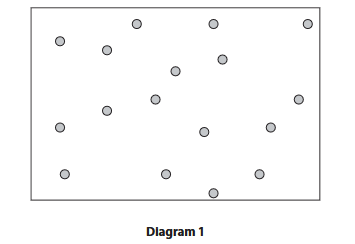
(i) The gas particles move in random motion.
State what is meant by the term random motion. (2 marks)
________________________________________________________________________________________________
________________________________________________________________________________________________
(ii) The gas exerts a pressure due to the gas particles colliding with the walls of the box.
Explain how these collisions produce a pressure. (2 marks)
________________________________________________________________________________________________
________________________________________________________________________________________________
(iii) The volume of the box is increased but the temperature of the gas remains constant.
Explain how increasing the volume of the box affects the pressure of the gas.
Assume the amount of gas remains constant. (3 marks)
________________________________________________________________________________________________
________________________________________________________________________________________________
________________________________________________________________________________________________
(b) Diagram 2 shows a device used to measure differences in gas pressure. This device is called a manometer.
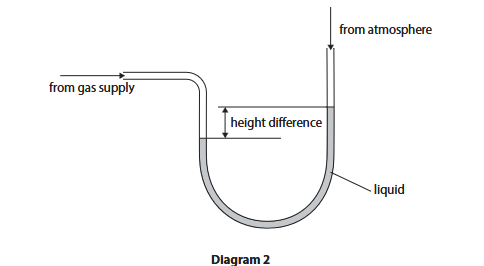
The difference between the pressure of the atmosphere and the pressure of the gas supply causes a difference in the height of the liquid levels on each side of the manometer.
(i) The liquid in the manometer is oil, which has a density of \(820\,\mathrm{kg\,m^{-3}}\).
The pressure difference between the atmosphere and the gas supply is \(1850\,\mathrm{Pa}\).
Calculate the height difference between the liquid levels in the manometer.
Use the formula
\(\mathrm{pressure\ difference}=\mathrm{height}\times\mathrm{density}\times\mathrm{gravitational\ field\ strength}\)
height difference = ____________________ \(\mathrm{m}\) (3 marks)
(ii) Different liquids can be used in the manometer.
Liquid mercury has a density of \(14000\,\mathrm{kg\,m^{-3}}\).
Suggest why liquid mercury would be more appropriate to use in the manometer when measuring large pressure differences. (2 marks)
________________________________________________________________________________________________
________________________________________________________________________________________________
(c) The pressure of a sample of gas is \(232\,\mathrm{kPa}\) at a temperature of \(16^\circ\mathrm{C}\).
Calculate the temperature when the pressure of the sample of gas increases to \(249\,\mathrm{kPa}\).
Give your answer in degrees Celsius \((^\circ\mathrm{C})\).
Assume that the volume and the mass of the gas sample remain constant. (4 marks)
temperature = ____________________ \(^{\circ}\mathrm{C}\)
Syllabus Topic Codes (Edexcel International GCSE Physics 4PH1):
• 5.20–5.22: Gas pressure relationships, especially pressure-volume — part (a)(iii)
• 5.6–5.7: Pressure in fluids at rest and pressure difference — parts (b)(i), (b)(ii)
• 5.16–5.17: Absolute zero and Kelvin temperature scale + 5.20–5.22: Gas pressure relationships — part (c)
▶️ Answer/Explanation and Mark Scheme
(a)(i) Random motion [2 marks]
- Gas particles move in different or unpredictable directions.
- They move at different or unpredictable speeds.
(a)(ii) Gas pressure [2 marks]
- The moving particles collide with the walls of the box, producing a force on the walls.
- Pressure is the force acting per unit area: \(p=\dfrac{F}{A}\).
(a)(iii) Effect of increasing volume [3 marks]
- The pressure decreases.
- At constant temperature, the average speed of the gas particles does not change.
- The particles have to travel a greater distance between collisions, so they collide with the walls less frequently, reducing the average force and therefore the pressure.
(b)(i) Height difference [3 marks]
Use
\(\Delta p=h\rho g\)
\(1850=h\times820\times10\)
\(h=\dfrac{1850}{8200}\)
\(h=0.2256\ldots\,\mathrm{m}\)
Answer: \( \boxed{0.23\,\mathrm{m}} \)
(b)(ii) Use of mercury [2 marks]
- Mercury has a much greater density than oil.
- For the same pressure difference, the height difference is therefore smaller, making the manometer more suitable for measuring large pressure differences.
(c) Temperature change [4 marks]
Since the volume and mass of the gas remain constant,
\(\dfrac{P_1}{T_1}=\dfrac{P_2}{T_2}\)
Convert the initial temperature to kelvin:
\(T_1=16+273=289\,\mathrm{K}\)
Rearrange:
\(T_2=\dfrac{P_2T_1}{P_1}\)
\(T_2=\dfrac{249\times289}{232}\)
\(T_2\approx310\,\mathrm{K}\)
Convert back to degrees Celsius:
\(T_2=310-273=37^\circ\mathrm{C}\)
Answer: \( \boxed{37^\circ\mathrm{C}} \)
Total: \(16\) marks
Question
This question is about gas pressure.
(a) Diagram 1 shows some of the molecules of a gas in a sealed container.

The molecules collide with all the surfaces of the container. This exerts an outward force on the container and causes pressure. Describe how the motion of the gas molecules causes an equal pressure on all the walls of the container. You may add to diagram 1 to help your answer.
(b) The width of the container is slowly decreased so that the volume of the container is smaller than before. Diagram 2 shows the width of the container before and after this change. All other dimensions of the container remain the same.

The initial volume of the gas is \(130\,\mathrm{cm^3}\). The initial pressure of the gas is \(100\,\mathrm{kPa}\). Calculate the pressure of the gas after the width of the container is decreased. Assume the temperature of the gas remains constant.
pressure = __________________ \(\mathrm{kPa}\)
Syllabus Topic Codes (Edexcel International GCSE Physics 4PH1):
▶️ Answer/Explanation
Ans
(a) idea that (large number of) molecules moving randomly;
idea of equal rate of collisions in each direction;
(b) evaluation of new volume;
substitution into \(p_1V_1=p_2V_2\);
rearrangement;
evaluation of new pressure;
e.g.
\(V_2=(130\times5.0/8.4=)77\,\mathrm{cm^3}\)
\(100\times130=p_2\times77\)
\((p_2=)\dfrac{100\times130}{77}\)
\((p_2=)170\,\mathrm{kPa}\)
Questions
(a) Diagram 1 represents the atoms of a gas inside a container.

(i) Explain how the atoms exert a pressure on the walls of the container. (3)
(ii) Explain why the pressure of the gas in the container decreases as its temperature decreases. The volume of the container does not change. (2)
(b) Diagram 2 shows a device called a magneto-optical trap (MOT). Physicists use the device to cool gases to extremely low temperatures. The MOT uses laser beams and magnetic fields to trap a small collection of atoms with extremely small kinetic energies.

Each trapped atom has a mass of \(5.0\times10^{-27}\,\mathrm{kg}\) and a mean speed of \(73\,\mathrm{m\,s^{-1}}\). Calculate the temperature of the trapped atoms.
[mean kinetic energy of an atom = \(2.1\times10^{-23}\times\) temperature in kelvin] (4)
Syllabus Topic Codes (Edexcel International GCSE Physics 4PH1):
• 5.18–5.19: Temperature, Molecular Speed, and Kinetic Energy — part (a)(ii)
• 5.18–5.19: Temperature, Molecular Speed, and Kinetic Energy — part (b)
▶️ Answer/Explanation
(a)(i) Pressure exerted by gas atoms [3 marks]
- The atoms are moving randomly and collide with the walls of the container.
- During each collision, a force is exerted on the walls because the momentum of the atoms changes.
- Pressure is the force exerted per unit area.
Therefore, the repeated collisions of the gas atoms with the container walls produce the gas pressure.
(a)(ii) Effect of decreasing temperature [2 marks]
- As the temperature decreases, the gas particles have less kinetic energy and move more slowly.
- The particles collide with the walls less frequently, so the force exerted on the container decreases.
Since pressure depends on the force exerted on the walls, the pressure decreases when the temperature decreases, provided the volume remains constant.
(b) Temperature of the trapped atoms [4 marks]
First calculate the mean kinetic energy using:
\(\mathrm{KE}=\dfrac{1}{2}mv^2\)
Substituting \(m=5.0\times10^{-27}\,\mathrm{kg}\) and \(v=73\,\mathrm{m\,s^{-1}}\):
\(\mathrm{KE}=0.5\times5.0\times10^{-27}\times73^2\)
\(\mathrm{KE}\approx1.3\times10^{-23}\,\mathrm{J}\)
The question gives:
\(\mathrm{KE}=2.1\times10^{-23}T\)
Rearranging:
\(T=\dfrac{\mathrm{KE}}{2.1\times10^{-23}}\)
\(T=\dfrac{1.3\times10^{-23}}{2.1\times10^{-23}}\)
\(T\approx0.63\,\mathrm{K}\)
\(\boxed{T\approx0.63\,\mathrm{K}}\)
This extremely low temperature is consistent with the very small kinetic energy of the trapped atoms.
Questions
The diagram shows a simple barometer designed to measure atmospheric pressure.

(a)
(i) State the formula linking pressure difference, height, density and gravitational field strength, \(g\).
(ii) The total pressure at point X is \(117\,\mathrm{kPa}\). The pressure of the trapped gas is \(12\,\mathrm{kPa}\). Calculate the height of the liquid above point X.
[density of liquid = \(1.36\times10^4\,\mathrm{kg\,m^{-3}}\)]
(b) The Sun shines onto the barometer, increasing the temperature of the trapped gas. The volume of the trapped gas remains constant.
(i) Explain why the pressure of the trapped gas increases as its temperature increases.
(ii) The temperature of the trapped gas increases from \(23^\circ\mathrm{C}\) to \(38^\circ\mathrm{C}\). The pressure of the trapped gas is \(12\,\mathrm{kPa}\) when its temperature is \(23^\circ\mathrm{C}\). Calculate the pressure of the trapped gas when its temperature is \(38^\circ\mathrm{C}\).
Syllabus Topic Codes (Edexcel International GCSE Physics 4PH1):
• 5.8–5.9: Gas Pressure, Temperature and the Behaviour of Gas Particles — part (b)(i)
• 5.10: Pressure-Temperature Relationship for a Fixed Mass of Gas at Constant Volume — part (b)(ii)
▶️ Answer/Explanation
(a)(i) Pressure difference
The pressure difference due to a column of liquid is:
\(\boxed{\Delta p=h\rho g}\)
(a)(ii) Height of the liquid
The pressure due to the liquid is the difference between the total pressure at X and the pressure of the trapped gas:
\(\Delta p=117-12=105\,\mathrm{kPa}\)
Convert to pascals:
\(\Delta p=105000\,\mathrm{Pa}\)
Using \(\Delta p=h\rho g\):
\(105000=h\times1.36\times10^4\times10\)
\(h=\dfrac{105000}{1.36\times10^5}\)
\(h=0.772\,\mathrm{m}\)
\(\boxed{h\approx0.77\,\mathrm{m}}\)
(b)(i) Effect of increasing temperature
- As temperature increases, the particles have greater kinetic energy and move faster.
- The particles collide with the walls more frequently.
- The collisions are harder, so a greater force is exerted on the walls.
- Therefore, the pressure of the gas increases.
(b)(ii) Pressure at \(38^\circ\mathrm{C}\)
At constant volume, pressure is proportional to absolute temperature:
\(\dfrac{p_1}{T_1}=\dfrac{p_2}{T_2}\)
Convert the temperatures to kelvin:
\(T_1=23+273=296\,\mathrm{K}\)
\(T_2=38+273=311\,\mathrm{K}\)
Substitute:
\(\dfrac{12}{296}=\dfrac{p_2}{311}\)
Rearranging:
\(p_2=\dfrac{12\times311}{296}\)
\(p_2\approx12.6\,\mathrm{kPa}\)
\(\boxed{p_2\approx13\,\mathrm{kPa}}\)