
Edexcel iGCSE Physics (4PH1) 6.4 Electromagnetic Induction Exam Style Question Paper 1B - New Syllabus
Question
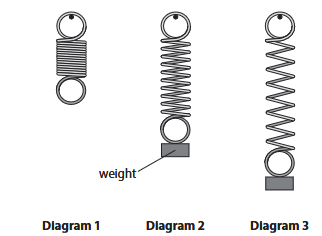
(a) The diagrams show a spring hanging from a nail.
- diagram 1 shows the spring with no weight added
- diagram 2 shows the spring stationary, after a weight has been added
- diagram 3 shows the spring after the weight has been pulled down
(i) Which energy store has increased for the spring in diagram 2 compared to the spring in diagram 1? (1)
A chemical
B elastic
C gravitational potential
D kinetic
(ii) The spring is released from the position shown in diagram 3.
Describe the energy transfers that take place until the spring stops vibrating. (6)
(b) Shock absorbers containing springs are used on motorcycles.
Shock absorbers are designed to compress and expand as the motorcycle moves across a rough surface.
A new type of shock absorber has been developed to generate electricity from the movement of the motorcycle.
This new type of shock absorber consists of magnets that slide inside a coil when the motorcycle goes over a bump.
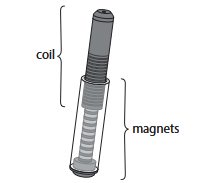
Some of the energy that would normally be wasted can be recovered, so fuel is saved.
(i) Which of these statements best describes the advantage of this new type of shock absorber? (1)
A it increases the energy transferred to a thermal store from the fuel
B it increases the efficiency of the motorcycle
C it decreases the speed of the motorcycle
D it decreases the braking power of the motorcycle
(ii) Explain how this new type of shock absorber can generate electricity. (3)
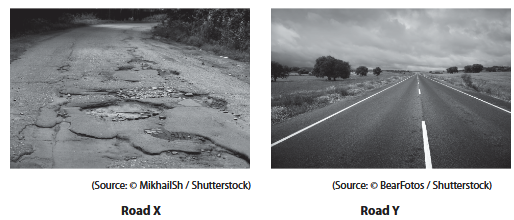
(iii) Road X has a rough surface.
Road Y has a smooth surface.
A motorcycle travels at the same speed along road X and road Y.
Explain why the new type of shock absorber will generate more electricity for this motorcycle on road X than on road Y. (3)
Syllabus Topic Codes (Edexcel International GCSE Physics 4PH1):
• 4.3: Conservation of energy — part (a)(ii)
• 6.15: Electromagnetic induction and induced voltage — parts (b)(ii) and (b)(iii)
• 6.16: Generation of electricity by electromagnetic induction — parts (b)(ii) and (b)(iii)
▶️ Answer/Explanation
(a)(i) Correct Answer: \( \boxed{\mathrm{B\ (elastic)}} \) [1 mark]
Adding the weight stretches the spring, so the energy in the elastic store of the spring increases.
For a spring, the elastic energy store can be related to its extension by \(E_{\mathrm{elastic}}=\dfrac{1}{2}kx^2\), where \(k\) is the spring constant and \(x\) is the extension.
(a)(ii) Energy transfers until the spring stops vibrating [6 marks]
- When the spring is released, its elastic energy store decreases as the spring moves upwards.
- Energy is transferred to the kinetic store of the weight and spring as they accelerate upwards.
- The gravitational potential energy store increases as the weight moves upwards.
- At the highest point, the motion reverses and the weight moves downwards, so gravitational potential energy is transferred to the kinetic store.
- As the spring moves downwards again, energy is transferred mechanically back into the elastic store of the spring.
- The amplitude of the vibrations decreases because energy is transferred to the thermal store of the spring and surroundings, mainly due to friction and air resistance.
Eventually, the vibrations stop and the energy initially stored in the spring has been transferred mainly to the thermal store of the spring and its surroundings.
Key principle: Energy is not destroyed. It is transferred between different energy stores.
(b)(i) Advantage of the new shock absorber [1 mark]
Correct Answer: \( \boxed{\mathrm{B\ it\ increases\ the\ efficiency\ of\ the\ motorcycle}} \)
Some energy that would otherwise be wasted is recovered and converted into useful electrical energy, so the overall efficiency increases.
(b)(ii) Generating electricity [3 marks]
- The magnets move through the coil when the shock absorber moves.
- The moving magnets cause the coil to cut magnetic field lines, so the magnetic field through the coil changes.
- An induced voltage is produced in the coil, which can cause a current to flow and generate electrical energy.
This is an example of electromagnetic induction.
(b)(iii) Why more electricity is generated on Road X [3 marks]
- Road X has a rougher surface, so there are more frequent and/or larger bumps.
- The shock absorber therefore compresses and expands more frequently and/or by a greater amount.
- The magnets move through the coil more frequently and/or over a greater distance, producing a larger or more frequent induced voltage and therefore more electrical energy.
The key idea is that greater movement of the magnets through the coil produces a greater amount of electromagnetic induction.
Final Answer: Road X causes more movement of the magnets through the coil, so the magnetic field through the coil changes more frequently and/or by a greater amount. This produces more induced voltage and therefore more electricity.
Question
Diagram 1 shows a generator inside a small wind turbine. The generator is connected to a lamp and the windmill blades.

(a) When the coil rotates in the direction of the arrow, the ammeter displays a small current. Explain how the generator produces a current.
(b) The generator in the wind turbine acts as an alternating current (a.c.) power supply. Diagram 2 shows an electric circuit containing the generator being used to charge a mobile phone battery.

(i) Direct current (d.c.) is needed to charge the battery. Explain why there is a diode in the circuit.
(ii) Explain how the current in the battery will change if the wind speed increases.
(c) The mean voltage across the battery is \(7.2\,\mathrm{V}\). The battery gains \(14\,\mathrm{kJ}\) of energy in \(8400\,\mathrm{s}\). Calculate the mean current in the battery.
mean current = __________________ \(\mathrm{A}\)
Syllabus Topic Codes (Edexcel International GCSE Physics 4PH1):
• 6.16: Generation of electricity by electromagnetic induction — part (a)
• 2.b: Electrical circuits and current — parts (b) and (c)
▶️ Answer/Explanation
Ans
(a) (coil rotates) through magnetic field / cutting field lines;
voltage is induced;
(b) (i) idea that d.c. is current in one direction only;
diode allows current flow in one direction only/eq;
(ii) higher speed generates higher voltage;
higher voltage causes higher current;
(c) substitution into given equation ‘E = IVt’;
rearrangement;
evaluation;
e.g.
\(14\,000=I\times7.2\times8400\)
\((\mathrm{current})=\dfrac{14000}{7.2\times8400}\)
\((\mathrm{current})=0.23\,\mathrm{A}\)
Question
Diagram 1 shows the magnetic field between the poles of two strong bar magnets.

(a) Add labels to diagram 1 to show the poles of the bar magnets. (1)
(b) The bar magnets are made from steel. Give one reason why steel is a good material for making bar magnets. (1)
(c) Explain how diagram 1 shows a uniform magnetic field. (2)
(d) Diagram 2 shows a metal wire being moved downwards through the uniform field between the poles of the same bar magnets. The orientation of the magnets has not been changed.

(i) Give a reason why a voltage is induced between the ends of the metal wire as it moves between the poles of the bar magnets. (1)
(ii) State two changes that could be made to this arrangement that would increase the magnitude of the induced voltage. (2)
Syllabus Topic Codes (Edexcel International GCSE Physics 4PH1):
• 6.2–6.3: Magnetic Materials, and Hard and Soft Magnetic Materials — part (b)
• 6.7: Uniform Magnetic Fields — part (c)
• 6.15: Induced Voltage — part (d)(i)
• 6.15–6.16: Induced Voltage and Electricity Generation by Induction — part (d)(ii)
▶️ Answer/Explanation
(a) Poles of the bar magnets [1 mark]
The pole on the left should be labelled N and the pole on the right should be labelled S.
(b) Steel as a material for bar magnets [1 mark]
- Steel is a hard magnetic material.
This means that it is difficult to demagnetise, so a steel bar can retain its magnetism.
(c) Uniform magnetic field [2 marks]
The diagram shows a uniform magnetic field because:
- The magnetic field lines are straight and parallel.
- The magnetic field lines are evenly spaced.
Parallel, equally spaced field lines indicate that the magnetic field has the same strength and direction throughout the region.
(d)(i) Induced voltage [1 mark]
- The wire cuts through magnetic field lines as it moves through the magnetic field.
This causes an induced voltage to be produced between the ends of the wire.
(d)(ii) Increasing the induced voltage [2 marks]
Any two of the following:
- Move the wire faster.
- Move the magnets closer together to increase the magnetic field strength in the region between the poles.
- Use stronger magnets.
- Turn the wire into a coil with more turns.
In general, a larger rate of change of magnetic flux through the conductor produces a larger induced voltage.
Questions
A device called a metal detector can be used to find metal buried underground.

The metal detector has two circuits, each containing a coil of copper wire. Diagram 1 shows the circuit for the transmitter coil.

(a) Suggest why there is a magnetic field around the transmitter coil.
(b) The cell supplies direct current (d.c.). The electronics in diagram 1 change the direct current into alternating current (a.c.) in the coil.
(i) Describe the difference between direct current (d.c.) and alternating current (a.c.).
(ii) Alternating current is supplied to the transmitter coil. Diagram 2 shows a gold ring in the soil below the metal detector.

Explain why there is an alternating current in the gold ring.
(c) Diagram 3 shows the circuit for the receiver coil.

As a result of the alternating current in the gold ring, there is an alternating current in the receiving coil. Explain how an alternating current in the receiving coil causes a sound to be emitted from the loudspeaker.
Syllabus Topic Codes (Edexcel International GCSE Physics 4PH1):
• 6.c: Electromagnetism, Direct Current and Alternating Current — part (b)(i)
• 6.d: Electromagnetic Induction — part (b)(ii)
• 6.c: Motor Effect and Loudspeakers — part (c)
▶️ Answer/Explanation
(a) Magnetic field around the transmitter coil
There is a current flowing through the coil. A current-carrying conductor produces a magnetic field around it.
Answer: The current in the coil produces a magnetic field around the coil.
(b)(i) Direct current and alternating current
- Direct current (d.c.) flows in one direction only.
- Alternating current (a.c.) continuously changes direction.
(b)(ii) Induced current in the gold ring
- The alternating current in the transmitter coil produces a changing magnetic field.
- The changing magnetic field passes through the gold ring, so the ring effectively cuts changing magnetic field lines.
- This changing magnetic field induces a voltage in the gold ring.
- Because the induced voltage continually changes direction, an alternating current flows in the gold ring.
This is an example of electromagnetic induction: a changing magnetic field induces a voltage in a conductor.
(c) Operation of the loudspeaker
- The alternating current flows through the coil in the loudspeaker.
- The current produces a magnetic field around the coil, which interacts with the permanent magnetic field of the loudspeaker.
- This interaction produces a force on the loudspeaker cone.
- Because the current is alternating, the direction of the force continually changes.
- The cone therefore vibrates.
- The vibrating cone produces pressure variations in the air, creating a sound wave.
Therefore: alternating current causes the loudspeaker cone to vibrate, producing sound.
Questions
Diagram 1 shows some of the stages of electricity generation in a nuclear power station.

(a) Nuclear fission takes place inside the reactor of the nuclear power station.
(i) Give the name of a fuel that could be used in the reactor.
(ii) Energy is released from the fuel in the reactor by nuclear fission. Describe the process of nuclear fission that takes place inside the reactor.
(b) High pressure steam transfers energy from the reactor to a turbine. The turbine spins as the steam passes through it. Diagram 2 shows a simplified generator connected to the turbine.

(i) Explain how electricity is generated by the generator.
(ii) At night the power station does not need to generate as much electricity. Suggest how the output of this generator could be reduced.
(iii) The generator produces alternating current. Describe the differences between alternating current (a.c.) and direct current (d.c.).
Syllabus Topic Codes (Edexcel International GCSE Physics 4PH1):
• 7.18–7.20: Nuclear Fission: Products and Chain Reaction — part (a)(ii)
• 6.15–6.16: Induced Voltage and Electricity Generation by Induction — parts (b)(i)–(ii)
• 6.16: Electricity Generation by Induction — part (b)(iii)
▶️ Answer/Explanation
(a)(i) Fuel for nuclear fission
A suitable fuel is uranium, such as uranium-235.
(a)(ii) Nuclear fission
- A neutron is absorbed by a large parent nucleus.
- The nucleus becomes unstable and splits into smaller daughter nuclei.
- More neutrons and energy are released.
- The released neutrons can cause further fission reactions, producing a chain reaction.
This chain reaction allows energy to be released continuously in the reactor.
(b)(i) Electricity generation by induction
- The turbine causes the coil to rotate relative to the magnetic field.
- The rotating coil cuts the magnetic field lines.
- This produces an induced voltage across the coil.
- When the circuit is complete, the induced voltage causes an electric current to flow.
Thus, the mechanical energy of the rotating turbine is transferred into electrical energy by electromagnetic induction.
(b)(ii) Reducing the generator output
One suitable method is to reduce the speed of rotation of the turbine, for example by reducing the flow, speed, or pressure of the steam entering the turbine.
Other acceptable methods include reducing the strength of the magnetic field or reducing the number of turns in the coil.
(b)(iii) Alternating current and direct current
- Alternating current (a.c.) continuously changes direction.
- Direct current (d.c.) flows in only one direction.
Therefore, the key difference is the direction of current flow.
Question
The diagrams show some equipment that the physicist Ørsted used in an investigation in 1820. Diagram 1 shows the position of eight compass needles around a wire with no current in the wire. The compass needles line up with and show the direction of the Earth’s magnetic field lines.

Diagram 2 shows the position of the same compass needles when a current is in the wire.

(a)(i) Explain why the compass needles turn when the current is switched on.
(ii) Using evidence from the compass needles in diagram 2, draw on diagram 2 the shape and direction of a magnetic field line produced by the current in the wire.
(iii) Suggest what happens to the magnetic field when the current in the wire is reversed.
(b) The current in the wire is turned off. Diagram 3 shows the wire placed in a uniform magnetic field.

The current is now switched on. Draw an arrow to show the direction of the force on the wire.
(c) The power supply in diagram 3 is replaced by an ammeter.
(i) When the wire is moved, a current is detected. Explain which direction the wire is moved in the magnetic field to produce a current in the wire.
(ii) Explain why a current is produced in the wire when the wire is moved in the magnetic field.
Syllabus Topic Codes (Edexcel International GCSE Physics 4PH1):
• 6.8–6.10P: Magnetic Fields around Current-Carrying Conductors and Field Patterns — parts (a)(i)–(iii)
• 6.12–6.14: Force on a Current-Carrying Conductor and the Left-Hand Rule — part (b)
• 6.15: Induced Voltage — part (c)
• 6.16: Electricity Generation by Induction — part (c)
▶️ Answer/Explanation
(a)(i) Effect of current on compass needles [2 marks]
When the current is switched on, the current-carrying wire produces a magnetic field around the wire.
The compass needles experience a magnetic effect and turn to align with the resulting magnetic field.
(a)(ii) Magnetic field around the wire [2 marks]
The magnetic field produced by a straight current-carrying wire consists of concentric circular field lines centred on the wire.
From the directions shown by the compass needles in diagram 2, the field line should have an arrow in the clockwise direction.
(a)(iii) Reversing the current [1 mark]
Reversing the current reverses the direction of the magnetic field around the wire.
(b) Force on the current-carrying wire [2 marks]
The current-carrying wire experiences a force because it is placed in a magnetic field.
Using the direction of the magnetic field and the current shown in diagram 3, the force on the wire is directed upwards.
Therefore, draw the arrow vertically upwards.
(c)(i) Direction of movement [2 marks]
The wire must be moved upwards or downwards, so that it moves across the magnetic field lines.
Moving the wire across the field lines causes the magnetic field lines to be cut by the wire.
(c)(ii) Why a current is produced [2 marks]
When the wire moves through the magnetic field, it cuts magnetic field lines. This induces a voltage across the wire.
Because the circuit is complete, the induced voltage causes a current to flow.
This is the principle of electromagnetic induction.