
Edexcel iGCSE Physics (4PH1) 6.4 Electromagnetic Induction Exam Style Question Paper 2B - New Syllabus
Question
(a) The diagram shows a cross-section of a solenoid.
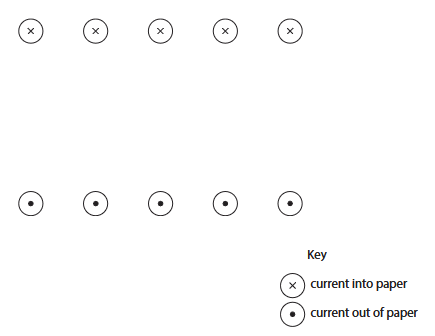
(i) Draw one field line on the diagram to show the direction of the magnetic field. (2)
(ii) Use the field line to determine which end of the solenoid is the north pole and label this on the diagram. (1)
(b) A transformer consists of two solenoids and an iron core.
This is the label on the transformer.
| Number of turns on primary coil: \(180\) |
| Number of turns on secondary coil: \(345\) |
| Output voltage: \(230\,\mathrm{V}\) |
| Output power: \(320\,\mathrm{W}\) |
(i) State the formula linking input (primary) voltage, output (secondary) voltage and the turns ratio. (1)
(ii) Calculate the input voltage of this transformer. (3)
input voltage = __________________ \(\mathrm{V}\)
(iii) Give the name of this type of transformer. (1)
(iv) When the transformer is in use, there is a current in the primary coil and in the secondary coil.
State the type of current in the coils of the transformer. (1)
Syllabus Topic Codes (Edexcel International GCSE Physics 4PH1):
• 6.17–6.18P: Transformers and Step-Up and Step-Down Transformers — parts (b)(iii) and (b)(iv)
• 6.19–6.20P: Transformer Voltage, Turns Ratio, and Power — parts (b)(i) and (b)(ii)
▶️ Answer/Explanation
(a)(i) Direction of the magnetic field [2 marks]
The current in the upper row is into the page and the current in the lower row is out of the page. Using the right-hand grip rule for the current in the solenoid, the magnetic field inside the solenoid is directed from right to left.
Therefore, a correct field line should be drawn through the solenoid without crossing the wires, with an arrow pointing from right to left inside the solenoid.
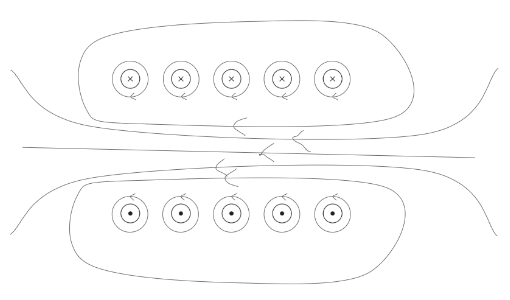
Final Answer: Draw a continuous magnetic field line with its arrow pointing from right to left through the solenoid.
(a)(ii) North pole of the solenoid [1 mark]
Magnetic field lines inside a solenoid point from the south pole to the north pole.
Since the field inside the solenoid is directed from right to left, the left-hand end is the north pole.
Final Answer: \( \boxed{\mathrm{Left\ end=N}} \)
(b)(i) Transformer equation [1 mark]
The relationship between voltage and number of turns is:
\(\dfrac{N_p}{N_s}=\dfrac{V_p}{V_s}\)
Final Answer: \( \boxed{\dfrac{N_p}{N_s}=\dfrac{V_p}{V_s}} \)
(b)(ii) Input voltage [3 marks]
1. Substitute the known values:
\(\dfrac{180}{345}=\dfrac{V_p}{230}\)
2. Rearrange for the primary voltage:
\(V_p=\dfrac{230\times180}{345}\)
3. Calculate:
\(V_p=120\,\mathrm{V}\)
Final Answer: \( \boxed{120\,\mathrm{V}} \)
(b)(iii) Type of transformer [1 mark]
The secondary coil has more turns than the primary coil:
\(345>180\)
Therefore, the transformer increases the output voltage and is a step-up transformer.
Final Answer: \( \boxed{\mathrm{Step\!-\!up\ transformer}} \)
(b)(iv) Type of current [1 mark]
A transformer operates using a changing magnetic field produced by an alternating current.
Therefore, the current in the coils is alternating current, or a.c.
Final Answer: \( \boxed{\mathrm{alternating\ current\ (a.c.)}} \)
Question
This question is about transformers.
(a) The diagram shows a step-down transformer.
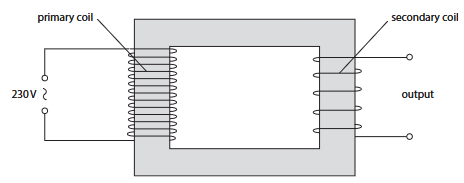
The table gives some data for the step-down transformer.
| Input (primary) voltage | \(230\,\mathrm{V}\) |
| Input (primary) current | \(1.3\,\mathrm{A}\) |
| Output (secondary) current | \(4.0\,\mathrm{A}\) |
| Number of turns on primary coil | \(1000\) |
| Number of turns on secondary coil | \(300\) |
(i) State the formula linking input (primary) voltage, output (secondary) voltage and the turns ratio for a transformer. (1)
(ii) Use data from the table to calculate the output (secondary) voltage of the transformer. (3)
output (secondary) voltage = __________________ \(\mathrm{V}\)
(iii) This transformer is not 100% efficient.
The efficiency of a transformer can be calculated using the formula
\(\mathrm{efficiency}=\dfrac{\mathrm{useful\ output\ power}}{\mathrm{total\ input\ power}}\times100\%\)
Calculate the efficiency of the transformer. (5)
efficiency = __________________ \(\%\)
(b) Explain how transformers are used in the efficient, large-scale transmission of electrical energy.
You may draw a diagram to help your answer. (5)
Syllabus Topic Codes (Edexcel International GCSE Physics 4PH1):
• 6.18P: Step-up and step-down transformers in large-scale transmission of electrical energy — part (b)
• 6.19P: Transformer voltage and turns ratio — part (a)(i) and (a)(ii)
• 6.20P: Transformer power relationship and efficiency — part (a)(iii)
▶️ Answer/Explanation
(a)(i) Transformer turns ratio equation [1 mark]
The relationship between voltage and number of turns is
\(\dfrac{V_\mathrm{p}}{V_\mathrm{s}}=\dfrac{N_\mathrm{p}}{N_\mathrm{s}}\)
where \(V_\mathrm{p}\) is the primary voltage, \(V_\mathrm{s}\) is the secondary voltage, \(N_\mathrm{p}\) is the number of primary turns and \(N_\mathrm{s}\) is the number of secondary turns.
Final Answer: \( \boxed{\dfrac{V_\mathrm{p}}{V_\mathrm{s}}=\dfrac{N_\mathrm{p}}{N_\mathrm{s}}} \)
(a)(ii) Output voltage [3 marks]
1. Substitute the known values:
\(\dfrac{230}{V_\mathrm{s}}=\dfrac{1000}{300}\)
2. Rearrange for \(V_\mathrm{s}\):
\(V_\mathrm{s}=\dfrac{230\times300}{1000}\)
3. Calculate:
\(V_\mathrm{s}=69\,\mathrm{V}\)
Final Answer: \( \boxed{69\,\mathrm{V}} \)
(a)(iii) Efficiency of the transformer [5 marks]
1. Use the power equation:
\(P=IV\)
2. Calculate the total input power:
\(P_\mathrm{in}=V_\mathrm{p}I_\mathrm{p}\)
\(P_\mathrm{in}=230\times1.3\)
\(P_\mathrm{in}=299\,\mathrm{W}\)
3. Calculate the useful output power:
\(P_\mathrm{out}=V_\mathrm{s}I_\mathrm{s}\)
\(P_\mathrm{out}=69\times4.0\)
\(P_\mathrm{out}=276\,\mathrm{W}\)
4. Use the efficiency equation:
\(\mathrm{efficiency}=\dfrac{P_\mathrm{out}}{P_\mathrm{in}}\times100\%\)
\(\mathrm{efficiency}=\dfrac{276}{299}\times100\%\)
5. Calculate:
\(\mathrm{efficiency}=92.3\%\)
Final Answer: \( \boxed{92.3\%} \)
(b) Efficient large-scale transmission of electrical energy [5 marks]
1. A step-up transformer is used before the electrical energy is transmitted.
2. The transformer increases the voltage before transmission.
3. For a given power, increasing the voltage reduces the current in the transmission cables, since \(P=IV\).
4. The lower current produces less heating of the transmission cables.
5. Therefore, less energy is wasted during transmission. At the receiving end, a step-down transformer reduces the voltage to a suitable and safer value for consumers.
Final Answer: A step-up transformer increases the voltage before transmission. This reduces the current for the same power, so less energy is wasted as heating in the cables. A step-down transformer is then used after transmission to reduce the voltage to a suitable value for consumers.
Question
(a) Describe the structure of a step-up transformer.
You may draw a diagram to help your answer. (3)
____________________________________________________________
____________________________________________________________
____________________________________________________________
(b) A step-up transformer has an input voltage of \(230\,\mathrm{V}\) and an input current of \(4.5\,\mathrm{A}\).
The output current of the transformer is \(0.21\,\mathrm{A}\).
(i) State the formula linking input power and output power for a transformer that is 100% efficient. (1)
____________________________________________________________
(ii) Calculate the output voltage of the transformer. (3)
output voltage = __________________ \(\mathrm{V}\)
Syllabus Topic Codes (Edexcel International GCSE Physics 4PH1):
• 6.17P: Structure of a transformer and different numbers of turns on the input and output sides.
• 6.19P: Relationship between input and output voltages and the turns ratio.
• 6.20P: Relationship between input and output power for a 100% efficient transformer.
▶️ Answer/Explanation
(a) Structure of a step-up transformer [3 marks]
A transformer consists of:
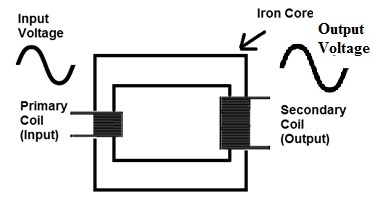
- Two coils of insulated wire, called the primary coil and secondary coil.
- The secondary coil has more turns than the primary coil for a step-up transformer.
- The two coils are linked by a soft iron core.
Key relationship:
For a step-up transformer, \(N_\mathrm{s}>N_\mathrm{p}\), so \(V_\mathrm{s}>V_\mathrm{p}\).
(b)(i) [1 mark]
For a transformer that is 100% efficient:
\(\mathrm{input\ power}=\mathrm{output\ power}\)
or
\(V_\mathrm{p}I_\mathrm{p}=V_\mathrm{s}I_\mathrm{s}\)
(b)(ii) Output voltage [3 marks]
Use conservation of power:
\(V_\mathrm{p}I_\mathrm{p}=V_\mathrm{s}I_\mathrm{s}\)
Substitute the values:
\(230\times4.5=V_\mathrm{s}\times0.21\)
Rearrange:
\(V_\mathrm{s}=\dfrac{230\times4.5}{0.21}\)
Evaluate:
\(V_\mathrm{s}\approx4929\,\mathrm{V}\)
Final Answer: \(\boxed{4930\,\mathrm{V}}\)
Question
The photograph shows transmission cables used for long-distance transmission of electricity.

(a) The diagram shows a power station and a school. Add to the diagram by drawing the structures needed to efficiently transfer energy from the power station to the school using electricity.

(b) Explain how the amount of current in the transmission cables increases the efficiency of the transmission of electricity.
Syllabus Topic Codes (Edexcel International GCSE Physics 4PH1):
• 6.19–6.20P: Transformer Voltage, Turns Ratio, and Power — part (a)
• 2.4–2.5: Power, Current, Voltage, and Electrical Energy Transfer — part (b)
▶️ Answer/Explanation
(a) Transformers for efficient transmission [3 marks]
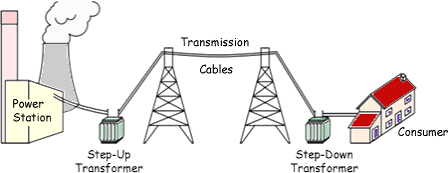
- Draw a transformer between the power station and the school.
- Draw a second transformer between the power station and the school.
- Label the transformer nearest the power station step-up and the transformer nearest the school step-down.
The step-up transformer increases the voltage before electricity is transmitted over long distances. The step-down transformer reduces the voltage before the electricity is supplied to the school.
(b) Effect of current on transmission efficiency [3 marks]
- Current flowing through the transmission cables causes the cables to heat up.
- Using a lower current reduces the heating effect in the cables.
- Therefore, less electrical energy is wasted to the surroundings, increasing the efficiency of transmission.
For a given power, increasing the transmission voltage allows the current to be reduced because \(P=IV\). The power wasted in the cables is proportional to \(I^2R\), so reducing the current greatly reduces energy loss.
Question
A transformer is used to charge a mobile phone. The diagram shows a label on the transformer.

(a) Explain how the information in the label shows that the transformer is a step-down transformer.
(b) Show that the transformer is approximately \(100\%\) efficient.
(c)(i) State the formula linking input voltage, output voltage and turns ratio for a transformer.
(ii) The primary coil has \(1500\) turns. Calculate the number of turns on the secondary coil.
Syllabus Topic Codes (Edexcel International GCSE Physics 4PH1):
• 6.19–6.20P: Transformer Voltage, Turns Ratio, and Power — parts (b) and (c)
▶️ Answer/Explanation
(a) Step-down transformer [2 marks]
- The output voltage is less than the input voltage.
- The output current is greater than the input current.
A transformer that reduces the input voltage is called a step-down transformer.
(b) Efficiency [3 marks]
Calculate the input power:
\(P_{\mathrm{in}}=V_{\mathrm{in}}I_{\mathrm{in}}\)
\(P_{\mathrm{in}}=230\times0.067\)
\(P_{\mathrm{in}}=15.41\,\mathrm{W}\)
The output power is approximately \(15.5\,\mathrm{W}\), which is approximately equal to the input power.
Efficiency is:
\(\mathrm{efficiency}=\dfrac{P_{\mathrm{out}}}{P_{\mathrm{in}}}\times100\%\)
Since \(P_{\mathrm{out}}\approx P_{\mathrm{in}}\), the efficiency is approximately:
\(\boxed{100\%}\)
(c)(i) Transformer turns ratio [1 mark]
The formula linking the voltages and turns is:
\(\boxed{\dfrac{N_{\mathrm{p}}}{N_{\mathrm{s}}}=\dfrac{V_{\mathrm{p}}}{V_{\mathrm{s}}}}\)
(c)(ii) Number of turns on the secondary coil [3 marks]
Use:
\(\dfrac{N_{\mathrm{p}}}{N_{\mathrm{s}}}=\dfrac{V_{\mathrm{p}}}{V_{\mathrm{s}}}\)
Substitute the values:
\(\dfrac{1500}{N_{\mathrm{s}}}=\dfrac{230}{5.0}\)
Rearrange:
\(N_{\mathrm{s}}=\dfrac{1500}{230/5.0}\)
\(N_{\mathrm{s}}=32.6\)
Therefore, to an appropriate number of significant figures:
\(\boxed{N_{\mathrm{s}}\approx33\text{ turns}}\)
Question
The diagram shows a step-down transformer.

(a) The input power to the transformer is \(16\,\mathrm{W}\). The transformer is used for \(2.5\) hours. Calculate the energy transferred to the transformer during this time.
(b) Explain how a transformer works. In your answer, include reasons for using
• two coils
• the iron core
• an a.c. power supply
(c) State how the primary coil of the transformer can be changed to increase the output voltage.
Syllabus Topic Codes (Edexcel International GCSE Physics 4PH1):
• 6.15–6.16: Induced Voltage and Electricity Generation by Induction — part (b)
• 6.17–6.18P: Transformers and Step-Up and Step-Down Transformers — parts (b) and (c)
• 6.19–6.20P: Transformer Voltage, Turns Ratio, and Power — part (c)
▶️ Answer/Explanation
(a) Energy transferred [3 marks]
Use the relationship:
\(E=Pt\)
The time must be converted from hours to seconds:
\(t=2.5\times3600=9000\,\mathrm{s}\)
Therefore:
\(E=16\times9000\)
\(E=144000\,\mathrm{J}\)
Therefore:
\(\boxed{E=1.44\times10^5\,\mathrm{J}}\)
(b) How a transformer works [6 marks]
- The transformer can step up or step down the voltage.
- An alternating current in the primary coil produces a magnetic field.
- Because the current is alternating, the magnetic field is continuously changing.
- The changing magnetic field passes through the iron core.
- The iron core strengthens the magnetic field and transfers the changing magnetic field to the secondary coil.
- The changing magnetic field through the secondary coil induces a voltage across the secondary coil.
Why two coils are used: The primary and secondary coils are electrically separate, allowing electrical energy to be transferred by the changing magnetic field.
Why an iron core is used: Iron is a soft magnetic material, so it can be magnetised and demagnetised easily. It also provides a strong magnetic field pathway between the coils.
Why an a.c. supply is used: An alternating current produces a changing magnetic field. This changing field is required to induce a voltage in the secondary coil. A steady d.c. supply would not continuously produce the changing magnetic field needed for transformer operation.
(c) Increasing the output voltage [1 mark]
For a transformer:
\(\displaystyle \frac{V_\mathrm{p}}{V_\mathrm{s}}=\frac{N_\mathrm{p}}{N_\mathrm{s}}\)
To increase the output voltage \(V_\mathrm{s}\), the number of turns on the primary coil should be decreased, while the secondary coil remains unchanged.
\(\boxed{\text{Use fewer turns on the primary coil.}}\)
Question
The National Grid is used in the United Kingdom for the large-scale transmission of electricity. The photograph shows solar panels connected to the National Grid.

(a) Solar panels provide direct current to a device that outputs an alternating current so that the energy from the solar panels can be supplied to the National Grid.
(i) Explain why a step-up transformer is used to supply the National Grid.
(ii) This is the label on the step-up transformer.

State the formula linking input voltage, output voltage and turns ratio for a transformer.
(iii) Calculate the number of turns on the secondary coil of the step-up transformer.
(b) Solar panels produce constant direct current (d.c.). Explain why a transformer will not work when connected to constant direct current.
Syllabus Topic Codes (Edexcel International GCSE Physics 4PH1):
• 6.19–6.20P: Transformer Voltage, Turns Ratio, and Power — parts (a)(i)–(iii)
• 6.15: Induced Voltage — part (b)
▶️ Answer/Explanation
(a)(i) Why a step-up transformer is used [2 marks]
A step-up transformer increases the voltage for transmission through the National Grid.
For a given power, increasing the voltage reduces the current because:
\(P=VI\)
A lower current means less energy is wasted as thermal energy in the transmission cables because the heating effect depends on the current.
Therefore, high-voltage transmission makes the transmission of electrical energy more efficient.
(a)(ii) Transformer turns ratio [1 mark]
The relationship between the primary and secondary voltages and the number of turns is:
\(\boxed{\dfrac{N_\mathrm{p}}{N_\mathrm{s}}=\dfrac{V_\mathrm{p}}{V_\mathrm{s}}}\)
(a)(iii) Number of turns on the secondary coil [3 marks]
Use:
\(\displaystyle \frac{N_\mathrm{p}}{N_\mathrm{s}}=\frac{V_\mathrm{p}}{V_\mathrm{s}}\)
From the transformer label:
\(N_\mathrm{p}=1400\)
\(V_\mathrm{p}=15\,\mathrm{V}\)
\(V_\mathrm{s}=340\,\mathrm{V}\)
Substitute:
\(\displaystyle \frac{1400}{N_\mathrm{s}}=\frac{15}{340}\)
Rearranging:
\(\displaystyle N_\mathrm{s}=\frac{340\times1400}{15}\)
\(N_\mathrm{s}=31733\)
Therefore, to an appropriate number of significant figures:
\(\boxed{N_\mathrm{s}\approx3.2\times10^4\text{ turns}}\)
(b) Why a transformer does not work with constant d.c. [3 marks]
A constant direct current produces a constant magnetic field in the primary coil.
Transformer action requires a changing magnetic field to produce electromagnetic induction in the secondary coil.
Since the magnetic field is not changing when a constant d.c. flows, there is no continuously induced voltage in the secondary coil.
\(\boxed{\text{A transformer requires an alternating current to operate continuously.}}\)
Question
The diagram shows a step-down transformer.
(a) The input power to the transformer is \(16\,\mathrm{W}\). The transformer is used for \(2.5\) hours. Calculate the energy transferred to the transformer during this time.
(b) Explain how a transformer works. In your answer, include reasons for using
• two coils
• the iron core
• an a.c. power supply
(c) State how the primary coil of the transformer can be changed to increase the output voltage.
Syllabus Topic Codes (Edexcel International GCSE Physics 4PH1):
• 6.15–6.16: Induced Voltage and Electricity Generation by Induction — part (b)
• 6.17–6.18P: Transformers and Step-Up and Step-Down Transformers — parts (b) and (c)
• 6.19–6.20P: Transformer Voltage, Turns Ratio, and Power — part (c)
▶️ Answer/Explanation
(a) Energy transferred [3 marks]
Use the relationship:
\(E=Pt\)
The time must be converted from hours to seconds:
\(t=2.5\times3600=9000\,\mathrm{s}\)
Therefore:
\(E=16\times9000\)
\(E=144000\,\mathrm{J}\)
Therefore:
\(\boxed{E=1.44\times10^5\,\mathrm{J}}\)
(b) How a transformer works [6 marks]
- The transformer can step up or step down the voltage.
- An alternating current in the primary coil produces a magnetic field.
- Because the current is alternating, the magnetic field is continuously changing.
- The changing magnetic field passes through the iron core.
- The iron core strengthens the magnetic field and transfers the changing magnetic field to the secondary coil.
- The changing magnetic field through the secondary coil induces a voltage across the secondary coil.
Why two coils are used: The primary and secondary coils are electrically separate, allowing electrical energy to be transferred by the changing magnetic field.
Why an iron core is used: Iron is a soft magnetic material, so it can be magnetised and demagnetised easily. It also provides a strong magnetic field pathway between the coils.
Why an a.c. supply is used: An alternating current produces a changing magnetic field. This changing field is required to induce a voltage in the secondary coil. A steady d.c. supply would not continuously produce the changing magnetic field needed for transformer operation.
(c) Increasing the output voltage [1 mark]
For a transformer:
\(\displaystyle \frac{V_\mathrm{p}}{V_\mathrm{s}}=\frac{N_\mathrm{p}}{N_\mathrm{s}}\)
To increase the output voltage \(V_\mathrm{s}\), the number of turns on the primary coil should be decreased, while the secondary coil remains unchanged.
\(\boxed{\text{Use fewer turns on the primary coil.}}\)