
Edexcel iGCSE Physics (4PH1) 7.2 Radioactivity Exam Style Question Paper 1B - New Syllabus
Question
A protactinium generator is a device that can produce samples of an isotope called protactinium-\(234\mathrm{m}\).
A teacher investigates the activity of protactinium-\(234\mathrm{m}\) using the apparatus shown in the photograph.
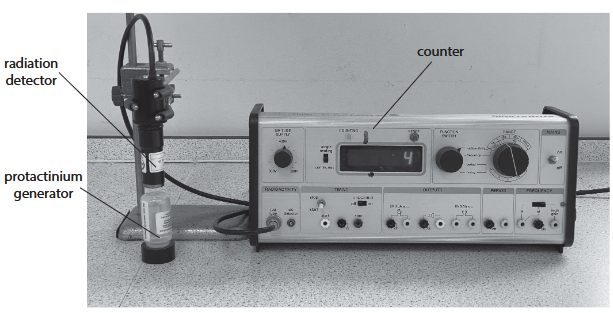
(a) The teacher uses a radiation detector to detect the radiation emitted from the protactinium-\(234\mathrm{m}\).
Give the name of a suitable radiation detector. (1)
(b) Give two safety precautions to minimise the risk of harm to the teacher from the radiation emitted by the protactinium generator. (2)
1. ________________________________________________________________
2. ________________________________________________________________
(c) Protactinium-\(234\mathrm{m}\) decays with a half-life of \(70\,\mathrm{s}\).
(i) The initial count rate is \(840\) counts per second.
Calculate the expected count rate after \(140\,\mathrm{s}\). (2)
count rate = __________________ counts per second
(ii) The activity of an isotope is the total amount of radiation emitted each second.
The teacher estimates that only \(5\%\) of the total radiation emitted is detected by the radiation detector.
Estimate the activity of the isotope when the count rate is \(840\) counts per second.
Give the unit. (3)
activity = __________________ unit = __________________
Syllabus Topic Codes (Edexcel International GCSE Physics 4PH1):
• 7.15–7.16: Contamination, irradiation and dangers of ionising radiation — part (b)
• 7.11: Radioactive decay and activity — part (c)(ii)
• 7.12–7.13: Half-life and calculations — part (c)(i)
▶️ Answer/Explanation
(a) Suitable radiation detector [1 mark]
Correct Answer: \( \boxed{\mathrm{Geiger\text{-}Muller\ tube}} \)
A Geiger-Muller tube, also called a Geiger counter, can detect ionising radiation.
(b) Safety precautions [2 marks]
Any two valid precautions:
- Increase the distance between the teacher and the radioactive source.
- Minimise the time of exposure to the radiation.
- Do not point the radioactive source towards people.
- Handle the source using tongs or suitable protective equipment rather than directly with bare hands.
- Use suitable shielding between the teacher and the radioactive source.
Award \(1\) mark for each valid precaution, up to \(2\) marks.
(c)(i) Count rate after \(140\,\mathrm{s}\) [2 marks]
1. Determine the number of half-lives:
\(\dfrac{140}{70}=2\)
Therefore, \(140\,\mathrm{s}\) corresponds to \(2\) half-lives.
2. Halve the count rate twice:
After \(1\) half-life:
\(\dfrac{840}{2}=420\,\mathrm{counts\,s^{-1}}\)
After \(2\) half-lives:
\(\dfrac{420}{2}=210\,\mathrm{counts\,s^{-1}}\)
Final Answer: \( \boxed{210\,\mathrm{counts\,s^{-1}}} \)
(c)(ii) Activity of the isotope [3 marks]
The detector records only \(5\%\) of the total radiation emitted.
Therefore,
\(\mathrm{count\ rate}=0.05\times\mathrm{activity}\)
Rearrange for activity:
\(\mathrm{activity}=\dfrac{\mathrm{count\ rate}}{0.05}\)
Substitute the value:
\(\mathrm{activity}=\dfrac{840}{0.05}\)
\(\mathrm{activity}=16800\,\mathrm{Bq}\)
Since \(1\,\mathrm{Bq}=1\) decay per second, the unit of activity is the becquerel (\(\mathrm{Bq}\)).
Final Answer: \( \boxed{16800\,\mathrm{Bq}} \)
Question
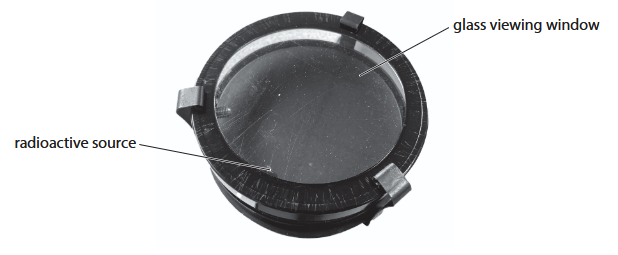
The photograph shows a cloud chamber, used to observe alpha radiation produced by a radioactive source. The radioactive source is inside the cloud chamber as shown in the photograph.
(a) Describe the structure of an alpha particle. (2)
(b) The source used in the cloud chamber contains the isotope radium-226.
The incomplete nuclear equation shows the decay of radium-226 into an isotope of radon.
Complete the nuclear equation by writing the correct numbers in the boxes. (3)
\(^{226}_{88}\mathrm{Ra}\rightarrow{}^{\boxed{\phantom{222}}}_{86}\mathrm{Rn}+{}^{\boxed{\phantom{4}}}_{\boxed{\phantom{2}}}\alpha\)
(c) The tracks in the cloud chamber can be seen through the glass viewing window.
Explain why the radioactive source is not a hazard to the person viewing the cloud chamber. (2)
(d) When radiation is emitted from the source a white line is produced in the cloud chamber. The white line is known as a track.
The diagram shows the tracks produced by the radiation from the source.
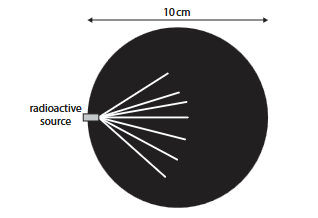
The diameter of the cloud chamber is \(10\,\mathrm{cm}\).
Explain the properties of alpha radiation that can be deduced from the length of the tracks. (3)
Syllabus Topic Codes (Edexcel International GCSE Physics 4PH1):
• 7.4–7.5: Alpha radiation, ionising radiation and penetrating power — parts (a), (c) and (d)
• 7.7–7.8: Effects of alpha emission and balancing nuclear equations — part (b)
▶️ Answer/Explanation
(a) Structure of an alpha particle [2 marks]
- An alpha particle contains protons and neutrons.
- It contains 2 protons and 2 neutrons.
Therefore, an alpha particle has a proton number of \(2\) and a nucleon number of \(4\).
(b) Completing the nuclear equation [3 marks]
An alpha particle has:
proton number \(=2\)
nucleon number \(=4\)
The nucleon numbers must balance:
\(226= A+4\)
\(A=222\)
The proton numbers must balance:
\(88=86+2\)
Therefore, the completed equation is:
\(\boxed{^{226}_{88}\mathrm{Ra}\rightarrow{}^{222}_{86}\mathrm{Rn}+{}^{4}_{2}\alpha}\)
Final Answer: \( \boxed{222,\ 4,\ 2} \)
(c) Why the source is not a hazard to the viewer [2 marks]
- Alpha radiation has a very short range and a low penetrating power.
- The alpha radiation is absorbed by the material of the cloud chamber and its glass viewing window, so it cannot reach the person viewing the chamber.
The radioactive source is also inside the cloud chamber, rather than being directly exposed to the viewer.
(d) Properties of alpha radiation from the track lengths [3 marks]
- The tracks are approximately the same length.
- This indicates that the alpha particles have approximately the same kinetic energy.
- The tracks are relatively short, showing that alpha radiation has a short range and is strongly ionising or poorly penetrating.
Since the cloud chamber has a diameter of \(10\,\mathrm{cm}\), the tracks are only a small fraction of this distance, supporting the conclusion that alpha radiation has a short range in air.
Final Answer: Alpha particles have a short range, are strongly ionising and have relatively low penetrating power. The similar track lengths indicate similar kinetic energies.
Question
This question is about the process of controlled nuclear fission in a nuclear reactor.
(a) In a nuclear reactor, uranium-\(235\) nuclei are split to produce daughter nuclei and neutrons.
State what else is released in nuclear fission that makes the process useful in a nuclear reactor. (1)
(b) What is the function of the control rods in a nuclear reactor? (1)
(B) create additional neutrons
(C) fuse neutrons together
(D) split neutrons
(c) What is the function of the moderator in a nuclear reactor? (1)
(B) change neutrons into protons
(C) slow down neutrons
(D) speed up neutrons
(d) Many of the daughter nuclei produced in nuclear fission are very radioactive.
These daughter nuclei decay by emitting ionising radiation in a random process.
(i) State what is meant by the term ionising radiation. (1)
(ii) State what is meant by the term random process. (1)
(iii) The diagram shows some parts of a nuclear reactor.
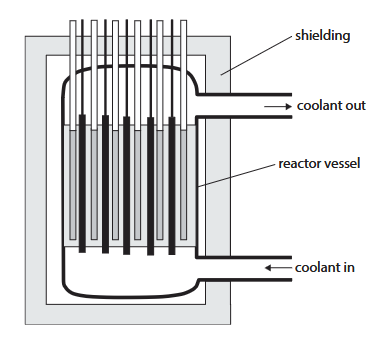
Explain the role of shielding in a nuclear reactor. (3)
Syllabus Topic Codes (Edexcel International GCSE Physics 4PH1):
• 7.21–7.22: Control rods, moderators and shielding — parts (b), (c) and (d)(iii)
• 7.4–7.5: Types and properties of alpha, beta and gamma radiation — part (d)(i)
• 7.11: Radioactive decay and activity — part (d)(ii)
• 7.15–7.16: Contamination, irradiation and dangers of ionising radiation — part (d)(iii)
▶️ Answer/Explanation
(a) Energy released in nuclear fission [1 mark]
Correct Answer: \( \boxed{\mathrm{kinetic\ energy}} \)
Nuclear fission releases energy, mainly as the kinetic energy of the daughter nuclei and neutrons. This energy is transferred to thermal energy and can be used to heat water and produce steam.
(b) Function of control rods [1 mark]
Correct Answer: \( \boxed{\mathrm{A}} \) absorb excess neutrons
Control rods absorb neutrons in the reactor. This controls the rate of the chain reaction and prevents the reaction from increasing too rapidly.
(c) Function of the moderator [1 mark]
Correct Answer: \( \boxed{\mathrm{C}} \) slow down neutrons
The moderator slows down fast neutrons so that they are more likely to cause further fission of uranium-\(235\) nuclei.
(d)(i) Meaning of ionising radiation [1 mark]
Ionising radiation has enough energy to remove electrons from atoms or molecules, producing ions.
Final Answer: Ionising radiation can remove electrons from atoms or molecules.
(d)(ii) Meaning of a random process [1 mark]
A random process is one in which it is not possible to predict when an individual nucleus will decay.
Radioactive decay is spontaneous and there is no pattern that allows the exact time of decay of an individual nucleus to be predicted.
(d)(iii) Role of shielding [3 marks]
- Radioactive materials in the reactor emit harmful ionising radiation.
- The shielding absorbs or reduces the intensity of the radiation escaping from the reactor.
- This reduces the amount of radiation reaching workers and other people, helping to protect them from harmful effects.
Exposure to ionising radiation can damage cells and increase the risk of harmful effects such as cancer.
Final Answer: Shielding absorbs ionising radiation from the reactor, reducing the radiation that escapes and protecting workers and the public from harmful exposure.
Question
This question is about radioactivity.
(a) Uranium-238 decays by emitting an alpha particle to become an isotope of thorium.
Complete the equation for the alpha decay of uranium-238. (3 marks)
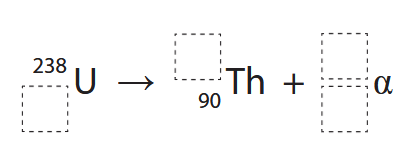
(b) The isotope of thorium produced in the decay of uranium-238 is also radioactive.
Thorium decays by emitting a beta particle.
Describe how the structure of a thorium nucleus changes when a beta particle is emitted. (2 marks)
________________________________________________________________________________________________
________________________________________________________________________________________________
(c) A teacher demonstrates radioactivity using a radioactive rock.
The rock contains uranium-238 and other radioactive isotopes.
The teacher takes precautions to reduce the risk of contamination and irradiation by the radioactive rock.
(i) Suggest a safety precaution that would reduce the risk of contamination by the radioactive rock. (1 mark)
________________________________________________________________________________________________
(ii) Suggest a safety precaution that would reduce the risk of irradiation by the radioactive rock. (1 mark)
________________________________________________________________________________________________
(iii) The teacher measures the amount of radiation emitted by the radioactive rock in a time of \(1\) minute using a Geiger-Müller (GM) tube and counter.
The teacher repeats this measurement to obtain a total of five measurements of the count rate.
| Count rate in counts per minute |
|---|
| 54 |
| 58 |
| 52 |
| 35 |
| 55 |
Calculate the mean count rate.
Give your answer to \(2\) significant figures. (3 marks)
mean count rate = ____________________ counts per minute
Syllabus Topic Codes (Edexcel International GCSE Physics 4PH1):
• 7.7: Nuclear changes during radioactive emission — part (b)
• 7.15–7.16: Contamination, irradiation and dangers of ionising radiation — parts (c)(i), (c)(ii)
• 7.9–7.11: Detection of ionising radiation, background radiation and activity — part (c)(iii)
▶️ Answer/Explanation and Mark Scheme
(a) Alpha decay equation [3 marks]
In alpha decay, the mass number decreases by \(4\) and the atomic number decreases by \(2\).
Therefore,
\(\boxed{{}^{238}_{92}\mathrm{U}\rightarrow{}^{234}_{90}\mathrm{Th}+{}^{4}_{2}\alpha}\)
- Thorium mass number \(=238-4=234\).
- Uranium atomic number \(=92\).
- Alpha particle: \({}^{4}_{2}\alpha\).
(b) Beta decay [2 marks]
- The number of neutrons decreases by \(1\).
- The number of protons increases by \(1\).
A neutron changes into a proton and an electron is emitted as the beta particle.
(c)(i) Reducing contamination [1 mark]
- Wear protective gloves while handling the rock.
- Alternatively, avoid touching the rock directly, for example by using tongs.
(c)(ii) Reducing irradiation [1 mark]
- Minimise exposure time or maximise the distance from the rock.
- Alternatively, use a suitable screen between the rock and people.
(c)(iii) Mean count rate [3 marks]
The value \(35\) is anomalous, so it is excluded from the mean.
\(\text{mean}=\dfrac{54+58+52+55}{4}\)
\(\text{mean}=54.75\)
To \(2\) significant figures:
\(\boxed{55\ \text{counts per minute}}\)
Total: \(10\) marks
Question
Fluorescent tube lamps can be used in schools and office buildings for lighting.
The photograph shows an engineer installing a fluorescent tube lamp.
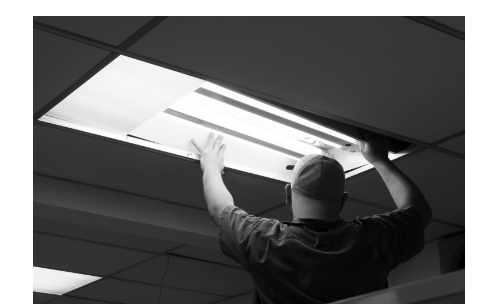
Diagram 1 shows a simplified view of the components of a fluorescent tube lamp.
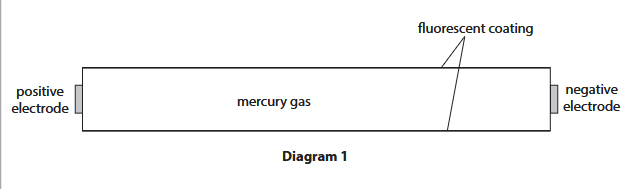
(a) When the lamp is on, a large voltage is applied between the positive electrode and the negative electrode.
(i) State what is meant by the term voltage. (1)
(ii) The large voltage causes electrons to accelerate from the negative electrode towards the positive electrode.
An electron gains \(1.0\times10^{-16}\,\mathrm{J}\) of energy when it accelerates between the electrodes.
Show that the voltage between the electrodes is about \(600\,\mathrm{V}\).
[magnitude of electron charge \(=1.6\times10^{-19}\,\mathrm{C}\)] (3)
(iii) The electron gains \(1.0\times10^{-16}\,\mathrm{J}\) of energy in its kinetic store when it accelerates from the negative electrode to the positive electrode.
Calculate the speed of an electron when it reaches the positive electrode.
Assume the electron is initially at rest.
[electron mass \(=9.1\times10^{-31}\,\mathrm{kg}\)] (4)
(b) When the electrons accelerate between the electrodes, they collide with mercury atoms.
Energy is transferred to the mercury atoms during the collisions. This causes the mercury atoms to emit ultraviolet light.
Atoms in the fluorescent coating absorb this ultraviolet light, which is then re-emitted as light from a different part of the electromagnetic spectrum.
Diagram 2 shows this process.
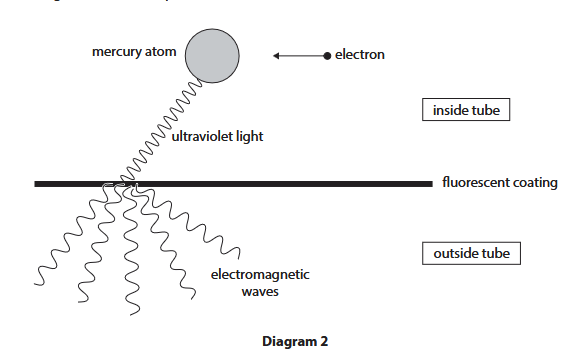
(i) Suggest why the tube must have a fluorescent coating for the lamp to operate effectively. (2)
(ii) Explain why the fluorescent tube lamp is dangerous if the fluorescent coating becomes damaged. (2)
Syllabus Topic Codes (Edexcel International GCSE Physics 4PH1):
• 4.4–4.5: Kinetic energy and energy transfers — part (a)(iii)
• 3.12–3.14: Electromagnetic waves and the electromagnetic spectrum — parts (b)(i) and (b)(ii)
• 7.4–7.5 and 7.15–7.16: Ionising radiation and associated hazards — part (b)(ii)
▶️ Answer/Explanation
(a)(i) Meaning of voltage [1 mark]
Voltage is the energy transferred per unit charge.
The relationship is:
\(V=\dfrac{E}{Q}\)
where \(V\) is voltage, \(E\) is energy transferred and \(Q\) is charge.
(a)(ii) Voltage between the electrodes [3 marks]
1. Use the electrical energy equation:
\(E=QV\)
2. Rearrange for voltage:
\(V=\dfrac{E}{Q}\)
3. Substitute the values:
\(V=\dfrac{1.0\times10^{-16}}{1.6\times10^{-19}}\)
\(V=625\,\mathrm{V}\)
Therefore, the voltage is about \(600\,\mathrm{V}\).
Final Answer: \( \boxed{625\,\mathrm{V}\approx600\,\mathrm{V}} \)
(a)(iii) Speed of the electron [4 marks]
The electron starts from rest, so its initial kinetic energy is zero. The energy gained becomes kinetic energy.
1. Use the kinetic energy equation:
\(E_{\mathrm{k}}=\dfrac{1}{2}mv^2\)
2. Rearrange for \(v\):
\(v^2=\dfrac{2E_{\mathrm{k}}}{m}\)
\(v=\sqrt{\dfrac{2E_{\mathrm{k}}}{m}}\)
3. Substitute the values:
\(v=\sqrt{\dfrac{2(1.0\times10^{-16})}{9.1\times10^{-31}}}\)
\(v\approx1.48\times10^7\,\mathrm{m\,s^{-1}}\)
Final Answer: \( \boxed{1.5\times10^7\,\mathrm{m\,s^{-1}}} \)
(b)(i) Function of the fluorescent coating [2 marks]
- Humans cannot see ultraviolet radiation.
- The fluorescent coating absorbs the ultraviolet radiation and emits visible light, which can be seen by humans.
Therefore, the coating converts the ultraviolet radiation produced by the mercury atoms into visible light, making the lamp useful for lighting.
(b)(ii) Danger if the coating is damaged [2 marks]
- If the coating is damaged, ultraviolet radiation could escape from the tube.
- Ultraviolet radiation is ionising radiation and can cause harmful effects such as skin damage, burns or an increased risk of cancer.
Mercury vapour is also harmful if it escapes from the damaged tube.
Final Answer: A damaged coating may allow ultraviolet radiation to escape. UV radiation can damage living cells and is harmful to people, while escaped mercury vapour is also toxic.
Question
This question is about radioactive isotopes used for medical imaging.
(a) Iodine-131 is represented by this symbol.
\({}^{131}_{53}\mathrm{I}\)
(i) How many neutrons are in the nucleus of an atom of iodine-131?
B 78
C 131
D 184
(ii) Iodine-131 is radioactive and decays with a half-life of \(8\,\mathrm{days}\). State what is meant by the term half-life.
________________________________________________________________
(iii) The cross (×) on the graph shows the initial number of atoms in a sample of iodine-131. Draw three more crosses (×) on the graph to show how the number of atoms of iodine-131 in the sample changes during three half-lives.
[iodine-131 half-life = \(8\,\mathrm{days}\)]

(iv) Use a curve of best fit on the graph to estimate the time taken for the number of atoms in the sample to decrease to \(5000\).
time = ____________________ \(\mathrm{days}\)
(b) When iodine-131 decays, it emits beta radiation and gamma radiation. A patient swallows a tablet containing iodine-131. The radiation emitted can be detected outside the body.
(i) State the name of a piece of equipment that can detect the radiation emitted by iodine-131.
________________________________________________________________
(ii) Give a reason why gamma radiation is more likely to be detected outside the body than beta radiation.
________________________________________________________________
(c) Technetium-99m is another radioactive isotope. Iodine-131 and technetium-99m are both used as medical tracers. Medical tracers use radiation detected outside the body to diagnose illnesses. The table gives information about some of the properties of iodine-131 and technetium-99m when they undergo radioactive decay.

Explain why technetium-99m is likely to be safer than iodine-131 when used as a medical tracer.
________________________________________________________________
________________________________________________________________
Syllabus Topic Codes (Edexcel International GCSE Physics 4PH1):
• 7.9: Detection of ionising radiation — part (b)(i)
• 7.10: Background radiation and activity — part (a)(iii), (a)(iv)
• 7.11: Half-life — parts (a)(ii), (a)(iii), (a)(iv)
• 7.15: Contamination and irradiation — part (c)
• 7.16: Dangers and uses of ionising radiation — parts (b)(ii), (c)
▶️ Answer/Explanation
Ans
(a)(i) Correct Answer: \( \boxed{\mathrm{B\ (78)}} \) [1 mark]
The number of neutrons is found using:
\(\text{number of neutrons}=\text{mass number}-\text{proton number}\)
\(131-53=78\)
A is incorrect because \(53\) is the number of protons. C is the number of nucleons. D is the sum of the mass number and proton number.
(a)(ii) Half-life [2 marks]
Half-life is the time taken for the activity to halve, or the time taken for half of the radioactive nuclei/atoms in a sample to decay.
(a)(iii) Number of atoms after three half-lives [3 marks]
At each half-life, the number of radioactive atoms halves.
After \(8\,\mathrm{days}\): \(8000\) atoms
After \(16\,\mathrm{days}\): \(4000\) atoms
After \(24\,\mathrm{days}\): \(2000\) atoms
Therefore, the three crosses should be placed at:
\(\boxed{(8,8000),\ (16,4000),\ (24,2000)}\)
(a)(iv) Time for number of atoms to decrease to \(5000\) [2 marks]
Draw a smooth curve of best fit through the plotted points.
Reading the time corresponding to \(5000\) atoms from the curve gives an estimate of approximately \(14\,\mathrm{days}\).
Answer: approximately \( \boxed{14\,\mathrm{days}} \)
(b)(i) Radiation detector [1 mark]
A suitable detector is a Geiger-Müller tube (GM tube).
(b)(ii) Gamma radiation [1 mark]
Gamma radiation is more penetrating than beta radiation, so it is more likely to pass through the patient’s body and be detected outside it.
(c) Why technetium-99m is safer [3 marks]
- Gamma radiation is less ionising than beta radiation.
- Beta radiation is more likely to cause cell damage than gamma radiation.
- Technetium-99m has a shorter half-life, so it decays more quickly and remains in the body for less time.
Therefore, technetium-99m gives less opportunity for harmful radiation exposure while still allowing the radiation to be detected outside the body.
Questions
This question is about radioactivity.
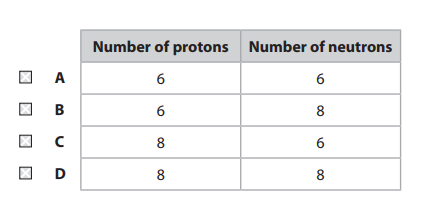
(a) The nucleus of an atom of carbon has 6 protons and 8 neutrons. Which row of the table shows the nucleus of an atom that is a different isotope of carbon?
(b) Which type of radiation is a high-energy electron?
A alpha
B beta
C gamma
D neutron
(c) A nucleus emits radiation. This causes the mass number to decrease by one. The atomic number stays the same. Which type of radiation does the nucleus emit?
A alpha
B beta
C gamma
D neutron
(d) The nucleus of an isotope of uranium can be represented using this symbol.
\(^{238}_{92}U\)
The nucleus forms part of a positively charged ion. How many electrons could be in this ion?
A 90
B 92
C 146
D 238
(e) A radioactive isotope has an initial activity of 400Bq. The half-life of the isotope is 8 hours. What is the activity of the isotope after 16 hours?
A 25Bq
B 50Bq
C 100Bq
D 200Bq
Syllabus Topic Codes (Edexcel International GCSE Physics 4PH1):
• 8.3: Properties of alpha, beta and gamma radiation — parts (b), (c)
• 8.1: Atomic and nuclear notation, proton number, nucleon number and ions — part (d)
• 8.5: Half-life and activity of radioactive isotopes — part (e)
▶️Answer/Explanation
Ans
(a) A (6 protons, 6 neutrons);
B is not the answer because it is the same isotope
C is not the answer because it is a different element
D is not the answer because it is a different element
(b) B (beta);
A is not the answer because alpha is a helium nucleus
C is not the answer because gamma is a high frequency EM wave
D is not the answer because it is not an electron
(c) D (neutron);
A is not the answer because this would decrease the atomic number and
decrease the mass number
B is not the answer because this would increase the atomic number and
keep the mass number the same
C is not the answer because this would keep the atomic number and mass
number the same
(d) A (90);
B is not the answer because this is a neutral atom
C is not the answer because it is a negatively charged ion
D is not the answer because it is a negatively charged ion
(e) C (100 Bq);
A is not the answer because this is 4 half-lives
B is not the answer because this is 3 half-lives
D is not the answer because this is 1 half-life
Questions
A teacher investigates the count rate detected from a radioactive source.
(a)
(i) State one source of background radiation. (1)
(ii) Describe how the teacher could measure the count rate from a radioactive source and correct the count rate for background radiation. (3)
(b) The teacher places a piece of lead sheet between the radioactive source and a radiation detector. The teacher determines the corrected count rate from the radioactive source three times and calculates the mean. They repeat this process using different thicknesses of lead sheet. The table shows their results.

(i) Calculate the mean count rate when the thickness of lead is \(6.0\,\mathrm{mm}\). (2)
(ii) Plot a graph of mean count rate against thickness of lead. (3)
(iii) Draw the curve of best fit. (1)

(iv) When there is not a sheet of lead between the radioactive source and the radiation detector, the mean count rate is \(484\,\mathrm{Bq}\). Use the graph to determine the thickness of lead needed to reduce the mean count rate by \(25\%\). (2)
(c) The radioactive source emits only one type of radiation. Explain which type of radiation this radioactive source emits. (2)
Syllabus Topic Codes (Edexcel International GCSE Physics 4PH1):
• 7.9: Detection of Ionising Radiation — part (a)(ii)
• 7.6: Core Practical: Radiation Penetration — part (b)
• 7.4–7.5: Types and Properties of Alpha, Beta, and Gamma Radiation — part (c)
▶️ Answer/Explanation
(a)(i) Background radiation [1 mark]
One source of background radiation is:
- the Sun / cosmic rays;
- rocks;
- radon in the air;
- food;
- medical equipment;
- nuclear weapons testing or a named nuclear disaster.
(a)(ii) Correcting for background radiation [3 marks]
- Use a GM tube with a counter and timer to measure the count rate.
- Remove the radioactive source from the room or place it sufficiently far away, then measure the background count several times and calculate the mean background count rate.
- Subtract the mean background count rate from the count rate measured with the radioactive source present.
Therefore:
\(\boxed{\mathrm{corrected\ count\ rate}=\mathrm{measured\ count\ rate}-\mathrm{background\ count\ rate}}\)
(b)(i) Mean count rate at \(6.0\,\mathrm{mm}\) [2 marks]
The three corrected count-rate readings give:
\(\mathrm{mean}=147.666\ldots\,\mathrm{Bq}\)
Rounding to \(0\) decimal places:
\(\boxed{148\,\mathrm{Bq}}\)
(b)(ii) Plotting the graph [3 marks]
- Use a suitable linear scale so that more than \(50\%\) of the graph grid is used.
- Label both axes with the correct physical quantities and units. The horizontal axis should show thickness of lead in \(\mathrm{mm}\), and the vertical axis should show mean count rate in \(\mathrm{Bq}\).
- Plot the points accurately, to the nearest half square where appropriate.
(b)(iii) Curve of best fit [1 mark]
Draw a smooth curve of best fit through the plotted data points. The curve should represent the overall trend of decreasing count rate as the thickness of lead increases.

(b)(iv) Thickness of lead required [2 marks]
The initial mean count rate is \(484\,\mathrm{Bq}\).
A reduction of \(25\%\) means that \(75\%\) of the original count rate remains:
\(\mathrm{target\ count\ rate}=0.75\times484\)
\(\mathrm{target\ count\ rate}=363\,\mathrm{Bq}\)
Using the graph, a count rate of approximately \(363\,\mathrm{Bq}\) corresponds to a lead thickness of approximately \(1.8\,\mathrm{mm}\).
\(\boxed{\mathrm{lead\ thickness}\approx1.8\,\mathrm{mm}}\)
(c) Type of radiation [2 marks]
Gamma radiation is emitted.
- Alpha and beta radiation would be absorbed by the lead.
- Gamma radiation is much more penetrating and can pass through the lead sheet.
Therefore, if radiation is still detected through the lead, the source must be emitting gamma radiation.
Questions
This is a question about radioactivity.
(a) Which of these is the unit of activity?
A becquerel
B kilogram
C newton
D pascal
(b) Which of these is the correct description of the term half-life?
A time taken for the activity of a substance to halve
B half of the time taken for the mass of a substance to decay
C time taken for the activity to decay completely
D time taken for the mass of a substance to decay twice
(c) A teacher demonstrates how the activity of a radioactive sample changes with time.
(i) The box gives the names of different pieces of equipment.

Complete the sentences using words from the box.
The teacher measures time with a …………………………………………………….. . The teacher measures the count rate with a …………………………………………………….. and a counter.
(ii) The graph shows the teacher’s results.

Draw a circle around the anomalous result.
(iii) Use the graph to determine the half-life of the radioactive sample.
(iv) Give a reason why the teacher should not expect the data points to lie exactly on the curve of best fit.
Syllabus Topic Codes (Edexcel International GCSE Physics 4PH1):
• 7.11–7.12: Radioactive Decay and Activity; Half-Life and Calculations — part (b) and parts (c)(ii)–(iv)
• 7.9: Detection of Ionising Radiation — part (c)(i)
▶️ Answer/Explanation
(a) Unit of activity [1 mark]
Answer: A, becquerel.
- B kilogram is the unit of mass.
- C newton is the unit of force.
- D pascal is the unit of pressure.
(b) Half-life [1 mark]
Answer: A, time taken for the activity of a substance to halve.
Half-life is the time required for the activity, or count rate, of a radioactive sample to decrease to half its initial value.
(c)(i) Equipment [2 marks]
The completed sentences are:
The teacher measures time with a stopwatch. The teacher measures the count rate with a GM tube and a counter.
(c)(ii) Anomalous result [1 mark]
The anomalous result is the point at approximately:
\(\boxed{t=20\,\mathrm{s}}\)
(c)(iii) Half-life [2 marks]
Use the graph to identify the time required for the activity to decrease to half its previous value.
The graph gives:
\(\boxed{\mathrm{half\!-\!life}=15\,\mathrm{s}}\)
(c)(iv) Scatter of radioactive decay data [1 mark]
Radioactive decay is a random process. Therefore, individual measurements will naturally vary and the data points are not expected to lie exactly on the curve of best fit.
Questions
This question is about using carbon dating to find the age of pieces of wood.
(a) The equation shows how carbon-14 forms in the atmosphere.

(i) State the name of particle X.
(ii) Carbon-14 decays by beta decay. State what happens to the number of protons and the number of neutrons in a carbon-14 nucleus when it decays.
(b) A scientist determines how the percentage of carbon-14 remaining in a sample of wood changes with time. The table shows the scientist’s data.

(i) Plot the scientist’s data on the grid.
(ii) Draw the curve of best fit.

(iii) Use the graph to determine the age of a sample of wood that has \(36\%\) of its carbon-14 remaining.
(c) Carbon-14 dating is inaccurate for samples of wood produced after 1950. This is because the concentration of carbon-14 in the atmosphere greatly increased due to nuclear weapons testing.
(i) A tree absorbs carbon-14 during its lifetime. A student suggests that trees grown after 1950 are contaminated with carbon-14. Give a reason why the student’s suggestion is correct.
(ii) Explain how nuclear weapons testing affects the determination of the age of a sample of wood produced after 1950.
Syllabus Topic Codes (Edexcel International GCSE Physics 4PH1):
• 7.12–7.13: Half-Life and Half-Life Calculations — parts (b)(i)–(iii)
• 7.14: Uses of Radioactivity — carbon dating in parts (b) and (c)
• 7.15–7.16: Contamination, Irradiation, and Dangers of Ionising Radiation — part (c)
▶️ Answer/Explanation
(a) Nuclear changes
(i) Particle X is a proton.
(ii) During beta decay:
- The number of protons increases by 1, from 6 to 7.
- The number of neutrons decreases by 1, from 8 to 7.
The total nucleon number remains unchanged because one neutron changes into a proton during beta decay.
(b)(i) Plotting the data
- Use suitable linear scales that use at least \(50\%\) of the grid on both axes.
- Label both axes with the correct physical quantities and units.
- Plot all the data points accurately, within approximately half a small square.
(b)(ii) Curve of best fit
Draw a smooth decreasing curve of best fit that follows the overall trend of the plotted data.

(b)(iii) Age of the wood
Locate \(36\%\) on the percentage of carbon-14 axis and read across to the curve. Then read down to the time axis.
The graph gives approximately:
\(\mathrm{age}=8400\,\mathrm{years}\)
\(\boxed{\mathrm{age}\approx8400\,\mathrm{years}}\)
(c)(i) Carbon-14 contamination
Trees absorb carbon-14 from the atmosphere during their lifetime. After nuclear weapons testing increased the concentration of carbon-14 in the atmosphere, trees grown after 1950 would contain more carbon-14 than they would normally have.
(c)(ii) Effect on carbon dating
- Nuclear weapons testing increased the amount of carbon-14 in the atmosphere.
- Trees absorbed this additional carbon-14 while they were growing.
- The sample therefore contains more carbon-14 than expected for its true age.
- As a result, the sample appears to have less decay and therefore appears younger than its actual age.
Question
The photograph shows the nuclear fusion reactor called ITER.

(a) Describe the difference between nuclear fusion and nuclear fission.
(b) At ITER, hydrogen-3 and hydrogen-2 will be fused into helium and another particle labelled X.
(i) Complete the nuclear equation for the fusion of hydrogen-3 and hydrogen-2.

(ii) Discuss potential safety advantages of a fusion reactor compared with a fission reactor. You should refer to the products of this fusion reaction and to the fission reaction of uranium.
(c) The half-life of a radioactive isotope is \(12\,\mathrm{years}\). The activity of a sample of this isotope is \(120\,\mathrm{kBq}\). Calculate the activity of this sample after \(48\,\mathrm{years}\).
Syllabus Topic Codes (Edexcel International GCSE Physics 4PH1):
• 7.18–7.20: Nuclear Fission: Products and Chain Reaction — parts (a) and (b)(ii)
• 7.23: Fission and Fusion Compared — parts (a) and (b)(ii)
• 7.24–7.26: Nuclear Fusion, Stars as Energy Sources, and Fusion Conditions — part (b)
• 7.8: Balancing Nuclear Equations — part (b)(i)
• 7.12–7.13: Half-Life and Calculations — part (c)
▶️ Answer/Explanation
(a) Nuclear fusion and fission [2 marks]
- Nuclear fission is the splitting of a large atomic nucleus into smaller nuclei.
- Nuclear fusion is the joining of two smaller nuclei to form a larger nucleus.
(b)(i) Completing the nuclear equation [2 marks]
The reaction involves hydrogen-3 and hydrogen-2 forming helium-4 and particle \(X\).
Conservation of mass number gives:
\(3+2=4+A_X\)
Therefore, \(A_X=1\).
Conservation of atomic number gives:
\(1+1=2+Z_X\)
Therefore, \(Z_X=0\).
A particle with mass number \(1\) and atomic number \(0\) is a neutron.
Therefore: \(\boxed{X={}^{1}_{0}\mathrm{n}}\)
(b)(ii) Safety advantages of fusion [3 marks]
- The reactants used for fusion are generally less hazardous than the radioactive fuel used in fission reactors.
- The products of this fusion reaction are not radioactive, reducing the risk of radioactive contamination and long-term storage problems.
- Fusion does not involve a runaway chain reaction in the same way as nuclear fission, so there is a lower risk of a meltdown.
The fusion reaction produces helium and a neutron. In contrast, uranium fission produces radioactive fission products that require careful handling and long-term storage.
(c) Activity after 48 years [3 marks]
The half-life is \(12\,\mathrm{years}\), so in \(48\,\mathrm{years}\) there are:
\(\dfrac{48}{12}=4\) half-lives.
The activity halves after each half-life:
\(120\div2=60\,\mathrm{kBq}\)
\(60\div2=30\,\mathrm{kBq}\)
\(30\div2=15\,\mathrm{kBq}\)
\(15\div2=7.5\,\mathrm{kBq}\)
Therefore: \(\boxed{7.5\,\mathrm{kBq}}\)
Question
A teacher demonstrates the penetrating ability of alpha, beta and gamma radiation from some radioactive sources.
(a)(i) State a precaution the teacher should take to make sure they are working safely with the radioactive sources.
(ii) State the name of a detector the teacher could use to detect the radiation from each source.
(b) Draw crosses (×) in the table to show which type of radiation cannot penetrate each material in the table.

(c) An alpha particle of mass \(6.6\times10^{-27}\,\mathrm{kg}\) travelling at a speed of \(2.1\times10^7\,\mathrm{m\,s^{-1}}\) hits a sheet of paper.
(i) Calculate the kinetic energy (KE) of the alpha particle.
(ii) State the work done on the alpha particle when its speed is reduced to \(0\,\mathrm{m\,s^{-1}}\) by the sheet of paper.
(iii) State which energy store of the paper increases when the alpha particle is stopped.
Syllabus Topic Codes (Edexcel International GCSE Physics 4PH1):
• 7.6: Core Practical: Radiation Penetration — part (b)
• 7.9: Detection of Ionising Radiation — part (a)(ii)
• 7.15–7.16: Contamination, Irradiation, and Dangers of Ionising Radiation — part (a)(i)
• 4.14: Kinetic Energy — part (c)(i)
• 4.12: Work Done and Energy Transfer — part (c)(ii)
• 4.2: Energy Stores and Energy Transfer Pathways — part (c)(iii)
▶️ Answer/Explanation
(a)(i) Safety precaution [1 mark]
One suitable precaution is to keep the radioactive source at arm’s length and minimise the exposure time.
(a)(ii) Detector [1 mark]
A Geiger-Müller tube and counter can be used to detect the radiation.

(b) Penetrating ability of radiation [3 marks]
The crosses should be placed as follows:
| Type of radiation | 10 cm of air | 2 cm of aluminium | 10 cm of lead |
|---|---|---|---|
| alpha | × | × | × |
| beta | × | × | |
| gamma | × |
Alpha radiation has the lowest penetrating ability, beta radiation has greater penetrating ability, and gamma radiation is the most penetrating.
(c)(i) Kinetic energy [3 marks]
Use:
\(\mathrm{KE}=\dfrac{1}{2}mv^2\)
Substitute \(m=6.6\times10^{-27}\,\mathrm{kg}\) and \(v=2.1\times10^7\,\mathrm{m\,s^{-1}}\):
\(\mathrm{KE}=\dfrac{1}{2}\times(6.6\times10^{-27})\times(2.1\times10^7)^2\)
\(\mathrm{KE}=1.4553\times10^{-12}\,\mathrm{J}\)
Therefore:
\(\boxed{\mathrm{KE}\approx1.5\times10^{-12}\,\mathrm{J}}\)
(c)(ii) Work done [1 mark]
The alpha particle is brought to rest, so all of its initial kinetic energy is transferred by the work done on it.
Therefore, the magnitude of the work done is:
\(\boxed{1.5\times10^{-12}\,\mathrm{J}}\)
(c)(iii) Energy store [1 mark]
The thermal energy store of the paper increases as the kinetic energy of the alpha particle is transferred to the paper.
Question
Protactinium is an element with several different radioactive isotopes.
(a) Protactinium-234 has a half-life of \(6.7\,\mathrm{hours}\). A sample of protactinium-234 has an initial activity of \(800\) units.
(i) Give a suitable unit for activity.
(ii) On the axes below, sketch a graph for the decay of the sample of protactinium-234 during its first three half-lives.

(iii) When protactinium-234 undergoes beta \((\beta^-)\) decay it becomes uranium-234. The incomplete nuclear equation shows this process.

Complete the nuclear equation to show the beta decay of protactinium-234. Write your answers in the dashed boxes.
(b) A student suggests an experiment to determine the type of radiation emitted by a different isotope of protactinium, protactinium-231. This is the suggested method.
Step 1 connect a suitable radiation detector to a radiation counter
Step 2 place a source of protactinium-231 at a fixed distance of \(3\,\mathrm{cm}\) from the radiation detector
Step 3 record the count of detected radiation for a time of one minute
Step 4 place a sheet of paper between the source and detector
Step 5 record the count of detected radiation for a time of one minute
Step 6 repeat Steps 4 and 5 using a sheet of aluminium and then a sheet of lead instead of the sheet of paper
The table shows the results of the investigation when it is done by a teacher.

(i) Which of these is the dependent variable in the investigation?
A count measured by the detector
B distance between source and detector
C material between source and detector
D time the count is measured
(ii) The student’s method does not allow for background radiation. Describe how the student’s method should be modified to allow for background radiation.
(iii) Describe how the student’s method could be modified to improve the reliability of the results.
(iv) Evaluate the data from the experiment to conclude the type of radiation emitted by protactinium-231.
Syllabus Topic Codes (Edexcel International GCSE Physics 4PH1):
• 7.11: Radioactive Decay and Activity — part (a)(ii)
• 7.12–7.13: Half-Life and Half-Life Calculations — part (a)(ii)
• 7.7: Nuclear Changes During Radioactive Emission — part (a)(iii)
• 7.8: Balancing Nuclear Equations — part (a)(iii)
• 7.6: Core Practical: Radiation Penetration — parts (b)(ii)–(iv)
• 7.9–7.10: Detection of Ionising Radiation and Background Radiation — parts (b)(i)–(iii)
• 7.4–7.5: Types and Properties of Alpha, Beta, and Gamma Radiation — part (b)(iv)
▶️ Answer/Explanation
(a)(i) Unit of activity [1 mark]
A suitable unit for activity is the becquerel, \(\mathrm{Bq}\).
(a)(ii) Radioactive decay graph [3 marks]
The initial activity is \(800\) units, so the graph should start at:
\((0,800)\)
After one half-life of \(6.7\,\mathrm{h}\), the activity is halved:
\(A=\dfrac{800}{2}=400\)
So the graph should pass through:
\((6.7,400)\)
The subsequent values are \(200\) units after \(13.4\,\mathrm{h}\) and \(100\) units after \(20.1\,\mathrm{h}\).
The decay curve should be smooth and decrease with decreasing steepness.

(a)(iii) Beta decay equation [2 marks]
In beta-minus decay, the mass number remains unchanged, while the atomic number increases by \(1\).
Protactinium has atomic number \(91\), so uranium has atomic number \(92\).
Therefore:
\(\boxed{{}^{234}_{91}\mathrm{Pa}\rightarrow{}^{234}_{92}\mathrm{U}+{}^{0}_{-1}\beta}\)

(b)(i) Dependent variable [1 mark]
The dependent variable is the quantity being measured in response to changing the material placed between the source and detector.
Therefore, the correct answer is A, count measured by the detector.
(b)(ii) Background radiation [3 marks]
- Remove the radioactive source from the experimental area.
- Measure the background radiation count for one minute using the same detector.
- Subtract the background count from each experimental result.
This gives a corrected count due to the radioactive source rather than the background radiation.
(b)(iii) Improving reliability [2 marks]
Repeat the count measurements for each material and calculate a mean value. Repeats help reduce the effect of random variation in radioactive count readings.
(b)(iv) Identifying the radiation [3 marks]
The count decreases significantly when the sheet of paper is placed between the source and detector.
There is no additional significant decrease in the count when aluminium and lead are used instead.
Alpha radiation is stopped by paper, so the results are consistent with the source emitting alpha radiation.
Therefore: \(\boxed{\text{protactinium-231 emits alpha radiation}}\)