
Edexcel iGCSE Physics (4PH1) 7.2 Radioactivity Exam Style Question Paper 2B - New Syllabus
Question
The photograph shows a nuclear power station.
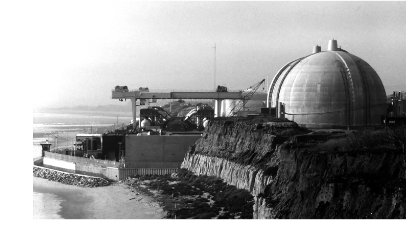
A chain reaction releases energy inside the power station.
(a) Explain how the fission of \(\mathrm{U\!-\!235}\) can set up a chain reaction. (3)
(b) Explain how nuclear fusion is different from radioactive decay. (2)
(c) An isotope of hydrogen is used as a fuel for nuclear fusion.
The nuclear equation shows how this isotope of hydrogen can be manufactured.
Complete the equation by giving the missing information. (2)
\({}^{1}_{\square}\mathrm{n}+{}^{6}_{3}\mathrm{Li}\rightarrow{}^{\square}_{1}\mathrm{H}+{}^{4}_{2}\alpha\)
(d) Explain why nuclear fusion can only happen at high temperatures and pressures. (2)
(e)(i) Which of these is the time taken for the number of undecayed nuclei in a radioactive isotope to halve? (1)
A. activity
B. becquerels
C. half-life
D. proton number
(e)(ii) This isotope of hydrogen is radioactive and has a half-life of \(12\) years.
A sample of the isotope has an activity of \(72\,\mathrm{kBq}\).
Calculate the activity of the isotope in the sample after \(60\) years. (3)
activity = __________________ \(\mathrm{kBq}\)
Syllabus Topic Codes (Edexcel International GCSE Physics 4PH1):
• 7.23: Fission and Fusion Compared — part (b)
• 7.24–7.26P: Nuclear Fusion, Stars as Energy Sources, and Fusion Conditions — parts (c) and (d)
• 7.12–7.13: Half-Life and Calculations — parts (e)(i) and (e)(ii)
▶️ Answer/Explanation
(a) Nuclear fission chain reaction [3 marks]
1. A neutron is absorbed by a \(\mathrm{U\!-\!235}\) nucleus.
2. The uranium nucleus becomes unstable and undergoes fission, splitting into smaller daughter nuclei and releasing neutrons.
3. The released neutrons are absorbed by other uranium nuclei, causing further fissions and releasing more neutrons.
Final Answer: A neutron is absorbed by a \(\mathrm{U\!-\!235}\) nucleus, causing it to become unstable and split into smaller nuclei while releasing neutrons. These neutrons cause further uranium nuclei to undergo fission, producing a chain reaction.
(b) Nuclear fusion compared with radioactive decay [2 marks]
- Nuclear fusion involves the joining of two nuclei to form a larger nucleus.
- Radioactive decay is the spontaneous release of particles or radiation from an unstable nucleus.
Final Answer: Fusion joins nuclei together, whereas radioactive decay involves the spontaneous release of particles or radiation from an unstable nucleus.
(c) Completing the nuclear equation [2 marks]
Use conservation of nucleon number and proton number.
1. Find the proton number of the neutron:
A neutron has proton number \(0\).
2. Find the nucleon number of the hydrogen isotope:
The total nucleon number on the left is:
\(1+6=7\)
The alpha particle has nucleon number \(4\), so the hydrogen isotope must have:
\(7-4=3\)
Therefore, the completed equation is:
\(\boxed{{}^{1}_{0}\mathrm{n}+{}^{6}_{3}\mathrm{Li}\rightarrow{}^{3}_{1}\mathrm{H}+{}^{4}_{2}\alpha}\)
Final Answer: Missing values are \( \boxed{0} \) for the neutron and \( \boxed{3} \) for the hydrogen isotope.
(d) Conditions required for nuclear fusion [2 marks]
- Nuclei are both positively charged, so they repel each other electrostatically.
- A high temperature gives the nuclei high kinetic energy and high speed, while high pressure helps bring the nuclei close enough for the strong nuclear force to allow fusion.
Final Answer: High temperatures give the nuclei enough kinetic energy to overcome their electrostatic repulsion, while high pressure helps bring the nuclei close enough together for fusion to occur.
(e)(i) Definition of half-life [1 mark]
The half-life is the time taken for the number of undecayed nuclei in a radioactive isotope to halve.
Correct Answer: \( \boxed{\mathrm{C.\ half\!-\!life}} \)
(e)(ii) Activity after 60 years [3 marks]
1. Calculate the number of half-lives:
\(\mathrm{number\ of\ half\!-\!lives}=\dfrac{60}{12}=5\)
2. Halve the activity five times:
\(72\rightarrow36\rightarrow18\rightarrow9\rightarrow4.5\rightarrow2.25\,\mathrm{kBq}\)
3. State the final activity:
\(\mathrm{activity}=2.25\,\mathrm{kBq}\)
To an appropriate number of significant figures:
\(\mathrm{activity}\approx2.3\,\mathrm{kBq}\)
Final Answer: \( \boxed{2.3\,\mathrm{kBq}} \)
Question
This question is about gamma radiation.
(a) Which of these statements is correct for gamma radiation? (1)
A. Gamma radiation has a weaker penetrating ability than alpha radiation
B. Gamma radiation is emitted by electrons in atoms
C. Gamma radiation is positively charged
D. Gamma radiation is less ionising than alpha radiation
(b) A student uses a simulation to investigate gamma radiation.
This is the student’s method.
- Place a Geiger-Müller (GM) tube at a distance of \(6\,\mathrm{cm}\) from a source of gamma radiation.
- Measure the count for a time of \(10\,\mathrm{s}\).
- Move the GM tube further away from the source and measure the count again.
The student measures the count three times for each distance.
(i) Give a reason why the student takes repeat readings. (1)
(ii) The graph shows the student’s results.
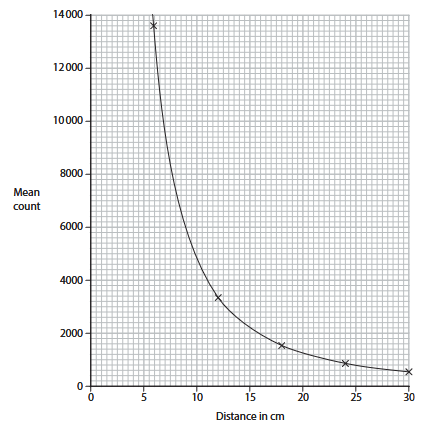
The student claims that the data obeys the formula
\(\mathrm{count}\times\mathrm{distance}^2=\mathrm{constant}\)
Evaluate the student’s claim. (3)
Syllabus Topic Codes (Edexcel International GCSE Physics 4PH1):
• 7.5–7.6: Detection and Measurement of Radiation — parts (b)(i) and (b)(ii)
• Experimental Skills: Repeat Measurements, Mean Values and Evaluating Relationships — parts (b)(i) and (b)(ii)
▶️ Answer/Explanation
(a) Correct statement about gamma radiation [1 mark]
Gamma radiation has a high penetrating ability and is less ionising than alpha radiation.
Final Answer: \( \boxed{\mathrm{D.\ Gamma\ radiation\ is\ less\ ionising\ than\ alpha\ radiation}} \)
(b)(i) Reason for repeat readings [1 mark]
Radioactive decay is random, so repeated readings can be used to calculate a mean and reduce the effect of random variations or anomalies.
Final Answer: Repeat readings allow a mean to be calculated and reduce the effect of random errors or anomalies.
(b)(ii) Evaluating the student’s claim [3 marks]
1. Calculate the constant using one pair of values:
For count \(=13\,600\) and distance \(=6\,\mathrm{cm}\):
\(\mathrm{constant}=13\,600\times6^2\)
\(\mathrm{constant}=489\,600\)
2. Calculate the constant using another pair of values:
For count \(=3\,300\) and distance \(=12\,\mathrm{cm}\):
\(\mathrm{constant}=3\,300\times12^2\)
\(\mathrm{constant}=475\,200\)
3. Compare the values:
| Count | Distance (\(\mathrm{cm}\)) | Count \(\times\) Distance\(^2\) |
|---|---|---|
| 13 600 | 6 | 489 600 |
| 3 300 | 12 | 475 200 |
| 1 600 | 18 | 518 400 |
| 800 | 24 | 460 800 |
| 600 | 30 | 540 000 |
The calculated values are reasonably close to one another, with values ranging from approximately \(460\,800\) to \(540\,000\).
Therefore, the data supports the idea that \(\mathrm{count}\times\mathrm{distance}^2\) is approximately constant.
Final Answer: The student’s claim is supported. The values of \(\mathrm{count}\times\mathrm{distance}^2\) are reasonably similar for the different distances, allowing for experimental variation.
Question
Uranium-239 is an isotope of the element uranium.
(a) State what is meant by the term isotopes. (2)
(b) Uranium-239 can be represented using the symbol
\(^{239}_{92}\mathrm{U}\)
Protons are one type of particle found in the nucleus of an atom.
(i) How many protons are in the nucleus of an atom of uranium-239? (1)
A. \(92\)
B. \(147\)
C. \(239\)
D. \(331\)
(ii) Give the name of the other particle found in the nucleus of an atom of uranium-239. (1)
(c) Uranium-239 is radioactive and decays by beta emission.
Uranium-239 has a half-life of \(23\,\mathrm{minutes}\).
(i) A sample of uranium-239 has an initial mass of \(60\,\mathrm{g}\).
Calculate the mass of uranium-239 remaining after \(46\,\mathrm{minutes}\). (2)
mass = __________________ \(\mathrm{g}\)
(ii) When uranium-239 undergoes beta decay, an isotope of the element neptunium, Np, is produced.
Which of these is the correct symbol for the neptunium nucleus produced in the beta decay of uranium-239? (1)
A. \(^{239}_{92}\mathrm{Np}\)
B. \(^{240}_{92}\mathrm{Np}\)
C. \(^{239}_{93}\mathrm{Np}\)
D. \(^{240}_{93}\mathrm{Np}\)
Syllabus Topic Codes (Edexcel International GCSE Physics 4PH1):
• 7.3: Atomic number, mass number and isotopes — parts (a) and (b)(i)
• 7.7: Effects of radioactive emissions on atomic and mass numbers — part (c)(ii)
• 7.12: Definition of half-life — part (c)(i)
• 7.13: Calculations using half-life — part (c)(i)
▶️ Answer/Explanation
(a) Meaning of isotopes [2 marks]
Isotopes are atoms of the same element that have the same number of protons but a different number of neutrons.
Final Answer: Isotopes have the same number of protons but different numbers of neutrons.
(b)(i) Number of protons [1 mark]
In nuclear notation \(^{A}_{Z}\mathrm{X}\), the lower number \(Z\) is the atomic number, which is equal to the number of protons.
For \(^{239}_{92}\mathrm{U}\):
\(\mathrm{number\ of\ protons}=92\)
Final Answer: \( \boxed{\mathrm{A.\ 92}} \)
(b)(ii) Other particle in the nucleus [1 mark]
The other particle found in the nucleus is a neutron.
Final Answer: \( \boxed{\mathrm{neutron}} \)
(c)(i) Mass remaining after 46 minutes [2 marks]
1. Determine the number of half-lives:
\(\mathrm{number\ of\ half\ lives}=\dfrac{46}{23}=2\)
So, \(46\,\mathrm{minutes}\) corresponds to 2 half-lives.
2. Halve the mass twice:
\(\mathrm{mass}=60\times\dfrac{1}{2}\times\dfrac{1}{2}\)
\(\mathrm{mass}=15\,\mathrm{g}\)
Final Answer: \( \boxed{15\,\mathrm{g}} \)
(c)(ii) Symbol of the neptunium nucleus [1 mark]
In beta-minus decay, a neutron changes into a proton and an electron is emitted.
Therefore:
- The mass number remains unchanged: \(239\).
- The atomic number increases by 1: \(92\rightarrow93\).
Therefore, the neptunium nucleus is
\(^{239}_{93}\mathrm{Np}\)
Final Answer: \( \boxed{\mathrm{C.\ }^{239}_{93}\mathrm{Np}} \)