
Edexcel iGCSE Physics (4PH1) 7.3 Fission and Fusion Exam Style Question Paper 1B - New Syllabus
Question
This question is about the process of controlled nuclear fission in a nuclear reactor.
(a) In a nuclear reactor, uranium-\(235\) nuclei are split to produce daughter nuclei and neutrons.
State what else is released in nuclear fission that makes the process useful in a nuclear reactor. (1)
(b) What is the function of the control rods in a nuclear reactor? (1)
(B) create additional neutrons
(C) fuse neutrons together
(D) split neutrons
(c) What is the function of the moderator in a nuclear reactor? (1)
(B) change neutrons into protons
(C) slow down neutrons
(D) speed up neutrons
(d) Many of the daughter nuclei produced in nuclear fission are very radioactive.
These daughter nuclei decay by emitting ionising radiation in a random process.
(i) State what is meant by the term ionising radiation. (1)
(ii) State what is meant by the term random process. (1)
(iii) The diagram shows some parts of a nuclear reactor.
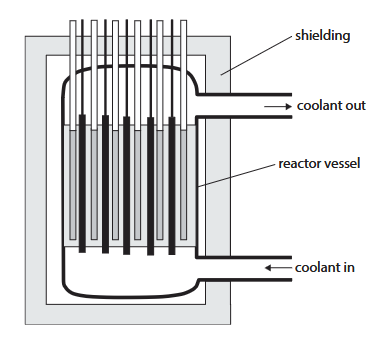
Explain the role of shielding in a nuclear reactor. (3)
Syllabus Topic Codes (Edexcel International GCSE Physics 4PH1):
• 7.21–7.22: Control rods, moderators and shielding — parts (b), (c) and (d)(iii)
• 7.4–7.5: Types and properties of alpha, beta and gamma radiation — part (d)(i)
• 7.11: Radioactive decay and activity — part (d)(ii)
• 7.15–7.16: Contamination, irradiation and dangers of ionising radiation — part (d)(iii)
▶️ Answer/Explanation
(a) Energy released in nuclear fission [1 mark]
Correct Answer: \( \boxed{\mathrm{kinetic\ energy}} \)
Nuclear fission releases energy, mainly as the kinetic energy of the daughter nuclei and neutrons. This energy is transferred to thermal energy and can be used to heat water and produce steam.
(b) Function of control rods [1 mark]
Correct Answer: \( \boxed{\mathrm{A}} \) absorb excess neutrons
Control rods absorb neutrons in the reactor. This controls the rate of the chain reaction and prevents the reaction from increasing too rapidly.
(c) Function of the moderator [1 mark]
Correct Answer: \( \boxed{\mathrm{C}} \) slow down neutrons
The moderator slows down fast neutrons so that they are more likely to cause further fission of uranium-\(235\) nuclei.
(d)(i) Meaning of ionising radiation [1 mark]
Ionising radiation has enough energy to remove electrons from atoms or molecules, producing ions.
Final Answer: Ionising radiation can remove electrons from atoms or molecules.
(d)(ii) Meaning of a random process [1 mark]
A random process is one in which it is not possible to predict when an individual nucleus will decay.
Radioactive decay is spontaneous and there is no pattern that allows the exact time of decay of an individual nucleus to be predicted.
(d)(iii) Role of shielding [3 marks]
- Radioactive materials in the reactor emit harmful ionising radiation.
- The shielding absorbs or reduces the intensity of the radiation escaping from the reactor.
- This reduces the amount of radiation reaching workers and other people, helping to protect them from harmful effects.
Exposure to ionising radiation can damage cells and increase the risk of harmful effects such as cancer.
Final Answer: Shielding absorbs ionising radiation from the reactor, reducing the radiation that escapes and protecting workers and the public from harmful exposure.
Questions
Diagram 1 shows some of the stages of electricity generation in a nuclear power station.

(a) Nuclear fission takes place inside the reactor of the nuclear power station.
(i) Give the name of a fuel that could be used in the reactor.
(ii) Energy is released from the fuel in the reactor by nuclear fission. Describe the process of nuclear fission that takes place inside the reactor.
(b) High pressure steam transfers energy from the reactor to a turbine. The turbine spins as the steam passes through it. Diagram 2 shows a simplified generator connected to the turbine.

(i) Explain how electricity is generated by the generator.
(ii) At night the power station does not need to generate as much electricity. Suggest how the output of this generator could be reduced.
(iii) The generator produces alternating current. Describe the differences between alternating current (a.c.) and direct current (d.c.).
Syllabus Topic Codes (Edexcel International GCSE Physics 4PH1):
• 7.18–7.20: Nuclear Fission: Products and Chain Reaction — part (a)(ii)
• 6.15–6.16: Induced Voltage and Electricity Generation by Induction — parts (b)(i)–(ii)
• 6.16: Electricity Generation by Induction — part (b)(iii)
▶️ Answer/Explanation
(a)(i) Fuel for nuclear fission
A suitable fuel is uranium, such as uranium-235.
(a)(ii) Nuclear fission
- A neutron is absorbed by a large parent nucleus.
- The nucleus becomes unstable and splits into smaller daughter nuclei.
- More neutrons and energy are released.
- The released neutrons can cause further fission reactions, producing a chain reaction.
This chain reaction allows energy to be released continuously in the reactor.
(b)(i) Electricity generation by induction
- The turbine causes the coil to rotate relative to the magnetic field.
- The rotating coil cuts the magnetic field lines.
- This produces an induced voltage across the coil.
- When the circuit is complete, the induced voltage causes an electric current to flow.
Thus, the mechanical energy of the rotating turbine is transferred into electrical energy by electromagnetic induction.
(b)(ii) Reducing the generator output
One suitable method is to reduce the speed of rotation of the turbine, for example by reducing the flow, speed, or pressure of the steam entering the turbine.
Other acceptable methods include reducing the strength of the magnetic field or reducing the number of turns in the coil.
(b)(iii) Alternating current and direct current
- Alternating current (a.c.) continuously changes direction.
- Direct current (d.c.) flows in only one direction.
Therefore, the key difference is the direction of current flow.
Question
The photograph shows the nuclear fusion reactor called ITER.

(a) Describe the difference between nuclear fusion and nuclear fission.
(b) At ITER, hydrogen-3 and hydrogen-2 will be fused into helium and another particle labelled X.
(i) Complete the nuclear equation for the fusion of hydrogen-3 and hydrogen-2.

(ii) Discuss potential safety advantages of a fusion reactor compared with a fission reactor. You should refer to the products of this fusion reaction and to the fission reaction of uranium.
(c) The half-life of a radioactive isotope is \(12\,\mathrm{years}\). The activity of a sample of this isotope is \(120\,\mathrm{kBq}\). Calculate the activity of this sample after \(48\,\mathrm{years}\).
Syllabus Topic Codes (Edexcel International GCSE Physics 4PH1):
• 7.18–7.20: Nuclear Fission: Products and Chain Reaction — parts (a) and (b)(ii)
• 7.23: Fission and Fusion Compared — parts (a) and (b)(ii)
• 7.24–7.26: Nuclear Fusion, Stars as Energy Sources, and Fusion Conditions — part (b)
• 7.8: Balancing Nuclear Equations — part (b)(i)
• 7.12–7.13: Half-Life and Calculations — part (c)
▶️ Answer/Explanation
(a) Nuclear fusion and fission [2 marks]
- Nuclear fission is the splitting of a large atomic nucleus into smaller nuclei.
- Nuclear fusion is the joining of two smaller nuclei to form a larger nucleus.
(b)(i) Completing the nuclear equation [2 marks]
The reaction involves hydrogen-3 and hydrogen-2 forming helium-4 and particle \(X\).
Conservation of mass number gives:
\(3+2=4+A_X\)
Therefore, \(A_X=1\).
Conservation of atomic number gives:
\(1+1=2+Z_X\)
Therefore, \(Z_X=0\).
A particle with mass number \(1\) and atomic number \(0\) is a neutron.
Therefore: \(\boxed{X={}^{1}_{0}\mathrm{n}}\)
(b)(ii) Safety advantages of fusion [3 marks]
- The reactants used for fusion are generally less hazardous than the radioactive fuel used in fission reactors.
- The products of this fusion reaction are not radioactive, reducing the risk of radioactive contamination and long-term storage problems.
- Fusion does not involve a runaway chain reaction in the same way as nuclear fission, so there is a lower risk of a meltdown.
The fusion reaction produces helium and a neutron. In contrast, uranium fission produces radioactive fission products that require careful handling and long-term storage.
(c) Activity after 48 years [3 marks]
The half-life is \(12\,\mathrm{years}\), so in \(48\,\mathrm{years}\) there are:
\(\dfrac{48}{12}=4\) half-lives.
The activity halves after each half-life:
\(120\div2=60\,\mathrm{kBq}\)
\(60\div2=30\,\mathrm{kBq}\)
\(30\div2=15\,\mathrm{kBq}\)
\(15\div2=7.5\,\mathrm{kBq}\)
Therefore: \(\boxed{7.5\,\mathrm{kBq}}\)