
Edexcel iGCSE Physics (4PH1) 7.3 Fission and Fusion Exam Style Question Paper 2B - New Syllabus
Question
The photograph shows a nuclear power station.
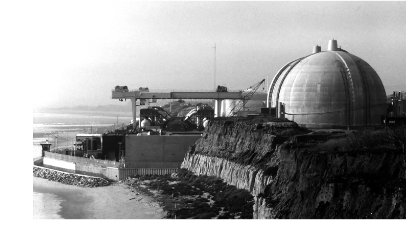
A chain reaction releases energy inside the power station.
(a) Explain how the fission of \(\mathrm{U\!-\!235}\) can set up a chain reaction. (3)
(b) Explain how nuclear fusion is different from radioactive decay. (2)
(c) An isotope of hydrogen is used as a fuel for nuclear fusion.
The nuclear equation shows how this isotope of hydrogen can be manufactured.
Complete the equation by giving the missing information. (2)
\({}^{1}_{\square}\mathrm{n}+{}^{6}_{3}\mathrm{Li}\rightarrow{}^{\square}_{1}\mathrm{H}+{}^{4}_{2}\alpha\)
(d) Explain why nuclear fusion can only happen at high temperatures and pressures. (2)
(e)(i) Which of these is the time taken for the number of undecayed nuclei in a radioactive isotope to halve? (1)
A. activity
B. becquerels
C. half-life
D. proton number
(e)(ii) This isotope of hydrogen is radioactive and has a half-life of \(12\) years.
A sample of the isotope has an activity of \(72\,\mathrm{kBq}\).
Calculate the activity of the isotope in the sample after \(60\) years. (3)
activity = __________________ \(\mathrm{kBq}\)
Syllabus Topic Codes (Edexcel International GCSE Physics 4PH1):
• 7.23: Fission and Fusion Compared — part (b)
• 7.24–7.26P: Nuclear Fusion, Stars as Energy Sources, and Fusion Conditions — parts (c) and (d)
• 7.12–7.13: Half-Life and Calculations — parts (e)(i) and (e)(ii)
▶️ Answer/Explanation
(a) Nuclear fission chain reaction [3 marks]
1. A neutron is absorbed by a \(\mathrm{U\!-\!235}\) nucleus.
2. The uranium nucleus becomes unstable and undergoes fission, splitting into smaller daughter nuclei and releasing neutrons.
3. The released neutrons are absorbed by other uranium nuclei, causing further fissions and releasing more neutrons.
Final Answer: A neutron is absorbed by a \(\mathrm{U\!-\!235}\) nucleus, causing it to become unstable and split into smaller nuclei while releasing neutrons. These neutrons cause further uranium nuclei to undergo fission, producing a chain reaction.
(b) Nuclear fusion compared with radioactive decay [2 marks]
- Nuclear fusion involves the joining of two nuclei to form a larger nucleus.
- Radioactive decay is the spontaneous release of particles or radiation from an unstable nucleus.
Final Answer: Fusion joins nuclei together, whereas radioactive decay involves the spontaneous release of particles or radiation from an unstable nucleus.
(c) Completing the nuclear equation [2 marks]
Use conservation of nucleon number and proton number.
1. Find the proton number of the neutron:
A neutron has proton number \(0\).
2. Find the nucleon number of the hydrogen isotope:
The total nucleon number on the left is:
\(1+6=7\)
The alpha particle has nucleon number \(4\), so the hydrogen isotope must have:
\(7-4=3\)
Therefore, the completed equation is:
\(\boxed{{}^{1}_{0}\mathrm{n}+{}^{6}_{3}\mathrm{Li}\rightarrow{}^{3}_{1}\mathrm{H}+{}^{4}_{2}\alpha}\)
Final Answer: Missing values are \( \boxed{0} \) for the neutron and \( \boxed{3} \) for the hydrogen isotope.
(d) Conditions required for nuclear fusion [2 marks]
- Nuclei are both positively charged, so they repel each other electrostatically.
- A high temperature gives the nuclei high kinetic energy and high speed, while high pressure helps bring the nuclei close enough for the strong nuclear force to allow fusion.
Final Answer: High temperatures give the nuclei enough kinetic energy to overcome their electrostatic repulsion, while high pressure helps bring the nuclei close enough together for fusion to occur.
(e)(i) Definition of half-life [1 mark]
The half-life is the time taken for the number of undecayed nuclei in a radioactive isotope to halve.
Correct Answer: \( \boxed{\mathrm{C.\ half\!-\!life}} \)
(e)(ii) Activity after 60 years [3 marks]
1. Calculate the number of half-lives:
\(\mathrm{number\ of\ half\!-\!lives}=\dfrac{60}{12}=5\)
2. Halve the activity five times:
\(72\rightarrow36\rightarrow18\rightarrow9\rightarrow4.5\rightarrow2.25\,\mathrm{kBq}\)
3. State the final activity:
\(\mathrm{activity}=2.25\,\mathrm{kBq}\)
To an appropriate number of significant figures:
\(\mathrm{activity}\approx2.3\,\mathrm{kBq}\)
Final Answer: \( \boxed{2.3\,\mathrm{kBq}} \)
Question
This question is about nuclear fission and nuclear fusion.
(a) The table gives some statements about nuclear fission, or nuclear fusion, or both nuclear fission and nuclear fusion. Place ticks in the table to show which statements are about nuclear fission and which statements are about nuclear fusion.

(b) Nuclear fission reactors use control rods and a moderator. Describe the function of the control rods and the function of the moderator in a nuclear fission reactor.
Syllabus Topic Codes (Edexcel International GCSE Physics 4PH1):
• 7.18–7.20: Nuclear Fission: Products, Chain Reaction — parts (a) and (b)
• 7.21–7.22: Control Rods, Moderators, and Shielding — part (b)
• 7.23: Fission and Fusion Compared — part (a)
▶️ Answer/Explanation
(a) Nuclear fission and nuclear fusion [marks as shown in table]
Place one tick in the appropriate column for each statement. Award one mark for each correct row.

Nuclear fission involves the splitting of a large nucleus, whereas nuclear fusion involves combining small nuclei. Both processes can release energy because the products have a greater binding energy per nucleon than the original nuclei.
(b) Control rods and moderator [2 marks]
- Control rods: absorb neutrons. This controls the rate of the chain reaction by reducing the number of neutrons available to cause further fission.
- Moderator: reduces the speed of neutrons. Slower neutrons are more likely to cause further fission in the fuel used in the reactor.
Therefore, the control rods control the number of neutrons, while the moderator controls their speed.
Question
The diagram shows some of the components of a nuclear fission reactor.

(a) Describe how a chain reaction occurs in a nuclear fission reactor.
(b) Describe the role of the control rods in a nuclear fission reactor.
(c) Describe how the process of nuclear fission is different from the process of nuclear fusion.
(d) (i) Which of these is the name of the nuclear process that is the main energy source for stars?
A alpha decay
B fission
C fusion
D gamma decay
(ii) Give a reason why the nuclear process in stars does not happen at low temperatures and pressures.
Syllabus Topic Codes (Edexcel International GCSE Physics 4PH1):
• 7.21–7.22: Control Rods, Moderators, and Shielding — part (b)
• 7.23: Fission and Fusion Compared — part (c)
• 7.24–7.26: Nuclear Fusion, Stars as Energy Sources, and Fusion Conditions — parts (d)(i)–(ii)
▶️ Answer/Explanation
(a) Nuclear chain reaction [3 marks]
- A uranium nucleus absorbs a neutron.
- The uranium nucleus undergoes fission, splitting into smaller nuclei and releasing further neutrons.
- The released neutrons can be absorbed by other uranium nuclei and cause further fission reactions.
This produces a chain reaction because neutrons released from one fission can cause additional fissions.
(b) Role of control rods [2 marks]
- Control rods absorb neutrons.
- This reduces the number of neutrons available to cause further fission, thereby slowing the rate of the chain reaction.
(c) Fission and fusion [2 marks]
In nuclear fission, a large nucleus splits into smaller nuclei, usually releasing neutrons and energy.
In nuclear fusion, two smaller nuclei combine to form a larger nucleus, releasing energy.
\(\boxed{\text{Fission = splitting of a nucleus; fusion = combining of nuclei}}\)
(d)(i) Energy source of stars [1 mark]
The main nuclear process that provides the energy of stars is nuclear fusion.
Correct answer: C, fusion
(d)(ii) Conditions required for fusion [1 mark]
The positively charged nuclei experience electrostatic repulsion. At low temperatures and pressures, the nuclei do not have enough kinetic energy to get sufficiently close together for the strong nuclear force to cause fusion.
Therefore, stars require extremely high temperatures and pressures for nuclear fusion to occur.
Question
Kori Nuclear Power Plant in South Korea is one of the world’s largest nuclear fission power stations.

(a) The reactors at Kori use nuclear fission to generate electricity. The products released during nuclear fission have high energy in their kinetic store. Give a product of nuclear fission.
(b) Give two disadvantages of using nuclear fission to generate electricity.
(c) Kori has a maximum power output of \(7.49\times10^9\,\mathrm{W}\).
(i) State what is meant by the term power.
(ii) Calculate the minimum time taken for Kori to transfer \(6.47\times10^{14}\,\mathrm{J}\) of energy.
Syllabus Topic Codes (Edexcel International GCSE Physics 4PH1):
• 4.18–4.19P: Electricity Generation from Energy Resources; Advantages and Disadvantages — part (b)
• 4.16–4.17: Power, Energy, and Time — parts (c)(i)–(ii)
▶️ Answer/Explanation
(a) Product of nuclear fission [1 mark]
A product of nuclear fission can be a daughter nucleus, such as a nucleus of barium or krypton.
Fission can also release neutrons.
Example answer: \(\boxed{\text{barium nucleus}}\)
(b) Disadvantages of nuclear fission [2 marks]
Any two valid disadvantages include:
- It produces radioactive waste, which requires safe storage and disposal.
- The fuel, such as uranium, is a non-renewable resource.
- There is a risk of a nuclear accident.
- Nuclear power stations have high construction or decommissioning costs.
(c)(i) Meaning of power [1 mark]
Power is the rate of energy transfer, or the rate of doing work.
\(\displaystyle P=\frac{E}{t}\)
(c)(ii) Minimum time [3 marks]
Use the relationship:
\(\displaystyle P=\frac{E}{t}\)
Rearrange to make \(t\) the subject:
\(\displaystyle t=\frac{E}{P}\)
Substitute the values:
\(\displaystyle t=\frac{6.47\times10^{14}}{7.49\times10^9}\)
\(\displaystyle t\approx86400\,\mathrm{s}\)
Therefore:
\(\boxed{t=8.64\times10^4\,\mathrm{s}}\)
This is the minimum time because the calculation assumes Kori operates continuously at its maximum power output.
Question
This question is about nuclear reactions.
(a) Nuclear fusion and nuclear fission release energy from the nuclear stores of atoms. The table gives some statements about nuclear fusion and some statements about nuclear fission. Place ticks (✓) in the table to show whether each statement applies to nuclear fusion or nuclear fission.

(b) In nuclear fusion, two positively charged nuclei must overcome the effects of the repulsive electrostatic force between them. Explain the two conditions needed to overcome the effects of this repulsive force and achieve nuclear fusion.
Syllabus Topic Codes (Edexcel International GCSE Physics 4PH1):
• 7.23: Fission and Fusion Compared — part (a)
• 7.24–7.26: Nuclear Fusion, Stars as Energy Sources, and Fusion Conditions — part (b)
▶️ Answer/Explanation
(a) Nuclear fusion and nuclear fission [3 marks]
All five rows must be correctly identified for 3 marks.
3–4 rows correct = 2 marks
1–2 rows correct = 1 mark

(b) Conditions needed for nuclear fusion [4 marks]
- High temperature is required.
- This gives the nuclei a higher speed or higher kinetic energy, allowing them to overcome the repulsive electrostatic force.
- High pressure is required.
- The high pressure brings the nuclei closer together, making collisions between the nuclei more likely.
The two positively charged nuclei repel each other because they have the same type of electric charge. A very high temperature gives the nuclei enough kinetic energy to approach each other, while high pressure increases the likelihood of collisions by keeping the nuclei close together.
Key conditions: high temperature and high pressure.