
Edexcel iGCSE Physics (4PH1) 8.1 Units Exam Style Question Paper 2B - New Syllabus
Question
This question is about stars.
The diagram shows an incomplete Hertzsprung-Russell (H-R) diagram.

(a) Label the axes on the diagram.
(b) There are three shaded areas on the diagram. State the name of the shaded area that contains the Sun.
(c) Which star is a white dwarf?
A
B
C
D
(d) At a standard distance from the Earth, which star is brighter than the Sun and has a greater surface temperature than the Sun?
A
B
C
D
Syllabus Topic Codes (Edexcel International GCSE Physics 4PH1):
• 8.11P: Absolute Magnitude — parts (a) and (d)
• 8.12P: Hertzsprung-Russell Diagram — parts (a), (b), (c) and (d)
▶️ Answer/Explanation
(a) Labels of the axes [2 marks]
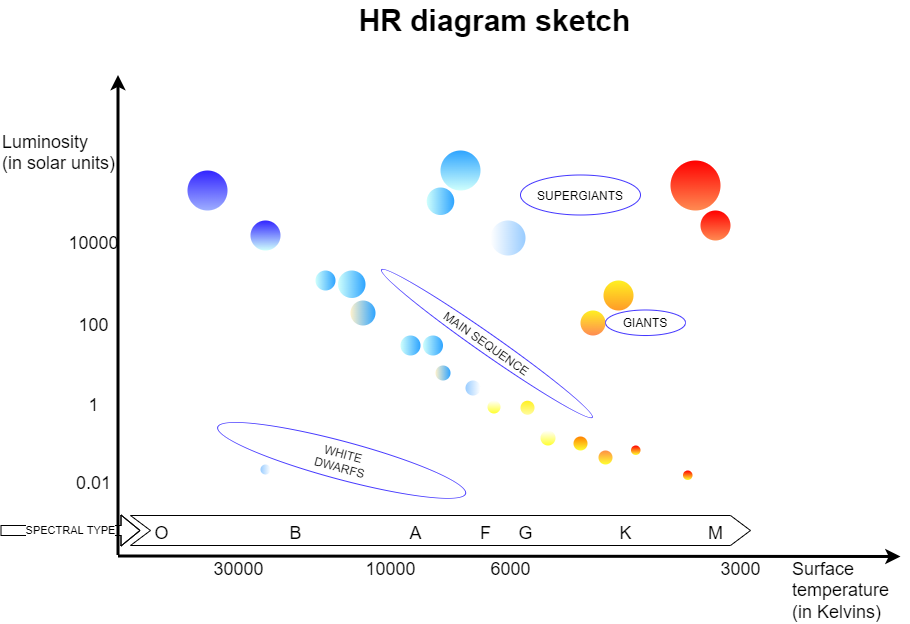
- Y-axis: one of luminosity, absolute magnitude, or power.
- X-axis: one of temperature, colour, or spectral class.
The H-R diagram compares the brightness or luminosity of stars with their surface temperature or related classification.
(b) Region containing the Sun [1 mark]
The Sun is located in the main sequence.
The main sequence contains stars that are undergoing hydrogen fusion in their cores. The Sun is a main-sequence star.
(c) White dwarf [1 mark]
Answer: B
- A is incorrect because it is a red giant.
- B is correct because it lies in the white dwarf region of the H-R diagram.
- C is incorrect because it is a hot main-sequence star.
- D is incorrect because it is a cool main-sequence star.
White dwarfs have relatively high surface temperatures but low luminosities compared with main-sequence stars.
(d) Star brighter and hotter than the Sun [1 mark]
Answer: C
- A is incorrect because red giant stars have lower surface temperatures than the Sun.
- B is incorrect because white dwarf stars are fainter than the Sun.
- C is correct because it has a greater surface temperature and greater brightness than the Sun.
- D is incorrect because this star is both cooler and fainter than the Sun.
At a standard distance, the apparent brightness can be compared directly using the star’s absolute magnitude or luminosity. On the H-R diagram, star C is positioned so that it is both hotter and more luminous than the Sun.