
Edexcel iGCSE Physics (4PH1) 8.2 Motion in the Universe Exam Style Question Paper 1B - New Syllabus
Question
This question is about stars.
(a) The table gives information about four different stars.
| Star | Colour | Mass in multiples of the mass of the Sun | Evolutionary stage |
|---|---|---|---|
| Betelgeuse | red | 16.5 | red supergiant |
| Sirius A | blue-white | 2.4 | main sequence |
| Sirius B | white | 1.0 | white dwarf |
| The Sun | yellow | 1.0 | main sequence |
(i) Which of these stars has the lowest surface temperature? (1)
(B) Sirius A
(C) Sirius B
(D) The Sun
(ii) Which of these stars will become a supernova in the future? (1)
(B) Sirius A
(C) Sirius B
(D) The Sun
(iii) Sirius B and the Sun have approximately the same mass but are different colours and in different evolutionary stages.
Describe two other differences between Sirius B and the Sun. (2)
1. ________________________________________________________________
2. ________________________________________________________________
(b) Sirius B orbits with Sirius A as part of a binary star system.
The mean orbital radius of Sirius B is \(29.7\times10^{9}\,\mathrm{km}\).
The time for Sirius B to complete one orbit is 50 years.
Calculate the mean orbital speed of Sirius B.
Give your answer in \(\mathrm{km\,s^{-1}}\). (3)
mean orbital speed = __________________ \(\mathrm{km\,s^{-1}}\)
Syllabus Topic Codes (Edexcel International GCSE Physics 4PH1):
• 8.9–8.10: Evolution of Sun-like stars and massive stars — part (a)(ii)
• 8.6: Orbital speed, orbital radius and time period — part (b)
▶️ Answer/Explanation
(a)(i) Correct Answer: \( \boxed{\mathrm{A}} \) Betelgeuse [1 mark]
- Red stars have the lowest surface temperatures.
(a)(ii) Correct Answer: \( \boxed{\mathrm{A}} \) Betelgeuse [1 mark]
- Betelgeuse is a massive red supergiant.
- It can eventually undergo a supernova.
(a)(iii) Any two differences [2 marks]
- Sirius B is smaller than the Sun.
- Sirius B is more dense than the Sun.
- Sirius B contains less hydrogen than the Sun.
- Nuclear fusion does not occur in Sirius B, but it occurs in the Sun.
- Sirius B is hotter than the Sun.
- Sirius B emits less light than the Sun.
Award \(1\) mark for each valid difference, up to \(2\) marks.
(b) Mean orbital speed [3 marks]
1. Convert time into seconds:
\(T=50\times365\times24\times60\times60=1.5768\times10^9\,\mathrm{s}\)
2. Use orbital speed:
\(v=\dfrac{2\pi r}{T}\)
3. Substitute:
\(v=\dfrac{2\pi(29.7\times10^9)}{1.5768\times10^9}\)
\(v\approx118\,\mathrm{km\,s^{-1}}\)
Final Answer: \( \boxed{118\,\mathrm{km\,s^{-1}}} \)
Question
This is a question about the Solar System.
(a) Give the name of the galaxy the Solar System is in. (1)
(b) Neptune is a planet in the Solar System.
(i) Triton is a moon that orbits the planet, Neptune.
Draw a diagram to show the orbit of Neptune and the orbit of Triton in the Solar System. (2)
(ii) Neptune orbits in the Solar System at an orbital speed of \(5.4\times10^{3}\,\mathrm{m\,s^{-1}}\) with an orbital radius of \(4.5\times10^{12}\,\mathrm{m}\).
Pluto is another object in the Solar System. Pluto orbits with a time period of \(7.8\times10^{9}\,\mathrm{s}\).
Show that the ratio of the orbital time period of Neptune to the orbital time period of Pluto is \(2:3\). (4)
Syllabus Topic Codes (Edexcel International GCSE Physics 4PH1):
• 8.5–8.6: Orbital motion, orbital radius, orbital speed and time period — parts (b)(i) and (b)(ii)
▶️ Answer/Explanation
(a) Galaxy [1 mark]
Correct Answer: \( \boxed{\mathrm{Milky\ Way}} \)
(b)(i) Orbits [2 marks]
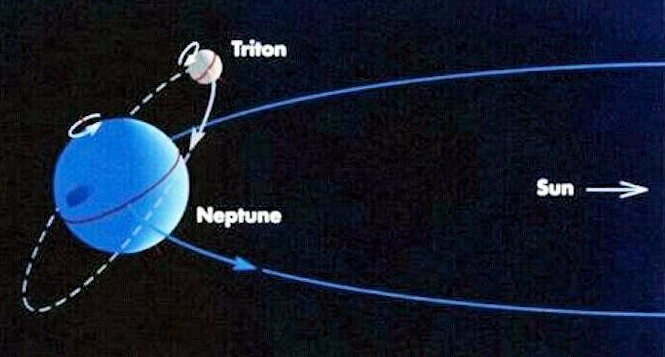
- Neptune orbits the Sun.
- Triton orbits Neptune.
The diagram should therefore show Neptune travelling around the Sun, with Triton travelling around Neptune.
(b)(ii) Ratio of orbital time periods [4 marks]
1. Use the orbital speed equation:
\(v=\dfrac{2\pi r}{T}\)
2. Rearrange for time period:
\(T=\dfrac{2\pi r}{v}\)
3. Calculate Neptune’s orbital time period:
\(T_{\mathrm{Neptune}}=\dfrac{2\pi(4.5\times10^{12})}{5.4\times10^{3}}\)
\(T_{\mathrm{Neptune}}\approx5.2\times10^{9}\,\mathrm{s}\)
4. Compare the two time periods:
\(T_{\mathrm{Neptune}}:T_{\mathrm{Pluto}}\)
\(=5.2\times10^{9}:7.8\times10^{9}\)
Cancel \(10^{9}\):
\(=5.2:7.8\)
Dividing both sides by \(2.6\):
\(=2:3\)
Final Answer: \( \boxed{T_{\mathrm{Neptune}}:T_{\mathrm{Pluto}}=2:3} \)
Question
This question is about astrophysics.
(a) Diagrams A, B, C and D show different orbital paths for object Y orbiting object X.
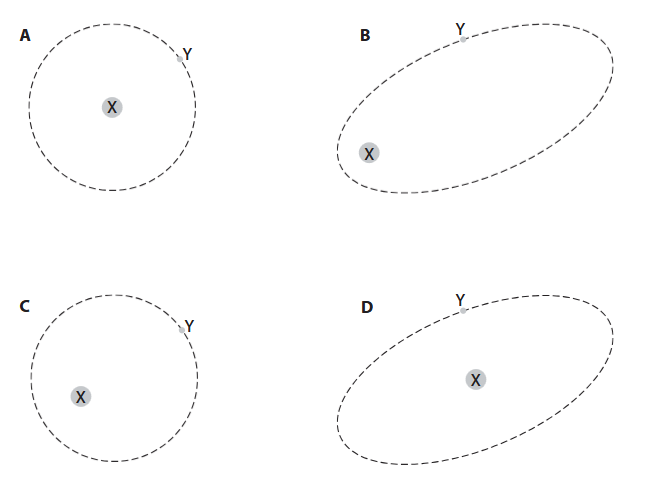
(i) Table 1 gives some possible names for object X and object Y.
Complete the table by placing one tick (\(\checkmark\)) in each row to show which orbital path is correct for each combination of object X and object Y.
Each orbital path may be used once, more than once, or not at all. (3)
| Object X | Object Y | Orbital path | |||
|---|---|---|---|---|---|
| A | B | C | D | ||
| the Earth | the Moon | ||||
| the Sun | a comet | ||||
| the Sun | the Earth | ||||
Table 1
(ii) Give the name of the force that causes one object to orbit another object in space. (1)
(b) Table 2 gives information about four different stars in the same galaxy as the Sun.
| Star | Colour | Evolutionary stage |
|---|---|---|
| Antares | red | red supergiant |
| Capella | yellow | main sequence |
| Sirius B | white | white dwarf |
| Vega | blue-white | main sequence |
Table 2
(i) Give the name of the galaxy that contains the Sun and the stars shown in table 2. (1)
(ii) Explain how the stars in table 2 can be classified according to their colour. (3)
(iii) Describe the likely future evolution of Antares. (3)
(iv) Describe what additional information is needed to predict the next evolutionary stage for Vega. (2)
Syllabus Topic Codes (Edexcel International GCSE Physics 4PH1):
• 8.2: The Universe, galaxies and solar systems — part (b)(i)
• 8.7–8.8: Classification of stars by colour and surface temperature — part (b)(ii)
• 8.9–8.10: Evolution of Sun-like stars and massive stars — parts (b)(iii) and (b)(iv)
▶️ Answer/Explanation
(a)(i) Correct orbital paths [3 marks]
| Object X | Object Y | Orbital path | |||
|---|---|---|---|---|---|
| A | B | C | D | ||
| the Earth | the Moon | \(\checkmark\) | |||
| the Sun | a comet | \(\checkmark\) | |||
| the Sun | the Earth | \(\checkmark\) | |||
- The Moon orbits the Earth in an approximately circular path, represented by A.
- A comet has a highly elliptical orbit around the Sun, represented by B.
- The Earth has an approximately circular orbit around the Sun, represented by A.
(a)(ii) Correct Answer: \( \boxed{\mathrm{gravity}} \) [1 mark]
Gravity provides the attractive force that keeps an object in orbit around another object.
(b)(i) Correct Answer: \( \boxed{\mathrm{the\ Milky\ Way}} \) [1 mark]
The Sun and the stars listed in Table 2 are located in the Milky Way galaxy.
(b)(ii) Classification by colour [3 marks]
- The colour of a star depends on its surface temperature.
- Red stars have the lowest surface temperatures.
- Blue-white stars have the highest surface temperatures.
For the stars in Table 2, the order from coolest to hottest is approximately:
\(\mathrm{red\rightarrow yellow\rightarrow white\rightarrow blue\text{-}white}\)
(b)(iii) Future evolution of Antares [3 marks]
- Antares is a red supergiant and is a massive star.
- It is expected to undergo a supernova.
- After the supernova, it may form a neutron star or a black hole, depending on its remaining mass.
(b)(iv) Additional information for Vega [2 marks]
- The evolutionary path of a star depends on its mass.
- Therefore, information about the mass of Vega, preferably relative to the mass of the Sun, is needed to predict its next evolutionary stage.
Final Answer: The required additional information is the mass of Vega relative to the Sun.
Question
This question is about stars.
(a) The table gives information about four different stars.
| Star | Colour | Mass in multiples of the mass of the Sun | Evolutionary stage |
|---|---|---|---|
| Betelgeuse | red | 16.5 | red supergiant |
| Sirius A | blue-white | 2.4 | main sequence |
| Sirius B | white | 1.0 | white dwarf |
| The Sun | yellow | 1.0 | main sequence |
(i) Which of these stars has the lowest surface temperature? (1)
(B) Sirius A
(C) Sirius B
(D) The Sun
(ii) Which of these stars will become a supernova in the future? (1)
(B) Sirius A
(C) Sirius B
(D) The Sun
(iii) Sirius B and the Sun have approximately the same mass but are different colours and in different evolutionary stages.
Describe two other differences between Sirius B and the Sun. (2)
1. ________________________________________________________________
2. ________________________________________________________________
(b) Sirius B orbits with Sirius A as part of a binary star system.
The mean orbital radius of Sirius B is \(29.7\times10^{9}\,\mathrm{km}\).
The time for Sirius B to complete one orbit is 50 years.
Calculate the mean orbital speed of Sirius B.
Give your answer in \(\mathrm{km\,s^{-1}}\). (3)
mean orbital speed = __________________ \(\mathrm{km\,s^{-1}}\)
Syllabus Topic Codes (Edexcel International GCSE Physics 4PH1):
• 8.9–8.10: Evolution of Sun-like stars and massive stars — part (a)(ii)
• 8.6: Orbital speed, orbital radius and time period — part (b)
▶️ Answer/Explanation
(a)(i) Correct Answer: \( \boxed{\mathrm{A}} \) Betelgeuse [1 mark]
- Red stars have the lowest surface temperatures.
(a)(ii) Correct Answer: \( \boxed{\mathrm{A}} \) Betelgeuse [1 mark]
- Betelgeuse is a massive red supergiant.
- It can eventually undergo a supernova.
(a)(iii) Any two differences [2 marks]
- Sirius B is smaller than the Sun.
- Sirius B is more dense than the Sun.
- Sirius B contains less hydrogen than the Sun.
- Nuclear fusion does not occur in Sirius B, but it occurs in the Sun.
- Sirius B is hotter than the Sun.
- Sirius B emits less light than the Sun.
Award \(1\) mark for each valid difference, up to \(2\) marks.
(b) Mean orbital speed [3 marks]
1. Convert time into seconds:
\(T=50\times365\times24\times60\times60=1.5768\times10^9\,\mathrm{s}\)
2. Use orbital speed:
\(v=\dfrac{2\pi r}{T}\)
3. Substitute:
\(v=\dfrac{2\pi(29.7\times10^9)}{1.5768\times10^9}\)
\(v\approx118\,\mathrm{km\,s^{-1}}\)
Final Answer: \( \boxed{118\,\mathrm{km\,s^{-1}}} \)
Questions
This question is about the motion of objects in the solar system.
(a) (i) Draw a labelled diagram showing the Moon orbiting the Earth.
(ii) Give the name of the force that causes the Moon to orbit the Earth.
(iii) Give the name of another object that orbits the Earth.
(b) A planet and a comet both orbit a star. Give a difference between the orbit of a planet and the orbit of a comet.
Syllabus Topic Codes (Edexcel International GCSE Physics 4PH1):
• 8.5: Differences between the orbits of comets, moons and planets — part (b)
▶️Answer/Explanation
Ans
(a) (i) labelled diagram showing a moon in circular orbit around Earth;
Earth approximately at the centre of the path;
(ii) gravitational (force);
(iii) satellite / space station;
(b) planet’s orbit is circular/slightly elliptical but comet’s orbit is elliptical/oval;
OR
planet has constant speed but comet has variable speed;
Questions
This question is about astrophysics.
(a) Which of these is a large collection of billions of galaxies?
A Milky Way
B nebula
C solar system
D universe
(b) Which of these is a correct unit for gravitational field strength, \(g\)?
A kilogram (\(\mathrm{kg}\))
B newton (\(\mathrm{N}\))
C newton kilogram (\(\mathrm{N\,kg}\))
D newton per kilogram (\(\mathrm{N\,kg^{-1}}\))
(c) Which statement explains why the gravitational field strength on the Moon is less than the gravitational field strength on Earth?
A the Moon is further away from the Sun than the Earth
B the Moon has less atmosphere than the Earth
C the Moon has less mass than the Earth
D the Moon has a greater density than the Earth
(d) Describe the differences between the orbit of the Moon and the orbit of a comet. You may include a diagram to support your answer. (2)
Syllabus Topic Codes (Edexcel International GCSE Physics 4PH1):
• 8.3–8.4: Gravitational Field Strength in Space and Its Effects on Orbits — parts (b) and (c)
• 8.5: Orbits of Comets, Moons, and Planets — part (d)
▶️ Answer/Explanation
(a) Universe [1 mark]
Answer: D, universe.
- The Milky Way is a galaxy.
- A nebula is a cloud of gas and dust.
- A solar system contains a star and the objects orbiting it.
(b) Unit of gravitational field strength [1 mark]
Answer: D, newton per kilogram.
Gravitational field strength is defined as force per unit mass:
\(g=\dfrac{F}{m}\)
Therefore, its unit is:
\(\boxed{\mathrm{N\,kg^{-1}}}\)
(c) Gravitational field strength of the Moon [1 mark]
Answer: C, the Moon has less mass than the Earth.
The gravitational field strength at the surface of a body depends on its mass and radius. The Moon has much less mass than Earth, so its gravitational field strength is lower.
(d) Orbits of the Moon and a comet [2 marks]
- The Moon orbits the Earth, whereas a comet orbits the Sun.
- The Moon’s orbit is approximately circular, while a comet’s orbit is usually highly elliptical.
The highly elliptical orbit of a comet means that its distance from the Sun changes significantly during its orbit.
Questions
A star has a circular orbit around the centre of a galaxy.
(a) The diagram shows an outline of the galaxy and the star’s position in the galaxy.

Draw an arrow on the diagram to show the force on the star that keeps the star in a circular orbit.
(b)
(i) The speed of light is \(3.0\times10^8\,\mathrm{m\,s^{-1}}\). One light year is the distance light travels in one year. Show that one light year is approximately \(10^{16}\,\mathrm{m}\).
[one year = \(3.2\times10^7\,\mathrm{s}\)]
(ii) The star is \(29000\) light years away from the centre of the galaxy and has an orbital speed of \(220\,\mathrm{km\,s^{-1}}\). Calculate the time period of the star’s orbit around the centre of the galaxy. Give your answer in standard form.
Syllabus Topic Codes (Edexcel International GCSE Physics 4PH1):
• 8.1: Astrophysics Units — part (b)(i)
• 8.6: Orbital Speed, Radius, and Time Period — part (b)(ii)
▶️ Answer/Explanation
(a) Force on the star
The force must act towards the centre of the galaxy. This inward force provides the centripetal force needed to keep the star moving in a circular orbit.
The arrow should therefore point from the star towards the centre of the galaxy.
(b)(i) One light year
Use:
\(\mathrm{distance}=\mathrm{speed}\times\mathrm{time}\)
\(\mathrm{distance}=(3.0\times10^8)(3.2\times10^7)\)
\(\mathrm{distance}=9.6\times10^{15}\,\mathrm{m}\)
This is approximately:
\(\boxed{1\,\mathrm{light\ year}\approx10^{16}\,\mathrm{m}}\)
(b)(ii) Orbital time period
Convert the orbital radius from light years to metres:
\(r=29000\times10^{16}\,\mathrm{m}\)
For a circular orbit:
\(v=\dfrac{2\pi r}{T}\)
Rearranging:
\(T=\dfrac{2\pi r}{v}\)
Convert the speed:
\(220\,\mathrm{km\,s^{-1}}=220000\,\mathrm{m\,s^{-1}}\)
Therefore:
\(T=\dfrac{2\pi(29000\times10^{16})}{220000}\)
\(T\approx8.3\times10^{15}\,\mathrm{s}\)
\(\boxed{T=8.3\times10^{15}\,\mathrm{s}}\)
Question
This is a question about reflection.
(a) Which diagram shows a light ray correctly reflected from a mirror?

(b) Name the equipment needed to measure the angle of incidence on a ray diagram.
(c) Light from a laser on the Earth reflects off special mirrors on the Moon. The graph shows the data from a light sensor attached to the laser. The first peak shows when the light leaves the laser and the second peak shows when the light has returned from the Moon.

(i) Determine the time taken for the light to travel from the Earth to the Moon and back again.
(ii) The speed of light is \(3.0\times10^5\,\mathrm{km\,s^{-1}}\). Calculate the total distance travelled by the light from the laser.
[average speed = distance moved ÷ time taken]
(iii) Calculate the distance from the Earth to the Moon.
Syllabus Topic Codes (Edexcel International GCSE Physics 4PH1):
• 8.2: The Universe, Galaxies, and Solar Systems — part (c)
• 8.6: Orbital Speed, Radius, and Time Period — part (c)(i)–(iii) calculation of distance using speed and time
▶️ Answer/Explanation
(a) Correct reflection [1 mark]
The correct diagram is C.
- The angle of reflection is equal to the angle of incidence.
- The reflected ray remains in the same medium and does not pass into the mirror.
(b) Measuring angle of incidence [1 mark]
A protractor is used to measure the angle of incidence on a ray diagram.
(c)(i) Time taken [1 mark]
The time taken is found from the difference between the times of the two peaks on the graph.
\(\boxed{t=2.5\,\mathrm{s}}\)
(c)(ii) Total distance travelled [2 marks]
Use:
\(\mathrm{distance}=\mathrm{speed}\times\mathrm{time}\)
Substitute \(v=3.0\times10^5\,\mathrm{km\,s^{-1}}\) and \(t=2.5\,\mathrm{s}\):
\(d=(3.0\times10^5)\times2.5\)
\(d=7.5\times10^5\,\mathrm{km}\)
Therefore: \(\boxed{d=750\,000\,\mathrm{km}}\)
(c)(iii) Distance from Earth to Moon [1 mark]
The light travels from Earth to the Moon and then back to Earth, so the Earth-Moon distance is half of the total distance.
\(\mathrm{distance}=\dfrac{750\,000}{2}\)
Therefore: \(\boxed{375\,000\,\mathrm{km}}\)
Question
The photograph shows the International Space Station (ISS) in orbit around the Earth.

(a) The ISS orbits the Earth in a circular orbit. Which of these also orbits the Earth?
A a comet
B Mars
C the Moon
D the Sun
(b) Which of these forces causes the ISS to orbit the Earth?
A air resistance
B electrostatic
C friction
D gravitational
(c) The ISS completes one orbit of the Earth in a time period of \(93\,\mathrm{minutes}\).
(i) The orbital radius of the ISS is \(6.8\times10^3\,\mathrm{km}\). Calculate the orbital speed of the ISS in \(\mathrm{km\,s^{-1}}\).
(ii) Show that the ISS completes approximately 15 orbits of the Earth each day.
Syllabus Topic Codes (Edexcel International GCSE Physics 4PH1):
• 8.3–8.4: Gravitational Field Strength in Space and Its Effects on Orbits — part (b)
• 8.6: Orbital Speed, Radius, and Time Period — parts (c)(i)–(ii)
▶️ Answer/Explanation
(a) Orbiting the Earth [1 mark]
The correct answer is C, the Moon.
The Moon orbits the Earth, while a comet, Mars, and the Sun orbit the Sun.
(b) Force causing the orbit [1 mark]
The correct answer is D, gravitational.
The gravitational force between the Earth and the ISS provides the force that keeps the ISS in orbit.
(c)(i) Orbital speed [3 marks]
The distance travelled in one complete circular orbit is the circumference:
\(\mathrm{distance}=2\pi r\)
First convert the time period into seconds:
\(T=93\times60=5580\,\mathrm{s}\)
Use:
\(v=\dfrac{2\pi r}{T}\)
Substitute \(r=6.8\times10^3\,\mathrm{km}\):
\(v=\dfrac{2\pi\times6.8\times10^3}{5580}\)
\(v\approx7.66\,\mathrm{km\,s^{-1}}\)
Therefore: \(\boxed{v\approx7.7\,\mathrm{km\,s^{-1}}}\)
(c)(ii) Number of orbits per day [2 marks]
One day is:
\(24\times60=1440\,\mathrm{minutes}\)
The number of orbits completed is:
\(\mathrm{number\ of\ orbits}=\dfrac{1440}{93}\)
\(\mathrm{number\ of\ orbits}\approx15.48\)
Therefore: the ISS completes approximately \(\boxed{15\text{ orbits}}\) of the Earth each day.
Question
The gravitational field strength of a planet decreases with increasing distance from the planet. The table shows the value of the gravitational field strength of Mars at different distances from the centre of Mars.

(a) A student finds this formula in a textbook, which links distance from the centre of a planet to its gravitational field strength.
gravitational field strength \(\times\) distance\(^2\) = constant
Use data from the table to justify this formula.
(b) Olympus Mons is the tallest mountain on Mars. The distance between the centre of Mars and the peak of Olympus Mons is \(3410\,\mathrm{km}\). Calculate the gravitational field strength at the peak of Olympus Mons.
Syllabus Topic Codes (Edexcel International GCSE Physics 4PH1):
▶️ Answer/Explanation
(a) Justifying the relationship [4 marks]
The proposed relationship is:
\(\mathrm{gravitational\ field\ strength}\times\mathrm{distance}^2=\mathrm{constant}\)
Use one pair of values from the table. For example:
\(\mathrm{constant}=g\times d^2\)
For the first set of data:
\(\mathrm{constant}=10.7\times(2000)^2\)
\(\mathrm{constant}=42\,800\,000\)
Using a second set of data gives approximately the same value:
\(\mathrm{constant}\approx42\,700\,000\)
The calculated value of the constant remains approximately unchanged for different distances.
Therefore, the data support the formula.

(b) Gravitational field strength at Olympus Mons [3 marks]
From the relationship:
\(g\times d^2=\mathrm{constant}\)
Rearrange:
\(g=\dfrac{\mathrm{constant}}{d^2}\)
Using \(\mathrm{constant}=42\,700\,000\) and \(d=3410\,\mathrm{km}\):
\(g=\dfrac{42\,700\,000}{3410^2}\)
\(g\approx3.67\,\mathrm{N\,kg^{-1}}\)
Therefore: \(\boxed{g\approx3.7\,\mathrm{N\,kg^{-1}}}\)
This is consistent with the gravitational field strength decreasing as the distance from the centre of Mars increases.