
Edexcel iGCSE Physics (4PH1) 8.3 Stellar Evolution Exam Style Question Paper 1B - New Syllabus
Question
This question is about astrophysics.
(a) Diagrams A, B, C and D show different orbital paths for object Y orbiting object X.
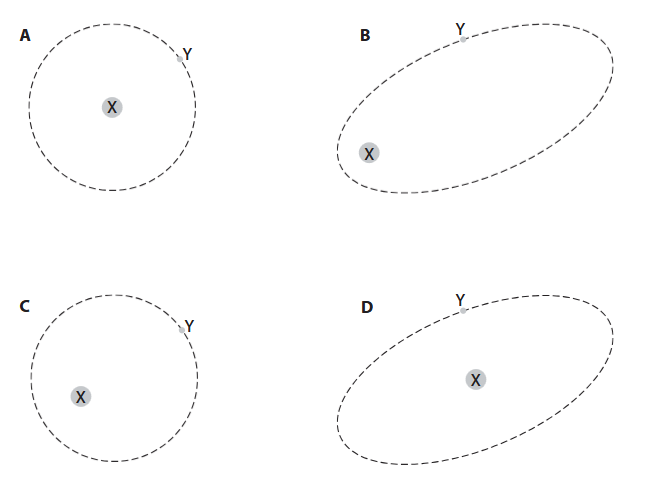
(i) Table 1 gives some possible names for object X and object Y.
Complete the table by placing one tick (\(\checkmark\)) in each row to show which orbital path is correct for each combination of object X and object Y.
Each orbital path may be used once, more than once, or not at all. (3)
| Object X | Object Y | Orbital path | |||
|---|---|---|---|---|---|
| A | B | C | D | ||
| the Earth | the Moon | ||||
| the Sun | a comet | ||||
| the Sun | the Earth | ||||
Table 1
(ii) Give the name of the force that causes one object to orbit another object in space. (1)
(b) Table 2 gives information about four different stars in the same galaxy as the Sun.
| Star | Colour | Evolutionary stage |
|---|---|---|
| Antares | red | red supergiant |
| Capella | yellow | main sequence |
| Sirius B | white | white dwarf |
| Vega | blue-white | main sequence |
Table 2
(i) Give the name of the galaxy that contains the Sun and the stars shown in table 2. (1)
(ii) Explain how the stars in table 2 can be classified according to their colour. (3)
(iii) Describe the likely future evolution of Antares. (3)
(iv) Describe what additional information is needed to predict the next evolutionary stage for Vega. (2)
Syllabus Topic Codes (Edexcel International GCSE Physics 4PH1):
• 8.2: The Universe, galaxies and solar systems — part (b)(i)
• 8.7–8.8: Classification of stars by colour and surface temperature — part (b)(ii)
• 8.9–8.10: Evolution of Sun-like stars and massive stars — parts (b)(iii) and (b)(iv)
▶️ Answer/Explanation
(a)(i) Correct orbital paths [3 marks]
| Object X | Object Y | Orbital path | |||
|---|---|---|---|---|---|
| A | B | C | D | ||
| the Earth | the Moon | \(\checkmark\) | |||
| the Sun | a comet | \(\checkmark\) | |||
| the Sun | the Earth | \(\checkmark\) | |||
- The Moon orbits the Earth in an approximately circular path, represented by A.
- A comet has a highly elliptical orbit around the Sun, represented by B.
- The Earth has an approximately circular orbit around the Sun, represented by A.
(a)(ii) Correct Answer: \( \boxed{\mathrm{gravity}} \) [1 mark]
Gravity provides the attractive force that keeps an object in orbit around another object.
(b)(i) Correct Answer: \( \boxed{\mathrm{the\ Milky\ Way}} \) [1 mark]
The Sun and the stars listed in Table 2 are located in the Milky Way galaxy.
(b)(ii) Classification by colour [3 marks]
- The colour of a star depends on its surface temperature.
- Red stars have the lowest surface temperatures.
- Blue-white stars have the highest surface temperatures.
For the stars in Table 2, the order from coolest to hottest is approximately:
\(\mathrm{red\rightarrow yellow\rightarrow white\rightarrow blue\text{-}white}\)
(b)(iii) Future evolution of Antares [3 marks]
- Antares is a red supergiant and is a massive star.
- It is expected to undergo a supernova.
- After the supernova, it may form a neutron star or a black hole, depending on its remaining mass.
(b)(iv) Additional information for Vega [2 marks]
- The evolutionary path of a star depends on its mass.
- Therefore, information about the mass of Vega, preferably relative to the mass of the Sun, is needed to predict its next evolutionary stage.
Final Answer: The required additional information is the mass of Vega relative to the Sun.
Question
This question is about the Sun.
(a) The table shows the different stages in the evolution of stars of different masses. Complete the table by adding ticks (ü) to show which stages of evolution occur in the life cycle of the Sun.

(b) When viewed from Earth, the surface of the Sun is yellow in colour. The surface of another star, Betelgeuse, is red in colour. Explain the difference between the Sun and Betelgeuse, based on the different colours of their surfaces.
(c) The Sun transfers energy to the Earth by radiation.
(i) Give a reason why energy is not transferred from the Sun to the Earth by conduction or convection.
(ii) A satellite orbiting the Earth contains sensitive equipment that can be damaged if it gets too hot. Explain which colour would be most appropriate for the outer surface of the satellite to protect the equipment.
Syllabus Topic Codes (Edexcel International GCSE Physics 4PH1):
• 8.7: Classification of stars according to their colour — part (b)
• 8.8: Relationship between a star’s colour and its surface temperature — part (b)
• 5.10: Arrangement and motion of particles in solids, liquids and gases — part (c)(i)
• 4.2: Energy transfers involving energy stores and radiation — part (c)(i)
• 3.10: Properties of electromagnetic radiation — part (c)(ii)
▶️ Answer/Explanation
Ans
(a) one mark for each correct tick;;;;

(b) idea of the temperatures being different;
Sun is hotter than Betelgeuse;
(c) (i) idea that there are no particles in space (between Sun and Earth);
(ii) shiny / white / silver;
poor absorber of (IR) radiation;
Questions
This question is about the evolution of a star.
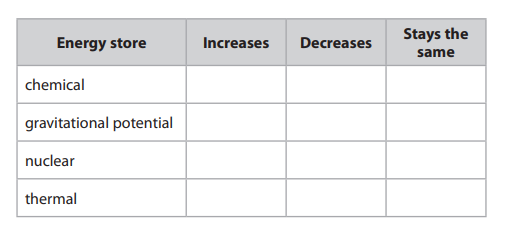
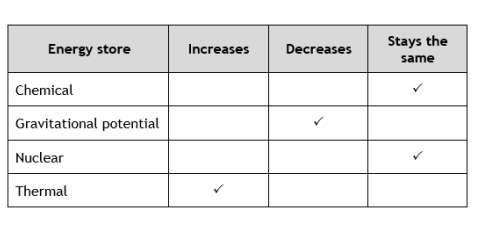
(a) A main sequence star is created in a collapsing region of a nebula. The table gives different energy stores for the gases in the collapsing nebula, from when the nebula starts to collapse to just before the main sequence star is created. Complete the table by placing ticks (ü) to show whether each energy store increases, decreases or stays the same.
(b) At the end of the main sequence stage of a star’s evolution, the star can become a red giant or a red supergiant. Give the property of a star that determines whether it becomes a red giant or a red supergiant.
(c) A red giant star eventually becomes a white dwarf star. Discuss the differences between a red giant star and a white dwarf star.
Syllabus Topic Codes (Edexcel International GCSE Physics 4PH1):
• 8.10: Evolution of stars with a mass larger than the Sun, including the distinction between red giants and red supergiants — part (b)
▶️Answer/Explanation
Ans
(a) one mark for each correct row;;;;
(b) mass;
(c) any four from:
MP1. red giant has greater brightness than white dwarf;
MP2. (nuclear) fusion takes place in red giant (core) but not in white dwarf (core);
MP3. red giant is larger than white dwarf;
MP4. red giant has lower (surface) temperature than white dwarf;
MP5. white dwarf is denser than a red giant;
MP6. white dwarf has a planetary nebula but a red giant does not;
Questions
The table gives information about four stars.

(a) Explain which of these stars has the highest surface temperature. (2)
(b) Discuss the evolution of the stars Rigel and Sirius. (6)
Syllabus Topic Codes (Edexcel International GCSE Physics 4PH1):
• 8.9–8.10: Evolution of Sun-Like Stars and Massive Stars — part (b)
▶️ Answer/Explanation
(a) Highest surface temperature [2 marks]
Answer: Rigel.
The colour of a star is related to its surface temperature. Blue stars have a higher surface temperature than stars with colours such as yellow or red.
Rigel is the hottest of the stars shown in the table.
(b) Evolution of Rigel and Sirius [6 marks]
Both stars:
- Both stars began in a nebula.
- Both stars became protostars.
- Both stars were or are main sequence stars.
Rigel:
- Rigel is a high-mass star.
- Rigel is or will become a red supergiant.
- Rigel will eventually become a supernova.
- After the supernova, Rigel will become a neutron star.
Sirius:
- Sirius is a low-mass star.
- Sirius will become a red giant.
- Sirius will eventually become a white dwarf.
The key difference is that the different masses of the stars lead to different evolutionary paths. A massive star such as Rigel follows the red-supergiant and supernova pathway, while a lower-mass star such as Sirius follows the red-giant and white-dwarf pathway.
Question
The diagram shows the orbit of the Earth around the Sun.

(a)(i) Draw the orbit of the Earth’s Moon on the diagram.
(ii) Draw the orbit of a comet on the diagram.
(b) Earth orbits the Sun in 365 days with an orbital radius of \(150\,000\,000\,\mathrm{km}\). Calculate the Earth’s orbital speed in \(\mathrm{km\,s^{-1}}\).
(c) Which force keeps the Earth in orbit around the Sun?
A electrostatic
B gravitational
C magnetic
D nuclear
(d) Describe the evolution of the Sun from the first stage of its evolution to the final stage of its evolution.
Syllabus Topic Codes (Edexcel International GCSE Physics 4PH1):
• 8.6: Orbital Speed, Radius, and Time Period — part (b)
• 8.3–8.4: Gravitational Field Strength in Space and Its Effects on Orbits — part (c)
• 8.9–8.10: Evolution of Sun-Like Stars and Massive Stars — part (d)
▶️ Answer/Explanation
(a)(i) Orbit of the Moon [2 marks]
- Draw an orbit around the Earth.
- The orbit should be approximately circular with the Earth at its centre.
(a)(ii) Orbit of a comet [2 marks]
- Draw an elliptical orbit around the Sun.
- The Sun should be at one focus of the ellipse.
(b) Orbital speed of Earth [3 marks]
First convert \(365\) days into seconds:
\(T=365\times24\times60\times60\)
\(T=31.536\times10^6\,\mathrm{s}\)
The distance travelled in one complete orbit is the circumference of the orbit:
\(\mathrm{distance}=2\pi r\)
Therefore:
\(v=\dfrac{2\pi r}{T}\)
\(v=\dfrac{2\pi\times150\,000\,000}{31.536\times10^6}\)
\(v\approx29.9\,\mathrm{km\,s^{-1}}\)
Therefore: \(\boxed{v\approx30\,\mathrm{km\,s^{-1}}}\)
(c) Force keeping Earth in orbit [1 mark]
The correct answer is B, gravitational.
The gravitational force between the Sun and Earth provides the force that keeps Earth in orbit around the Sun.
(d) Evolution of the Sun [3 marks]
The Sun begins as a nebula, a cloud of gas and dust. Gravity causes the cloud to collapse and form a protostar. The Sun then enters the main sequence stage, where it remains for most of its lifetime.
After the hydrogen fuel in its core is depleted, the Sun becomes a red giant. Its outer layers are eventually expelled, forming a planetary nebula, leaving behind a white dwarf as the final stage.
Sequence:
\(\mathrm{nebula}\rightarrow\mathrm{protostar}\rightarrow\mathrm{main\ sequence}\rightarrow\mathrm{red\ giant}\rightarrow\mathrm{planetary\ nebula}\rightarrow\mathrm{white\ dwarf}\)