
Edexcel iGCSE Physics (4PH1) 8.3 Stellar Evolution Exam Style Question Paper 2B - New Syllabus
Question
This question is about stars.
The diagram shows an incomplete Hertzsprung-Russell (H-R) diagram.

(a) Label the axes on the diagram.
(b) There are three shaded areas on the diagram. State the name of the shaded area that contains the Sun.
(c) Which star is a white dwarf?
A
B
C
D
(d) At a standard distance from the Earth, which star is brighter than the Sun and has a greater surface temperature than the Sun?
A
B
C
D
Syllabus Topic Codes (Edexcel International GCSE Physics 4PH1):
• 8.11P: Absolute Magnitude — parts (a) and (d)
• 8.12P: Hertzsprung-Russell Diagram — parts (a), (b), (c) and (d)
▶️ Answer/Explanation
(a) Labels of the axes [2 marks]
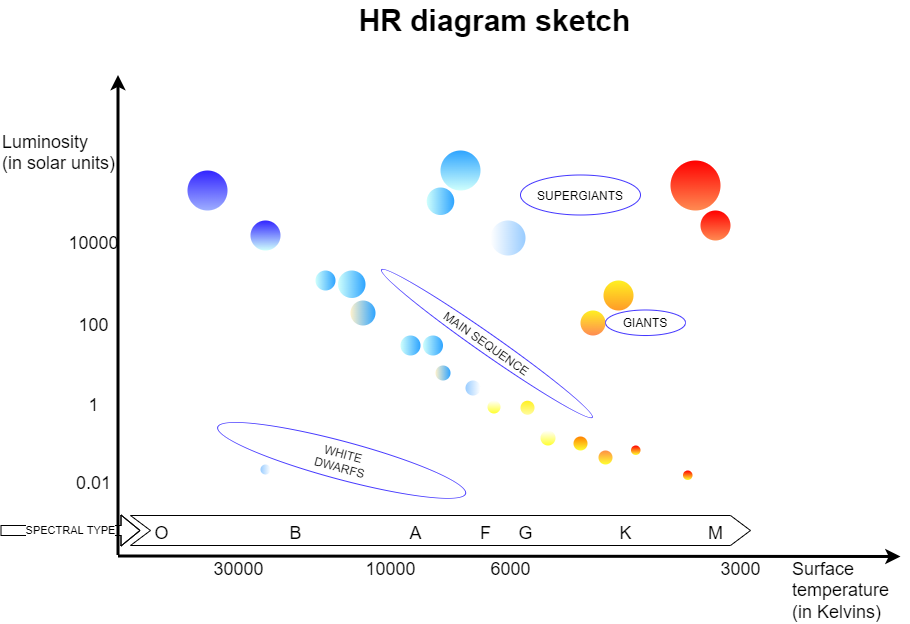
- Y-axis: one of luminosity, absolute magnitude, or power.
- X-axis: one of temperature, colour, or spectral class.
The H-R diagram compares the brightness or luminosity of stars with their surface temperature or related classification.
(b) Region containing the Sun [1 mark]
The Sun is located in the main sequence.
The main sequence contains stars that are undergoing hydrogen fusion in their cores. The Sun is a main-sequence star.
(c) White dwarf [1 mark]
Answer: B
- A is incorrect because it is a red giant.
- B is correct because it lies in the white dwarf region of the H-R diagram.
- C is incorrect because it is a hot main-sequence star.
- D is incorrect because it is a cool main-sequence star.
White dwarfs have relatively high surface temperatures but low luminosities compared with main-sequence stars.
(d) Star brighter and hotter than the Sun [1 mark]
Answer: C
- A is incorrect because red giant stars have lower surface temperatures than the Sun.
- B is incorrect because white dwarf stars are fainter than the Sun.
- C is correct because it has a greater surface temperature and greater brightness than the Sun.
- D is incorrect because this star is both cooler and fainter than the Sun.
At a standard distance, the apparent brightness can be compared directly using the star’s absolute magnitude or luminosity. On the H-R diagram, star C is positioned so that it is both hotter and more luminous than the Sun.
Question
This question is about stars.
(a) The table gives some information about four stars.

(i) Star C is much more powerful than star A. Stars A and C appear to have the same brightness when viewed from Earth. Suggest how this is possible.
(ii) Using information from the table, explain which star is in the supernova stage of its evolution.
(b) Explain how a main sequence star evolves into a supernova.
(c) Astronomers have used supernovas in distant galaxies to investigate the expansion of the universe.
(i) Light emitted from a supernova at a wavelength of \(7.774\times10^{-7}\,\mathrm{m}\) was detected at Earth with a wavelength of \(7.780\times10^{-7}\,\mathrm{m}\). Calculate the speed at which the galaxy containing this supernova was moving away from the Earth. [speed of light \(=3.0\times10^8\,\mathrm{m\,s^{-1}}\)]
(ii) The astronomers investigated supernovas that showed a red-shift in the wavelengths detected in different galaxies. The astronomers discovered that the red-shifted light detected from supernovas in nearby galaxies had shorter wavelengths than the red-shifted light detected from supernovas in galaxies further away. Explain how this discovery supports the Big Bang theory.
Syllabus Topic Codes (Edexcel International GCSE Physics 4PH1):
• 8.11P: Absolute Magnitude — part (a)(i)
• 8.13–8.14P: The Big Bang Theory and Its Evidence — part (c)(ii)
• 8.15–8.16P: Red-Shift, Motion of Galaxies, the Red-Shift Equation — parts (c)(i) and (c)(ii)
• 8.17P: Red-Shift and Distance — part (c)(ii)
▶️ Answer/Explanation
(a)(i) Apparent brightness of stars [1 mark]
Star A can appear to have the same brightness as star C because star A is closer to the Earth than star C.
Although star C has a greater power output, its greater distance means that less of its light reaches a given area at Earth.
(a)(ii) Identifying the supernova stage [2 marks]
The star in the supernova stage is star D.
- Star D has a mass much greater than the mass of the Sun.
- It has a much lower value of absolute magnitude, indicating a very bright star.
A very massive star can undergo the sequence of changes that eventually leads to a supernova explosion.
(b) Evolution into a supernova [3 marks]
- Hydrogen fusion eventually stops in the core.
- The core collapses or contracts, causing conditions that allow fusion to restart and heavier elements to form.
- The star becomes a red supergiant.
- Eventually, fusion of heavier elements stops in the core.
- The star then explodes as a supernova.
Only sufficiently massive stars follow this pathway and end their lives in a supernova explosion.
(c)(i) Speed of recession [4 marks]
First calculate the change in wavelength:
\(\Delta\lambda=(7.780-7.774)\times10^{-7}\)
\(\Delta\lambda=6.0\times10^{-10}\,\mathrm{m}\)
Use the red-shift relationship:
\(\dfrac{\Delta\lambda}{\lambda}=\dfrac{v}{c}\)
Rearrange to make \(v\) the subject:
\(v=\dfrac{\Delta\lambda}{\lambda}c\)
Substitute:
\(v=\dfrac{6.0\times10^{-10}}{7.774\times10^{-7}}\times3.0\times10^8\)
\(v=2.315\times10^5\,\mathrm{m\,s^{-1}}\)
Speed of the galaxy: \(\boxed{2.3\times10^5\,\mathrm{m\,s^{-1}}}\)
(c)(ii) Red-shift and the Big Bang theory [4 marks]
- Nearby galaxies show a smaller red-shift, or smaller change in wavelength.
- This indicates that nearby galaxies are moving away from Earth more slowly than galaxies that are further away.
- The red-shift observed in galaxies provides evidence that the universe is expanding.
- If the universe is expanding, tracing this expansion backwards suggests that the universe was once concentrated at a single point, supporting the Big Bang theory.
The observation therefore supports the idea that galaxies have been moving apart as the universe has expanded from an earlier, much more concentrated state.
Question
The diagram is an incomplete Hertzsprung-Russell diagram which astronomers use to compare stars.

(a) The y-axis label is missing. Which of these is the correct label for the y-axis?
A absolute magnitude
B apparent magnitude
C scalar magnitude
D vector magnitude
(b) The box contains words to identify the shaded areas P, Q and R on the Hertzsprung-Russell diagram.

Use words from the box to identify P, Q and R.
(c) Explain which side of the diagram contains stars with the highest surface temperature.
Syllabus Topic Codes (Edexcel International GCSE Physics 4PH1):
• 8.11P: Absolute Magnitude — part (a)
• 8.12P: Hertzsprung-Russell Diagram — parts (a), (b) and (c)
▶️ Answer/Explanation
(a) Y-axis label [1 mark]
Answer: A, absolute magnitude
- A is correct because absolute magnitude is used to compare the intrinsic brightness of stars on an H-R diagram.
- B is incorrect because apparent magnitude depends on how bright a star appears from Earth and therefore depends on distance.
- C is incorrect because scalar magnitude is not the quantity used to label this axis.
- D is incorrect because vector magnitude is not the quantity used on an H-R diagram.
(b) Identifying the shaded regions [3 marks]
The shaded regions are:
- P: white dwarfs
- Q: main sequence
- R: red giants
The main sequence is the region containing stars such as the Sun, while white dwarfs and red giants occupy different regions of the H-R diagram because of their different luminosities and surface temperatures.
(c) Surface temperature [2 marks]
- The stars with the highest surface temperatures are on the left-hand side of the H-R diagram.
- Blue and white stars have higher surface temperatures than red and orange stars.
Therefore, the temperature scale on an H-R diagram decreases from left to right.