
Edexcel iGCSE Physics (4PH1) 8.4 Cosmology Exam Style Question Paper 2B - New Syllabus
Question
Galaxies A, B and C are different distances from the Earth.
Galaxy A is moving away from the Earth with a velocity of \(1.7\times10^4\,\mathrm{km\,s^{-1}}\).
(a) The reference wavelength for light arriving at the Earth from galaxy A is \(506\,\mathrm{nm}\).
Calculate the observed wavelength for the light arriving from galaxy A.
[speed of light \(=3.0\times10^5\,\mathrm{km\,s^{-1}}\)] (3)
wavelength = __________________ \(\mathrm{nm}\)
(b) Galaxy B is twice as far away from the Earth as galaxy A is from the Earth.
Galaxy C is four times as far away from the Earth as galaxy A is from the Earth.
Explain how the velocities of galaxies B and C are different. (2)
(c) The universe started with an event called the Big Bang.
Explain how evidence from cosmic microwave background radiation shows how the temperature of the universe has changed since the Big Bang. (2)
Syllabus Topic Codes (Edexcel International GCSE Physics 4PH1):
• 8.17P: Red-Shift and Distance — part (b)
• 8.13–8.14P: The Big Bang Theory and Its Evidence — part (c)
▶️ Answer/Explanation
(a) Observed wavelength [3 marks]
1. Use the red-shift equation:
\(\dfrac{\Delta\lambda}{\lambda}=\dfrac{v}{c}\)
where \(\lambda=506\,\mathrm{nm}\), \(v=1.7\times10^4\,\mathrm{km\,s^{-1}}\), and \(c=3.0\times10^5\,\mathrm{km\,s^{-1}}\).
2. Substitute the values:
\(\dfrac{\Delta\lambda}{506}=\dfrac{1.7\times10^4}{3.0\times10^5}\)
3. Calculate the change in wavelength:
\(\Delta\lambda=506\left(\dfrac{1.7\times10^4}{3.0\times10^5}\right)\)
\(\Delta\lambda\approx28.7\,\mathrm{nm}\)
Since the galaxy is moving away from the Earth, the light is red-shifted, so the wavelength increases.
\(\lambda_{\mathrm{observed}}=506+28.7\)
\(\lambda_{\mathrm{observed}}=534.7\,\mathrm{nm}\)
To an appropriate number of significant figures:
\(\lambda_{\mathrm{observed}}\approx535\,\mathrm{nm}\)
Final Answer: \( \boxed{535\,\mathrm{nm}} \)
(b) Velocities of galaxies B and C [2 marks]
- The universe is expanding, so the recession velocity of a galaxy increases with its distance from the Earth.
- Galaxy B is twice as far away as galaxy A, so galaxy B is moving away at approximately twice the velocity of galaxy A.
- Galaxy C is four times as far away as galaxy A, so galaxy C is moving away at approximately four times the velocity of galaxy A.
Final Answer: Galaxy B has approximately twice the recession velocity of galaxy A, while galaxy C has approximately four times the recession velocity of galaxy A. Therefore, galaxy C is moving away faster than galaxy B.
(c) Cosmic microwave background radiation and the temperature of the universe [2 marks]
- The wavelength of cosmic microwave background radiation has increased over time as the universe has expanded.
- The universe was significantly hotter in the past. As the wavelength of the cosmic microwave background radiation increases, its temperature decreases.
Final Answer: The wavelength of cosmic microwave background radiation has increased as the universe expanded, showing that the universe has cooled from a much hotter state after the Big Bang.
Question
This question is about cosmology.
(a) Give two pieces of evidence that support the Big Bang theory. (2)
1. ________________________________________________
2. ________________________________________________
(b) The galaxy NGC 300 is moving away from the Earth at a speed of \(1.44\times10^5\,\mathrm{m\,s^{-1}}\).
Hydrogen atoms in NGC 300 emit light with a reference wavelength of \(4.3405\times10^{-7}\,\mathrm{m}\).
Calculate the wavelength of this light when it is detected at Earth.
Give your answer to five significant figures.
[speed of light in a vacuum, \(c=3.00\times10^8\,\mathrm{m\,s^{-1}}\)] (4)
wavelength = __________________ \(\mathrm{m}\)
(c) Another galaxy, Centaurus A, is much further away from the Earth than NGC 300.
Explain how the wavelength of light detected from hydrogen atoms in Centaurus A compares with the wavelength of light detected from hydrogen atoms in NGC 300. (2)
Syllabus Topic Codes (Edexcel International GCSE Physics 4PH1):
• 8.16P: Equation relating change in wavelength, reference wavelength, velocity of a galaxy and the speed of light — part (b)
• 8.17P: Red-shift in light received from galaxies at different distances from Earth — part (c)
▶️ Answer/Explanation
(a) Evidence supporting the Big Bang theory [2 marks]
Any two suitable pieces of evidence:
- Cosmic microwave background radiation (CMBR) is detected from the universe.
- Light from most galaxies shows a red-shift, showing that galaxies are moving away from Earth.
Final Answer: Cosmic microwave background radiation and the red-shift of galaxies.
(b) Observed wavelength from NGC 300 [4 marks]
1. Use the red-shift equation:
\(\dfrac{\lambda-\lambda_0}{\lambda_0}=\dfrac{v}{c}\)
where \(\lambda_0\) is the reference wavelength, \(\lambda\) is the observed wavelength, \(v\) is the velocity of the galaxy and \(c\) is the speed of light.
2. Substitute the values:
\(\dfrac{\lambda-4.3405\times10^{-7}}{4.3405\times10^{-7}}=\dfrac{1.44\times10^5}{3.00\times10^8}\)
3. Rearrange:
\(\lambda-4.3405\times10^{-7}=\left(\dfrac{1.44\times10^5}{3.00\times10^8}\right)(4.3405\times10^{-7})\)
\(\lambda=(0.00048)(4.3405\times10^{-7})+4.3405\times10^{-7}\)
4. Calculate the observed wavelength:
\(\lambda=4.34258344\times10^{-7}\,\mathrm{m}\)
To five significant figures:
\(\lambda=4.3426\times10^{-7}\,\mathrm{m}\)
Final Answer: \( \boxed{4.3426\times10^{-7}\,\mathrm{m}} \)
(c) Wavelength from Centaurus A [2 marks]
Centaurus A is further away from Earth than NGC 300.
A more distant galaxy has a greater red-shift, so the light received from Centaurus A has a longer wavelength.
Final Answer: Centaurus A will have a greater red-shift, so its detected wavelength will be longer than the wavelength detected from NGC 300.
Question
This question is about cosmic microwave background radiation (CMBR) and the Big Bang.
(a) CMBR has a mean frequency of \(1.6\times10^{11}\,\mathrm{Hz}\).
(i) State the formula linking wave speed, frequency and wavelength. (1)
(ii) Show that the mean wavelength of CMBR is about \(2\,\mathrm{mm}\). (3)
[speed of light \(=3.0\times10^8\,\mathrm{m\,s^{-1}}\)]
(b) CMBR was first released after the Big Bang.
When CMBR was first released it had a wavelength of about \(9\times10^{-5}\,\mathrm{mm}\), but now it has a wavelength of about \(2\,\mathrm{mm}\).
Using this information, explain how CMBR supports the Big Bang theory. (2)
(c) Explain how the cosmological red-shift of galaxies also supports the Big Bang theory. (4)
Syllabus Topic Codes (Edexcel International GCSE Physics 4PH1):
• 8.13–8.14P: The Big Bang Theory and its evidence — part (b)
• 8.15–8.16P: Red-shift, motion of galaxies and the red-shift equation — part (c)
• 8.17P: Red-shift and distance — relevant to part (c)
• 8.18P: Expansion of the Universe — relevant to parts (b) and (c)
▶️ Answer/Explanation
(a)(i) Wave speed equation [1 mark]
The relationship between wave speed, frequency and wavelength is
\(v=f\lambda\)
Final Answer: \( \boxed{v=f\lambda} \)
(a)(ii) Mean wavelength of CMBR [3 marks]
1. Use the wave equation:
\(v=f\lambda\)
2. Rearrange for wavelength:
\(\lambda=\dfrac{v}{f}\)
3. Substitute the values:
\(\lambda=\dfrac{3.0\times10^8}{1.6\times10^{11}}\)
\(\lambda=1.875\times10^{-3}\,\mathrm{m}\)
Since \(1\,\mathrm{m}=1000\,\mathrm{mm}\):
\(\lambda=1.875\,\mathrm{mm}\approx1.9\,\mathrm{mm}\)
Final Answer: \( \boxed{1.9\,\mathrm{mm}\approx2\,\mathrm{mm}} \)
(b) CMBR as evidence for the Big Bang [2 marks]
- The wavelength of CMBR has increased over time, from about \(9\times10^{-5}\,\mathrm{mm}\) to about \(2\,\mathrm{mm}\).
- This is evidence that the Universe is expanding, which supports the Big Bang theory.
Final Answer: The wavelength of CMBR has increased since it was first released, showing that the Universe has expanded. This supports the Big Bang theory because the theory predicts an expanding Universe.
(c) Cosmological red-shift and the Big Bang [4 marks]
- Most galaxies show a red-shift, indicating that they are moving away from the Earth and from each other.
- More distant galaxies show a greater red-shift.
- This indicates that more distant galaxies are travelling away from us faster.
- This provides evidence that the Universe is expanding, so the matter in the Universe must have originated from a much smaller, concentrated state, supporting the Big Bang theory.
Final Answer: Most galaxies are red-shifted, showing that they are moving away from Earth. More distant galaxies have a greater red-shift and are therefore moving away faster. This shows that the Universe is expanding, supporting the idea that all matter originated from a single point or very small region in the Big Bang.
Question
This question is about stars.
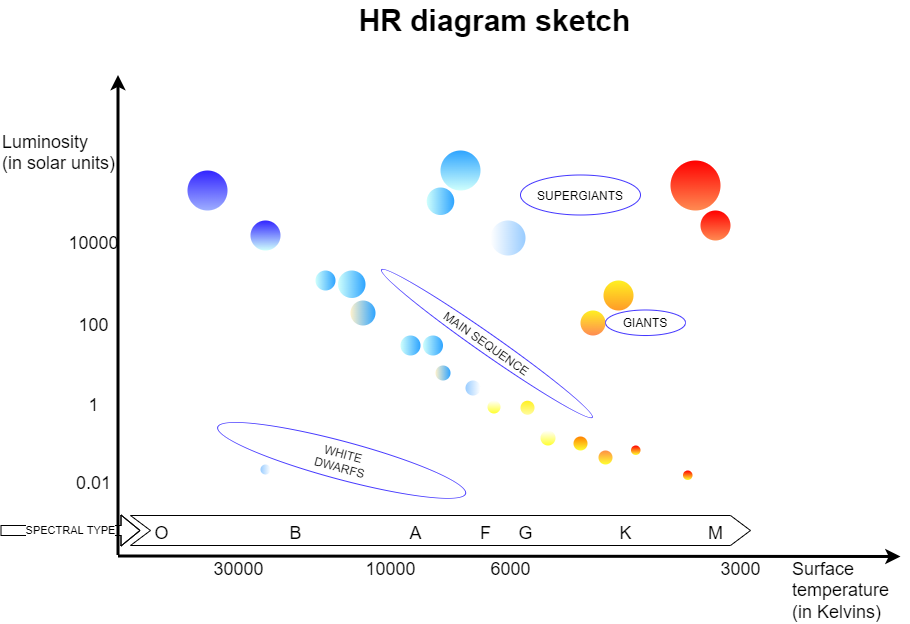
The diagram shows an incomplete Hertzsprung-Russell (H-R) diagram.

(a) Label the axes on the diagram.
(b) There are three shaded areas on the diagram. State the name of the shaded area that contains the Sun.
(c) Which star is a white dwarf?
A
B
C
D
(d) At a standard distance from the Earth, which star is brighter than the Sun and has a greater surface temperature than the Sun?
A
B
C
D
Syllabus Topic Codes (Edexcel International GCSE Physics 4PH1):
• 8.11P: Absolute Magnitude — parts (a) and (d)
• 8.12P: Hertzsprung-Russell Diagram — parts (a), (b), (c) and (d)
▶️ Answer/Explanation
(a) Labels of the axes [2 marks]
- Y-axis: one of luminosity, absolute magnitude, or power.
- X-axis: one of temperature, colour, or spectral class.
The H-R diagram compares the brightness or luminosity of stars with their surface temperature or related classification.
(b) Region containing the Sun [1 mark]
The Sun is located in the main sequence.
The main sequence contains stars that are undergoing hydrogen fusion in their cores. The Sun is a main-sequence star.
(c) White dwarf [1 mark]
Answer: B
- A is incorrect because it is a red giant.
- B is correct because it lies in the white dwarf region of the H-R diagram.
- C is incorrect because it is a hot main-sequence star.
- D is incorrect because it is a cool main-sequence star.
White dwarfs have relatively high surface temperatures but low luminosities compared with main-sequence stars.
(d) Star brighter and hotter than the Sun [1 mark]
Answer: C
- A is incorrect because red giant stars have lower surface temperatures than the Sun.
- B is incorrect because white dwarf stars are fainter than the Sun.
- C is correct because it has a greater surface temperature and greater brightness than the Sun.
- D is incorrect because this star is both cooler and fainter than the Sun.
At a standard distance, the apparent brightness can be compared directly using the star’s absolute magnitude or luminosity. On the H-R diagram, star C is positioned so that it is both hotter and more luminous than the Sun.
Question
The Hertzsprung-Russell (HR) diagram shown can be used to classify stars.

(a) Three regions in the HR diagram are labelled P, Q and R. The boxes show the three regions and different astronomical objects. Draw a straight line from each region to the type of astronomical object contained in that region.

(b) Define the term absolute magnitude.
Syllabus Topic Codes (Edexcel International GCSE Physics 4PH1):
• 8.11P: Absolute Magnitude — part (b)
• 8.7–8.10: Classification and Evolution of Stars — supports part (a)
▶️ Answer/Explanation
(a) Classification using the H-R diagram
Draw one straight line from each region to the corresponding type of astronomical object, as shown in the mark-scheme diagram.

The position of an object on an H-R diagram is determined by properties such as its luminosity or absolute magnitude and its surface temperature. Different regions therefore correspond to different types of astronomical objects.
(b) Absolute magnitude
Absolute magnitude is a measure of the brightness of a star at a standard distance.
Using a standard distance allows the intrinsic brightness of different stars to be compared without the distance from Earth affecting the comparison.
Question
This question is about stars.
(a) The table gives some information about four stars.

(i) Star C is much more powerful than star A. Stars A and C appear to have the same brightness when viewed from Earth. Suggest how this is possible.
(ii) Using information from the table, explain which star is in the supernova stage of its evolution.
(b) Explain how a main sequence star evolves into a supernova.
(c) Astronomers have used supernovas in distant galaxies to investigate the expansion of the universe.
(i) Light emitted from a supernova at a wavelength of \(7.774\times10^{-7}\,\mathrm{m}\) was detected at Earth with a wavelength of \(7.780\times10^{-7}\,\mathrm{m}\). Calculate the speed at which the galaxy containing this supernova was moving away from the Earth. [speed of light \(=3.0\times10^8\,\mathrm{m\,s^{-1}}\)]
(ii) The astronomers investigated supernovas that showed a red-shift in the wavelengths detected in different galaxies. The astronomers discovered that the red-shifted light detected from supernovas in nearby galaxies had shorter wavelengths than the red-shifted light detected from supernovas in galaxies further away. Explain how this discovery supports the Big Bang theory.
Syllabus Topic Codes (Edexcel International GCSE Physics 4PH1):
• 8.11P: Absolute Magnitude — part (a)(i)
• 8.13–8.14P: The Big Bang Theory and Its Evidence — part (c)(ii)
• 8.15–8.16P: Red-Shift, Motion of Galaxies, the Red-Shift Equation — parts (c)(i) and (c)(ii)
• 8.17P: Red-Shift and Distance — part (c)(ii)
▶️ Answer/Explanation
(a)(i) Apparent brightness of stars [1 mark]
Star A can appear to have the same brightness as star C because star A is closer to the Earth than star C.
Although star C has a greater power output, its greater distance means that less of its light reaches a given area at Earth.
(a)(ii) Identifying the supernova stage [2 marks]
The star in the supernova stage is star D.
- Star D has a mass much greater than the mass of the Sun.
- It has a much lower value of absolute magnitude, indicating a very bright star.
A very massive star can undergo the sequence of changes that eventually leads to a supernova explosion.
(b) Evolution into a supernova [3 marks]
- Hydrogen fusion eventually stops in the core.
- The core collapses or contracts, causing conditions that allow fusion to restart and heavier elements to form.
- The star becomes a red supergiant.
- Eventually, fusion of heavier elements stops in the core.
- The star then explodes as a supernova.
Only sufficiently massive stars follow this pathway and end their lives in a supernova explosion.
(c)(i) Speed of recession [4 marks]
First calculate the change in wavelength:
\(\Delta\lambda=(7.780-7.774)\times10^{-7}\)
\(\Delta\lambda=6.0\times10^{-10}\,\mathrm{m}\)
Use the red-shift relationship:
\(\dfrac{\Delta\lambda}{\lambda}=\dfrac{v}{c}\)
Rearrange to make \(v\) the subject:
\(v=\dfrac{\Delta\lambda}{\lambda}c\)
Substitute:
\(v=\dfrac{6.0\times10^{-10}}{7.774\times10^{-7}}\times3.0\times10^8\)
\(v=2.315\times10^5\,\mathrm{m\,s^{-1}}\)
Speed of the galaxy: \(\boxed{2.3\times10^5\,\mathrm{m\,s^{-1}}}\)
(c)(ii) Red-shift and the Big Bang theory [4 marks]
- Nearby galaxies show a smaller red-shift, or smaller change in wavelength.
- This indicates that nearby galaxies are moving away from Earth more slowly than galaxies that are further away.
- The red-shift observed in galaxies provides evidence that the universe is expanding.
- If the universe is expanding, tracing this expansion backwards suggests that the universe was once concentrated at a single point, supporting the Big Bang theory.
The observation therefore supports the idea that galaxies have been moving apart as the universe has expanded from an earlier, much more concentrated state.
Question
The diagram is an incomplete Hertzsprung-Russell diagram which astronomers use to compare stars.

(a) The y-axis label is missing. Which of these is the correct label for the y-axis?
A absolute magnitude
B apparent magnitude
C scalar magnitude
D vector magnitude
(b) The box contains words to identify the shaded areas P, Q and R on the Hertzsprung-Russell diagram.

Use words from the box to identify P, Q and R.
(c) Explain which side of the diagram contains stars with the highest surface temperature.
Syllabus Topic Codes (Edexcel International GCSE Physics 4PH1):
• 8.11P: Absolute Magnitude — part (a)
• 8.12P: Hertzsprung-Russell Diagram — parts (a), (b) and (c)
▶️ Answer/Explanation
(a) Y-axis label [1 mark]
Answer: A, absolute magnitude
- A is correct because absolute magnitude is used to compare the intrinsic brightness of stars on an H-R diagram.
- B is incorrect because apparent magnitude depends on how bright a star appears from Earth and therefore depends on distance.
- C is incorrect because scalar magnitude is not the quantity used to label this axis.
- D is incorrect because vector magnitude is not the quantity used on an H-R diagram.
(b) Identifying the shaded regions [3 marks]
The shaded regions are:
- P: white dwarfs
- Q: main sequence
- R: red giants
The main sequence is the region containing stars such as the Sun, while white dwarfs and red giants occupy different regions of the H-R diagram because of their different luminosities and surface temperatures.
(c) Surface temperature [2 marks]
- The stars with the highest surface temperatures are on the left-hand side of the H-R diagram.
- Blue and white stars have higher surface temperatures than red and orange stars.
Therefore, the temperature scale on an H-R diagram decreases from left to right.
Question
Between 1929 and 1931, physicists Hubble and Humason investigated the red-shift of light from galaxies at different distances from the Earth. The distance unit they used is the megaparsec (Mpc).
(a) Describe what is meant by the term red-shift.
(b) The graph shows some of the results of their investigation.

(i) Draw a circle to show the anomalous data point.
(ii) Draw the line of best fit on the graph.
(iii) The reference wavelength of the light used in this investigation is \(660\,\mathrm{nm}\). Use information from the graph to determine the velocity of a galaxy at a distance of \(0.75\,\mathrm{Mpc}\).
[speed of light \(=300000\,\mathrm{km\,s^{-1}}\)]
(iv) Explain why the graph from Hubble’s investigation provides evidence for the expansion of the universe.
Syllabus Topic Codes (Edexcel International GCSE Physics 4PH1):
• 8.17P: Red-Shift and Distance — parts (b)(iii) and (b)(iv)
• 8.13–8.14P: The Big Bang Theory and Its Evidence — part (b)(iv)
▶️ Answer/Explanation
(a) Red-shift [2 marks]
- Red-shift is an increase in the wavelength of light detected from a source.
- It occurs when the source or galaxy is moving away from the observer.
The observed wavelength is therefore shifted towards the red end of the electromagnetic spectrum.
(b)(i) Anomalous data point [1 mark]
The anomalous point is approximately at:
\(\boxed{(0.5,\ 0.03)}\)
This point should be identified by drawing a circle around it on the original graph.
(b)(ii) Line of best fit [1 mark]
Draw a straight line of best fit through the main pattern of the data, ignoring the anomalous point. The line should have approximately equal distribution of data points on either side.

(b)(iii) Velocity of the galaxy [3 marks]
From the graph, at a distance of \(0.75\,\mathrm{Mpc}\), the change in wavelength is approximately:
\(\Delta\lambda=0.03\,\mathrm{nm}\)
Use the red-shift equation:
\(\dfrac{\Delta\lambda}{\lambda}=\dfrac{v}{c}\)
Rearrange to make \(v\) the subject:
\(v=\dfrac{\Delta\lambda}{\lambda}\times c\)
Substitute the values:
\(v=\dfrac{0.03}{660}\times300000\)
\(v=13.6\,\mathrm{km\,s^{-1}}\)
Therefore, to an appropriate number of significant figures:
\(\boxed{v\approx14\,\mathrm{km\,s^{-1}}}\)
(b)(iv) Evidence for expansion of the universe [3 marks]
- The change in wavelength, or red-shift, increases with distance from the Earth.
- A greater red-shift indicates that the galaxy has a greater recession velocity.
- Therefore, galaxies further away are moving away faster, providing evidence that the universe is expanding.
The observed relationship between distance and recession velocity is consistent with an expanding universe. This expansion is also consistent with the Big Bang model, in which the universe was once in a much more concentrated state.
Question
(a) A glass prism can be used to refract light.

(i) State the name of the piece of equipment used to measure angles.
(ii) Measure the angle of incidence and the angle of refraction for the light entering the prism.
(iii) State the formula linking refractive index, angle of incidence and angle of refraction.
(iv) Calculate the refractive index of the glass.
(b) Two galaxies, A and B, emit red light with a reference wavelength of \(630\,\mathrm{nm}\). An astronomer measures the wavelength of red light from galaxy A when the light arrives at the Earth. The astronomer’s value for the wavelength is \(645\,\mathrm{nm}\).
(i) Calculate the difference between the astronomer’s value for the wavelength and the reference wavelength of red light.
(ii) The change in wavelength happens because galaxy A is moving away from the Earth. Calculate the speed of galaxy A.
[speed of light = \(3.0\times10^8\,\mathrm{m\,s^{-1}}\)]
(iii) Light from galaxy B has twice the redshift as light from galaxy A. Galaxy B is twice as far away from Earth as galaxy A. Explain how these observations support the Big Bang theory of the origin of the Universe.
Syllabus Topic Codes (Edexcel International GCSE Physics 4PH1):
• 3.18: Refractive Index — parts (a)(iii)–(iv)
• 8.15–8.16P: Red-Shift, Motion of Galaxies, the Red-Shift Equation — parts (b)(i)–(ii)
• 8.17P: Red-Shift and Distance — part (b)(iii)
• 8.13–8.14P: The Big Bang Theory and Its Evidence — part (b)(iii)
▶️ Answer/Explanation
(a)(i) Measuring angles [1 mark]
The equipment used to measure angles is a protractor.
\(\boxed{\text{Protractor}}\)
(a)(ii) Angles of incidence and refraction [2 marks]
The angle of incidence is measured between the incident ray and the normal to the surface.
From the diagram:
- Angle of incidence, \(i\), is approximately \(42^\circ\) to \(46^\circ\).
- Angle of refraction, \(r\), is approximately \(26^\circ\) to \(30^\circ\).
(a)(iii) Refractive index formula [1 mark]
The relationship is:
\(\boxed{n=\dfrac{\sin i}{\sin r}}\)
(a)(iv) Refractive index of glass [2 marks]
Using representative measured values from the diagram, for example \(i\approx44^\circ\) and \(r\approx28^\circ\):
\(\displaystyle n=\frac{\sin44^\circ}{\sin28^\circ}\)
\(n\approx1.48\)
Therefore:
\(\boxed{n\approx1.5}\)
(b)(i) Change in wavelength [1 mark]
\(\Delta\lambda=645-630\)
\(\Delta\lambda=15\,\mathrm{nm}\)
\(\boxed{\Delta\lambda=15\,\mathrm{nm}}\)
(b)(ii) Speed of galaxy A [3 marks]
Use the red-shift equation:
\(\displaystyle \frac{\Delta\lambda}{\lambda}=\frac{v}{c}\)
Substitute the values:
\(\displaystyle \frac{15}{630}=\frac{v}{3.0\times10^8}\)
Rearranging:
\(\displaystyle v=3.0\times10^8\times\frac{15}{630}\)
\(v=7.14\times10^6\,\mathrm{m\,s^{-1}}\)
Therefore:
\(\boxed{v\approx7.1\times10^6\,\mathrm{m\,s^{-1}}}\)
(b)(iii) Red-shift and the Big Bang theory [2 marks]
Galaxy B has twice the redshift of galaxy A. Since redshift is related to the velocity of recession, this means galaxy B is moving away from Earth at approximately twice the speed of galaxy A.
Galaxy B is also twice as far away, showing a relationship between the distance of a galaxy and its speed of recession.
This supports the Big Bang theory because it provides evidence that galaxies are moving apart and that the Universe is expanding.
If the expansion is traced backwards in time, the galaxies would have been much closer together, supporting the idea of an early, very dense Universe.
Question
A binary star system has two nearby stars, which orbit each other in a circular path around a common centre of gravity.

(a) In an eclipsing binary system, one star passes behind the other star in its orbit. This causes a decrease in the light intensity of the binary star system when viewed from Earth. The graph shows how the light intensity of the binary star system changes with time.

(i) Suggest why the decreases in light intensity are not all the same.
(ii) Use the graph to determine the time period of the binary star system.
(iii) One of the stars in this binary system has an orbital speed of \(19\,\mathrm{km\,s^{-1}}\). Calculate the orbital radius of this star.
(b) A different binary star system is in a distant galaxy. When observed from the Earth, light from this galaxy has a longer wavelength than the wavelength of the light when it is emitted from the galaxy. Explain why this gives evidence for the Big Bang theory.
Syllabus Topic Codes (Edexcel International GCSE Physics 4PH1):
• 8.6: Orbital Speed, Radius, and Time Period — parts (a)(ii)–(iii)
• 8.13–8.14P: The Big Bang Theory and Its Evidence — part (b)
• 8.15–8.16P: Red-Shift, Motion of Galaxies, the Red-Shift Equation — part (b)
▶️ Answer/Explanation
(a)(i) Different decreases in light intensity [1 mark]
The two stars are not necessarily the same size, brightness, mass, temperature or luminosity.
Therefore, the decrease in light intensity depends on which star is passing in front of the other.
(a)(ii) Time period [1 mark]
The time period is the time between two identical points in successive cycles, such as two successive large decreases in light intensity.
From the graph:
\(\boxed{T\approx31\,\mathrm{years}}\)
(a)(iii) Orbital radius [4 marks]
For circular motion, the distance travelled in one complete orbit is:
\(\displaystyle d=2\pi r\)
Since \(\displaystyle v=\frac{d}{t}\):
\(\displaystyle v=\frac{2\pi r}{T}\)
Rearranging:
\(\displaystyle r=\frac{vT}{2\pi}\)
Convert \(31\) years into seconds:
\(\displaystyle T=31\times365\times24\times3600\)
\(\displaystyle T\approx9.78\times10^8\,\mathrm{s}\)
Substitute \(v=19\,\mathrm{km\,s^{-1}}\):
\(\displaystyle r=\frac{19\times9.78\times10^8}{2\pi}\)
\(\displaystyle r\approx2.96\times10^9\,\mathrm{km}\)
Therefore:
\(\boxed{r\approx3.0\times10^9\,\mathrm{km}}\)
(b) Evidence for the Big Bang [4 marks]
- The light from the distant galaxy has been red-shifted, because its observed wavelength is longer than its emitted wavelength.
- Red-shift provides evidence that the galaxy is moving away from Earth.
- This shows that galaxies are moving apart, providing evidence that the Universe is expanding.
- If the Universe is expanding, tracing the expansion backwards suggests that the Universe was once concentrated at a single point, supporting the Big Bang theory.
Thus, the observed red-shift of distant galaxies provides evidence for an expanding Universe and therefore supports the Big Bang theory.