
Density, Mass and Volume
Density describes how much mass is contained in a given volume. It helps explain why some objects float while others sink and why materials feel heavy or light for their size.
Relationship Between Density, Mass and Volume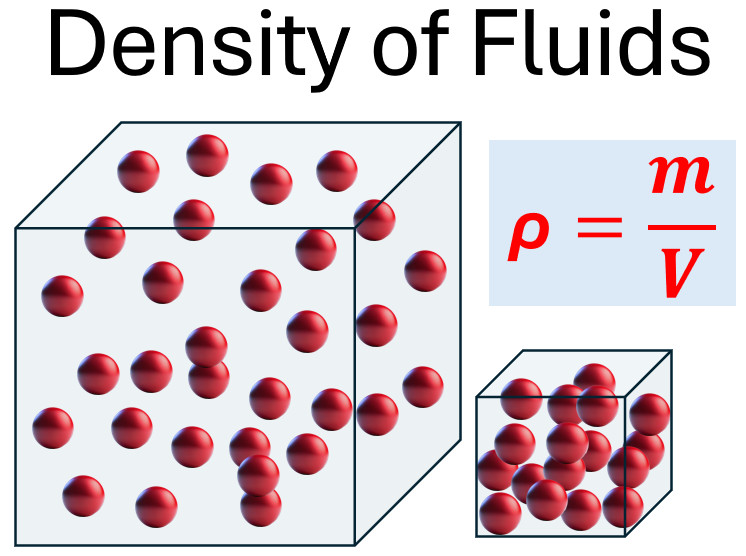
The density of a substance is given by:
\( \mathrm{density = \dfrac{mass}{volume}} \)
\( \mathrm{\rho = \dfrac{m}{V}} \)
- \( \mathrm{\rho} \) = density (kilogram per metre cubed, kg/m³)
- \( \mathrm{m} \) = mass (kilogram, kg)
- \( \mathrm{V} \) = volume (cubic metre, m³)
Understanding the Equation
- A large mass in a small volume → high density.
- A small mass in a large volume → low density.
- Density depends on the material, not the size.
This is why a small steel object can be denser than a large piece of wood.
Rearranging the Formula

- Mass: \( \mathrm{m = \rho V} \)
- Volume: \( \mathrm{V = \dfrac{m}{\rho}} \)
Density and Floating
- If an object’s density is less than the liquid → it floats.
- If an object’s density is greater than the liquid → it sinks.
Water has a density of approximately \( \mathrm{1000\ kg/m^3} \).
Key Idea
- Density compares mass with volume.
- Different materials have different densities.
- Density explains floating and sinking.
Important Points to Remember
- Convert volume to m³ before calculating.
- Use kilograms for mass.
- Always include correct units.
Example
A metal block has a mass of \( \mathrm{3.0\ kg} \) and a volume of \( \mathrm{0.0015\ m^3} \).
Calculate the density of the metal.
▶️ Answer / Explanation
Use:
\( \mathrm{\rho = \dfrac{m}{V}} \)
\( \mathrm{\rho = \dfrac{3.0}{0.0015}} \)
\( \mathrm{\rho = 2000\ kg/m^3} \)
Example
An object has a density of \( \mathrm{800\ kg/m^3} \) and a mass of \( \mathrm{2.4\ kg} \).
Calculate the volume of the object.
▶️ Answer / Explanation
Rearrange:
\( \mathrm{V = \dfrac{m}{\rho}} \)
\( \mathrm{V = \dfrac{2.4}{800}} \)
\( \mathrm{V = 0.003\ m^3} \)