
Electrical Units: Ampere (A), Volt (V) and Watt (W)
In electrical circuits, different physical quantities are used to describe how electric current flows, how energy is transferred, and how powerful an electrical device is. The three key electrical units required at IGCSE level are the ampere (A), volt (V), and watt (W).
Electric Current – Ampere (A)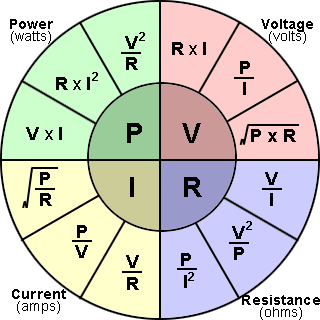
Definition: Electric current is the rate of flow of electric charge in a circuit.
Unit: Ampere (A)
Meaning: One ampere means one coulomb of charge flows past a point in the circuit every second.
Mathematically:
\( \mathrm{I = \dfrac{Q}{t}} \)
- \( \mathrm{I} \) = current (A)
- \( \mathrm{Q} \) = charge (C)
- \( \mathrm{t} \) = time (s)
Measurement: Current is measured using an ammeter connected in series.
Potential Difference – Volt (V)
Definition: Potential difference is the energy transferred per unit charge between two points in a circuit.
Unit: Volt (V)
Meaning: One volt means one joule of energy is transferred for each coulomb of charge.
Mathematically:
\( \mathrm{V = \dfrac{E}{Q}} \)
- \( \mathrm{V} \) = potential difference (V)
- \( \mathrm{E} \) = energy (J)
- \( \mathrm{Q} \) = charge (C)
Measurement: Potential difference is measured using a voltmeter connected in parallel.
Electrical Power – Watt (W)
Definition: Electrical power is the rate at which electrical energy is transferred or converted.
Unit: Watt (W)
Meaning: One watt means one joule of energy is transferred every second.
Mathematically:
\( \mathrm{P = VI} \)
- \( \mathrm{P} \) = power (W)
- \( \mathrm{V} \) = potential difference (V)
- \( \mathrm{I} \) = current (A)
Key idea: Power tells us how quickly an electrical device uses energy.
Relationship Between Electrical Units
- Current controls how much charge flows.
- Voltage provides the energy to move the charge.
- Power depends on both current and voltage.
\( \mathrm{Higher\ V\ or\ higher\ I \Rightarrow higher\ power} \)
Common Situations Using Electrical Units
- Rating of electrical appliances (e.g. 60 W bulb).
- Household electricity supply voltage.
- Measuring current in series circuits.
- Comparing energy usage of devices.
Example
An electric heater operates with a current of 5 A at a voltage of 230 V. Calculate the power of the heater.
▶️ Answer / Explanation
Using:
\( \mathrm{P = VI} \)
\( \mathrm{P = 230 \times 5 = 1150\ W} \)
The power of the heater is 1150 W.
Example
A charge of 300 C flows through a lamp in 2 minutes. Calculate the current.
▶️ Answer / Explanation
Time:
\( \mathrm{t = 2 \times 60 = 120\ s} \)
Using:
\( \mathrm{I = \dfrac{Q}{t}} \)
\( \mathrm{I = \dfrac{300}{120} = 2.5\ A} \)
The current is 2.5 A.