
Force on a Moving Charged Particle in a Magnetic Field
When a charged particle moves through a magnetic field, it may experience a force. This force depends on the direction of motion of the particle relative to the magnetic field.
Key Statement
Statement: A charged particle moving in a magnetic field experiences a force provided its motion is not parallel to the magnetic field.

Key idea: The magnetic force only acts on moving charges.
When Does the Force Act?
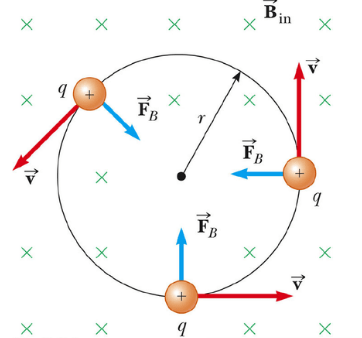
- If the particle moves perpendicular to the magnetic field → force is maximum.
- If the particle moves at an angle to the field → force acts.
- If the particle moves parallel to the field → no force acts.
- If the particle is stationary → no force acts.
Important point: The force depends on the component of velocity perpendicular to the magnetic field.
Direction of the Magnetic Force
- The force is perpendicular to both the direction of motion and the magnetic field.
- This causes the particle’s path to change direction, not speed.
- For a positive charge, the direction follows Fleming’s left-hand rule.
- For a negative charge, the force acts in the opposite direction.
Effect on the Motion of the Particle
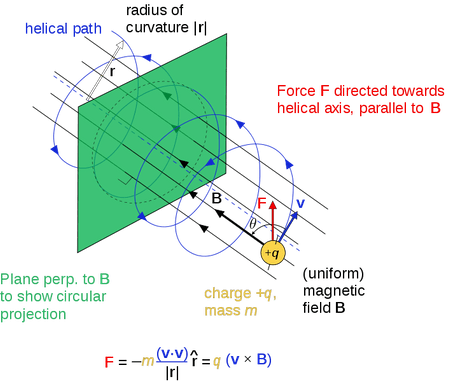
- The force provides centripetal force.
- The particle may follow a curved or circular path.
- The speed remains constant, but the direction changes.
Why No Force Acts When Motion Is Parallel
- Magnetic force depends on motion across field lines.
- Parallel motion does not cut magnetic field lines.
- No interaction → no force.
Example
An electron enters a uniform magnetic field with its velocity perpendicular to the field direction. Describe the motion of the electron and explain why this motion occurs.
▶️ Answer / Explanation
- The electron experiences a magnetic force.
- The force is perpendicular to its velocity.
- The force changes the direction but not the speed.
- The electron follows a curved or circular path.
- The force provides centripetal acceleration.
Example
A proton moves through a magnetic field parallel to the field lines. Explain why the proton is not deflected.
▶️ Answer / Explanation
- The proton is moving parallel to the magnetic field.
- There is no component of velocity perpendicular to the field.
- Magnetic force depends on cutting field lines.
- No magnetic force acts on the proton.
- The proton continues in a straight line.