
Force on a Current-Carrying Wire in a Magnetic Field
When a current-carrying conductor is placed in a magnetic field, it experiences a force. This effect is known as the motor effect and forms the basis of devices such as d.c. electric motors and loudspeakers.
Why a Force Is Exerted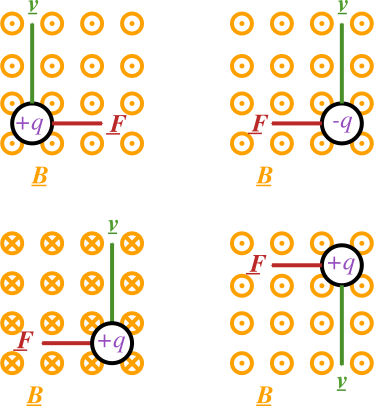
Explanation:
- A current consists of moving electric charges.
- Moving charges in a magnetic field experience a force.
- Therefore, a current-carrying wire in a magnetic field experiences a force.
Key condition: The force acts only if the wire is not parallel to the magnetic field.
Factors Affecting the Size of the Force
- Size of the current
- Strength of the magnetic field
- Length of wire in the magnetic field
- Angle between the wire and the magnetic field
Maximum force: When the wire is perpendicular to the magnetic field.
Application: Simple d.c. Electric Motor
How the motor works:
- A rectangular coil is placed in a magnetic field.
- Current flows through the coil.
- Opposite sides of the coil experience forces in opposite directions.
- This produces a turning effect (rotation).
Role of the split-ring commutator:
- Reverses the current every half-turn.
- Keeps the coil rotating in the same direction.
Application: Loudspeaker
How a loudspeaker works:
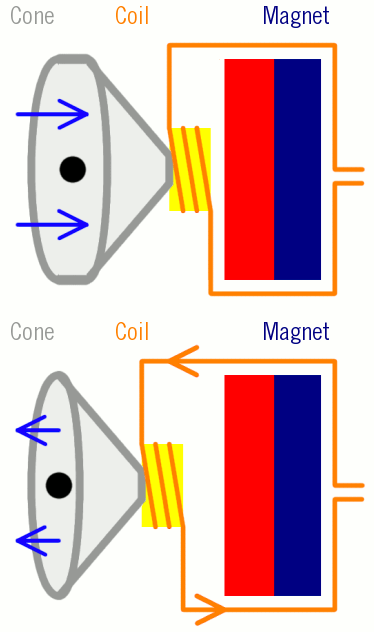
- A coil is placed in a magnetic field.
- An alternating current flows through the coil.
- The direction of the force changes as the current changes.
- The coil vibrates back and forth.
- These vibrations produce sound waves.
Key idea: Electrical energy is converted into sound energy.
Example
A straight wire carrying current is placed between the poles of a magnet. The wire moves sideways. Explain why this happens and describe what would occur if the current direction were reversed.
▶️ Answer / Explanation
- The wire carries moving charges.
- The magnetic field exerts a force on these charges.
- This force acts on the wire, causing motion.
- Reversing the current reverses the direction of the force.
- The wire moves in the opposite direction.
Example
Explain why a loudspeaker uses an alternating current rather than a direct current.
▶️ Answer / Explanation
- An alternating current continually changes direction.
- This causes the direction of the force on the coil to change.
- The coil vibrates back and forth.
- These vibrations create sound waves.
- A direct current would only cause movement in one direction.
Using the Left-Hand Rule to Predict Force Direction
When a wire carries a current and is placed perpendicular to a magnetic field, a force acts on the wire. The direction of this force can be predicted using Fleming’s left-hand rule.
Key Condition
- The wire must carry a current.
- The wire must be in a magnetic field.
- The current must be perpendicular to the magnetic field.
Result: A force acts on the wire, causing it to move.
Fleming’s Left-Hand Rule
Rule:
- Thumb → direction of Force (motion)
- First finger → direction of magnetic Field (N to S)
- Second finger → direction of Current (conventional current)
Key idea: All three directions are at right angles to each other.
How to Use the Left-Hand Rule (Exam Method)
- Point the first finger in the direction of the magnetic field.
- Point the second finger in the direction of the current.
- The thumb then shows the direction of the force on the wire.
Important: If either the current or the magnetic field is reversed, the force direction also reverses.
Why the Force Occurs
- The wire contains moving electric charges.
- Moving charges experience a force in a magnetic field.
- This force acts on the wire as a whole.
Key point: No force acts if the wire is parallel to the magnetic field.
Example
A straight horizontal wire is placed between the poles of a magnet. The magnetic field is from left to right. A current flows into the page. Use Fleming’s left-hand rule to determine the direction of the force on the wire.
▶️ Answer / Explanation
- First finger points left to right (field direction).
- Second finger points into the page (current direction).
- Thumb points downward.
- The force on the wire is downward.
Example
A wire carrying current experiences an upward force when placed perpendicular to a magnetic field. The magnetic field direction remains unchanged. Explain what change to the circuit would reverse the direction of the force.
▶️ Answer / Explanation
- The force direction depends on current direction.
- Reversing the current reverses the force.
- This can be done by reversing the power supply connections.
- The wire would then experience a downward force.
Factors Affecting the Force on a Current-Carrying Conductor in a Magnetic Field
The force experienced by a current-carrying conductor placed in a magnetic field depends on both the magnitude and direction of the current and the magnetic field.
Key Idea
A force acts on a current-carrying conductor because the moving charges interact with the magnetic field. Changing the current or the magnetic field changes the size and direction of this force.
Effect of Current Magnitude
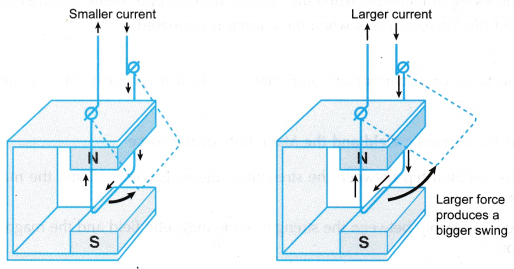
- Increasing the current increases the force.
- Decreasing the current decreases the force.
- If there is no current, no force acts.
Reason: A larger current means more moving charges per second, so the magnetic force is greater.
Effect of Magnetic Field Strength
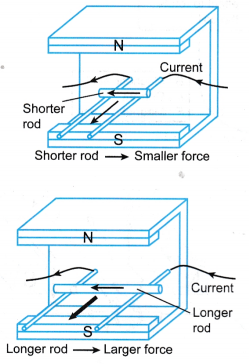
- A stronger magnetic field produces a larger force.
- A weaker magnetic field produces a smaller force.
Reason: Stronger magnetic fields exert a greater force on moving charges.
Effect of Direction of Current
- Reversing the direction of the current reverses the direction of the force.
- The size of the force remains the same if the current magnitude is unchanged.
Explanation: The direction of motion of charges changes, so the magnetic force direction changes.
Effect of Direction of Magnetic Field
- Reversing the magnetic field direction reverses the force direction.
- The size of the force is unchanged if the field strength is the same.
Key point: Reversing either the current or the field reverses the force, but reversing both keeps the force direction the same.
Angle Between Field and Current
- Maximum force occurs when the conductor is perpendicular to the magnetic field.
- No force occurs when the conductor is parallel to the magnetic field.
- At other angles, the force is reduced.
Reason: The force depends on the component of current perpendicular to the field.
Example
A straight wire is placed perpendicular to a uniform magnetic field. The current in the wire is doubled while the magnetic field strength remains constant. Describe and explain the effect on the force acting on the wire.
▶️ Answer / Explanation
- Doubling the current doubles the force.
- More charge flows per second through the wire.
- Moving charges experience a larger magnetic force.
- The direction of the force remains unchanged.
Example
A current-carrying wire experiences a force to the right when placed in a magnetic field. The current direction is unchanged, but the magnetic field direction is reversed. State and explain the new direction of the force.
▶️ Answer / Explanation
- The force direction depends on field direction.
- Reversing the magnetic field reverses the force.
- The force now acts to the left.
- The force magnitude remains the same.