
Structure and Operation of a Transformer
A transformer is an electrical device that changes the size of an alternating voltage. It works using electromagnetic induction and depends on having different numbers of turns on the input and output coils.
Transformer – Definition
Definition: A transformer is a device that changes the magnitude of an alternating voltage using two coils linked by a magnetic field.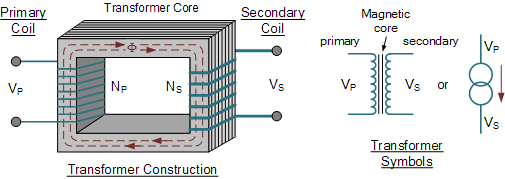
Key idea: Transformers only work with a.c., not d.c.
Structure of a Transformer
A transformer consists of the following main parts:
- Primary coil (input coil)
- Secondary coil (output coil)
- Laminated soft iron core
Description of each part:
- Primary coil: connected to the a.c. supply.
- Secondary coil: connected to the output circuit.
- Iron core: provides a path for the magnetic field linking the coils.
Why the Core Is Laminated Soft Iron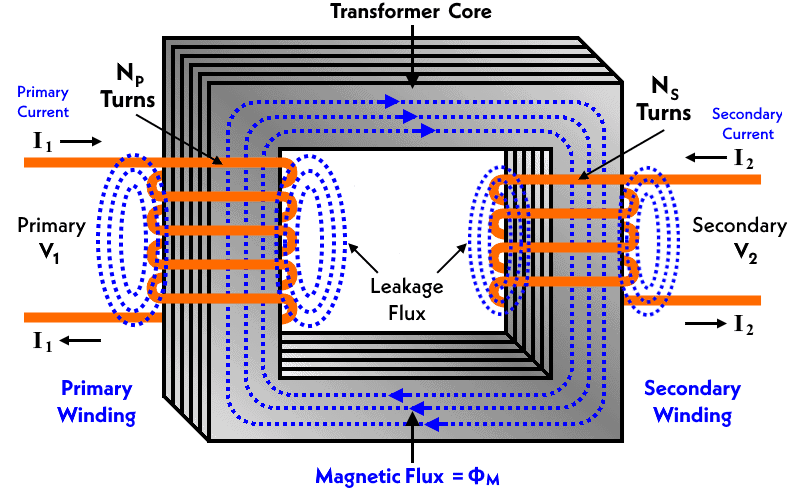
- Soft iron is magnetically soft.
- It magnetises and demagnetises easily.
- Laminations reduce energy loss due to heating.
Key idea: The core ensures efficient transfer of the magnetic field between the coils.
How a Transformer Works
- An alternating current flows in the primary coil.
- This produces a changing magnetic field in the iron core.
- The changing magnetic field links the secondary coil.
- A voltage is induced in the secondary coil.
Important point: The voltage is induced because the magnetic field is changing.
Changing the Size of the Voltage
The size of the output voltage depends on the number of turns on each coil.
- More turns on the secondary → larger output voltage.
- Fewer turns on the secondary → smaller output voltage.
Key idea: Different numbers of turns change the voltage.
Step-Up and Step-Down Transformers
- Step-up transformer: more turns on secondary than primary.
- Step-down transformer: fewer turns on secondary than primary.
Note: The frequency of the a.c. remains unchanged.
Example
A transformer has 400 turns on the primary coil and 100 turns on the secondary coil. State whether this is a step-up or step-down transformer and explain your answer.
▶️ Answer / Explanation
- The secondary coil has fewer turns than the primary.
- This reduces the voltage.
- The transformer is a step-down transformer.
Example
A transformer is connected to a d.c. power supply. Explain why no voltage is produced across the secondary coil.
▶️ Answer / Explanation
- d.c. produces a constant current.
- A constant current produces a constant magnetic field.
- No changing magnetic field links the secondary coil.
- No voltage is induced.
Use of Step-Up and Step-Down Transformers in Electricity Transmission
In large-scale electricity generation, electrical energy must be transmitted over long distances efficiently. Step-up and step-down transformers are used to reduce energy losses and provide safe, usable voltages.
The Problem with Long-Distance Transmission
- Power stations are often far from cities.
- Electricity is transmitted using long cables.
- Cables have resistance.
- Resistance causes energy loss as heat.
Key idea: Energy loss in cables increases when the current is large.
Role of the Step-Up Transformer

What it does:
- Increases the voltage at the power station.
- Reduces the current for the same power transfer.
Why this is useful:
- Lower current → less heating of cables.
- Less energy lost to the surroundings.
- More efficient transmission.
Key idea: High voltage and low current reduce power loss.
Transmission at High Voltage
- Electricity travels through overhead power lines.
- Voltage is very high.
- Current is kept low.
Result: Minimal energy loss over long distances.
Role of the Step-Down Transformer

What it does:
- Reduces voltage near homes and factories.
- Makes electricity safe to use.
Why this is necessary:
- High voltages are dangerous.
- Appliances require much lower voltages.
Overall Energy Transfer Process
- Electricity generated at a power station.
- Voltage increased using a step-up transformer.
- Electricity transmitted at high voltage.
- Voltage reduced using step-down transformers.
- Electricity supplied safely to consumers.
Why Transformers Must Use a.c.
- Transformers rely on changing magnetic fields.
- Only alternating current produces changing fields.
- Direct current does not work.
Example
Explain why electrical energy is transmitted at very high voltages from power stations to cities.
▶️ Answer / Explanation
- High voltage allows the current to be smaller.
- Lower current reduces heating in the cables.
- Less electrical energy is lost to the surroundings.
- This makes transmission more efficient.
Example
A power station supplies electricity at high voltage. Explain why step-down transformers are needed before electricity enters homes.
▶️ Answer / Explanation
- The transmission voltage is very high.
- High voltages are unsafe for domestic use.
- Step-down transformers reduce the voltage.
- This makes electricity safe for household appliances.