
Transformer Voltage and Turns Ratio
In a transformer, the size of the output (secondary) voltage depends on the number of turns on the secondary coil compared to the number of turns on the input (primary) coil. This relationship allows transformers to step voltages up or down.
Key Relationship
Statement: The ratio of the secondary voltage to the primary voltage is equal to the ratio of the number of turns on the secondary coil to the number of turns on the primary coil.
Mathematically:
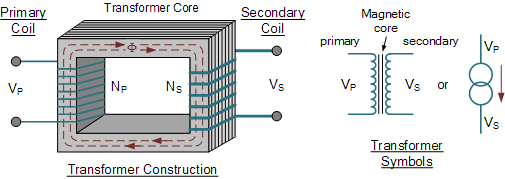
\( \mathrm{\dfrac{V_s}{V_p} = \dfrac{N_s}{N_p}} \)
- \( \mathrm{V_p} \) = primary (input) voltage
- \( \mathrm{V_s} \) = secondary (output) voltage
- \( \mathrm{N_p} \) = number of turns on primary coil
- \( \mathrm{N_s} \) = number of turns on secondary coil
Understanding the Relationship
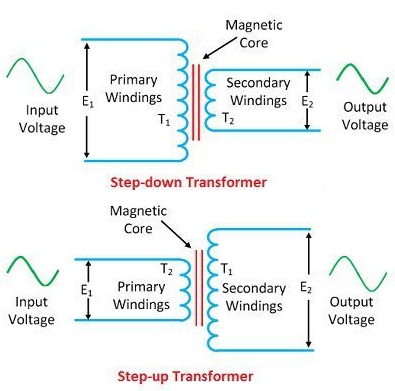
- If \( \mathrm{N_s > N_p} \), then \( \mathrm{V_s > V_p} \) → step-up transformer.
- If \( \mathrm{N_s < N_p} \), then \( \mathrm{V_s < V_p} \) → step-down transformer.
- If \( \mathrm{N_s = N_p} \), then \( \mathrm{V_s = V_p} \).
Key idea: Changing the number of turns changes the voltage.
Conditions for the Formula
- The transformer must be operating with a.c.
- Energy losses are assumed to be negligible.
- The formula applies to ideal transformers.
Using the Formula (Exam Method)
- Write down the transformer equation.
- Substitute known values.
- Rearrange if necessary.
- State the final answer with correct units.
Example
A transformer has 200 turns on the primary coil and 50 turns on the secondary coil. The primary voltage is 240 V. Calculate the secondary voltage.
▶️ Answer / Explanation
\( \mathrm{\dfrac{V_s}{240} = \dfrac{50}{200}} \)
\( \mathrm{V_s = 240 \times \dfrac{50}{200}} \)
\( \mathrm{V_s = 60\ V} \)
The transformer is a step-down transformer.
Example
A step-up transformer produces an output voltage of 12 kV from an input voltage of 240 V. The primary coil has 400 turns. Calculate the number of turns on the secondary coil.
▶️ Answer / Explanation
\( \mathrm{\dfrac{12000}{240} = \dfrac{N_s}{400}} \)
\( \mathrm{50 = \dfrac{N_s}{400}} \)
\( \mathrm{N_s = 50 \times 400 = 20000\ turns} \)
The secondary coil has 20 000 turns.
Transformer Power Relationship (100% Efficiency)
In an ideal transformer, no energy is lost to the surroundings. This means that all the electrical power supplied to the primary coil is transferred to the secondary coil.
Key Statement
Statement: For a transformer operating at 100% efficiency: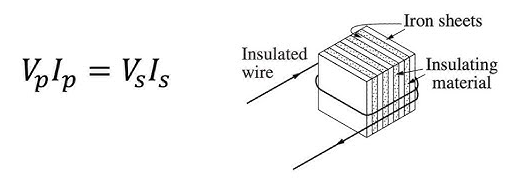
\( \mathrm{input\ power = output\ power} \)
Mathematically:
\( \mathrm{V_p I_p = V_s I_s} \)
- \( \mathrm{V_p} \) = primary voltage
- \( \mathrm{I_p} \) = primary current
- \( \mathrm{V_s} \) = secondary voltage
- \( \mathrm{I_s} \) = secondary current
Meaning of 100% Efficiency
- No energy is lost as heat or sound.
- All input electrical energy becomes output electrical energy.
- This is an ideal situation used for calculations.
Key idea: Real transformers are not perfectly efficient, but many are close enough for this equation to be used.
Understanding the Relationship
- If voltage is increased, current must decrease.
- If voltage is decreased, current must increase.
- This keeps power the same.
Example idea: Step-up transformer → higher voltage, lower current Step-down transformer → lower voltage, higher current
Why This Relationship Is Important
- Explains why high-voltage transmission uses low current.
- Shows how transformers reduce energy losses.
- Allows calculation of unknown currents or voltages.
Using the Formula (Exam Method)
- Write down \( \mathrm{V_p I_p = V_s I_s} \).
- Substitute known values.
- Rearrange to find the unknown quantity.
- Include correct units.
Example
An ideal transformer has a primary voltage of 240 V and a primary current of 2.0 A. The secondary voltage is 480 V. Calculate the secondary current.
▶️ Answer / Explanation
\( \mathrm{V_p I_p = V_s I_s} \)
\( \mathrm{240 \times 2.0 = 480 \times I_s} \)
\( \mathrm{480 = 480 I_s} \)
\( \mathrm{I_s = 1.0\ A} \)
The current decreases because the voltage increases.
Example
A step-down transformer supplies 12 V at a current of 5.0 A to a device. Assume 100% efficiency. Calculate the input current if the input voltage is 240 V.
▶️ Answer / Explanation
\( \mathrm{V_p I_p = V_s I_s} \)
\( \mathrm{240 \times I_p = 12 \times 5.0} \)
\( \mathrm{240 I_p = 60} \)
\( \mathrm{I_p = 0.25\ A} \)
The input current is much smaller due to the higher input voltage.