
Induced Magnetism
Some materials become magnetic when they are placed in a magnetic field. This effect is called induced magnetism and only occurs in certain materials.
Induced Magnetism – Definition
Definition: Induced magnetism occurs when a material becomes magnetised after being placed in a magnetic field.

Key idea: The material is not a magnet to begin with but behaves like one while the magnetic field is present.
Materials That Can Be Magnetised by Induction
Only magnetic materials can become magnetised by induction.
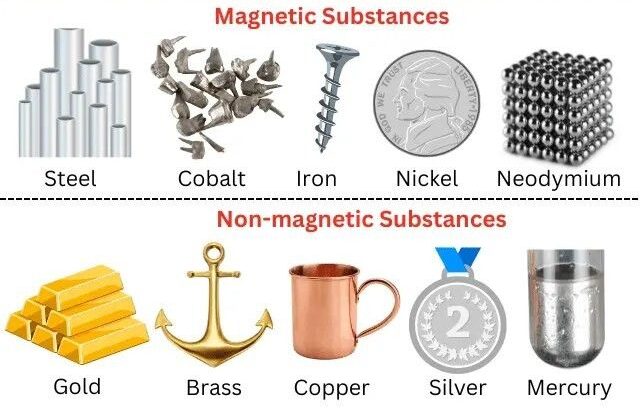
- Iron
- Steel
- Nickel
- Cobalt
Important point: Non-magnetic materials such as plastic, wood, copper, and aluminium do not become magnetised.
How Induced Magnetism Occurs
- A magnetic field causes the magnetic domains inside the material to line up.
- This produces north and south poles in the material.
- The end nearest the magnet becomes the opposite pole to the nearby pole of the magnet.
Key consequence: Induced magnetism always causes attraction, never repulsion.
Temporary and Permanent Induced Magnetism
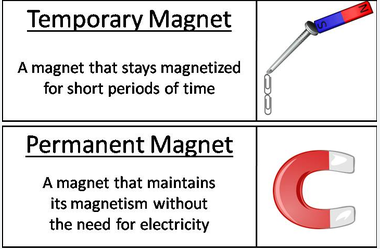
- Soft iron: magnetism is temporary and disappears when the field is removed.
- Steel: magnetism may remain after the field is removed.
Key idea: The type of material determines whether the induced magnetism is temporary or permanent.
Induced Magnetism and Magnetic Forces
- The induced pole nearest the magnet is always opposite.
- This results in an attractive force.
- This explains why magnets attract unmagnetised iron objects.
Summary
- Induced magnetism occurs in a magnetic field.
- Only magnetic materials can be magnetised.
- The induced magnet always attracts the magnet.
- Soft iron loses magnetism quickly; steel may retain it.
Example
An unmagnetised iron nail is placed near the north pole of a bar magnet. Explain why the nail is attracted and state the polarity induced at the end of the nail nearest the magnet.
▶️ Answer / Explanation
- The magnetic field of the magnet induces magnetism in the iron nail.
- Magnetic domains in the nail align.
- The end of the nail nearest the north pole becomes a south pole.
- Opposite poles attract, so the nail is pulled towards the magnet.
Example
A magnet attracts a steel paper clip. After the magnet is removed, the paper clip still attracts small iron filings. Explain why this happens and why the effect would be different if the paper clip were made of soft iron.
▶️ Answer / Explanation
- The steel paper clip becomes magnetised by induction.
- Steel has high retentivity and keeps some magnetism.
- This allows it to attract iron filings after the magnet is removed.
- Soft iron has low retentivity.
- A soft iron paper clip would lose its magnetism quickly.