
Practical: Investigating Magnetic Field Patterns
This practical investigates the shape and direction of magnetic field lines around a permanent bar magnet and between two bar magnets. Magnetic field lines are visualised using iron filings or a plotting compass.
Aim
To investigate and compare the magnetic field patterns: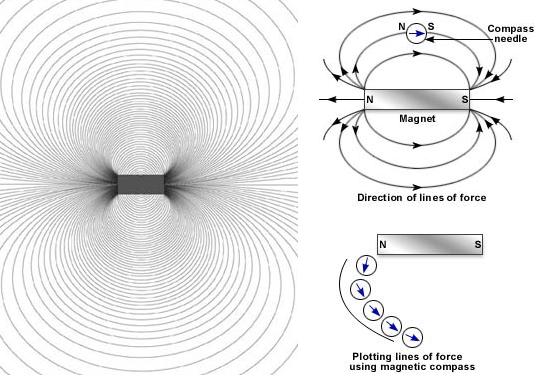
- around a single permanent bar magnet
- between two bar magnets in different arrangements
Apparatus
- Bar magnet(s)
- Sheet of paper or card
- Iron filings or plotting compass
- Pencil
Method 1: Magnetic Field Pattern Around a Single Bar Magnet
- Place the bar magnet on the bench.
- Place a sheet of paper over the magnet.
- Sprinkle iron filings evenly over the paper.
- Tap the paper gently.
- Observe and draw the pattern formed.
Alternative method: Use a plotting compass to trace the direction of field lines, marking arrows from north to south.
Observations (Single Magnet)
- Field lines curve from the north pole to the south pole.
- Lines are closest together near the poles.
- The pattern is symmetrical.
Conclusion: The magnetic field is strongest near the poles of the magnet.
Method 2: Magnetic Field Pattern Between Two Bar Magnets
Place two bar magnets close together on the bench in one of the following arrangements:
- Unlike poles facing (N–S)
- Like poles facing (N–N or S–S)
Repeat the iron filings or plotting compass method and record the field pattern.
Observations (Two Magnets)
- Unlike poles: field lines join smoothly between the magnets.
- Like poles: field lines bend away and do not connect.
Conclusion: The pattern shows attraction between unlike poles and repulsion between like poles.
Safety
- Avoid iron filings near eyes.
- Wash hands after handling filings.
- Keep magnets away from electronic devices.
Key Sources of Error and Improvements
- Iron filings may clump → tap gently for even distribution.
- Compass interference → keep other magnets away.
- Paper movement → tape paper in place.
Example
When two bar magnets are placed with unlike poles facing, the iron filings form continuous lines between the magnets. Explain what this shows about the magnetic field and forces between the magnets.
▶️ Answer / Explanation
- Field lines connect from north to south.
- This shows a continuous magnetic field between the magnets.
- The joining of field lines indicates attraction.
- Unlike poles exert attractive forces on each other.
Example
In an investigation using iron filings, the field pattern between two like poles shows a clear gap with no filings in the centre. Explain why this region occurs and what it indicates about the magnetic forces.
▶️ Answer / Explanation
- Like poles repel each other.
- Field lines bend away from the space between the magnets.
- The gap shows a region of weak magnetic field.
- This pattern indicates magnetic repulsion.