
Radioactive Activity and Its Change with Time
The activity of a radioactive source describes how quickly the nuclei in the source are decaying. As radioactive decay occurs, the activity of the source decreases over time.
Activity – Definition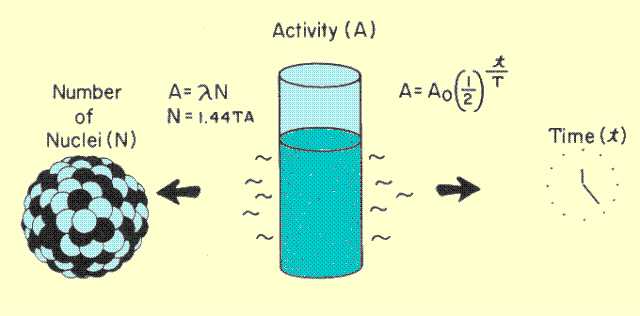
Definition: The activity of a radioactive source is the number of nuclear decays per second.
Unit: The unit of activity is the becquerel (Bq).
\( \mathrm{1\ Bq = 1\ decay\ s^{-1}} \)
Key idea: Higher activity means more decays occur each second.
Why Activity Decreases with Time
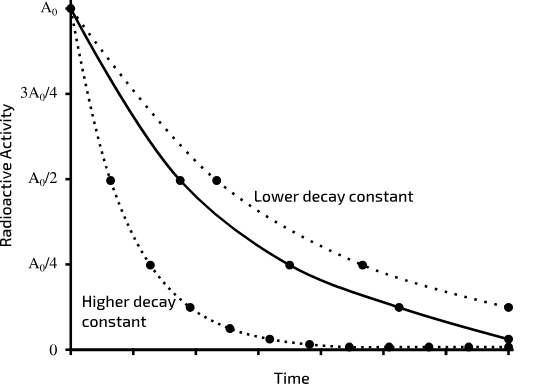
- Radioactive decay is a random process.
- Each decay removes one unstable nucleus.
- Over time, fewer unstable nuclei remain.
- Fewer nuclei available → fewer decays per second.
Result: The activity of the source decreases with time.
Activity and Time
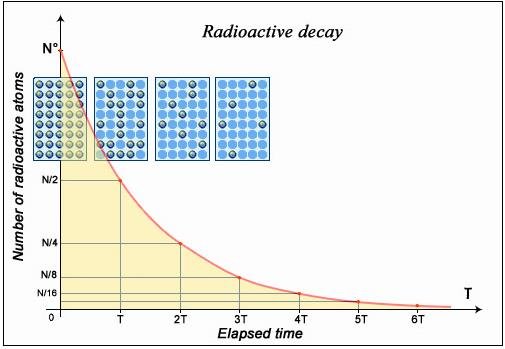
- At the start, activity is high.
- As time increases, activity falls.
- The decrease is gradual, not sudden.
Important: Although individual decays are random, the overall activity follows a predictable pattern.
Measuring Activity
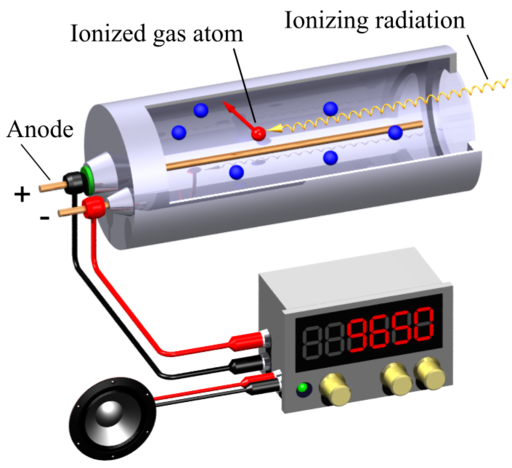
- Activity is measured using a Geiger–Müller detector.
- The detector records count rate.
- Count rate is proportional to activity.
- Background radiation must be subtracted.
Key idea: Measured activity is usually lower than the true activity because not all radiation is detected.
Example
A radioactive source has an activity of 12 000 Bq. Explain what this value means and why the activity will be lower after several days.
▶️ Answer / Explanation
- 12 000 Bq means 12 000 decays per second.
- Radioactive nuclei decay randomly.
- Each decay reduces the number of unstable nuclei.
- Fewer nuclei remain to decay after several days.
- The activity therefore decreases.
Example
A detector measures the activity of a radioactive source over time and shows a decreasing count rate. Explain why the decrease is smooth even though radioactive decay is random.
▶️ Answer / Explanation
- It is impossible to predict individual decays.
- Large numbers of nuclei are present.
- An average decay rate is observed.
- This produces a smooth decrease in activity.