
Contamination and Irradiation
When dealing with ionising radiation, it is essential to understand the difference between contamination and irradiation. These terms describe very different situations and have different safety implications.
Contamination
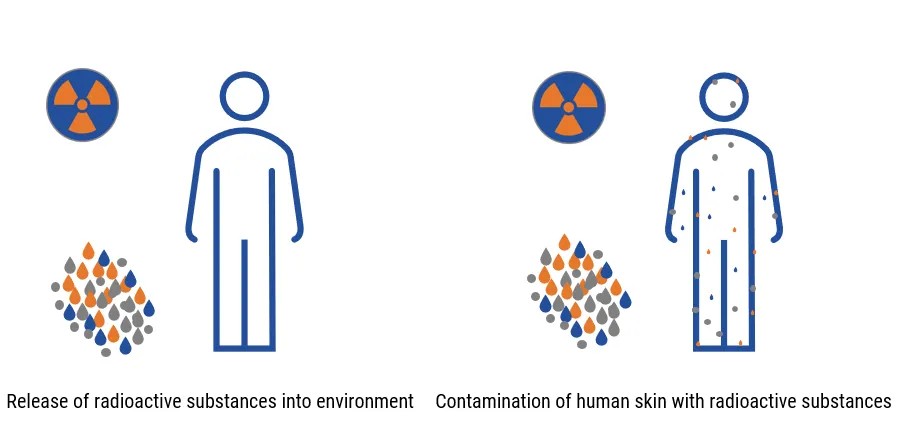
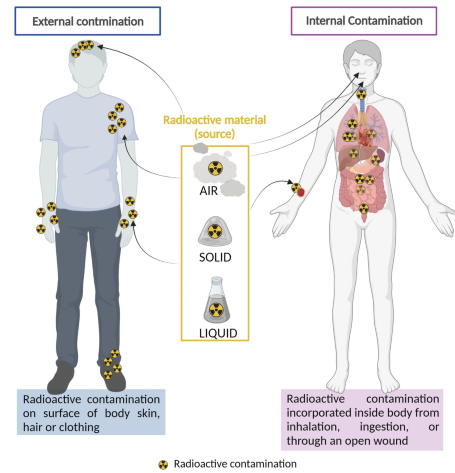
Definition: Contamination occurs when radioactive material gets onto or into an object or a person.
Key points:
- Radioactive particles are physically present.
- Radiation continues to be emitted.
- The object or person becomes a source of radiation.
- Can be internal (inhaled or swallowed) or external.
Important: Contamination is dangerous because the radiation source remains until removed.
Irradiation
Definition: Irradiation occurs when an object or person is exposed to ionising radiation from an external source.
Key points:
- No radioactive material is transferred.
- The object does not become radioactive.
- Radiation stops when the source is removed.
Important: Irradiation does not leave lasting radioactivity.
Comparison: Contamination vs Irradiation
| Feature | Contamination | Irradiation |
|---|---|---|
| Radioactive material present? | Yes | No |
| Object becomes radioactive? | Yes | No |
| Radiation continues after exposure? | Yes | No |
| Example | Radioactive dust on skin | X-ray exposure |
Key Exam Point
- Contamination involves radioactive material.
- Irradiation involves exposure only.
- Irradiation does not make objects radioactive.
Example
A worker is exposed to gamma radiation from a sealed source for a short time. Explain whether this is contamination or irradiation.
▶️ Answer / Explanation
- The radiation comes from an external source.
- No radioactive material is transferred.
- The worker does not become radioactive.
- This is irradiation.
Example
A scientist accidentally spills radioactive powder onto their glove. Identify the hazard and explain why it is dangerous.
▶️ Answer / Explanation
- This is contamination.
- Radioactive material is present on the glove.
- Radiation continues to be emitted.
- The contamination must be removed to stop exposure.
Dangers of Ionising Radiation
Ionising radiation can remove electrons from atoms in living tissue. This process can damage cells, alter DNA, and create long-term health risks if exposure is not controlled.
Key Statement
Statement: Ionising radiation can cause cell damage, tissue damage, and mutations in living organisms, and presents risks when radioactive waste is not safely managed.
Damage to Cells and Tissue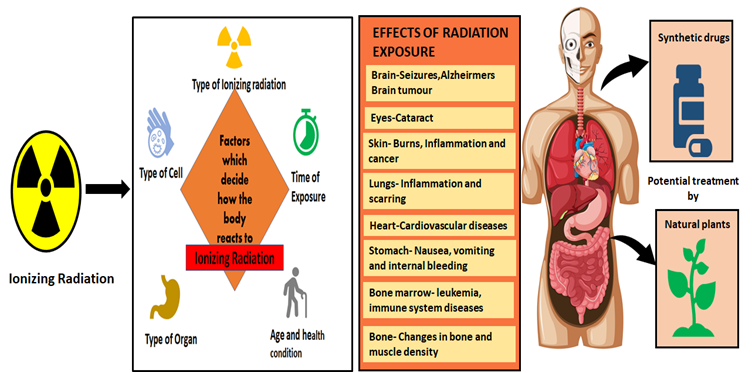
- Ionising radiation removes electrons from atoms in cells.
- This damages cell structures and molecules.
- Cells may stop functioning or die.
Effects depend on:
- Type of radiation.
- Amount of exposure (dose).
- Time of exposure.
Mutations in Living Organisms
Mutation: A mutation is a change in the DNA of a cell.
- Radiation can damage DNA inside the nucleus.
- This can cause incorrect cell division.
- Mutations may lead to cancer.
Important:
- Mutations in body cells may cause cancer.
- Mutations in reproductive cells can be passed to offspring.
Long-Term Health Effects
| Type of effect | Description | Example |
|---|---|---|
| Cell death | Cells stop functioning | Burns, tissue damage |
| Mutation | DNA damage | Cancer |
Radioactive Waste – The Problem
- Radioactive waste emits ionising radiation.
- Some waste remains dangerous for thousands of years.
- Radiation can harm people and the environment.
Sources of radioactive waste:
- Nuclear power stations.
- Medical and industrial uses.
- Research laboratories.
Reducing the Risks of Radioactive Waste
| Method | How risk is reduced |
|---|---|
| Shielding | Absorbs radiation (lead, concrete) |
| Remote handling | Limits human exposure |
| Secure storage | Prevents leaks into environment |
| Deep geological disposal | Keeps waste isolated for long periods |
Key Note
- Ionising radiation damages cells by ionisation.
- DNA damage can cause mutations and cancer.
- Radioactive waste must be carefully stored.
- Risks are reduced using shielding, distance, and time control.
Example
Explain how exposure to ionising radiation can increase the risk of cancer in humans.
▶️ Answer / Explanation
- Ionising radiation can damage DNA in cells.
- This damage can cause mutations.
- Mutations may lead to uncontrolled cell division.
- This can result in cancer.
Example
Explain two problems associated with radioactive waste and describe how the risks can be reduced.
▶️ Answer / Explanation
- Waste remains radioactive for long periods.
- Radiation can harm people and ecosystems.
- Waste is stored in shielded containers.
- Deep underground storage reduces exposure.