
Nuclear Reactions as Sources of Energy
Nuclear reactions involve changes in the nucleus of an atom. These reactions can release very large amounts of energy. The main nuclear processes that release energy are radioactive decay, nuclear fission, and nuclear fusion.
Key Statement
Statement: Nuclear reactions, including fission, fusion, and radioactive decay, can be a source of energy.
Key idea: Energy is released because a small amount of mass is converted into energy.
Radioactive Decay as a Source of Energy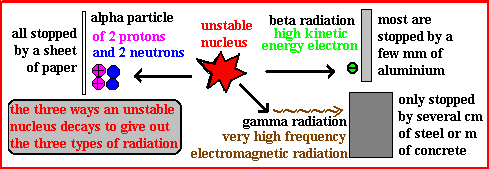
Description:
- Unstable nuclei emit radiation.
- Energy is released during this process.
- The energy appears as kinetic energy of particles or radiation.
Uses:
- Radioisotope power sources.
- Space probes and remote power supplies.
Important: Energy release is continuous but relatively small.
Nuclear Fission
Description:
- A large, unstable nucleus splits into two smaller nuclei.
- This usually happens after absorbing a neutron.
- Energy and more neutrons are released.
Key points:
- Produces a large amount of energy.
- Can cause a chain reaction.
- Used in nuclear power stations.
Key idea: The released energy is used to heat water and produce electricity.
Nuclear Fusion
Description: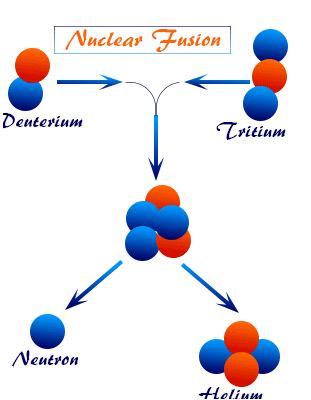
- Two small nuclei join together to form a larger nucleus.
- Occurs at extremely high temperatures and pressures.
- Large amounts of energy are released.
Examples:
- Energy production in the Sun.
- Energy production in stars.
Important: Fusion produces more energy per kilogram than fission.
Why Energy Is Released in Nuclear Reactions
- The total mass after the reaction is slightly less than before.
- The missing mass is converted into energy.
- This follows the mass–energy principle.
Key idea: A very small mass change produces a very large amount of energy.
Comparison of Nuclear Energy Processes
| Process | What happens | Energy output |
|---|---|---|
| Radioactive decay | Unstable nucleus emits radiation | Small, continuous |
| Fission | Large nucleus splits | Large |
| Fusion | Small nuclei join | Very large |
Example
Explain how nuclear fission is used to generate electrical energy in a power station.
▶️ Answer / Explanation
- Fission releases a large amount of energy.
- This energy heats water to produce steam.
- The steam turns turbines.
- The turbines drive generators to produce electricity.
Example
Fusion releases more energy per kilogram than fission. Explain why fusion is difficult to use in power stations.
▶️ Answer / Explanation
- Fusion requires extremely high temperatures.
- Nuclei must overcome repulsive forces.
- Containing the reaction is difficult.
- Current technology cannot maintain controlled fusion easily.