
Difference Between Nuclear Fusion and Nuclear Fission
Nuclear fusion and nuclear fission are both nuclear reactions that release very large amounts of energy. However, they occur in very different ways and under very different conditions.
Key Statement
Statement: Nuclear fission involves the splitting of a large nucleus, whereas nuclear fusion involves the joining of small nuclei.
Key idea: Both processes release energy because a small amount of mass is converted into energy.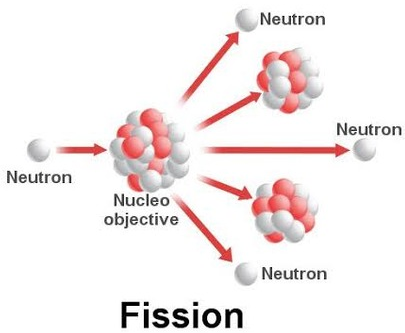
Nuclear Fission
Description:
- A large, unstable nucleus splits into two smaller nuclei.
- Usually triggered by absorbing a neutron.
- Extra neutrons are released.
Key features:
- Produces radioactive daughter nuclei.
- Can produce a chain reaction.
- Used in nuclear power stations.
Nuclear Fusion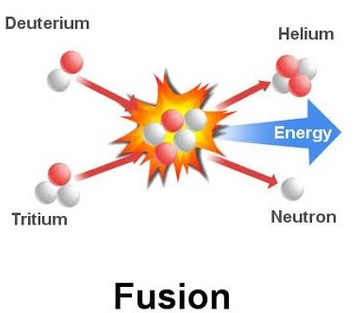
Description:
- Two small nuclei join together to form a larger nucleus.
- Requires extremely high temperature and pressure.
- Occurs naturally in stars.
Key features:
- Releases more energy per kilogram than fission.
- Does not produce long-lived radioactive waste.
- Very difficult to control on Earth.
Comparison: Nuclear Fission vs Nuclear Fusion
| Feature | Nuclear Fission | Nuclear Fusion |
|---|---|---|
| Process | Large nucleus splits | Small nuclei join |
| Fuel | U-235 or Pu-239 | Hydrogen isotopes |
| Trigger | Absorption of a neutron | Extremely high temperature |
| Energy output | Very large | Even larger per kg |
| Radioactive waste | Yes | Very little |
| Where it occurs | Nuclear reactors | Stars (e.g. Sun) |
Example
Explain one advantage and one disadvantage of using nuclear fusion instead of nuclear fission to generate electricity.
▶️ Answer / Explanation
- Fusion produces very little long-lived radioactive waste.
- However, fusion requires extremely high temperatures.
- This makes it very difficult to control in power stations.
Example
Explain why nuclear fission can be used in power stations but nuclear fusion is not yet widely used.
▶️ Answer / Explanation
- Fission can be controlled using control rods and moderators.
- Fusion requires extremely high temperatures and pressures.
- Current technology cannot maintain controlled fusion easily.