
Practical: Investigating the Penetrating Power of Radiation
This practical investigates the penetrating power of alpha (α), beta (β⁻), and gamma (γ) radiation by measuring how different materials reduce the detected count rate.
Aim
To compare the penetrating power of alpha, beta, and gamma radiation using absorbing materials.
Apparatus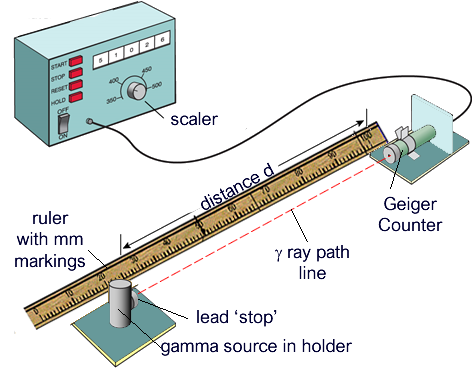
- Radioactive sources (α, β, γ) or computer simulation
- Geiger–Müller tube and counter
- Absorbing materials:
- Paper
- Aluminium sheets
- Lead sheets
- Ruler (cm)
- Stopwatch (s)
Method
- Place the radioactive source a fixed distance from the detector.
- Measure the background radiation for a fixed time.
- Record the initial count rate with no absorber.
- Place a sheet of paper between the source and detector and record the count rate.
- Repeat using increasing thicknesses of aluminium.
- Finally, repeat using lead sheets.
- Keep distance and time constant throughout.
Alternative (Simulation): Use an online radiation simulation to insert absorbing materials and record count rates.
Results and Observations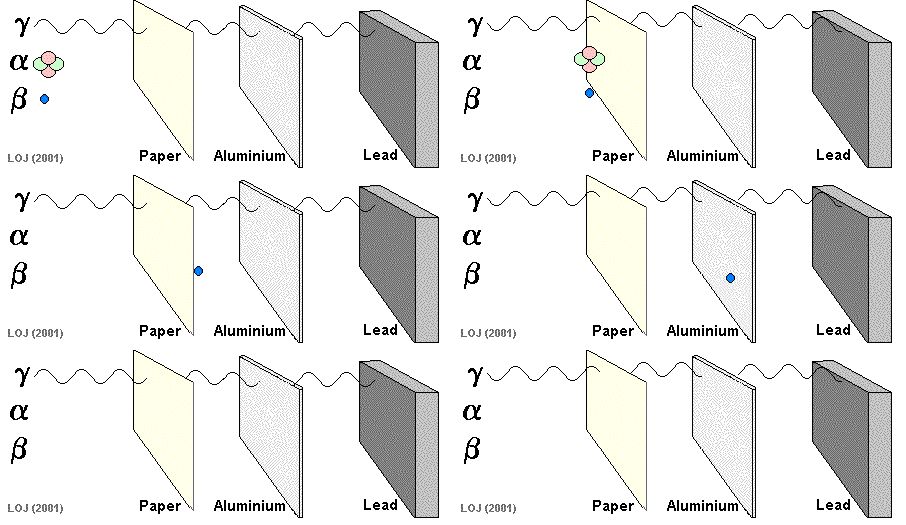
- Paper stops alpha radiation completely.
- Aluminium reduces beta radiation significantly.
- Gamma radiation is only reduced by thick lead.
Conclusion:
- Alpha → least penetrating
- Beta → moderately penetrating
- Gamma → most penetrating
Safety Precautions
- Use tongs to handle radioactive sources.
- Never point sources at people.
- Store sources in lead-lined containers.
- Limit exposure time.
Key Sources of Error and Improvements
- Background radiation → subtract background count.
- Detector movement → fix positions securely.
- Short counting times → use longer times to reduce random error.
Example
During the experiment, the count rate falls to zero when paper is placed between the source and the detector. Explain what type of radiation is being emitted and why.
▶️ Answer / Explanation
- Paper completely absorbs alpha radiation.
- Alpha particles have very low penetrating power.
- Beta and gamma would pass through paper.
- The radiation must be alpha.
Example
A radiation source passes through paper but is significantly reduced by 3 mm of aluminium. Identify the radiation and explain how the result supports your answer.
▶️ Answer / Explanation
- The radiation is not alpha because it passes through paper.
- It is not gamma because aluminium reduces it strongly.
- Beta radiation is stopped by thin aluminium.
- This matches the observed result.