
Balancing Nuclear Equations
Nuclear equations describe radioactive decay and nuclear reactions. These equations must be balanced so that both mass number and charge are conserved.
Key Principle
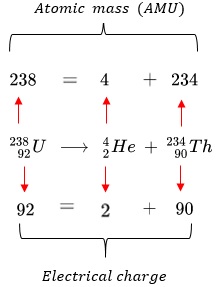
Statement: In a nuclear equation, the total mass number and the total atomic (proton) number must be the same on both sides of the equation.
Key idea: Nuclear reactions obey conservation laws.
What Must Be Balanced
- Mass number (A) → total number of nucleons
- Atomic number (Z) → total charge (number of protons)
Important: Electrons involved in beta decay are included in charge balancing.
General Nuclear Notation
\( \mathrm{^{A}_{Z}X} \)
- \( \mathrm{A} \) = mass number
- \( \mathrm{Z} \) = atomic (proton) number
- \( \mathrm{X} \) = element symbol
Balancing Alpha Decay
Alpha particle:
\( \mathrm{^4_2\alpha} \)
Rule:
- Mass number decreases by 4
- Atomic number decreases by 2
General form:
\( \mathrm{^{A}_{Z}X \rightarrow ^{A-4}_{Z-2}Y + ^4_2\alpha} \)
Balancing Beta (β⁻) Decay
Beta particle:
\( \mathrm{^0_{-1}\beta} \)
Rule:
- Mass number remains unchanged
- Atomic number increases by 1
General form:
\( \mathrm{^{A}_{Z}X \rightarrow ^{A}_{Z+1}Y + ^0_{-1}\beta} \)
Balancing Gamma Decay
Gamma ray:
\( \mathrm{^0_0\gamma} \)
Rule:
- No change in mass number
- No change in atomic number
General form:
\( \mathrm{^{A}_{Z}X^* \rightarrow ^{A}_{Z}X + \gamma} \)
Balancing Neutron Emission
Neutron:
\( \mathrm{^1_0n} \)
Rule:
- Mass number decreases by 1
- Atomic number unchanged
General form:
\( \mathrm{^{A}_{Z}X \rightarrow ^{A-1}_{Z}Y + ^1_0n} \)
Step-by-Step Method (Exam Technique)
- Write the incomplete nuclear equation.
- Add up mass numbers on both sides.
- Add up atomic numbers on both sides.
- Adjust the unknown nucleus so both totals match.
- Check both mass and charge are conserved.
Example
Complete and balance the following nuclear equation:
\( \mathrm{^{210}_{84}Po \rightarrow \; ? \; + ^4_2\alpha} \)
▶️ Answer / Explanation
Mass number:
\( \mathrm{210 – 4 = 206} \)
Atomic number:
\( \mathrm{84 – 2 = 82} \)
Balanced equation:
\( \mathrm{^{210}_{84}Po \rightarrow ^{206}_{82}Pb + ^4_2\alpha} \)
Example
A nucleus undergoes beta decay and changes from \( \mathrm{^{14}_{6}C} \) to nitrogen. Write the balanced nuclear equation.
▶️ Answer / Explanation
Mass number stays the same:
\( \mathrm{A = 14} \)
Atomic number increases by 1:
\( \mathrm{Z = 7} \)
Balanced equation:
\( \mathrm{^{14}_{6}C \rightarrow ^{14}_{7}N + ^0_{-1}\beta} \)