
Absolute Magnitude and Stellar Brightness
The brightness of a star seen from Earth depends on both its actual energy output and its distance. To compare stars fairly, astronomers use absolute magnitude, which represents brightness at a standard distance.
Key Statement
Statement: The brightness of a star at a standard distance is represented using its absolute magnitude.
Key idea: Absolute magnitude removes the effect of distance.
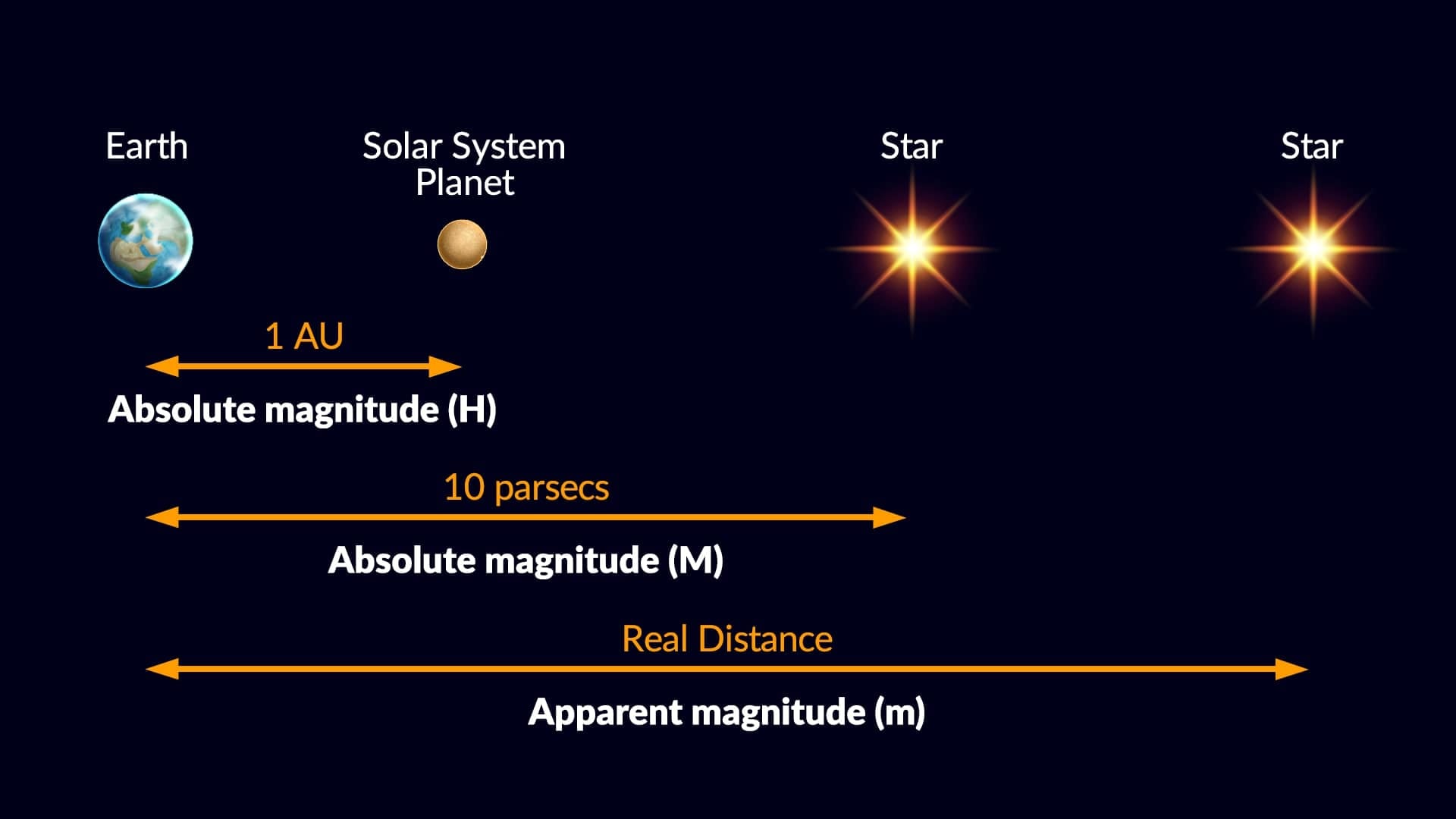
Why Apparent Brightness Is Misleading
- Nearby stars appear brighter than distant stars.
- A dim nearby star can appear brighter than a luminous distant star.
- Distance affects how much light reaches Earth.
Conclusion: Apparent brightness alone cannot be used to compare stars.
Definition of Absolute Magnitude
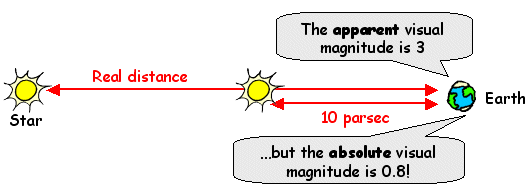
Definition:
Absolute magnitude is the brightness a star would have if it were placed at a standard distance of 10 parsecs from Earth.
Important: All stars are compared as if they were at the same distance.
Understanding the Magnitude Scale
- The magnitude scale is inverted.
- Lower (or more negative) values mean brighter stars.
- Higher values mean dimmer stars.
Key idea: A star with a smaller absolute magnitude is more luminous.
Absolute Magnitude and True Brightness
- Absolute magnitude depends on energy output.
- It is related to the star’s luminosity.
- It does not depend on distance.
Comparing Apparent and Absolute Magnitude
| Feature | Apparent Magnitude | Absolute Magnitude |
|---|---|---|
| Depends on distance | Yes | No |
| Standard distance used | No | 10 parsecs |
| Represents true brightness | No | Yes |
Why Absolute Magnitude Is Useful
- Allows fair comparison between stars.
- Used in star classification.
- Used in the Hertzsprung–Russell diagram.
Key idea: Absolute magnitude represents intrinsic brightness.
Example
Star A appears brighter than Star B when viewed from Earth. Explain how absolute magnitude can be used to determine which star is actually more luminous.
▶️ Answer / Explanation
- Apparent brightness depends on distance.
- Absolute magnitude compares stars at the same distance.
- The star with the lower absolute magnitude is more luminous.
- This allows true brightness to be identified.
Example
A nearby star has a higher apparent brightness than a distant supergiant star. Explain why the distant star can still have a lower absolute magnitude.
▶️ Answer / Explanation
- Absolute magnitude removes the effect of distance.
- The distant star may produce much more energy.
- This gives it a lower absolute magnitude.
- Therefore it is intrinsically brighter despite appearing dimmer.