Edexcel iGCSE Physics -8.3–8.4 Gravitational Field Strength in Space and Its Effects on Orbits- Study Notes- New Syllabus
Edexcel iGCSE Physics -8.3–8.4 Gravitational Field Strength in Space and Its Effects on Orbits- Study Notes- New syllabus
Edexcel iGCSE Physics -8.3–8.4 Gravitational Field Strength in Space and Its Effects on Orbits- Study Notes -Edexcel iGCSE Physics – per latest Syllabus.
Key Concepts:
8.3 understand why gravitational field strength, g, varies and know that it is different on other planets and the Moon from that on the Earth
8.4 explain that gravitational force:
• causes moons to orbit planets
• causes the planets to orbit the Sun
• causes artificial satellites to orbit the Earth
• causes comets to orbit the Sun
Variation of Gravitational Field Strength, g
Gravitational field strength, \( \mathrm{g} \), describes how strong gravity is at a particular point. Its value is not the same everywhere and varies from one planet to another.
Key Statement
Statement: Gravitational field strength, \( \mathrm{g} \), varies because it depends on the mass of the object creating the field and the distance from its centre, and its value is different on other planets and the Moon compared with Earth.
Key idea: Different celestial bodies have different gravitational strengths.
Meaning of Gravitational Field Strength
Definition:
Gravitational field strength is the force per unit mass acting on an object.
\( \mathrm{g = \dfrac{F}{m}} \)
- Unit of \( \mathrm{g} \) is N/kg.
- It can also be written as m/s².
Why Gravitational Field Strength Varies
1. Mass of the Planet or Moon
- More massive objects produce stronger gravitational fields.
- Planets with larger mass have larger values of \( \mathrm{g} \).
2. Distance from the Centre
- Gravitational field strength decreases with distance.
- Objects farther from the centre experience weaker gravity.
Key idea: Both mass and distance affect the strength of gravity.
Gravitational Field Strength on Different Bodies
| Body | Gravitational field strength (N/kg) | Comparison with Earth |
|---|---|---|
| Earth | 9.8 | Reference value |
| Moon | 1.6 | Much weaker |
| Mars | 3.7 | Weaker |
| Jupiter | 24.8 | Much stronger |
Earth vs Moon
- The Moon has much less mass than Earth.
- This gives it a much smaller gravitational field strength.
- Objects weigh less on the Moon.
Key idea: Mass stays the same, but weight changes.
Effect on Weight
\( \mathrm{W = mg} \)
- If \( \mathrm{g} \) increases → weight increases.
- If \( \mathrm{g} \) decreases → weight decreases.
Example
Explain why an astronaut weighs less on the Moon than on the Earth.
▶️ Answer / Explanation
- The Moon has less mass than the Earth.
- Its gravitational field strength is smaller.
- Weight depends on gravitational field strength.
- Therefore the astronaut weighs less on the Moon.
Example
A planet has a larger mass than Earth. Explain how this affects the value of gravitational field strength at its surface.
▶️ Answer / Explanation
- A larger mass produces a stronger gravitational field.
- The gravitational field strength will be greater.
- Objects would weigh more on this planet.
Gravitational Force and Orbital Motion
Gravitational force is the force of attraction between masses. In astrophysics, gravity is responsible for the orbital motion of moons, planets, artificial satellites, and comets.
Key Statement
Statement: Gravitational force causes moons to orbit planets, planets to orbit the Sun, artificial satellites to orbit the Earth, and comets to orbit the Sun.
Key idea: Gravity provides the force needed to keep objects moving in curved paths called orbits.
Gravitational Force and Orbits
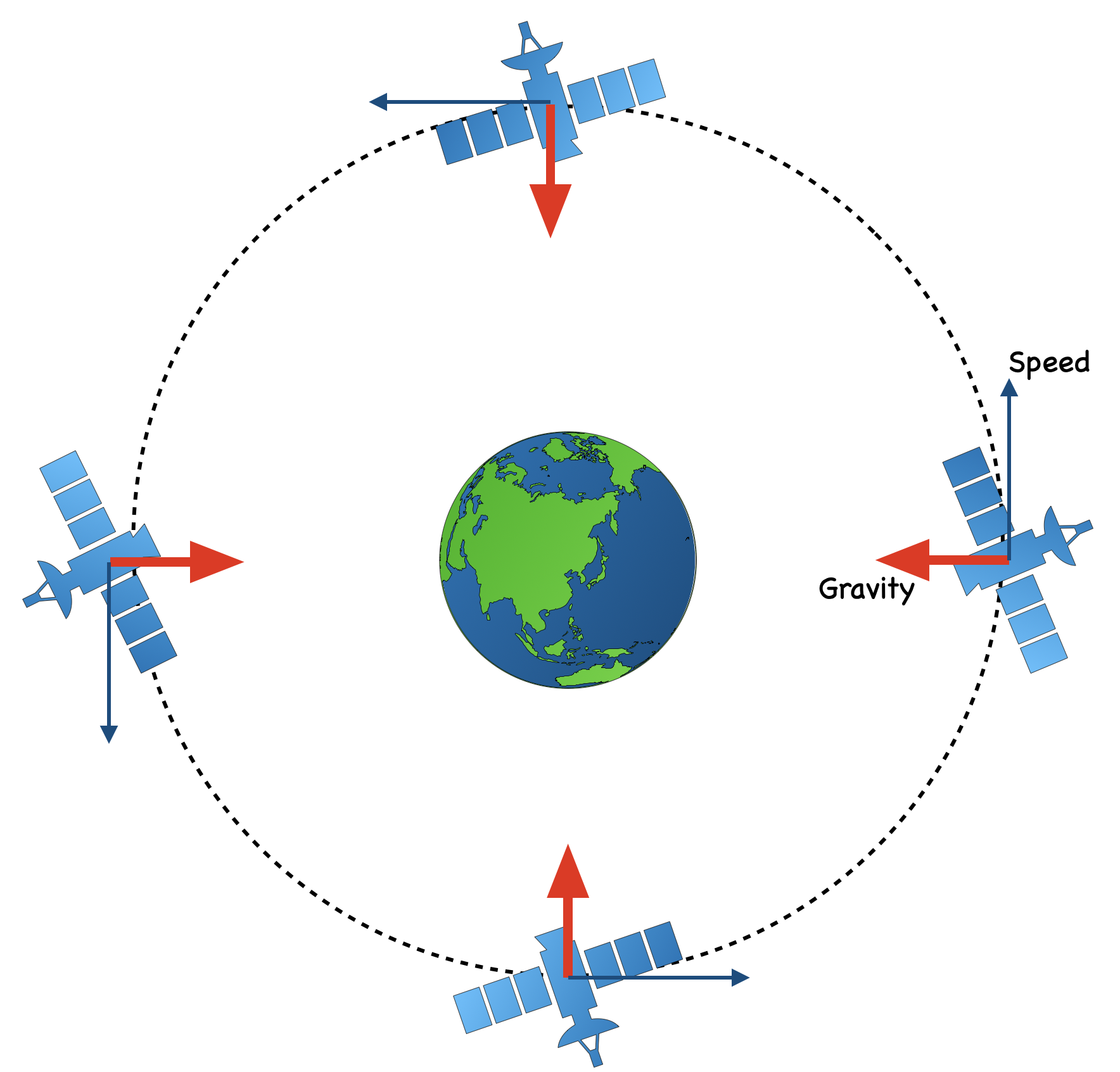
- Objects in space move forward due to their velocity.
- Gravity pulls them toward another massive body.
- This combination produces a curved path.
Important: The gravitational force acts as a centripetal force, constantly changing the direction of motion.
Moons Orbiting Planets
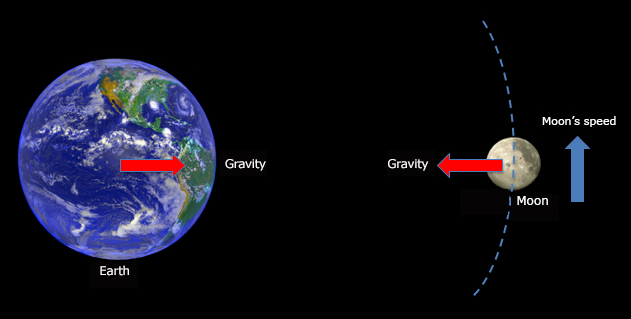
- Planets exert gravitational force on their moons.
- This force pulls the moon toward the planet.
- The moon’s sideways velocity prevents it from falling straight down.
Key idea: The moon is constantly falling toward the planet but never reaches it.
Planets Orbiting the Sun
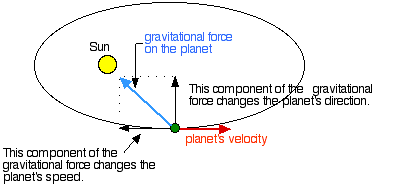
- The Sun has a very large mass.
- It produces a strong gravitational field.
- This gravitational force attracts planets.
Key idea: Gravity keeps planets in stable orbits around the Sun.
Artificial Satellites Orbiting the Earth
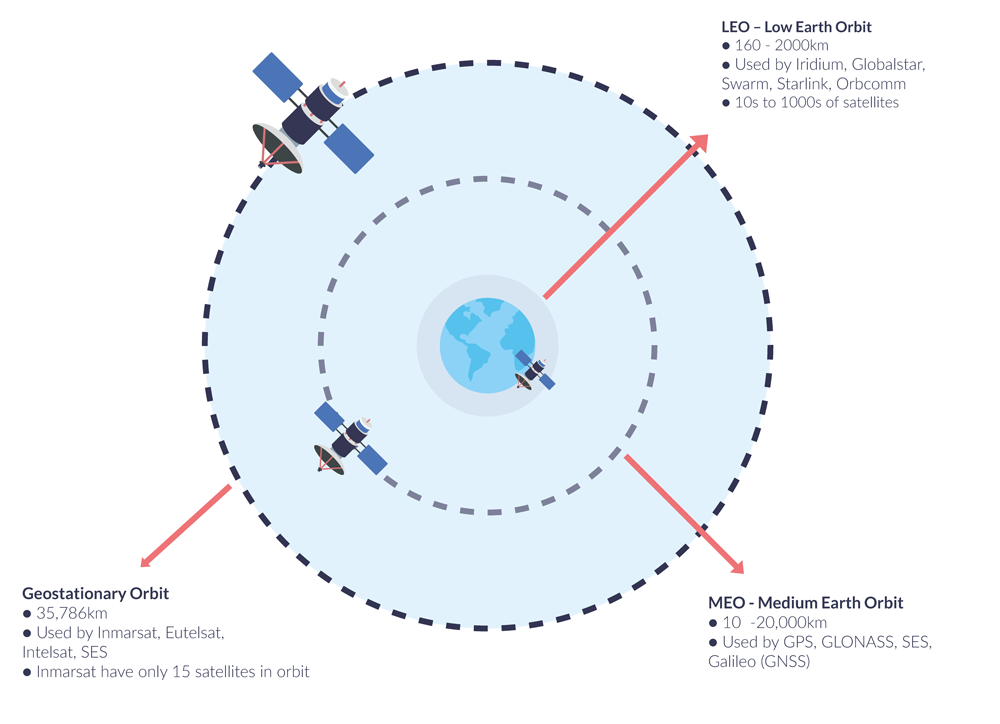
- Artificial satellites are launched with high horizontal speed.
- Earth’s gravity pulls the satellite toward the Earth.
- The satellite continually falls around the Earth.
Important: Satellites are not weightless because gravity is still acting on them.
Comets Orbiting the Sun
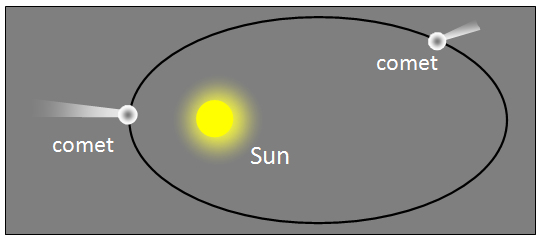
- Comets are small bodies in the solar system.
- The Sun’s gravity attracts comets.
- Comets usually follow highly elliptical orbits.
Key idea: Even distant objects remain in orbit due to the Sun’s gravity.
Common Feature of All Orbits
- Gravity always acts toward the centre of the orbit.
- Gravity changes direction of velocity, not speed.
- Without gravity, objects would move in straight lines.
Example
Explain why an artificial satellite does not fall straight down to the Earth after being launched.
▶️ Answer / Explanation
- The satellite has a large horizontal velocity.
- Earth’s gravity pulls the satellite toward the Earth.
- The satellite continually falls toward the Earth.
- Its forward motion causes it to miss the Earth.
- This results in a circular or curved orbit.
Example
Comets often follow highly elliptical orbits around the Sun. Explain why the Sun is able to keep comets in orbit even when they are very far away.
▶️ Answer / Explanation
- The Sun has a very large mass.
- It produces a strong gravitational field.
- Gravitational force acts over very large distances.
- This force pulls the comet toward the Sun.
- The comet’s velocity prevents it from falling straight in.
