
Classification of Stars by Colour
Stars can be classified according to their colour. The colour of a star provides information about its surface temperature and the type of light it emits.
Key Statement
Statement: Stars are classified by their colour, which depends on their surface temperature.
Key idea: Hotter stars appear bluer, while cooler stars appear redder.
Why Stars Have Different Colours
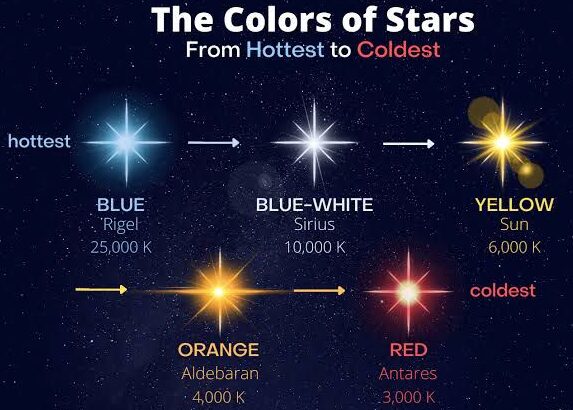
- Stars emit light across a range of wavelengths.
- The most intense wavelength determines the star’s colour.
- This wavelength depends on surface temperature.
Important: Star colour is not caused by distance or brightness.
Colour and Temperature Relationship
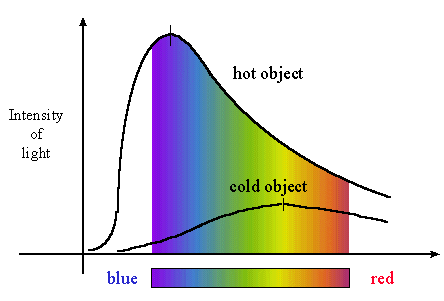
- Higher temperature → shorter wavelength → blue light.
- Lower temperature → longer wavelength → red light.
- White and yellow stars have intermediate temperatures.
Key idea: Colour is a direct indicator of temperature.
Classification of Stars by Colour
| Colour | Relative temperature | Typical description |
|---|---|---|
| Blue | Very hot | Highest surface temperature |
| White | Hot | Hot but cooler than blue stars |
| Yellow | Medium | Moderate surface temperature |
| Red | Cool | Lowest surface temperature |
Important Clarifications
- Blue stars are hotter than red stars.
- Red stars are cooler, not more energetic.
- Brightness depends on size and distance, not just temperature.
Colour vs Brightness
- A red star can be brighter than a blue star.
- This happens if the red star is much larger.
- Colour alone does not determine luminosity.
Key idea: Colour tells us temperature, not size.
Example
Two stars appear red and blue when observed from Earth. Explain which star has the higher surface temperature and why.
▶️ Answer / Explanation
- Star colour depends on surface temperature.
- Blue light has a shorter wavelength than red light.
- Shorter wavelengths correspond to higher temperatures.
- Therefore the blue star has the higher surface temperature.
Example
A red star is observed to be brighter than a nearby blue star. Explain how this is possible.
▶️ Answer / Explanation
- Brightness depends on both size and temperature.
- Red stars are cooler than blue stars.
- The red star may have a much larger surface area.
- A larger surface area allows more total energy to be emitted.
- This makes the red star appear brighter.
Star Colour and Surface Temperature
The colour of a star is directly related to its surface temperature. Astronomers use a star’s colour as an indicator of how hot its surface is.
Key Statement
Statement: A star’s colour depends on its surface temperature.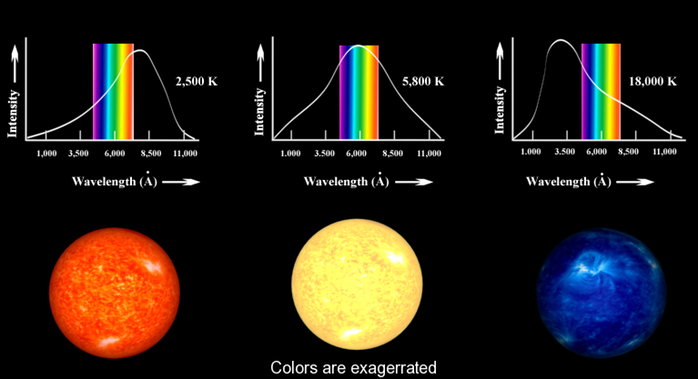
Key idea: Hotter stars emit more short-wavelength light, while cooler stars emit more long-wavelength light.
Why Colour Indicates Temperature
- Stars emit light over a wide range of wavelengths.
- The most intense wavelength determines the star’s colour.
- This wavelength depends on surface temperature.
Important: Colour is not affected by distance from Earth.
Colour–Temperature Relationship
- Blue stars → very high surface temperature.
- White stars → high surface temperature.
- Yellow stars → medium surface temperature.
- Red stars → low surface temperature.
Key idea: Blue stars are hotter than red stars.
Star Colour Comparison
| Colour | Relative surface temperature | Wavelength type |
|---|---|---|
| Blue | Highest | Short wavelength |
| White | High | Short–medium wavelength |
| Yellow | Medium | Medium wavelength |
| Red | Lowest | Long wavelength |
Common Misconceptions (Exam Focus)
- Red stars are cooler, not hotter.
- Blue stars are hotter, not colder.
- Brightness does not depend only on colour.
Example
A blue star and a red star are observed in the same galaxy. Explain which star has the higher surface temperature and how colour provides this information.
▶️ Answer / Explanation
- Star colour depends on surface temperature.
- Blue light has a shorter wavelength than red light.
- Shorter wavelengths correspond to higher temperatures.
- Therefore the blue star has the higher surface temperature.
Example
A star appears yellow rather than blue. Explain what this indicates about its surface temperature compared with a blue star.
▶️ Answer / Explanation
- Yellow stars emit most strongly at medium wavelengths.
- This corresponds to a lower temperature than blue stars.
- Therefore the yellow star has a lower surface temperature than a blue star.