
Evolution of a Star with Mass Similar to the Sun
Stars with a mass similar to the Sun follow a specific life cycle. Their evolution is controlled by the balance between gravitational collapse and energy released by nuclear fusion.
Key Statement
Statement: A star of similar mass to the Sun evolves through the stages: nebula → main sequence star → red giant → white dwarf.
Key idea: Each stage is determined by changes in fusion reactions and gravitational forces.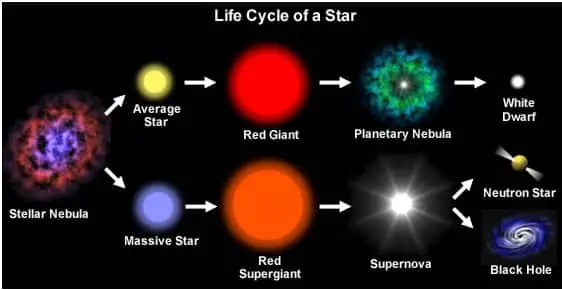
Stage 1: Nebula
Description:
- A nebula is a large cloud of gas and dust.
- Mainly composed of hydrogen.
- Gravity causes the gas and dust to collapse.
What happens:
- Gravitational potential energy is converted to thermal energy.
- Temperature and pressure increase.
- A protostar begins to form.
Stage 2: Main Sequence Star
Description:
- The star enters the main sequence.
- Hydrogen nuclei fuse to form helium.
- Fusion releases energy.
Balance of forces:
- Outward pressure from fusion energy.
- Inward pull due to gravity.
- This balance makes the star stable.
Key idea: This is the longest stage of the star’s life.
Stage 3: Red Giant
Description:
- Hydrogen in the core begins to run out.
- Fusion in the core decreases.
- Gravity causes the core to contract.
Result:
- Temperature increases in the surrounding layers.
- Outer layers expand.
- The star becomes a red giant.
Key idea: The star becomes larger and cooler at the surface.
Stage 4: White Dwarf
Description:
- The outer layers are expelled.
- The core remains.
- No nuclear fusion occurs.
Properties:
- Very hot initially.
- Very small and dense.
- Gradually cools over time.
Key idea: A white dwarf is the final stage for Sun-like stars.
Summary of the Life Cycle
| Stage | Main process | Key feature |
|---|---|---|
| Nebula | Gravitational collapse | Star formation begins |
| Main sequence | Hydrogen fusion | Stable star |
| Red giant | Core contraction | Large, cool surface |
| White dwarf | No fusion | Hot, dense remnant |
Example
Explain why a star expands to form a red giant after the main sequence stage.
▶️ Answer / Explanation
- Hydrogen in the core is used up.
- Fusion in the core decreases.
- Gravity causes the core to contract.
- The surrounding layers heat up.
- The outer layers expand, forming a red giant.
Example
A star has stopped nuclear fusion and is small, hot, and very dense. Explain which stage it is in and how it formed.
▶️ Answer / Explanation
- The star is a white dwarf.
- Fusion has stopped in the core.
- The outer layers were expelled during the red giant stage.
- The remaining core is hot and dense.
- It slowly cools over time.
Evolution of Stars with a Mass Larger than the Sun
Stars that are much more massive than the Sun follow a different evolutionary path. Their greater mass leads to higher temperatures, faster fusion rates, and a more violent end.
Key Statement
Statement: A star with a mass larger than the Sun evolves through the stages: nebula → main sequence star → red supergiant → supernova → neutron star or black hole.
Key idea: Greater mass leads to stronger gravity and more extreme final stages.
Stage 1: Nebula
- A large cloud of gas and dust.
- Mainly hydrogen.
- Gravity causes collapse.
Important: A very massive nebula forms a massive star.
Stage 2: Main Sequence Star (Massive)
- Hydrogen fusion occurs in the core.
- Fusion rate is much higher than in Sun-like stars.
- The star is hotter, brighter, and blue-white.
Key idea: Massive stars use up their fuel very quickly.
Stage 3: Red Supergiant
- Hydrogen in the core runs out.
- Core contracts under gravity.
- Outer layers expand enormously.
Important: Fusion of heavier elements occurs in layers around the core.
Key idea: The star becomes extremely large and unstable.
Stage 4: Supernova
- Fusion can no longer release energy.
- The core collapses suddenly.
- A massive explosion occurs.
Results of supernova:
- Outer layers are ejected.
- Heavy elements are formed.
- Huge amounts of energy are released.
Final Stage: Neutron Star or Black Hole
Neutron Star:
- Forms if the remaining core is not extremely massive.
- Very small and extremely dense.
- Mostly made of neutrons.
Black Hole:
- Forms if the remaining core is very massive.
- Gravity is so strong that light cannot escape.
Key idea: The final outcome depends on the mass of the remaining core.
Life Cycle Summary (Massive Star)
| Stage | Main process | Key feature |
|---|---|---|
| Nebula | Gravitational collapse | Star formation |
| Main sequence | Hydrogen fusion | Very hot and bright |
| Red supergiant | Fusion of heavy elements | Extremely large |
| Supernova | Core collapse | Explosion |
| Final state | Gravity dominates | Neutron star / black hole |
Why Massive Stars End Violently
- Greater mass → stronger gravitational force.
- Fusion fuel is used rapidly.
- Once fusion stops, collapse is sudden.
Example
Explain why a star with a mass much larger than the Sun ends its life in a supernova rather than becoming a white dwarf.
▶️ Answer / Explanation
- Massive stars have stronger gravity.
- They fuse fuel more quickly.
- Fusion eventually stops completely.
- The core collapses suddenly.
- This causes a supernova explosion.
Example
After a supernova, one star becomes a neutron star while another becomes a black hole. Explain why the final outcomes are different.
▶️ Answer / Explanation
- The final outcome depends on the remaining core mass.
- A smaller core collapses into a neutron star.
- A larger core has stronger gravity.
- Gravity prevents even light from escaping.
- This forms a black hole.