
Principle of Conservation of Energy
The principle of conservation of energy states that energy cannot be created or destroyed. It can only be transferred from one energy store to another.
This principle applies to all physical processes and is used to analyse motion, heating, electrical devices, and energy systems.
Statement of the Principle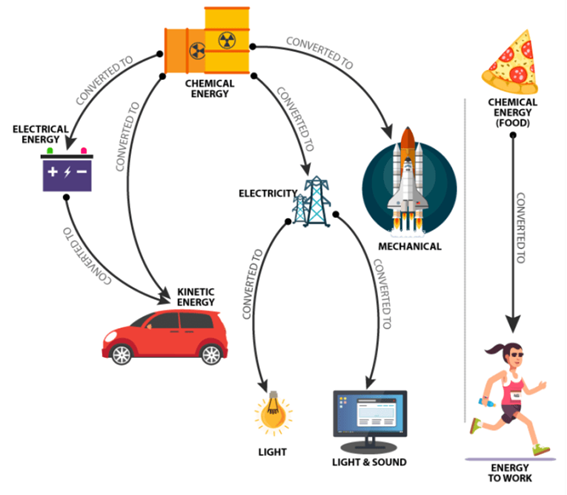
- The total energy of a closed system remains constant.
- Energy is not lost — it is only transferred to different stores.
- Any energy that appears “wasted” is usually transferred to the thermal store of the surroundings.
Energy Transfers and Stores
When energy changes form, it moves between energy stores:
- Chemical → kinetic
- Gravitational → kinetic
- Elastic → kinetic
- Electrical → thermal / light / sound
The total energy before the transfer equals the total energy after the transfer.
Using Conservation of Energy in Calculations
In an ideal system (no energy losses):
Energy before = Energy after
For example:
- Gravitational potential energy = kinetic energy
\( \mathrm{mgh = \dfrac{1}{2}mv^2} \)
Mass often cancels out, simplifying calculations.
Real Systems
- Some energy is transferred to the thermal store due to friction.
- Some energy may be transferred as sound or light.
- Total energy is still conserved.
Sankey diagrams are often used to show these energy transfers.
Key Idea
- Energy before = energy after.
- Energy is transferred, not destroyed.
- Useful and wasted energy together equal total energy input.
Important Points to Remember
- Always identify energy stores clearly.
- Use correct energy equations.
- Include all energy transfers, including thermal losses.
Example
A ball of mass \( \mathrm{2.0\ kg} \) is dropped from a height of \( \mathrm{5.0\ m} \).
Calculate the speed of the ball just before it hits the ground. (Take \( \mathrm{g = 10\ m/s^2} \).)
▶️ Answer / Explanation
Initial energy (gravitational potential):
\( \mathrm{E_p = mgh = 2.0 \times 10 \times 5.0 = 100\ J} \)
Final energy (kinetic):
\( \mathrm{\dfrac{1}{2}mv^2 = 100} \)
\( \mathrm{v^2 = 100} \)
\( \mathrm{v = 10\ m/s} \)
Example
An electric motor receives \( \mathrm{500\ J} \) of electrical energy.
It transfers \( \mathrm{380\ J} \) to the kinetic energy store.
Explain what happens to the remaining energy.
▶️ Answer / Explanation
The remaining \( \mathrm{120\ J} \) is transferred to the thermal store of the motor and surroundings.
This occurs due to friction and electrical resistance.
The total energy is conserved.