Edexcel A Level (IAL) Biology -1.6-1.7 Blood Vessels: Structure & Function - Study Notes- New Syllabus
Edexcel A Level (IAL) Biology -1.6-1.7 Blood Vessels: Structure & Function- Study Notes- New syllabus
Edexcel A Level (IAL) Biology -1.6-1.7 Blood Vessels: Structure & Function- Study Notes -Edexcel A level Biology – per latest Syllabus.
Key Concepts:
- Â understand why many animals have a heart and circulation (mass transport to overcome the limitations of diffusion in meeting the requirements of organisms)
- understand how the structures of blood vessels (capillaries, arteries and veins) relate to their functionsÂ
Why Many Animals Have a Heart and Circulation
🌱 Introduction
All living cells need oxygen, nutrients, and removal of wastes (like COâ‚‚) to survive.
In small organisms, substances can diffuse directly through the body because the surface area to volume ratio is large.
As animals get larger, diffusion alone becomes insufficient due to:
- ↓ Surface area to volume ratio
- ↑ Distance for substances to diffuse
- ↑ Metabolic rate → higher demand for nutrients and oxygen
Solution: Animals have evolved a mass transport system a heart and circulation to efficiently transport substances around the body.
🧩 Key Reasons for Having a Heart & Circulation
- Overcoming diffusion limits
Diffusion is too slow for large, multicellular organisms.
Circulation ensures fast movement of substances to all cells. - Transport of essential substances
Oxygen, glucose, hormones, and other nutrients delivered efficiently.
Waste products like COâ‚‚ and urea removed quickly. - Controlled direction
Blood moves in a specific direction from the heart → arteries → capillaries → veins.
Valves prevent backflow. - Maintaining pressure and speed
Heart contraction + elastic recoil of vessels → maintains blood pressure.
Ensures consistent flow rate for all tissues. - Support for high metabolic rates
High-energy animals (e.g., mammals, birds) need continuous oxygen supply.
Heart and circulation meet the energy demands of active tissues.
âš¡ Quick RecapÂ
Small animals: Diffusion sufficient → no heart needed
Large animals: Diffusion insufficient → heart + circulation required
Mass transport system features:
– Network of vessels
– Fluid medium (blood/hemolymph)
– Controlled direction (valves + pressure)
– Maintains speed of transport
Purpose: Deliver nutrients & Oâ‚‚, remove wastes, support high metabolism
Blood Vessels: Structure & Function
🌱 Introduction
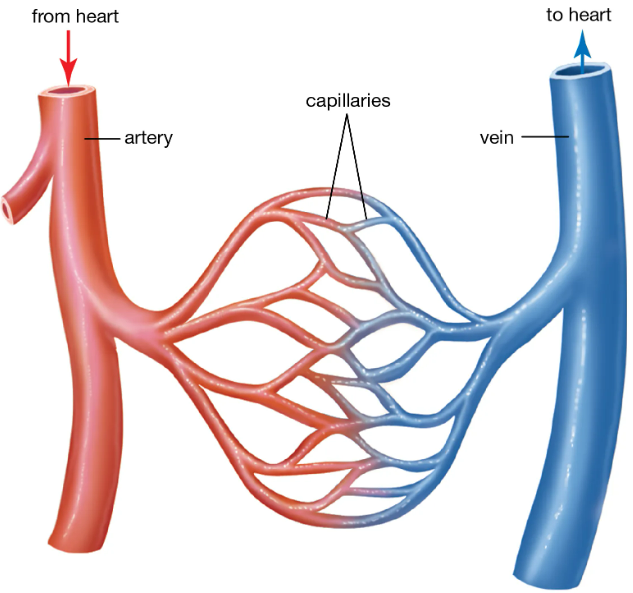
Blood vessels form a network to transport blood around the body.
Different vessels are specialised structurally to carry out their functions efficiently:
- Arteries: carry blood away from the heart under high pressure
- Veins: carry blood toward the heart under lower pressure
- Capillaries: connect arteries and veins, allowing exchange of substances with tissues
🧩 Structures and Functions
| Blood Vessel | Structure | Function | Key Adaptations |
|---|---|---|---|
| Arteries | – Thick muscular wall – Elastic fibres – Narrow lumen | Carry blood away from the heart under high pressure | – Thick wall resists pressure – Elastic fibres stretch and recoil → maintain pressure – Narrow lumen maintains high blood flow speed |
| Veins | – Thin muscular wall – Less elastic tissue – Wide lumen – Valves | Carry blood toward the heart under low pressure | – Valves prevent backflow – Wide lumen eases low-pressure blood flow – Less elastic tissue needed due to low pressure |
| Capillaries | – One cell thick walls (endothelium) – Very narrow diameter | Exchange of gases, nutrients, and wastes between blood & tissues | – Thin wall → short diffusion distance – Narrow diameter → blood moves slowly → efficient exchange – Large number → huge surface area for exchange |
âš¡ Key Points
- Structure matches function: thickness, elasticity, lumen size, valves
- Arteries: withstand high pressure → away from heart
- Veins: low pressure → return blood to heart efficiently
- Capillaries: allow diffusion of materials to cells
💡 Quick Recap
📌 Arteries: thick, elastic, narrow → high-pressure transport
📌 Veins: thin, wide, valves → low-pressure return
📌 Capillaries: one-cell wall → efficient exchange
