
Protein Synthesis – Transcription & Translation
🌱 Introduction
Protein synthesis is the process by which cells make proteins using the genetic information stored in DNA.
It happens in two main stages:
- Transcription – making an mRNA copy of the DNA code.
- Translation – using that mRNA code to build a polypeptide chain.
🧩 Transcription – Making mRNA from DNA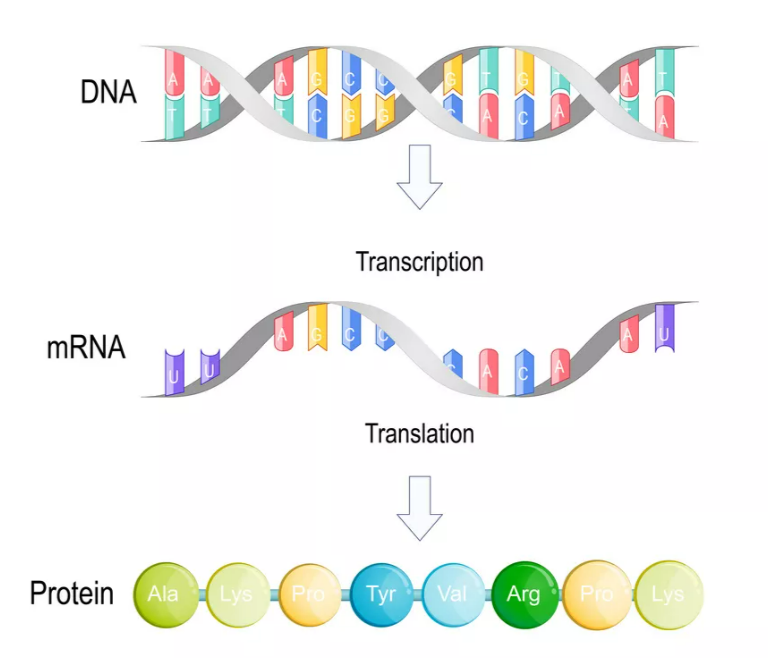
🔹 Where it occurs: Nucleus
🔹 Main idea: DNA → mRNA
🧠 Step-by-Step Process
- DNA unzips: RNA polymerase binds to a specific region (promoter) and unwinds the DNA helix.
- Template strand used: Only the antisense strand is copied. The sense strand has the same sequence as mRNA (T → U).
- mRNA formation: Free RNA nucleotides line up complementary to DNA antisense strand:
- A → U
- T → A
- C → G
- G → C
- Joining of nucleotides: RNA polymerase links nucleotides → single-stranded mRNA.
- Completion: Transcription ends at stop codon. mRNA detaches → exits nucleus to ribosome.
🧬 Key Terms in Transcription
| Term | Description |
|---|---|
| RNA polymerase | Enzyme that catalyzes mRNA formation |
| Antisense strand | DNA strand used as template for mRNA |
| Sense strand | Complementary DNA strand, same sequence as mRNA |
| mRNA | Messenger RNA carrying code to ribosome |
| Start codon (AUG) | Signals start of translation; codes for methionine |
| Stop codon (UAA, UAG, UGA) | Signals end of translation |
⚙️ Translation – Making Polypeptide from mRNA
🔹 Where it occurs: Cytoplasm (ribosomes)
🔹 Main idea: mRNA → amino acid chain (protein)
🧠 Step-by-Step Process
- mRNA attaches to ribosome: Ribosome reads codons (3-base sequences).
- tRNA brings amino acids: Each tRNA has a specific amino acid and an anticodon complementary to mRNA codon.
- Codon–anticodon pairing: Anticodon pairs with mRNA codon (A-U, G-C).
- Peptide bond formation: Ribosome links amino acids → growing polypeptide chain.
- Movement along mRNA: Ribosome moves codon by codon until stop codon is reached.
- Termination: Polypeptide released → folds into 3D structure → functional protein.
🧩 Codons & Anticodons – Key Relationships
| Molecule | Base Triplet | Function |
|---|---|---|
| DNA (template/antisense) | TAC | Used to make mRNA |
| mRNA codon | AUG | Codes for amino acid |
| tRNA anticodon | UAC | Pairs with mRNA codon |
| Amino acid | Methionine | Added to polypeptide chain |
🧠 Start & Stop Codons
| Codon | Type | Function |
|---|---|---|
| AUG | Start codon | Begins translation, codes for methionine |
| UAA, UAG, UGA | Stop codons | End translation, release polypeptide |
💡 Summary Table
| Stage | Location | Key Enzyme / Molecule | Product |
|---|---|---|---|
| Transcription | Nucleus | RNA polymerase | mRNA |
| Translation | Cytoplasm (ribosome) | Ribosome, tRNA | Polypeptide (protein) |
📦 Quick Recap
| Concept | Key Point |
|---|---|
| Transcription | DNA → mRNA using RNA polymerase |
| Antisense strand | Template for mRNA synthesis |
| Translation | mRNA → amino acid chain at ribosomes |
| mRNA | Carries genetic code from DNA |
| tRNA | Brings amino acids to ribosome |
| Codon | 3-base triplet on mRNA |
| Anticodon | 3-base triplet on tRNA complementary to codon |
| Start codon | AUG (signals where translation begins) |
| Stop codon | UAA, UAG, UGA (signals translation ends) |
In short: DNA acts as the master code. Through transcription, it makes mRNA; through translation, mRNA is decoded into a protein.
This flow from gene → protein is called the central dogma of molecular biology.