
Development of Drug Testing – From History to Modern Clinical Trials
🌱 Introduction
Drug testing ensures that new medicines are effective, safe, and reliable before being given to the public.
It has evolved over centuries from trial-and-error herbal methods to highly controlled, scientific clinical trials used today.
🧾 1. The Historical Beginning – William Withering’s Digitalis Soup (18th Century)
Background:
In the 1700s, William Withering, an English doctor, studied the use of the foxglove plant (Digitalis purpurea).
Traditional healers used a “digitalis soup” (a herbal extract) to treat dropsy – now known as heart failure.
What He Did:
- Tested different doses of foxglove extract on patients.
- Carefully recorded both positive improvements and toxic symptoms.
- Identified a safe and effective dose through repeated trials.
Key Idea:
Withering’s work was crude but systematic – it laid the foundation for modern drug testing.
He basically performed an early clinical trial, even before the concept existed!
🧬 2. Modern Drug Testing – Step-by-Step Protocol
Modern drug development follows a strict scientific procedure to ensure safety, effectiveness, and reliability.
It includes laboratory research, animal testing, and three main phases of human trials.
Stage 1: Preclinical Testing (in labs)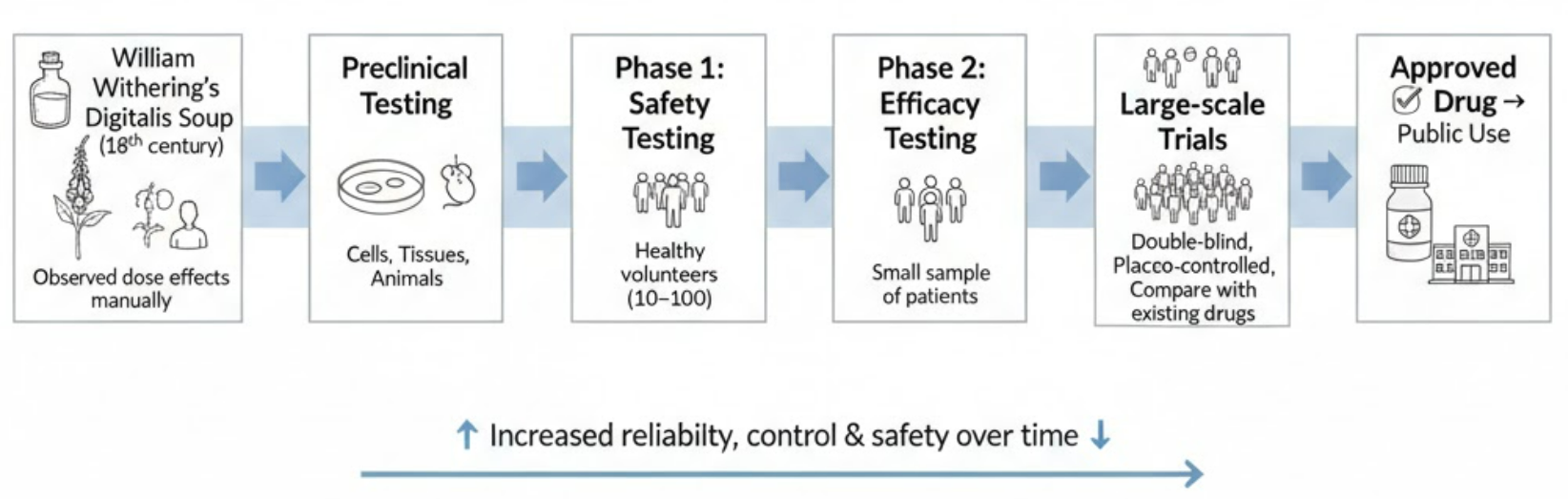
- Done on cells, tissues, and animals.
- Checks for:
- Toxicity (is it safe?)
- Efficacy (does it work?)
- Dosage range (how much is safe & effective?)
- Only if results are promising → move to human testing.
Stage 2: Clinical Trials (on humans)
- Phase 1 – Safety: Very small group (10–100 healthy volunteers). Checks side effects, safe dosage, and metabolism.
- Phase 2 – Efficacy: Small group of patients. Tests effectiveness and monitors side effects.
- Phase 3 – Large-scale trials: Hundreds to thousands of patients. Confirms effectiveness, compares with existing treatments, and checks rare side effects.
These trials often use double-blind and placebo-controlled methods for reliability.
🧠 3. Double-Blind & Placebo-Controlled Trials
Placebo:
A fake drug (no active ingredient) given to some participants.
Used to see if improvement is due to the drug’s actual effect or the psychological belief of being treated (the placebo effect).
Double-Blind Design:
Neither the doctor nor the patient knows who receives the real drug or placebo.
This removes bias and ensures objective results.
Why It Matters:
It ensures that conclusions about the drug’s effect are accurate, unbiased, and scientifically valid.
📋 Summary Table
| Stage / Concept | Description | Purpose |
|---|---|---|
| Withering’s digitalis soup | 18th-century herbal testing on patients | Early dose-response observation |
| Preclinical testing | On cells and animals | Tests safety & dosage before human trials |
| Phase 1 | Small group of healthy volunteers | Tests safety & dosage range |
| Phase 2 | Small group of patients | Tests drug effectiveness |
| Phase 3 | Large group of patients | Confirms effectiveness, monitors side effects |
| Placebo | Inactive substance | Controls for psychological effects |
| Double-blind trial | Neither patient nor doctor knows treatment group | Removes bias, ensures reliability |
🧠 Quick Recap
William Withering (Digitalis soup): first recorded systematic drug test.
Modern testing: begins with lab + animal studies.
Clinical trials: 3 phases — Safety → Efficacy → Large-scale confirmation.
Placebo: checks for psychological effects.
Double-blind: prevents bias → ensures accurate results.
Purpose: every stage ensures safety, correct dosage, and proven effectiveness before public use.