
Importance of Water and Inorganic Ions in Plants
🌱 Introduction
Plants need both water and inorganic ions (minerals) to survive, grow, and carry out life processes. These substances are taken up by roots from the soil and transported through the xylem.
Each plays a special role from maintaining structure to enabling photosynthesis and enzyme action.
💦 1. Importance of Water to Plants
Water is essential for almost every plant function.
Main Roles of Water:
| Function | Explanation |
|---|---|
| Solvent | Dissolves minerals and nutrients → allows transport in xylem and phloem |
| Transport Medium | Carries minerals, sugars, and hormones throughout the plant |
| Photosynthesis | Reactant in the light-dependent stage → provides H and electrons (H₂O → O₂ + H⁺ + e⁻) |
| Turgidity | Maintains cell shape and rigidity through turgor pressure |
| Cooling | Evaporation from leaves (transpiration) cools the plant |
| Growth | Needed for cell elongation during growth |
Memory Tip: “Silly Tall Plants Take Cool Growths” → Solvent, Transport, Photosynthesis, Turgidity, Cooling, Growth.
⚗️ 2. Inorganic Ions Required by Plants
Plants absorb various minerals (ions) dissolved in soil water through root hair cells.
A. Nitrate Ions (NO₃⁻)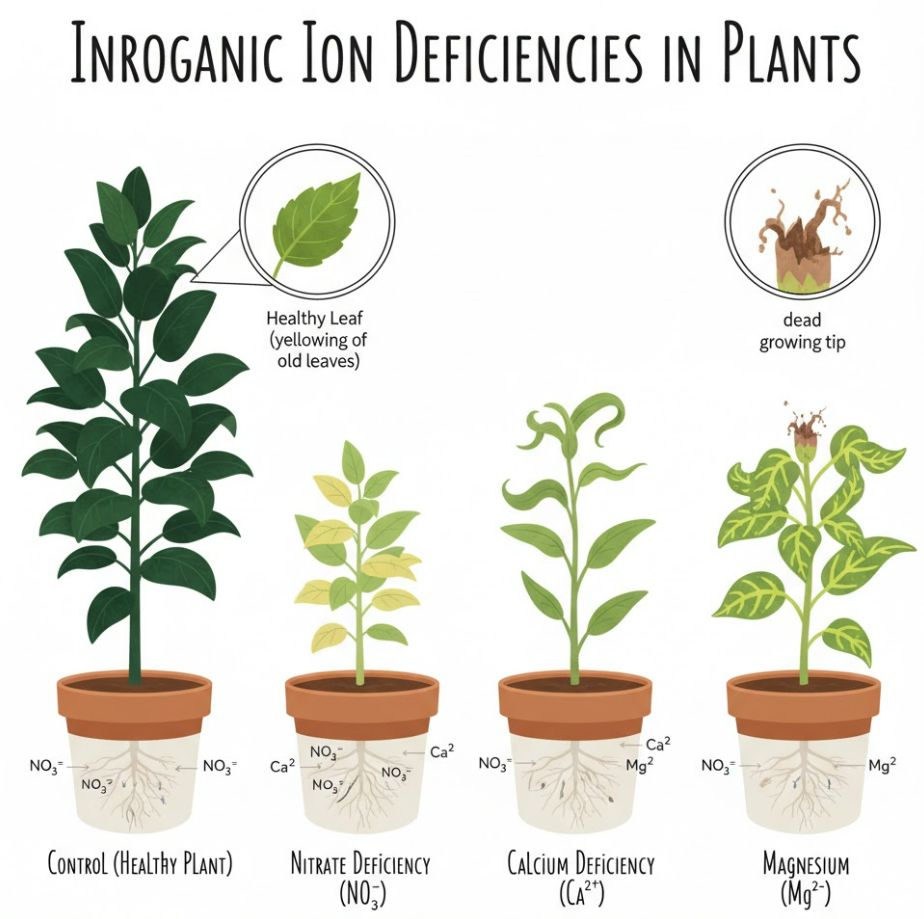
- Role:
- Needed to make amino acids, proteins, nucleic acids (DNA, RNA), and chlorophyll.
- Essential for growth of new cells and tissues.
- Deficiency Symptoms:
- Stunted growth (due to less protein synthesis).
- Yellowing of older leaves (chlorosis) as nitrogen is moved to younger leaves.
Trick: N for Nitrogen → N for Needed for growth.
B. Calcium Ions (Ca²⁺)
- Role:
- Important for cell wall formation (binds pectins in middle lamella).
- Helps in cell membrane stability.
- Needed for enzyme activity and root growth.
- Deficiency Symptoms:
- Weak cell walls → stunted growth.
- Death of growing tips (shoot & root).
- Distorted or curled leaves.
Trick: Ca²⁺ = “Cell Adhesive” → keeps cells together.
C. Magnesium Ions (Mg²⁺)
- Role:
- Central atom in chlorophyll molecule (for photosynthesis).
- Activates many plant enzymes.
- Deficiency Symptoms:
- Yellowing between veins (interveinal chlorosis) of older leaves.
- Reduced photosynthesis → poor growth.
Trick: Mg = Middle of Green (chlorophyll’s centre atom).
🌾 3. Summary Table
| Substance | Main Function | Deficiency Symptom |
|---|---|---|
| Water | Solvent, turgor, transport, photosynthesis | Wilting, loss of turgidity |
| Nitrate (NO₃⁻) | Proteins, DNA, chlorophyll | Yellow leaves, poor growth |
| Calcium (Ca²⁺) | Cell walls, membranes | Weak stems, dead tips |
| Magnesium (Mg²⁺) | Chlorophyll formation | Yellow leaves (interveinal chlorosis) |
💡 4. Why They’re Important Together
All these components work together:
- Water transports ions throughout the plant.
- Ions like nitrate, calcium, and magnesium support growth and photosynthesis.
- Deficiency in one affects the whole plant’s metabolism and strength.
⚡ Quick Recap:
Water → transport + turgor + photosynthesis
Nitrate → proteins, DNA → growth
Calcium → cell wall strength
Magnesium → chlorophyll & enzymes
🧠 Mnemonic: “We Need Cool Minerals” → Water, Nitrate, Calcium, Magnesium
RECOMMENDED ADDITIONAL PRACTICAL
Investigate Plant Mineral Deficiencies
🎯 Aim
To investigate how lack of specific mineral ions (nitrate, calcium, magnesium – plus a control) affects the growth and appearance of young plants.
🧪 Materials
- Fast-growing seedlings (e.g., radish, cress, or lettuce) uniform and healthy
- Pots or trays (4 sets × 5 replicates = 20 pots)
- Standard compost/soil or inert medium (perlite + vermiculite)
- Distilled water
- Nutrient solutions:
- Complete control nutrient solution (all ions present)
- Nitrate-free solution (no NO₃⁻)
- Calcium-free solution (no Ca²⁺)
- Magnesium-free solution (no Mg²⁺)
- Measuring cylinders, pipettes, beakers
- Ruler / eyepiece graticule
- pH meter or pH strips
- Labels, marker, notebook, camera
- Balance (optional)
- Growth area with controlled light; timer if indoors
⚙️ Variables & Controls
- Independent variable: Which ion is missing (NO₃⁻, Ca²⁺, Mg²⁺, or none)
 Dependent variables: Shoot length, root length, leaf colour, fresh mass, number of true leaves
- Control variables: Same species, same seed age, same pot size, same light, temperature, watering volume, solution pH, number of replicates
- Control treatment: Complete nutrient solution (positive control); optional water-only negative control
 Dependent variables: Shoot length, root length, leaf colour, fresh mass, number of true leaves
🔬 Method (Step-by-Step)
- Prepare medium & pots: Fill pots equally, label treatments and replicates.
- Sow seeds: 3-5 seeds per pot; thin to 1 healthy seedling. Start all same day.
- Prepare nutrient solutions: Make complete control solution. Create deficient ones by omitting target salts. Keep pH and ionic strength equal.
- Watering: Apply same volume and schedule (e.g., 20 ml every second day). Use distilled water to top up.
- Growth conditions: Same light/temp, grow for 2-3 weeks or until symptoms appear.
- Record data: Every 2-3 days record shoot height, true leaves, symptoms, and take photos. At end measure root length and fresh mass.
- Replicates: ≥5 per treatment, calculate mean ± SD.
🧾 Observations to Make
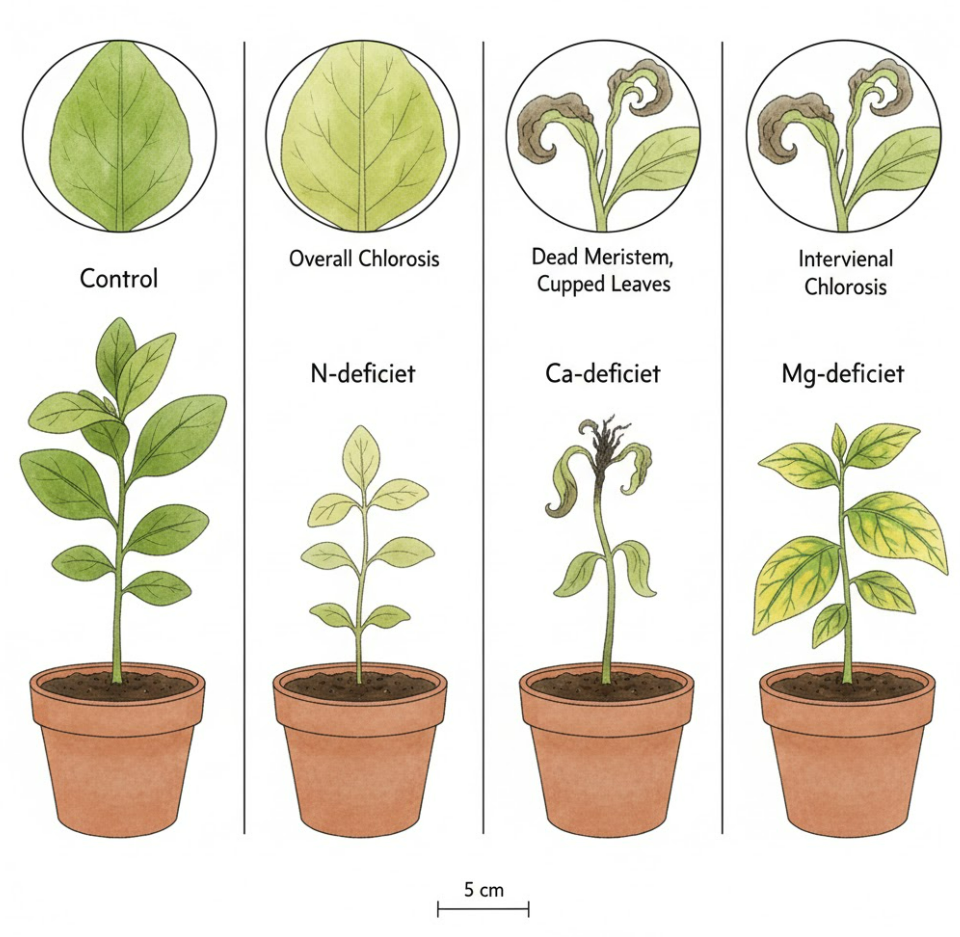
| Deficiency | Visible Symptoms |
|---|---|
| Nitrate (NO₃⁻) | Stunted growth, older leaves pale/yellow (chlorosis), reduced mass |
| Calcium (Ca²⁺) | Death of growing tips, distorted/necrotic young leaves, poor root growth |
| Magnesium (Mg²⁺) | Yellowing between veins (interveinal chlorosis), curled leaves, poor photosynthesis |
| Control | Healthy green leaves, normal growth |
📊 Data Analysis
- Calculate mean ± SD for shoot/root length, fresh mass.
- Use bar charts to compare treatments (with error bars).
- Optionally perform t-test or ANOVA for significance.
- Link results to ion functions (refer theory).
🔬 Safety & Ethics
- Handle salts carefully; wear gloves if concentrated.
- Dispose of waste properly (as per lab rules).
- Clean tools to prevent contamination.
✅ Expected Results & Explanation
- Nitrate missing: Poor protein synthesis → slow growth, pale older leaves.
- Calcium missing: Weak cell walls → tip death, distorted young leaves.
- Magnesium missing: Chlorophyll loss → interveinal chlorosis, reduced photosynthesis.
- Control: Normal healthy growth.
✨ Common Sources of Error
- Uneven seed vigour or light.
- Solution cross-contamination.
- Wrong pH altering ion uptake.
- Too few replicates.
🧠 Quick Recap
Aim: Compare growth under nitrate, calcium, and magnesium deficiency vs control.
Key Measures: Shoot/root length, leaf colour, fresh mass.
Nitrate → Growth & chlorophyll
Calcium → Cell wall & tip growth
Magnesium → Chlorophyll centre (interveinal chlorosis)
✅ Tip: Use ≥5 replicates, same light/temp, regular data recording.